







Since its creation, the European Union has always advocated for democracy among its Member States. Over the years, the EU has always worked to ensure the strength of the Rule of Law, implementing different legislation via the European Commission, the Council of the European Union, the European Parliament, and even through the Court of Justice of the European Union. Democracy has always been considered one of the elemental components of the EU, defined as one of its values in Article 2 of the Treaty on European Union. Consequently, the reinforcement of democracy implies the necessity of eradicating corruption in all its forms. But why is corruption so importantly attached to the development of democracy in Member States?
The bonds between corruption and democracy have been discussed by many scholars who have attempted to explain the effects of corruption on the limited performance of democracies. As a matter of fact, in 2021, the European Court of Auditors stated in its Special Report, “Regarding grand corruption in Ukraine: several EU Initiatives, but still insufficient results”, how corruption “harms democracy”. The report emphasises the way in which corruption threatens the democratic process, as well as describing corruption as an obstacle towards the rule of law. In addition, the Group of States Against Corruption, part of the Council of Europe, has repeatedly reminded us of the harm and hazards that corruption can provoke in democracy and the rule of law.
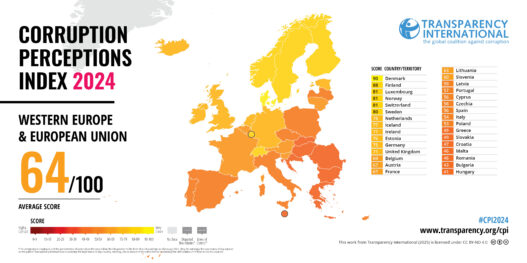
According to Transparency International, corruption is the abuse of power for one’s profit. From this perspective, every public official who uses his power to obtain a private benefit is committing corruption. As corruption is an inherently clandestine act, as it is criminalised and persecuted in many countries around the world, the most reliable manner to measure the levels of corruption in a country is through public perception. For that reason, the purpose of this article is to analyze the perception of corruption in member states of the EU according to the analysis and ranking made by Transparency International.
How is the current corruption perception among the members of the European Union?
To analyze the perception and sensibility of the population towards corruption in the public sector, Transparency International constructs the Corruption Perception Index. The organization compiles information and data from different corruption surveys conducted by multiple institutions. Based on the data sets, Transparency International assigns a score from 0 to 100. In this sense, a lower score indicates a higher degree of corruption, while a higher score implies a lower degree of corruption. Apart from the individual scores that Transparency International gives to each country, a ranking is made to compare among states. 
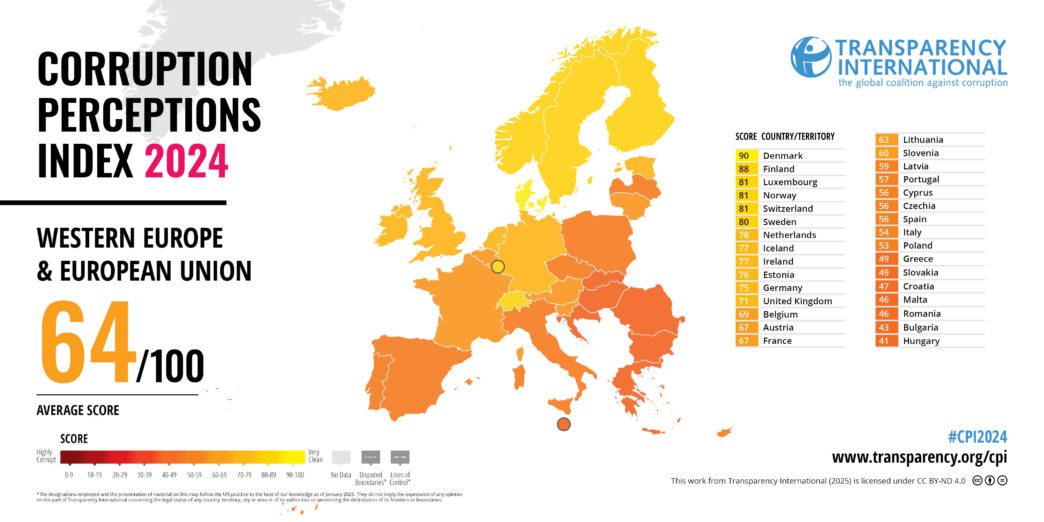
To start with, in spite of the fact that the corruption in the EU has been deteriorating, the majority of the members of the EU are ranked favorably in the 2024 global ranking. In this regard, 5 of the first 10 countries ranked are EU member states: Denmark, Finland, Luxembourg, Sweden and the Netherlands. Denmark and Finland hold the first two positions in the ranking, implying their low perception of corruption in the world. Furthermore, Ireland, Estonia, Germany, Belgium, Austria and France are ranked among the top 30, while the other EU member states with lower rankings, such as Hungary and Bulgaria, are ranked at the top 83.
The following table shows the full ranking of the EU member states in 2024 according to Transparency International.
| MEMBER STATE | RANKING BETWEEN EU | GLOBAL RANKING |
| Denmark | 1 | 1 |
| Finland | 2 | 2 |
| Luxembourg | 3 | 5 |
| Sweden | 4 | 8 |
| The Netherlands | 5 | 9 |
| Ireland | 6 | 10 |
| Estonia | 7 | 13 |
| Germany | 8 | 15 |
| Belgium | 9 | 22 |
| Austria | 10 | 25 |
| France | 10 | 25 |
| Lithuania | 12 | 32 |
| Slovenia | 13 | 36 |
| Latvia | 14 | 38 |
| Portugal | 15 | 43 |
| Cyprus | 16 | 46 |
| Czechia | 16 | 46 |
| Spain | 16 | 46 |
| Italy | 19 | 52 |
| Poland | 20 | 53 |
| Greece | 21 | 59 |
| Slovakia | 21 | 59 |
| Croatia | 23 | 63 |
| Malta | 24 | 65 |
| Romania | 25 | 65 |
| Bulgaria | 26 | 76 |
| Hungary | 27 | 82 |
However, even if the EU countries continue to outperform the rest of the planet, the situation regarding corruption has evidently and significantly worsened in the last ten years. A vast majority of Member States have seen significant declines in their scores, and their corruption trends have weakened the constitution of their democracies.
How has the situation changed among the members of the European Union?
Examining the situation of the EU Member States, the situation has slightly worsened from 2015 overall. The score given to the EU as a whole in 2024 by Transparency International was 62 points, with a drop of 3 points from 2015. Even if it may not be seen as a risk as a whole, it is proof of the deterioration the European Union has experienced in corruption. Nonetheless, the drop does not imply losses in all European Union countries, and that is the reason why the focus should be on each country. Therefore, it is relevant to revise the particular situation of the States composing the EU.
On the one hand, it is essential to highlight that over half of the members of the EU have seen a decrease in their scores from 2015 to 2024. 17 of 27 countries have seen their perception index worsen through the years. These countries are: Austria, Belgium, Croatia, Cyprus, Denmark, Finland, France, Germany, Hungary, Luxembourg, Malta, Poland, Portugal, Slovakia, Spain, Sweden and the Netherlands. The country that has experienced the sharpest downgrade is Malta, with a loss in its score of 14 points in the last ten years (from 60 to 46). Malta is closely followed by Poland and Hungary, which have lost 10 points since 2015. Austria and Sweden, with a drop of 9 points, and Belgium, with a decrease of 8 points, have also suffered some of the largest losses in this period. On the contrary, the smallest decreases can be seen in Denmark, Finland and Slovakia, with a loss of only two points in their score.
On the other hand, it is equally fundamental to emphasise that, contrary to expectations, Bulgaria, Estonia, Greece, Ireland, Italy, Latvia and Lithuania have upgraded their scores and improved their marks concerning how corruption is noticed by citizens. The country with the highest upgrade is Italy, with an increase of 10 points in almost ten years. On the contrary, despite the improvement, the countries with the lowest upgrade are Bulgaria and Ireland, even though their situation is better than it was in 2015.
Finally, the scores of Czechia, Romania and Slovenia have remained unchanged in the past 9 years. Although their scores have not improved over the years, they have not worsened, so they could be considered as part of the group whose perception of corruption has not deteriorated.
Where does this leave the European Union?
As the results have proven, the EU has taken a step backwards regarding corruption in its Member States. In comparison to the achievements they reached in 2015, the last ten years have seen a clear decline. Nonetheless, has this decrease affected the ambition of the EU in the fight against corruption? Actually, the answer is no. On the contrary, in the past years, the European Union has implemented different laws and adopted different commitments in its battle against corruption.
In 2019, the European Union adopted the Directive (EU) 2019/1937 regarding the protection of whistleblowers, aiming to establish better reporting channels and prevent punitive effects on them. In the same vein, the Regulation (EU) 2023/1114 extends the issues covered by anti-money laundering, creating at the same time the EU Anti-Money Laundering Authority. In addition, the European Union has adopted several non-legally binding acts, like the Anti-Corruption Strategy in 2023, and the creation of the European Public Prosecutor’s Office in 2021.
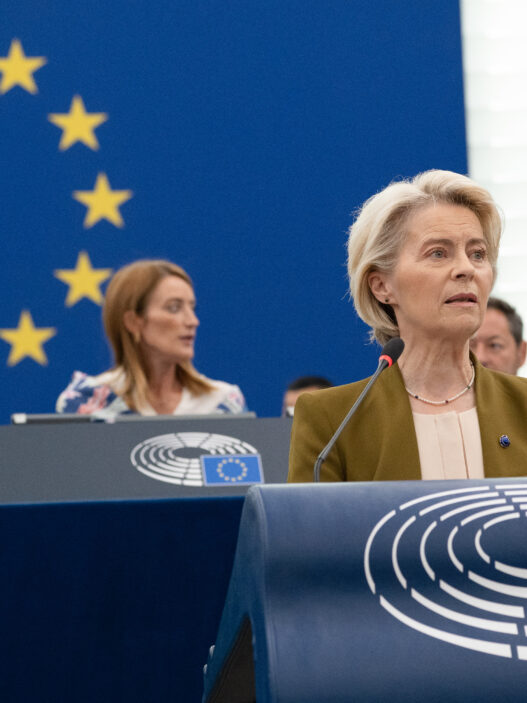
Throughout this legislation, the framework shows that the European Union is attempting to ensure its engagement and responsibility in the fight against corruption. Despite the increase in corruption perception among EU citizens, the European Union is actively working towards corruption eradication, an extremely important requisite for the safeguarding of democracy. In a time where corruption is expanding at hazardous levels across European institutions, the European Union is trying to ensure that countries implement its policies regarding the prosecution and control of this matter. As President of the European Parliament Roberta Metsola said, “There will always be people who try to break the rules […] What matters is that we have strengthened the safeguards to catch them earlier”.