



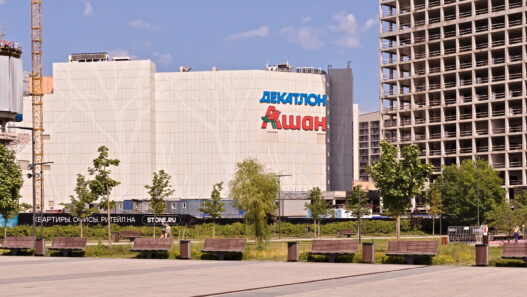




Since the beginning of Russia’s full-scale invasion of Ukraine, multinational corporations have occupied a central role in the conflict, influencing the strategies of Ukraine, Russia, and third countries towards it. Western corporations in particular face a difficult dilemma: they are headquartered in countries that support Ukraine and have imposed sanctions on Russia, yet many continue to maintain some form of business presence in the Russian market. Those that left the aggressor’s market early were rewarded by the public and by investors for their retreat well enough to cover their initial losses. Those still inside, however, face increasing pressures both from the West to exit and from Russia due to it increasing the costs of leaving for foreign corporations. Thus, even if they wished to leave, the financial cost of doing so has trapped them within Russian markets and is forcing them to fund the Kremlin’s war efforts.
For the EU and for other Western governments, imposing economic pressure on Russia while European companies continue to operate there presents an obvious policy contradiction. Naturally, to win the war and end the crisis caused by it faster, European conglomerates must completely exit Russia as soon as possible in order to handicap the aggressor’s economy further and end the dependency European capital has on Moscow. But is this fast and complete ideal exit possible, and if it is, then what are the costs the EU would have to endure to achieve it? This article examines the policy options available to the EU and argues that a rapid and comprehensive corporate withdrawal would be extremely costly under current conditions. Reducing the cost of leaving is not sustainable in the long term due to it being financially straining, while increasing the cost of remaining is too difficult to implement and also poses financial strains. Brussels is therefore likely to remain dependent on a gradual approach that increases pressure on companies to leave while allowing them to minimise the financial and legal consequences. Despite the fact that this gives Russia time to adapt to European measures, the downside for the EU is much lower than the downside of a fast and complete exit.
Corporate strategies since the start of the war and their payoffs
European and other Western corporations operating in Russia have generally faced three broad options since the beginning of the war: fully exiting the Russian market, reducing their activities, or continuing their operations. They chose their strategy based on their own cost-benefit calculations, and, as the war continues, they are still faced with the decision between leaving or staying in Russia, and to what extent. In the beginning, corporations weighed the financial cost of exiting Russian markets against the reputational and operational cost of remaining. The financial cost refers to that of selling their assets, many times at an unfair price, and abandoning their investments. So far, this cost has amounted to over 170 billion USD coming from asset write-offs, business seizures, aggressive court rulings, and punitive exit taxes. Operational costs refer to those derived from sanctions and regulations (imposed both by Western entities and Russia), while reputational costs refer to those derived from appearing to the public as enabling Russia’s aggression.
Over time, the balance between the costs of staying and leaving has increasingly shifted in favour of the latter strategy. Russia has introduced a series of measures affecting companies from “unfriendly countries”. These include forcing companies to register their employees for the military and to directly support the aggression by providing material means (e.g. buildings, transport, etc.). Another important one is partially nationalising firms that do not fulfill state contracts. On top of these measures, international banks have increased their scrutiny and caution when dealing with Russian entities. This increases reputational costs from directly helping the aggressor state and operational costs from being sanctioned by the government if the company refuses to help. Meanwhile, the cost of leaving has been rising due to the regulations and legislation adopted by Moscow to impede firms from “unfriendly countries” from getting their money back, such as adding slow bureaucratic processes, forcing companies to sell assets at large discounts, and restricting the repatriation of profits. Essentially, European companies within Russian markets are operating in an increasingly constrained environment in which both staying or exiting carry significant financial risks. 
Fully leaving Russia remains the better strategy, but at what cost?
Companies that exited the Russian market, especially those that did so fully, saw quick reputational benefits from the public, which considered the exit ethically correct and proof of the responsibility and trustworthiness of these companies. Withdrawals boosted their sales, their popularity, and their overall appreciation in the eyes of Western consumers. Late leavers also saw such payoffs reputation-wise after deciding to change their strategy, but before that they had to endure being seen as sponsors of war, which damaged their profits. Consequently, as they received a good reputation from the public as fighters against international aggression, the financial benefits came. Investors sensed their potential profits and funded these companies massively.
At the same time, European firms that remain in Russia face a different set of risks. Although the exit of other firms diminished their competition within the country, the benefits offered by this position are increasingly constrained. First, new Russian legislation handicapped the repatriation of profits, so the only use of those gains is to reinvest them in their assets there and hope not to lose them. Second, the exodus of Western firms left room for corporations from the Global South, predominantly Chinese, to enter the market. These conglomerates are not subject to the harsh regulations intended for companies from “unfriendly countries”, and their products are steadily replacing European ones. Hence, Western companies that remained in Russia receive a shrinking piece of a shrinking pie (i.e. a decreasing share of a more stagnant economy), which they may not even be able to eat (i.e. they cannot repatriate the profits).
Thus, from a theoretical perspective, ending operations in Russia more quickly and to a greater extent is the better long-term strategy. In practice, however, the financial and legal costs imposed on foreign firms have made a rapid exit difficult. For companies with substantial assets or operations in Russia, a sudden withdrawal would generate significant short-term losses, even if remaining in the market becomes less profitable over time.
Why the EU can’t make corporations exit quickly
Companies that remain in Russia consider that the financial cost of leaving may still outweigh the reputational and operational costs of staying, though the way they weigh the costs varies. Some firms consider they are constrained and unable to exit due to Russian legislation, while others remain voluntarily and argue their merchandise and activity (like selling food and hygiene products) are essential to Russian citizens and they have a humanitarian duty of maintaining their operations. To encourage European firms to exit sooner, the EU must reverse this relationship, which it can do by either increasing the operational and reputational costs of staying or decreasing the financial cost of leaving. Both approaches, however, have significant limitations and could generate immense costs for European companies and the wider European economy.
First, operational costs can be increased by making it more difficult for European firms to operate in Russia, i.e., by imposing new legislation and sanctions against European corporations for doing business with Moscow. However, the shock would be too great for European economies. Although Europe has substantially reduced its dependence on Russian resources since the war began, some European industries have still been importing billions of euros worth of gas and raw materials from Russia using legal loopholes. Forcing corporations to quickly cut ties with Russia would lead to a drastic shortage of critical resources needed for key European industries. Moreover, imposing direct restrictions on European companies could raise concerns among investors about the extent to which governments are willing to intervene in corporate decisions and impose losses for geopolitical purposes.
A second option is to increase the reputational costs by naming and shaming campaigns directed either by the EU itself or by its civil society actors (like NGOs or activist groups). In the best-case scenario, it would lead to boycotts, worker strikes, pro-Ukraine activism, and general public outrage. Investors would then fear investing in unpopular companies, thus forcing the hand of European corporations towards completing their exit faster. In practice, such activities meant to enlarge reputational costs also hurt the people who fight against the corporations. Many of the European firms still in Russia are part of industries necessary for consumers, such as car manufacturing, hygiene products, or food. Boycotting or campaigning against them is costly for the many European people who consume their products and/or services regularly. Furthermore, the war in Ukraine is just one crisis among others that the EU is facing. There are also a multitude of other crises affecting Europe which require attention and awareness from citizens, reducing their capacity to sustain pressure on any single issue. This capacity is also affected by the situation in Palestine, which has seen much activism within the EU but, in the process, has directed demonstrations and activism efforts from Ukraine. So many conflicts, tensions, and global developments may be too much for the average citizen, leading to activism fatigue. Combined with their dependence on these companies and with the increased difficulty of campaigning over time, it is unrealistic for citizens to mobilise and actually force corporations towards leaving Russia.
Third, the financial cost can be decreased by offering economic incentives and benefits to firms in order to at least partly cover the loss. However, this comes with many costly side effects for the EU. The most obvious one is the moral implication of aiding companies that have so far helped Russia (directly or indirectly) in its war effort. Then, there is the possibility that corporations, even in distress, may wish to negotiate with the EU to receive larger benefits, especially if these firms are in critical sectors with extensive operations in Russia, and thus lose precious time and money. Finally, if this method would work in the short term, Moscow would quickly react and simply increase the financial cost of leaving through new legislation, further forcing the EU to either abandon offering financial benefits or increase them and repeat the process, albeit now with higher stakes.
How does the slow exit work?
Having established that a rapid and comprehensive corporate exit could impose significant economic costs on the EU, the analysis now turns to the gradual approach that Brussels has pursued since the beginning of the war. Rather than forcing all European companies to withdraw immediately, the EU has combined sanctions, restrictions and regulatory measures designed to progressively reduce economic ties with Russia.
The EU has taken many different measures to end business activity between European companies and Russian entities, three of which stand out. The first is banning European business services in Russia. The second is the no-Russia clause, which consists of contractual restrictions on “sensitive goods” (e.g. advanced technology) being exported to buyers from third countries where there is a risk of re-exportation to Russia. Third, divestment deadlines have been introduced, which refer to deadlines for companies to sell their assets and close their operations progressively, such that their financial losses are minimised. The EU has continued to expand and adjust these instruments as Moscow’s sanctions regime developed.
What these measures have in common is that they attenuate the shock caused by the conflict and keep the crisis under control. Additionally, as companies exit the country more, even at the sluggish pace they do, these measures increasingly toughen. Although this also means that Russia has time to adapt and find new ways to attract capital from friendly countries (especially Chinese capital) and milk Western companies even harder, the EU must accept these costs, as the alternative is drastically more harmful.
Conclusion
Multinational European corporations had little time to decide whether to leave or stay in Russia following the onset of the war. They had to quickly weigh the operational and reputational costs of maintaining operations there against the financial cost of ending them. Those who chose to risk it all and exit won, while those who still engage in business there today have been steadily losing since and have been funding the aggressor country by complying with its regulations and paying taxes to its government. This article looked at the EU’s possibilities to fix this issue and get European conglomerates out of Russia.
Both the costs of staying and leaving have been continuously rising, albeit in favour of the latter strategy, meaning the best course of action for Western companies is to end all business with the Kremlin as soon as possible. However, as the financial cost of doing that is unbearable at the moment, they are trapped within Russia’s markets and helping the country engaged in war with Ukraine, a state supported by European governments.
Thus, for a faster and more comprehensive corporate exit, the EU could either increase the operational and reputational costs of staying or decrease the financial cost of leaving. In theory, operational damage could be induced through new legislation and sanctions meant to impede companies from doing business in Russia, and reputational damage could be induced through shaming campaigns and civil society action, which could lead to activism and consumer boycotts. Moreover, the financial cost could be reduced through economic incentives and benefits to cover the loss of selling assets and ending operations. In practice, the economic shock the EU would suffer from using such methods is too great due to expensive remaining assets, supply chain disruptions and shortages, and substantial price hikes, so an ideal exit is very difficult to achieve under current conditions.
Finally, at least regarding corporate activity, this analysis shows that Brussels is stuck with committing to gradually reducing economic ties with Russia, dismantling its economy “brick by brick”. This slow approach gives Moscow time to adapt to restrictions and change its strategy, but it is the most feasible option given the costs of a fast and comprehensive withdrawal. Therefore, the EU must find ways to increase pressure on the aggressor in the economic domain without imposing disproportionate costs on European firms and citizens, and in other domains where pressure implies smaller costs and risks.