







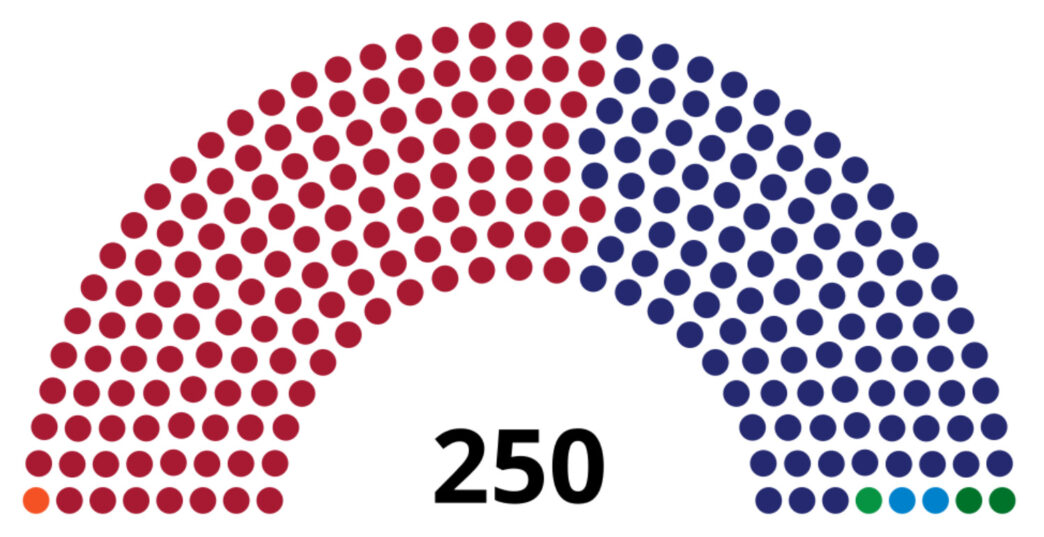
A student-backed list won an outright majority. Governing will be the harder test.
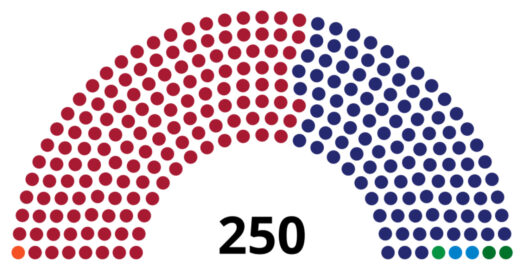
Serbia’s parliamentary election has produced a decisive change in power. Preliminary results from the Republic Electoral Commission give the Student List – Students Are Winning 52.71% of the vote and 140 of parliament’s 250 seats, enough for an outright majority. Aleksandar Vučić’s United Serbia alliance won 39.17% and 104 seats.
The result turns a protest movement into a governing majority. The Student List emerged from demonstrations following the November 2024 collapse of the railway-station canopy in Novi Sad, which killed 16 people and triggered demands for accountability and action against corruption. It is formally a citizens’ group rather than a political party, built around collective leadership and opposition to the concentration of political power.
The stakes were particularly high for Vučić. He resigned as president on 27 September, seven months before the end of his final term, opening the possibility of returning to executive office as prime minister if his political camp won the parliamentary election. It did not.
Why it matters
The election shows that years of political dominance did not make Serbia’s governing system electorally invulnerable. But an opposition victory does not erase the weaknesses of the system in which that victory occurred.
The OSCE/ODIHR preliminary assessment found high turnout and vigorous competition, but said equality of campaign opportunities had been “seriously compromised.” Observers pointed to misuse of public resources, voter intimidation and pressure, disruptions of campaign activities and incidents of physical violence.
That creates an unusual challenge for the incoming majority. The Student List campaigned on changing the institutions precisely what it will now inherit. Its programme calls for greater judicial independence, transparent public procurement, depoliticised state institutions, freer media and stronger public services. Winning the election gives it the authority to pursue those reforms. It does not guarantee the administrative capacity or internal cohesion required to deliver them.
The movement deliberately avoided organising itself around a single dominant leader. That helped distinguish it from the personalised politics it opposed. In government, however, collective leadership must produce ministers, budgets and decisions. Its list brings together academics, professionals and public figures with diverse political backgrounds and limited collective governing experience.
An opening for the EU, not yet a geopolitical turn
For the European Union, the result creates an opening. Serbia has been an EU candidate since 2012, but the Commission records only 22 of 35 negotiating chapters as opened and two as provisionally closed. The EU opened the last cluster in December 2021.
The EU Delegation in Serbia welcomed the Student List’s victory. It noted that its priorities on accountability, rule of law, media freedom, and corruption closely overlap with reforms expected in Serbia’s European accession process.
Yet the election should not automatically be read as a geopolitical realignment toward Brussels.
The movement’s strongest common ground is domestic institutional reform. On foreign policy, important differences with the EU remain. Student List representatives have opposed sanctions on Russia, support continued Serbian military neutrality and maintain that Kosovo is part of Serbia. The movement has also argued that the EU should decide eventual membership in a referendum.
The opportunity for Brussels is therefore institutional before it is geopolitical. A government that strengthens courts, procurement rules, media pluralism and electoral integrity could move Serbia closer to European standards without immediately resolving disputes over Russia, Kosovo or foreign-policy alignment.
That distinction matters. Treating the result simply as Serbia “choosing the West” would misunderstand both the coalition that won and the grievances that brought it to power.
What to Watch Next
The first test is government formation. The preliminary result gives the Student List enough seats to govern without a coalition. Still, its decentralised structure leaves open who will become prime minister and how a movement built around collective decision-making will distribute political responsibility. The final result must also still be certified.
The second test will be institutional rather than rhetorical. Judicial independence, public procurement, media regulation, anti-corruption investigations and appointments to the state administration will show whether political change produces institutional change.
The third test is already approaching. Vučić’s resignation made National Assembly Speaker Ana Brnabić acting president, and Serbian law requires a new presidential election within three months. The Serbian government has said the vote must therefore be held by the end of December.
That election will provide an early indication of whether the Student List can turn one extraordinary parliamentary victory into a durable political realignment.
Serbia has changed who holds the majority. The harder task is changing how power itself is exercised.
Sources
- Republic Electoral Commission / Government of Serbia – preliminary parliamentary election results from 8,187 polling stations. 26 October 2026.
- OSCE/ODIHR – Serbia’s early parliamentary elections saw high turnout amid a polarised environment and unequal campaign opportunities. 26 October 2026.
- Students Are Winning – official description of the Student List and its organisational structure.
- Students Are Winning – official electoral programme.
- European Commission – Serbia’s EU accession state of play.
- EU Delegation to Serbia – Harnessing the momentum for deeper EU–Serbia cooperation. 26 October 2026.
- Reuters – reporting on Vučić’s resignation and the possibility of returning as prime minister. 27 September 2026.
- Reuters – reporting on the Student List’s governing challenge and composition. 26 October 2026.
- Reuters – reporting on the incoming leadership’s domestic and foreign-policy positions. 26 October 2026.
- Government of Serbia – transfer of presidential duties to Ana Brnabić and constitutional timetable for a new presidential election. 28 September 2026.
AI Transparency Note: Artificial intelligence supported research, source comparison and the structuring of this briefing. Editorial decisions, source selection and the final assessment remain subject to human review.
News from European Relations:
ERA – Serbia’s student-led movement wins parliamentary elections Following Nationwide Protests. 27 October 2026.