






In January 2025, several Western Balkan countries – from Croatia all the way down to North Macedonia – went through a wave of boycotts organized by consumers and associations as a reaction to the skyrocketing prices of goods in supermarkets. The reasons behind that drastic surge in prices are multiple, and strictly connected to phenomena such as inflation and goods scarcity. But what is left of these boycotts six months after the first one was launched? And, most importantly, what can they tell us about the society of Western Balkan countries?
The history of boycotts
Boycotts are an interesting phenomenon because, among other things, they are interdisciplinary by nature, as they combine societal dynamics and economic behaviors. Therefore, while it is particularly difficult to find a one-size-fits-all definition adopted by all scholars, it is possible to identify some recurrent features that have been present since the earliest time a boycott was organized. According to historical reconstructions, such as the one offered by Gerard Moran in the late 1980s, social ostracism had already been employed as a tactic by groups of people to express discontent and frustration towards policies and decisions, albeit in a legal manner.
However, it was only in 1880 that the term ‘boycott’ emerged as a concept, when, in Ireland, a group of citizens and tenants started actively countering the policy of land evictions and high rents put in place by a real estate agent, Charles Cunningham Boycott. Boycott, a former member of the British army, was sent to Ireland during the Irish land agitations, which he tried to settle by signing a series of evictions. As a reaction, the community, guided by the nationalist leader Charles Stewart Parnell, decided to stand united against his policies by implementing social excommunication practices. Basically, they excluded him from the community, forced him to deal with discomforting situations, and, above all, isolated him so efficiently that any of his attempts to proceed with the evictions proved to be pointless.
Boycotts: what makes them work?
Diving deeper into the origins of boycotts may seem distant from the recent episodes that took place in the Western Balkans. However, this story allows us to grasp the main features of boycotts and what makes them effective. 
First, boycotts increase their success rate the more people decide to participate in them. Just like it happened in Ireland, social excommunication was successful because the whole community was actively engaged in countering Boycott’s land-related measures. Second, even more concrete results can be achieved when one or more authorities become involved in the boycott, either as supporters or as the original initiators of the action. Third, boycotts are more likely to accomplish considerable results if the involved community manages to influence the behavior of others outside of that group, often through the implementation of performative actions such as strikes, picketing, investment withdrawals, and, to a greater extent, economic sanctions.
One more crucial element shall not be overlooked: at the very basis of any boycotting action must be a high degree of organization by the party organizing the campaign. A lack of meticulous coordination may cause those participating in the action to lose focus or, even worse, may affect the credibility and accountability of the action. Additionally, a well-defined target is essential to evaluate the effects of the boycott during and after it has been performed.
The 2025 retail boycotts in the Western Balkans
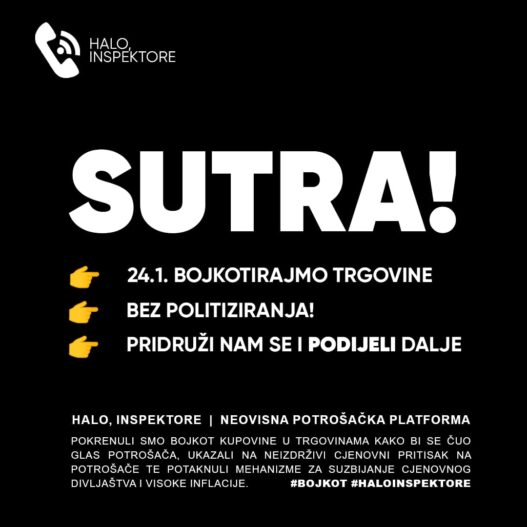
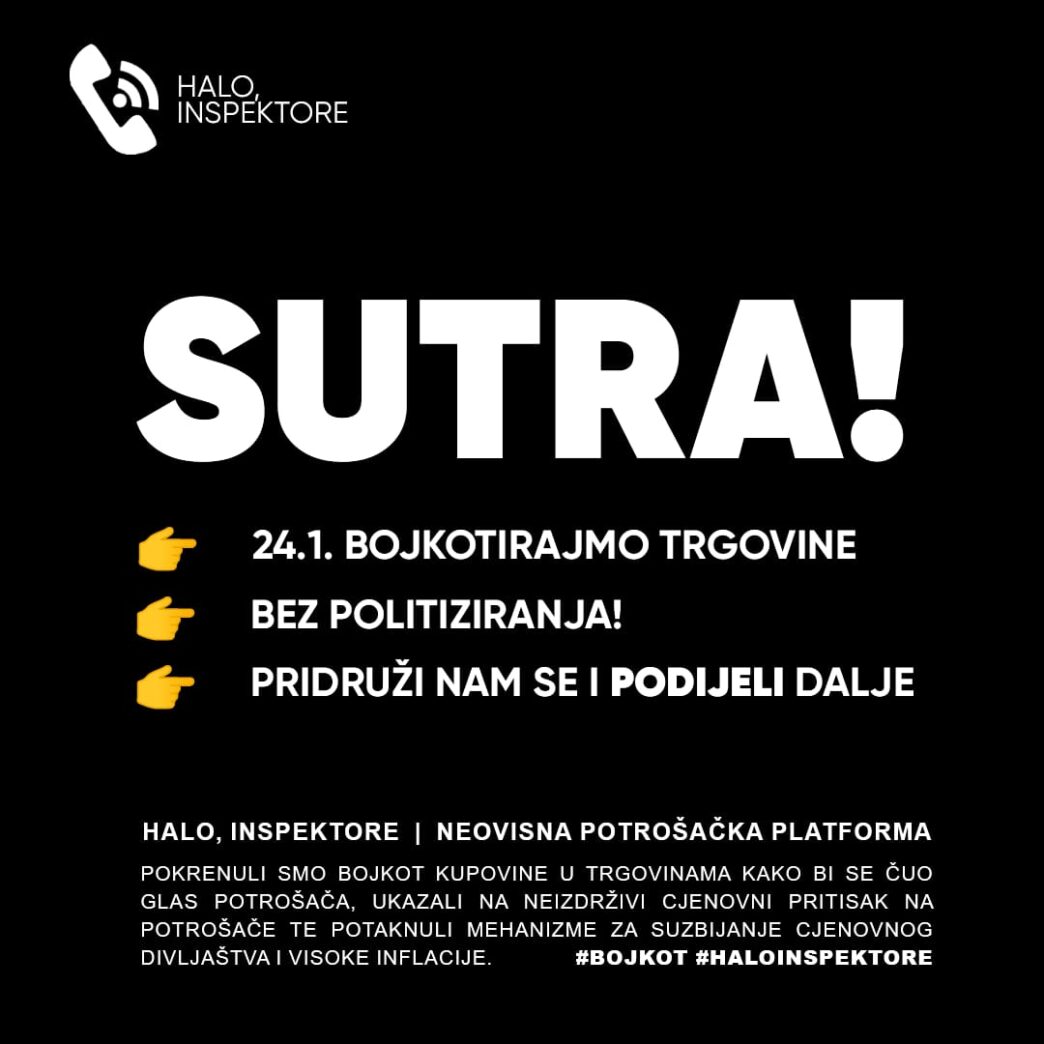
The boycotting campaign that involved the Western Balkan countries started from Croatia in the mid of January 2025, led by Halo, inspektore (Eng. Hello, inspector), a Facebook page linked to the European Center for Consumer Excellence whose goal is to ensure consumers are protected and that they are aware of their rights and that they can shop consciously.
On January 15, Halo, inspektore shared a Facebook post denouncing that the price of veal neck sold by Konzum, a supermarket chain in Croatia, had increased significantly over the previous three months, and incited consumers to refrain from buying the product for a week. This specific event worked as a catalyst, as the neck veil was not the only product whose price had skyrocketed in the previous months, and Konzum was not the only supermarket chain whose list of prices had seen systematic increases in the prices of goods.
Evidently, the problem was not just the cost of neck veils. A huge range of goods experienced a significant price increase due to the country’s incredibly high inflation levels. According to the available data, inflation affected Croatia much more than other Eurozone countries, as a result of several events, including not only the war in Ukraine but also shortsighted economic policies adopted by the Croatian government. An example in this respect is the decision of raising the salaries of public servants, which ended up adding more pressure on the economy: as it can be easily understood, increased liquidity in the hands of people impacted on their demands for goods, and – as prescribed by the most basic laws of economy – this also contributed to price increases.
Soon, the wave of boycotts started spreading to other Western Balkan countries, including Serbia, Bosnia and Herzegovina, Montenegro, and North Macedonia. The popularity of protests propagated quickly, not only because rising prices were affecting the quality of living for citizens of these countries as well, but also due to the impact of actions performed by Croatian consumers on the sales of big supermarket chains, with several retail chains introducing price caps on a wide range of items.
Boycotts went on for the entire month of February; then, silence.
The calm after the storm?
Interestingly, some debate was recently sparked among Croatian citizens on Reddit, when a user asked What is the status on the grocery store boycotts over inflation? Are they still going on? Here, the principles of unity and civic engagement that had appeared to guide the boycotts between January and March seemed to be completely dissolved.
The comments left by other users reveal skepticism, strong criticism, and little to no enthusiasm about the results attained by the boycotts, which are surely noteworthy, although often quite small-scaled. In Croatia, for instance, the government passed a law forcing big retailers to make their goods’ prices publicly available online, making price comparison easier for consumers. In other countries, however, boycotts were significantly less effective: In Serbia, these actions had only a marginal impact on the sales of supermarket chains. Additionally, in those very same weeks, Serbia experienced the explosion of the student-led protests that have been challenging President Aleksandar Vučić’s corrupt government and asking for new elections in the country. Similarly, in Bosnia and Herzegovina and Montenegro, aside from a drop in sales for the days of boycotts, no further legislation was implemented to counter the increase in prices.
Civil engagement and the Western Balkans
One may wonder what the reason is behind such a rapid vanishment of consumers’ engagement with retail boycotts, and an answer may be found by looking at how Western Balkan societies approach protests and activism.
Research conducted in 2021 by the Balkans in Europe Policy Advisory Group (BiEPAG) shows that political activism is not a rarity in the region, although some topics generate more engagement than others. Indeed, citizens proved to be highly sensitive to questions concerning their local communities, the environment, or corruption. However, the very same study also highlights that a considerably smaller group of people is willing to show their engagement by participating in public protests, with more than 50% of citizens openly stating their lack of faith in the ability of protests to influence power and contribute to change.
In this sense, the 2025 retail boycotts represent a great example of the complexity of societies in the Western Balkans. While the initial wave of activism revealed how citizens strive for change when primary needs are at stake, the sudden decline in their involvement shows the fragility of collective action in deeply disillusioned societies when tangible change does not occur as quickly.
The features of retail boycotts that have been highlighted in this article also depend on the lack of sound civil society organizations that can resist pressure over time. In many Western Balkan countries, activism often emerges spontaneously, triggered by social media (as in the case of Halo, inspektore, and its Facebook post) or as a response to a crisis, but it rarely evolves into campaigns that can achieve long-lasting results. The case of boycotts and their initial success is emblematic: while it encouraged consumers to participate in the protests, it lacked the structure to consolidate the action in the long run, thus basically condemning boycotts to failure.
Yet, the value of the 2025 boycott campaign should not be underestimated. The actions taken by supermarket chains in Croatia, such as price transparency and price caps, prove that consumer action can be successful when well-organized and can affect large companies and, to some extent, politics. It remains open to discussion whether involved actors (like consumers, policymakers, and retailers) will learn a valuable lesson from this moment and find ways to build more sustainable forms of civic engagement in the future. Simultaneously, governments’ actions should be monitored in the future to assess whether they will adopt wiser and more sustainable economic policies, in an attempt to reduce the financial burden on consumers and improve their overall living standards.