








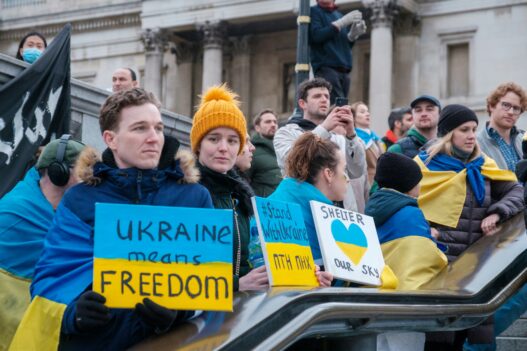
Since gaining independence on August 24, 1991, Ukraine has been undergoing a difficult transformation process. This process has been significantly shaped by Russia’s influence, its military aggression, and the annexation of Ukrainian territories. In addition, there are challenges arising from Ukraine’s aspirations for and economic integration into the European Union as well as from its closer ties to the West.
The European Union has regarded Ukraine as an important potential partner since the mid-1990s. This was first established in the Partnership and Cooperation Agreement between the EU and Ukraine. Further agreements followed, aiming to strengthen democratic principles and the rule of law in Ukraine, effectively combat corruption, and facilitate trade relations.
Despite these efforts, the EU initially did not engage in serious accession talks with Ukraine. It was only through Russia’s increasing aggression toward Ukraine that voices within the EU advocating for Ukraine’s accession grew stronger. In particular, the large-scale Russian war of aggression against Ukraine accelerated this process. As a result, the European Commission officially recommended the opening of accession negotiations with Ukraine in November 2023, which the European Council approved in December of the same year.
After the collapse of the Soviet Union, Russia sought to maintain its influence in Ukraine on multiple levels. In doing so, Moscow relied on a mix of cultural affinity, economic dependence, and geopolitical pressure. The idea of a common Slavic people, as well as the promotion of the Russian language and culture, were central elements intended to strengthen Ukraine’s ties to Russia. Economically, Russia kept Ukraine dependent through gas supplies, investments in key industries, and trade interconnections. Russia also attempted to exert influence through the Church. 
Politically, it was reported that the Kremlin supported pro-Russian separatist forces in Ukraine, including through the delivery of weapons and personnel, and recognized the outcome of the separatist-organized elections in eastern Ukraine. These measures were aimed at hindering Ukraine’s further rapprochement with the West – out of fear of possible further Russian aggression.
A key instrument of military pressure was also the Black Sea Fleet stationed in Sevastopol, whose presence represented a constant display of power until the illegal annexation of Crimea in 2014.
Although Russia was temporarily able to achieve political successes, Moscow ultimately failed to keep Ukraine permanently within its sphere of influence. Instead, the desire for sovereignty and closer ties to European and progressive structures grew among the Ukrainian population. Russia’s increasing aggressiveness, especially from 2014 onward, led to a significant strengthening of national identity and independence in Ukraine, which reached its peak with Russia’s large-scale attack in 2022.
Nevertheless, it must not be overlooked that this development varied regionally. Especially in the south and east of Ukraine, there were close cultural, linguistic, and familial ties to Russia. Although these ties gradually declined from the 1990s onward, a noticeable turn away from Russia in these regions often occurred only as a result of the large-scale war of aggression since 2022. For many Ukrainians, this marked a definitive turning point and accelerated the process of national self-assertion.
Despite remarkable reform steps toward the European Union in recent years, serious challenges remain: corruption, nepotism, and a lack of transparency represent key obstacles on the path to EU membership. These structural problems not only endanger the country’s democratic progress in the long term but also make reliable international cooperation more difficult.
These deficits were exacerbated by Ukraine’s geopolitical situation, particularly by the ongoing conflict between Russian influence and European rapprochement. The Kremlin’s support for pro-Russian forces led to corrupt elites—who benefited from nepotism and opaque power structures—gaining political influence. As a result, reform processes were blocked or deliberately undermined.
The strong economic dependence on Russia, particularly in the form of gas supplies, also made it difficult to establish transparent market structures. These would not only have exposed Moscow’s influence but also endangered the power of domestic oligarchs who benefited from monopolistic structures.
But it was not only Russia that contributed to the persistence of these conditions. European actors have also – albeit unintentionally – contributed to sustaining corrupt networks. For years, and possibly to this day, negotiations have been conducted with governments that are closely linked to oligarchic structures in Ukraine. The consistent enforcement of conditions related to the rule of law or anti-corruption measures was thwarted, as such measures would have harmed the oligarchs connected to the government and endangered their economic and political power.
The allocation of financial aid and investments, for example within the framework of EU funding programs or the European Neighbourhood Policy, was at times carried out under insufficient oversight. In several cases, funds were misused or disappeared into opaque structures—often without serious consequences.
In the following, we take a closer look at these three central challenges—corruption, nepotism, and lack of transparency—as well as their concrete effects on Ukraine’s democratic stability and its process of integration into the European Union.
Corruption as a Structural Challenge
Widespread corruption in Ukraine represents one of the main obstacles to the ongoing EU accession negotiations. It undermines trust in state institutions, hinders effective reform processes, and contradicts the rule-of-law and democratic standards that are fundamental for membership in the European Union.
Corruption refers to the unlawful exploitation of an entrusted position or decision-making authority with the aim of securing illegitimate advantages for oneself or others. It can occur in various sectors of society—whether in politics, business, or public administration—and ranges from everyday favors to the systematic exploitation of state resources. The consequences are severe: in addition to economic damage, corruption leads to a massive loss of trust in public order and fosters political instability.
Corruption typically unfolds in three successive phases during which corrupt relationships emerge and become entrenched:
- Initiation:
In this first phase, public officials initially receive small gifts or favors—seemingly without any direct reciprocation. However, these gestures, which appear harmless, create subtle psychological pressure to return the favor. At the same time, the personal preferences, habits, or weaknesses of the target individual are probed in order to identify potential points of leverage for future influence. - Compromise:
In the second phase, the relationships intensify. The officials begin to feel increasingly obligated to show gratitude. At this stage, the corrupters start to deliberately demand reciprocation. Since smaller favors have already been accepted, the public officials find themselves in a relationship of dependence—often accompanied by fear of exposure or blackmail. - Exploitation:
In the final stage, the compromised individuals are exploited on a long-term basis. They have become entangled in corrupt structures and themselves turn into active perpetrators. The relationship is now characterized by a pronounced imbalance of power, which enables long-term control and systematic enrichment.
These mechanisms illustrate how deeply corruption can penetrate institutional processes—a circumstance that not only hinders internal reforms but also significantly undermines the trust of international partners, above all that of the EU.
According to the Corruption Perceptions Index (CPI) by Transparency International, Ukraine ranked 105th out of 180 countries in 2024. Compared to 2014, when Ukraine was still ranked 142nd, this represents a significant improvement—yet even this progress highlights how deeply corruption remains entrenched in the country.
Corruption in Ukraine is evident in nearly all areas of society and the state: in public procurement, the judiciary, the military, as well as in everyday life—for example, in hospital treatments, basic administrative procedures, or police operations. Particularly serious, however, is the so-called “grand corruption.” This refers to the abuse of power at the highest political and economic levels, in which individual actors gain personal advantages at the expense of the general public.
This form of corruption causes serious and long-term harm not only to individuals but to society as a whole. It undermines trust in state institutions, blocks reform processes, and exacerbates social inequalities. For this very reason, combating grand corruption remains one of the central challenges for Ukraine—both in terms of its democratic development and in the context of its desired EU membership.
During the presidency of Volodymyr Zelensky, who remains in office in light of the Russian war of aggression, the fight against the power of the oligarchs has been significantly intensified. A central instrument is the so-called de-oligarchization law, which was passed in 2021. For the first time, it legally defines who is considered an oligarch in Ukraine: individuals who meet at least three of the following four criteria—significant wealth, political influence, control over relevant media, and economic dominance.
Anyone classified as an oligarch is entered into an official register. The law aims to limit the excessive influence of these individuals on politics, the media, and state decision-making processes. Among other things, they are prohibited from financing political parties or participating in the privatization of major state-owned enterprises. In addition, meetings with public officials must be disclosed in order to prevent informal influence.
As a result, several prominent oligarchs were sanctioned—including Ihor Kolomoyskyi, who was arrested in 2023, as well as Kostiantyn Zhevago, Hennadiy Boholyubov, Petro Poroshenko, and Viktor Medvedchuk. These measures indicate stronger state control and mark a clear departure from the long-standing political tolerance of great wealth and its influence on public institutions.
However, the anti-oligarch campaign has also faced criticism. Observers have pointed out the selective application of the law: some influential individuals, despite their obvious economic and political power, are not included on the oligarch list. This fuels suspicion that political loyalty plays a role in the enforcement of the law. It is viewed particularly critically that the classification is carried out by the National Security and Defense Council—a body directly subordinate to the president. This creates the impression of political instrumentalization.
At the same time, concerns about political instrumentalization are not limited to the implementation of the de-oligarchization law. Recent developments suggest that anti-corruption institutions themselves may be increasingly subject to political interference. During the week of July 21–27, 2025, thousands are protesting against a new law that restricts the independence of anti-corruption authorities—the largest demonstrations since the war began in 2022.
The law, passed in a fast-track procedure and signed by President Zelensky, grants the Prosecutor General, appointed by him, far-reaching powers: he can direct investigations, withdraw cases, and even dismiss proceedings against top politicians.
At the center of attention are the National Anti-Corruption Bureau (NABU) and the Specialized Anti-Corruption Prosecutor’s Office (SAPO), two key institutions in the fight against corruption and a prerequisite for EU membership.
Zelensky justifies the law by citing Russian infiltration within the agencies. Critics, however, see a power struggle within the security apparatus—especially since NABU reportedly launched an investigation against a former deputy prime minister close to him. Shortly before the law was passed, two NABU officers were arrested by the SBU security service.
The EU speaks of a “setback” on the path to membership; Berlin and Paris have also expressed concern. Zelensky has announced revisions, but pressure is mounting. NABU is now demanding the complete repeal of the law. Further protests are considered likely.
In addition, transparency and legal accountability of the procedures remain insufficiently regulated. These weaknesses endanger the credibility of the de-oligarchization campaign and raise the question of whether there is truly a structural disempowerment of oligarchic networks—or whether, in part, it is a means of consolidating power by the current government.
Nevertheless, progress can be observed: the state’s confrontation with the power of economic elites and their influence on democratic processes is beginning to show results—even though there is still considerable need for improvement in order to make genuine systemic change both credible and sustainable.
Corruption in Ukraine is by no means limited to private actors or the oligarchy—state institutions themselves are repeatedly involved in corruption scandals. This not only undermines public trust in the state but also jeopardizes the credibility of the reform agenda with international partners.
A particularly high-profile case occurred in 2025: Andriy Smyrnov, former Deputy Head of the Presidential Office and close confidant of President Zelensky, was taken into pre-trial detention by the National Anti-Corruption Bureau (NABU). He is accused of having acquired assets worth over 17 million hryvnias (around 426,000 US dollars) between 2020 and 2022—despite his official salary and savings for that period amounting to only 1.3 million hryvnias (approximately 32,500 US dollars).
As early as 2024, another scandal occurred that once again revealed the entanglement of corruption and state structures. According to its own statements, the domestic intelligence service SBU uncovered a large-scale fraud attempt within the Ministry of Defense. Around 1.5 billion hryvnias (approximately 40 million dollars) were allegedly to be embezzled by ordering 100,000 mortar shells that were never delivered.
In 2023 as well, allegations of corruption shook Ukrainian politics. After media reports emerged claiming that the Ministry of Defense had purchased food for soldiers at heavily inflated prices, several high-ranking officials and government members resigned. As a result, Defense Minister Oleksii Reznikov was ultimately replaced—even though he himself was not directly suspected of corruption, public pressure was so great that a personnel change appeared necessary.
These cases demonstrate: even in times of war, the fight against corruption remains a central domestic political challenge. It does not concern only individual actors but points to structural weaknesses within the institutional framework—weaknesses that must be consistently addressed in the course of Ukraine’s rapprochement with the EU.
A particularly alarming case of possible intimidation against critical voices occurred in 2024: Ukrainian investigative journalist Yevhen Shulhat suspects that he was deliberately conscripted into the military—as a response to his investigations into alleged corruption within the Ukrainian domestic intelligence service SBU. Shulhat had previously submitted official inquiries to the SBU. Shortly thereafter, he was approached in a supermarket by men in uniform—accompanied by a civilian who was later identified as an SBU employee. Video footage confirms the incident.
Media experts interpret the incident as an attempt to suppress critical reporting—a potentially systematic tool of intimidation against investigative journalists. Although the SBU officer involved was suspended and an investigation was launched, Shulhat himself expressed doubts that it was a serious institutional effort to address the matter.
This case highlights the following: even though corruption in Ukraine is increasingly being combated, it remains deeply rooted. The examples mentioned reveal a high level of corruption that extends to the highest levels of the Presidential Office and ministries. From this, it can be inferred that at lower levels of administration—such as local authorities or municipal governments—corruption is likely even more widespread and, at times, even more brazen. These levels are less frequently in the spotlight of the public and international observers, which further complicates effective oversight.
Despite extensive reform efforts, Ukraine is still not entirely free from corruption, even at the lower levels of administration and public services. According to an OECD report, perceptions of corruption remain high, although the situation has improved since 2013, and self-reported experiences of corruption among citizens have declined significantly (OECD, 2024).
In addition to these findings, several informal interviews were conducted informal interviews with Ukrainians from a range of income groups. Several interviewees reported that, in everyday life, corruption can manifest in the form of small informal payments or gifts to responsible public officials—aimed at speeding up the processing of applications or securing a more favorable decision. Such practices were said to occur both in clearly lawful procedures and in contentious cases where the outcome lies within the discretion of the authority. These individual observations align with the trend identified in the OECD analysis, which notes that this form of corruption has noticeably decreased in recent years.
A similar picture emerges in the healthcare system: in public hospitals, patients report that preferential or faster treatment may be tied to payments. While these are individual experiences, many of these accounts are consistent—especially among people currently living in Ukraine.
At the same time, a certain improvement can be observed in these areas over the past five years. Government measures to combat corruption are showing results, and societal rejection of informal payments is also growing. Pressure on institutions is increasing—not least due to civic engagement and the attention of international partners.
A systematic statistical survey of these phenomena does not yet exist. The assessment is therefore based primarily on qualitative reports and the personal experiences of citizens.
One particularly sensitive area remains the education sector. Based on firsthand accounts from faculty members at universities in Lviv and Mykolaiv, higher education institutions often receive insufficient government funding—both for building maintenance and for the repair of damaged infrastructure, such as after missile strikes. In practice, this can sometimes lead students to provide material goods or assistance without receiving any official compensation in return. While this is often regarded as a pragmatic emergency measure, the potential for conflicts of interest cannot be dismissed—especially when it comes to the evaluation of academic performance. It does not take a cynic to recognize structural weaknesses that leave the system vulnerable to informal practices. This makes it all the more crucial to ensure transparency, establish clear rules, and provide adequate resources in this area as well, in order to safeguard the integrity of the education system.
Conclusion:
Corruption remains a deeply rooted structural weakness in Ukraine, threatening democratic processes and complicating the country’s path toward EU integration. Despite legal reforms, international pressure, and initial progress, corruption persists at all levels—from the political elite to everyday life. Sustainable progress requires more than legislation: it demands political will, effective oversight mechanisms, and a strengthened civil society.
Nepotism – Informal Networks and Political Influence
Nepotism is a widespread phenomenon in many political systems, but in Ukraine, it may represent a structural problem that not only undermines the population’s trust in the state but also threatens institutional stability. Especially in the context of the country’s desired EU membership and the high expectations regarding the rule of law, nepotism could carry particular weight. Criticism often comes from both international partners and Ukrainian civil society. For example, former Foreign Minister Annalena Baerbock stated on June 21, 2023, on the sidelines of the Ukraine Recovery Conference in London, that for EU accession, Ukraine must “put an end to 30 years of nepotism and corruption.” The demand is understandable, but it could just as well be directed at countries like Germany, where similar networks exist—albeit under different conditions.
Nepotism refers to the preferential treatment of individuals from one’s own circle in the allocation of positions, contracts, or other advantages—not based on qualifications, but on personal relationships, loyalty, or political affiliation. This form of influence undermines transparent selection processes and promotes informal power structures that evade democratic oversight.
In Ukraine, nepotism is particularly evident in the fact that political loyalties and personal networks often carry more weight than professional qualifications when filling public offices. The NGO Anti-Corruption Action Center (AntAC) has repeatedly criticized the lack of transparency and corruption in state institutions over the past years. On its website, it documents numerous cases, highlighting in particular the lack of understanding on the part of officials.
The former infrastructure advisor Yury Holyk was confronted with allegations that he had protected individuals within his personal network from potential consequences, thereby enabling them to retain decision-making positions despite non-transparent appointment procedures. He was also accused of ensuring that state contracts were preferentially awarded to companies with which he had close personal or business ties. In the Ministry of Defense, another incident drew public attention when Minister Rustem Umerov decided not to renew the contracts of the leadership of the procurement department. As a result of these and other occurrences, the National Anti-Corruption Bureau (NABU) initiated investigations, which are still ongoing and are expected to be brought to trial in mid-2025.
In addition, both Ukrainian and international observers have noted that politically motivated personnel decisions and instances of nepotism can undermine the work of independent institutions. In this context, the European Commission’s 2023 report on Ukraine raised concerns about a lack of transparency in certain high-level appointments and an insufficient institutional balance between the executive and oversight bodies.
In response to sustained pressure from Western partners, a series of reform measures have been implemented in Ukraine.These include, among other things, the strengthening of judicial independence, the mandatory disclosure of assets by public officials, and the establishment of specialized anti-corruption bodies such as NABU (National Anti-Corruption Bureau) and SAPO (Specialized Anti-Corruption Prosecutor’s Office). Public procurement has also been made more transparent through digital tendering procedures.
These measures aim to make nepotism more difficult and to make the appointment of public offices more transparent. Nevertheless, nepotism remains a deeply entrenched structural problem that cannot be eliminated by legislation alone. Much still depends on political will, public pressure, and the consistent international support of the reform process.
Conclusion: Nepotism as a Structural Weakness:
Nepotism remains a central challenge for Ukraine. Despite reform laws, international support, and measures to increase transparency, political loyalties and personal networks continue to exert significant influence over the appointment of key state positions. This not only undermines public trust in institutions but also weakens the state’s capacity to act—especially at a time when strong, independent structures are of crucial importance.
To achieve true independence and stability, more is needed than just legal regulations: political culture, oversight mechanisms, and awareness of institutional integrity must be strengthened in a sustainable way. As long as this transformation does not succeed, nepotism will remain a serious obstacle on Ukraine’s path toward EU membership and democratic consolidation.
Lack of Transparency – A Risk to Democratic Stability
Nepotism and corruption arise and persist in an environment of insufficient transparency. In Ukraine, the central question is therefore how deep this lack of transparency truly runs—because only those who understand its extent can realistically assess the effectiveness of the reforms implemented so far.
Lack of transparency in a state refers to the absence of openness, traceability, and accessibility of government actions to the public. It exists when political, administrative, or legal decisions are not communicated transparently, are not subject to public oversight, or are deliberately concealed. In such an environment, it becomes easier to favor personal networks, evade responsibility, and misuse public funds—without facing consequences.
Non-transparent procedures and a lack of public communication continue to significantly hinder democratic oversight in Ukraine. Both the Council of Europe and the European Commission emphasize that transparent governance and comprehensible decision-making processes are fundamental prerequisites for a country’s accession to the European Union. This is particularly evident in the so-called Copenhagen Criteria, formulated by the European Council in 1993. These criteria include, among other things, institutional stability, the rule of law, and the ability to effectively implement EU law – which requires a transparent and accountable administration. For instance, the Venice Commission criticized in 2024 the lack of transparency in the appointment of high-ranking judicial officials.
With increasing support from Western countries, progress has indeed been made in Ukraine—particularly in areas where transparency was made a condition for financial aid. In several cases, this led to institutional approaches aimed at creating greater openness. One can therefore say: transparency has improved—but “improved” does not mean “guaranteed.” A recent example illustrates how fragile this progress can be.
The issue at hand is the controversial reappointment of the position of the Language Commissioner (Commissioner for the Protection and Preservation of the Ukrainian State Language), which is currently still held by Taras Kremin. In our interview, Kremin provided insight into his work and his commitment to protecting and promoting the Ukrainian language. As a lecturer, co-author of the Ukrainian language law, and long-standing commissioner, he has built an institution with strong public recognition and functional effectiveness.
Despite these qualifications, his reappointment remains uncertain. Numerous prominent public figures have publicly called for his renomination—so far without success. Among them are:
- Writers Oksana Zabuzhko, Serhiy Zhadan, Yuriy Andrukhovych, and Andriy Kurkov
- Actors Irma Vitovska, Ada Rohovtseva, Nataliya Sumska, and Anatoliy Khostikoyev
- Poet and soldier Yaryna Chornohuz
- Chairman of the Mejlis of the Crimean Tatar People Refat Chubarov
- President of the National University “Kyiv-Mohyla Academy” Serhiy Kvit
- Four-time Paralympic champion Zvetov
- Former President of Ukraine, Viktor Yushchenko
Despite this broad public backing, there has been no response. The responsible bodies are sticking with the previously selected candidates—whose nomination, however, has been widely criticized by media outlets, civil society groups, and experts as politically motivated and non-transparent. To this day, it remains unclear how the nominations were made and why Taras Kremin was not reconsidered.
This case illustrates the following: even though there has been progress toward greater transparency, key political procedures—particularly in the appointment of public key positions—often remain non-transparent. As such, the case exemplifies a structural weakness that undermines democratic consolidation and public trust in government action.
Conclusion:
The case surrounding the possible non-reappointment of Taras Kremin clearly illustrates that, despite measurable progress in transparency, fundamental structural deficits remain. The lack of transparency in appointing key public officials exposes a weakness that hinders democratic consolidation and undermines public trust in government actions. Without transparent decision-making and clear accountability, personal networks continue to dominate institutional processes. Real reform requires not only legislation but also a shift in political culture and consistent implementation.
Impact on EU Integration
The ongoing problems with corruption, nepotism, and lack of transparency represent major obstacles on Ukraine’s path to joining the European Union. The EU places great importance on the rule of law, democratic oversight, and transparent administrative procedures—they are fundamental pillars of the European value system and a prerequisite for membership
In the European Commission’s 2024 progress report, it was explicitly emphasized that Ukraine’s accession to the EU would hardly be achievable without profound and sustainable progress in addressing these structural weaknesses. Particular attention was drawn to shortcomings in the appointment of high-ranking judicial officials, the insufficient independence of oversight bodies, and non-transparent procedures at all levels of administration.
The cases described so far—from questionable personnel decisions to corruption scandals in ministries and restrictions on press freedom in the context of investigative reporting—demonstrate that while there are reform efforts, they are often implemented selectively or undermined by political interference. The positive development of individual institutions—such as the anti-corruption agencies or in digital procurement—is counteracted by other setbacks, such as the lack of transparency in political appointments, as exemplified by the case of Language Commissioner Taras Kremin.
This ambivalent development endangers not only the credibility of the reform agenda but also the institutional stability necessary for European integration. After all, EU membership does not merely mean adopting laws, but also proving the existence of functioning, independent structures that prevent corruption, enable oversight, and strengthen public trust.
As long as structural problems such as nepotism and lack of transparency are not systematically and demonstrably reduced, full membership in the EU remains unlikely—even if the political will for rapprochement is undoubtedly present. What will be decisive is whether Ukraine succeeds in turning isolated successes into a comprehensive, reliable reform process—one that functions not only under external pressure but is driven by genuine internal conviction.
Conclusion:
Transparency is not an end in itself—it is a prerequisite for democratic stability. Ukraine’s reform efforts have achieved measurable progress, yet key processes such as the appointment of public officials reveal that structural opacity remains. As long as decisions are made without clear traceability and political loyalties can outweigh institutional merit, the democratic system remains vulnerable. To build public trust and enable sustainable integration into European structures, transparency must become the norm—not the exception.
Approaches to Solutions and International Perspectives
To effectively combat Ukraine’s structural problems—particularly corruption, nepotism, and lack of transparency—sustainable and systemically thought-out reforms are needed. A central lever lies in strengthening independent oversight and supervisory bodies such as the National Agency on Corruption Prevention (NACP), the National Anti-Corruption Bureau (NABU), and the Specialized Anti-Corruption Prosecutor’s Office (SAPO). These institutions must not only be formally independent, but also genuinely equipped with the resources, mandate, and political backing necessary to act effectively.
In this regard, international partners play a significant role. Through technical assistance, capacity building, monitoring programs, and targeted financing mechanisms, Western countries and organizations such as the EU or the Council of Europe can help support and safeguard reform processes. Financial incentives tied to concrete progress in combating corruption and upholding the rule of law could also be considered—for instance, in the form of milestone-based payments or access to specific funding instruments.
Another important approach is the consistent introduction of standardized and transparent procedures for public appointments and tenders. In some areas—such as public procurement—such procedures have already been successfully implemented. The next step is to transfer these positive examples to other sectors and establish them on a binding basis.
However, as previously highlighted, the challenges are not limited to isolated levels. Corruption and informal structures permeate the entire system—from local administrations to the highest levels of government. Therefore, reforms must be conceived holistically. It is not enough to address isolated points; rather, a profound cultural change is required—one that embeds integrity, transparency, and accountability throughout all areas of public life.
Only if Ukraine succeeds in decisively combating corruption at all levels and reducing it in the long term can it strengthen public trust—and credibly continue on the path toward a European, democratic, and rule-of-law-based order.
Conclusion: Long-Term Commitment Is Necessary
Ukraine stands at a historic turning point. The prospect of EU membership offers the opportunity to become permanently embedded—politically, economically, and socially—within the European and democratic community of values. But the path toward that goal is long and continues to be shaped by deep-rooted structural challenges. Corruption, nepotism, and lack of transparency are not isolated incidents but systemically entrenched problems that pervade large parts of the state, the economy, and society.
Despite remarkable reform initiatives, international support, and a strengthened political will for renewal, the implementation of many measures remains incomplete, selective, or dependent on daily political developments. The fight against oligarchy, the creation of new anti-corruption institutions, and the growing engagement of civil society are important signals—but they are not sufficient as long as transparent procedures are lacking, political calculation determines access to public office, and critical voices—such as in the case of Taras Kremin—are marginalized.
Successful EU integration requires far more than legal adjustments. What is needed is a profound cultural and institutional transformation—toward a political system grounded in the rule of law, transparency, and accountability. Reforms must take effect across the board, regardless of party affiliation or economic power structures. Only in this way can public trust in state institutions be restored and the path toward a stable European future be paved.
At the same time, the European Union also has a role to play: it should define clear, measurable conditions, visibly reward achieved progress, and consistently call out setbacks. Through a partnership-based yet critical dialogue, the kind of transformation can be supported that is necessary for Ukraine to become, in the long term, a stable, democratic, and rule-of-law-based member of the European community.