






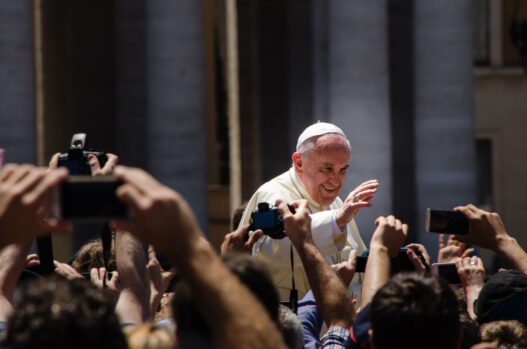
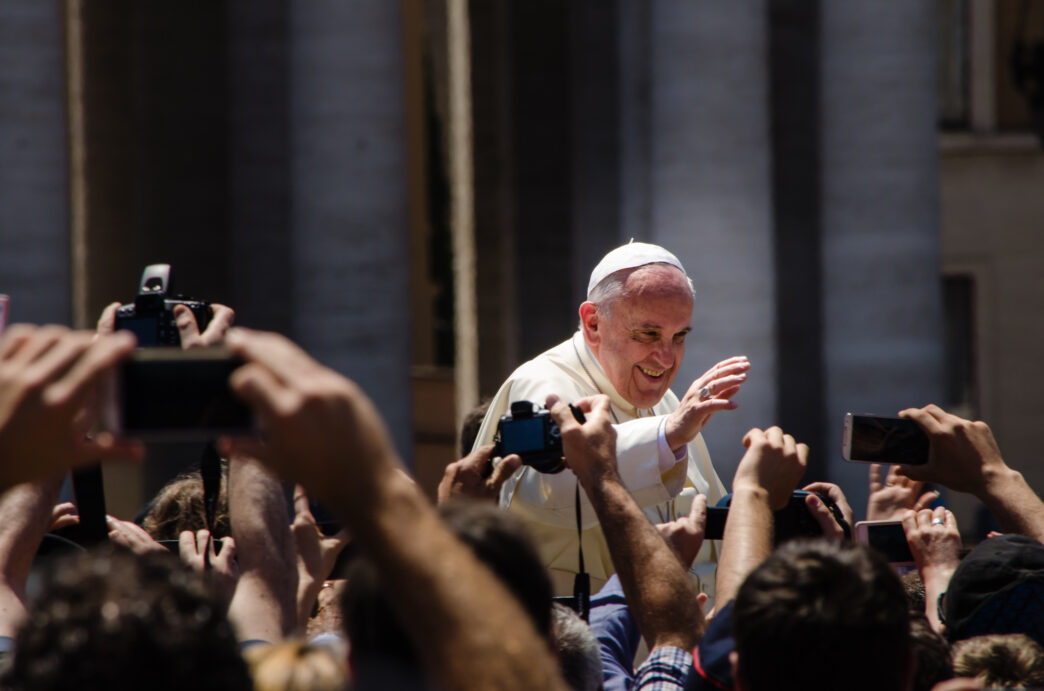
A simple wooden coffin was slowly placed on the ground. This simplistic coffin was in stark contrast to the grand colonnades and giant buildings of St. Peter’s Square in Vatican City. The square was lined with high-profile guests and world leaders. Further down the square was a gathering of Rome’s poor, criminals, and refugees. This gathering was present at the request of the man in the coffin, Pope Francis.
Pope Francis was the 266th Pope of the Roman Catholic Church until his death on April 21st. He was 88 years old at the time of his passing in Vatican City. He held the papacy for 12 years, and his term received positive reactions due to his attempts to modernize the Catholic Church. His policies were shaped in part by his upbringing.
Pope Francis was born Jorge Mario Bergoglio on December 17th, 1937, in Buenos Aires, Argentina. He was one of five children born to Italian immigrants. In his youth, he had portions of his lungs removed due to illness, which left him vulnerable to respiratory infections. This vulnerability contributed to his death, as he had been hospitalized for pneumonia shortly before suffering a stroke, followed by complete cardiac collapse, which was his official cause of death.
Later in his life, Pope Francis earned a degree in chemical engineering and had a brief stint as a bouncer. After these varied experiences, he attended seminary school. He became a Jesuit, taking vows of poverty, chastity, and obedience. These vows would go on to shape his views regarding the role of the Church and the Pope. 
On March 13th, 2013, he was elected Pope, becoming the first Jesuit Pope and the first Pope from the Americas. In keeping with his vows, he chose not to live in the Apostolic Palace but rather in the modest Vatican guest house. He also continued work with the poor that same year, spending the Thursday before Easter washing the feet of prisoners in Rome.
Throughout his papacy, Francis focused on liberal policies. Early on, when approached about same-sex relationships, he remarked, “Who am I to judge?” He then went on to encourage the Church to allow the blessing of same-sex couples, explaining, “We cannot be judges who only deny, reject, and exclude.” The Church formally allowed the blessing of same-sex couples in 2023. However, it continues to prohibit same-sex weddings.
Francis’s papacy also saw changes in the role of women in the Church. He created two commissions to explore the possibility of allowing women to serve as deacons, who are ordained but at a lower level than priests. These commissions, however, failed to yield public results, and Francis continued to uphold the ban on female priests. At the same time, he granted women the right to vote in the Synod, which determines the rules in the Church. However, he stood firmly by the Church’s pro-life stance, comparing abortion to “hiring a hitman to solve a problem.” This contributed to his rather complex legacy regarding gender in the Church.
Another aspect of Pope Francis’s legacy is his complex relationship with Indigenous peoples. In 2022, he issued an apology to the First Nations of Canada for the Church’s role in the residential school system. The residential school system, which operated from the 1880s until the last school closed in 1996, amounted to cultural genocide. These schools forcibly assimilated Indigenous children into white Canadian society, stripping them of their traditional culture and language. Children were taken from their communities by force, and the schools became hotbeds of physical, mental, and sexual abuse.
In 2022, Francis traveled to the former Ermineskin Indian Residential School to issue his apology, telling those in attendance, “I humbly beg forgiveness for the evil committed by so many Christians against the Indigenous peoples.” While this apology was important for many survivors, others still wanted more from the Church. They continue to advocate for the full release of Church records related to the schools and the return of stolen artifacts held by the Vatican.
One of the final issues Francis chose to focus on was Gaza and the survival of its citizens. Every night at 7 p.m., he would call the Church of the Holy Family in Gaza, which has become a shelter for nearly 300 Palestinians since the start of the war. His last call was made two days before his death. One of his final wishes was for one of his popemobiles to be converted into a mobile children’s hospital.
His most lasting impact may be on the College of Cardinals, which elects the next pope. The College is made up of 252 cardinals from around the world. Those under the age of 80 are eligible to vote in the conclave that will select the next pope. Currently, 135 cardinals meet this requirement, and 103 of them were appointed by Francis. Some were chosen for sharing his progressive worldview, while others were selected for their geographic background, diversifying the College. While they are not guaranteed to vote in line with Francis, their presence has diminished the influence of the conservative wing.
The conclave met on May 7th to decide who the next pope would be. While any Catholic male is technically eligible to become pope, it is tradition to elect one of the members of the conclave. The cardinals vote multiple times a day until a consensus is reached. These votes are conducted privately, away from the public eye. If no pope is elected, the public will be notified by black smoke from the chapel chimney. If a pope is chosen, the chimney will emit white smoke. When this happens, crowds traditionally gather in St. Peter’s Square to witness the moment a new pope is finally chosen.
On May 8th, the world saw the white smoke emerge from the chimney. Cardinal Robert Prevost of Chicago, who chose Leo XIV for his papal name, was elected as the 267th Pope. He is the first Pope from the United States of America.
While he is seen as a centrist, Pope Leo XIV shares many of Francis’s views on immigration and the poor. He has also expressed support for female deacons and the blessing of same-sex couples, though he has encouraged local bishops to consider cultural and regional contexts when implementing such changes.
His first words as Pope, “Peace be upon you,” hint at a papacy dedicated to building bridges. Only time will tell how his views and ideas will take shape in practice and what they will mean for the legacy of Francis.