






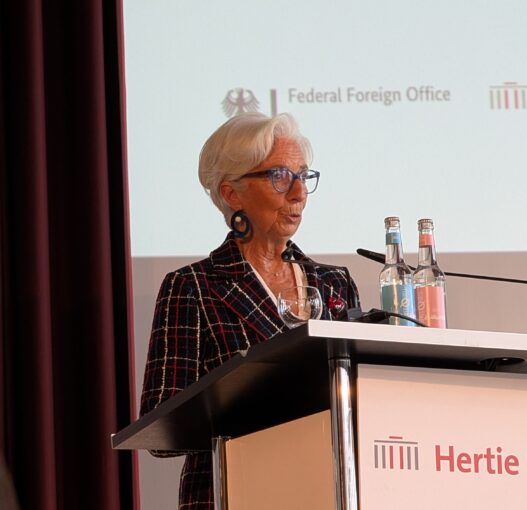
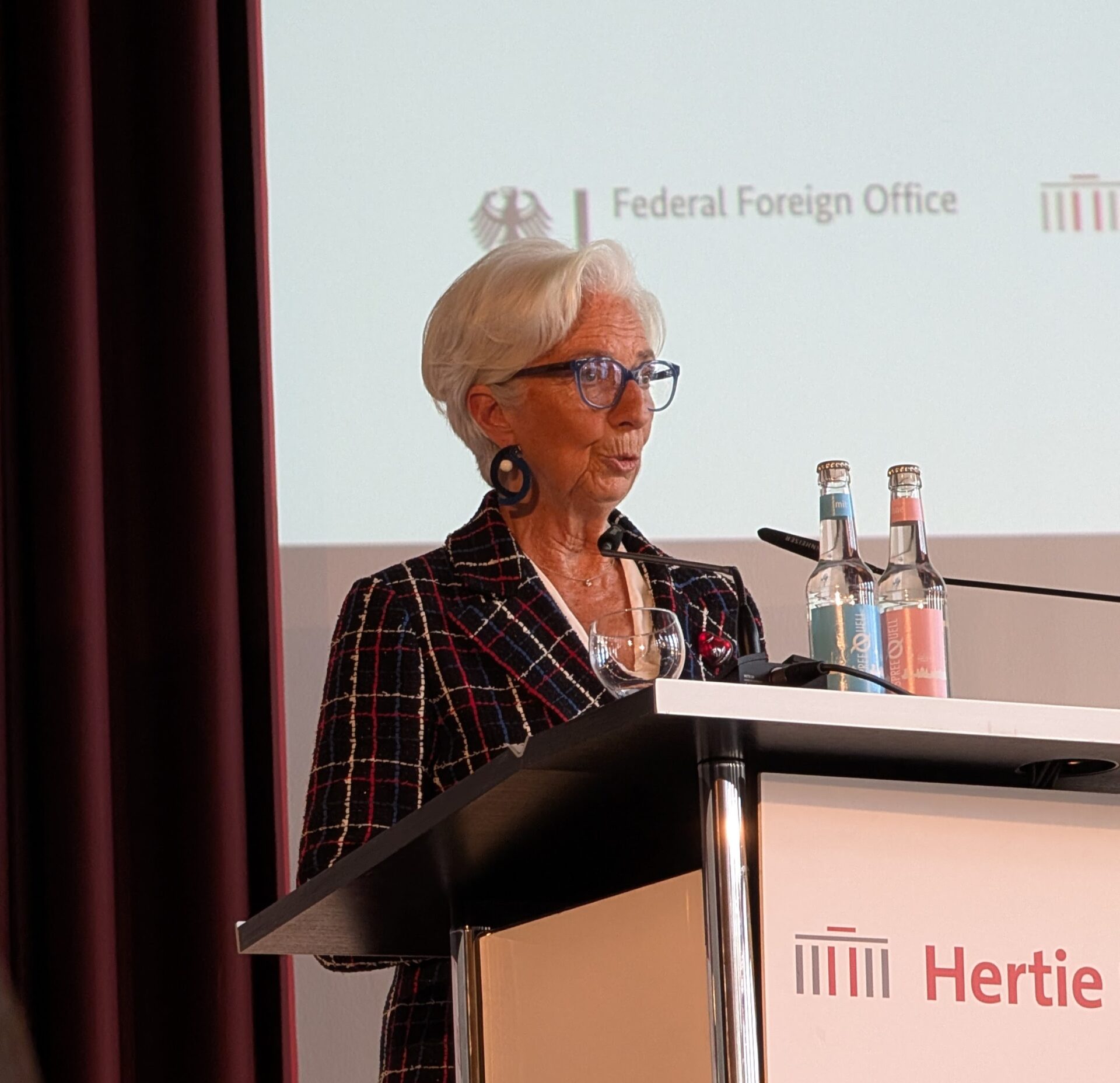
Christine Lagarde delivered a sharp warning on May 26th: Europe must act decisively to strengthen the euro’s global role or risk falling behind in a shifting monetary world order.
Speaking at the Hertie School in Berlin, hosted by the Jacques Delors Centre, the ECB President outlined the strategic foundations Europe must build to seize what she called a potential “global euro moment”, in which the euro might move from second-tier status to true global currency.
We are, it seems, at the tail end of the dollar century. For over 80 years, the global economy has orbited the gravitational pull of the US dollar, an era defined by multilateralism, openness, and an American-built architecture of trust. But that architecture is cracking. Protectionism is no longer taboo. Strategic blocs are re-emerging. And most significantly: trust in the dollar is no longer immune to doubt.
“There is even uncertainty about the cornerstone of the system: the dominant role of the US dollar,” Lagarde noted.
History may not repeat, but it often revisits old themes. As Lagarde pointed out, the pound sterling’s reign ended not in cataclysm but in gradual erosion. Twice in the past century, American leaders took decisions, Roosevelt in the 1930s, Nixon in the 1970s, that unilaterally reshaped the monetary system. In both cases, trust in the dollar wobbled. But there was no real alternative. Today, however, a viable challenger stands ready: the euro.
The Euro’s Unfulfilled Promise
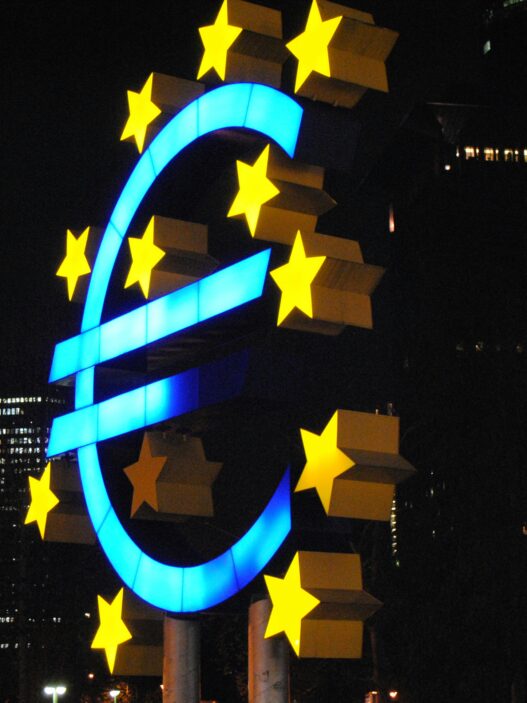
To date, the euro has been a paradox: a currency with global ambition limited by continental indecision. It is already the second most-used currency in the world, accounting for 20% of foreign exchange reserves. But it lags far behind the dollar’s 58%, and astonishingly, it now trails even gold in global reserves. 
Why has the euro, despite its economic mass and political symbolism, not risen to rival the dollar? The answer lies not in its potential, but in its incompleteness. Lagarde was blunt: “The euro will not gain influence by default, it will have to earn it.”
And earning it means constructing three solid pillars: geopolitical credibility, economic depth, and legal stability. Europe is rich in ingredients. But only a deliberate strategy can bind them into power.
Geopolitics: Currency as a Projection of Power
Money is never neutral. It is, as Lagarde emphasized, a proxy for power, hard, soft, and institutional. The US dollar does not dominate only because of America’s GDP. It dominates because it is underwritten by security guarantees, military alliances, and political alignment.
For the euro to rise, it must become the currency of a power capable of defending its interests.
“This dual strength is essentially what we can learn from the US dollar’s dominance,” Lagarde argued. “It is not just a product of economic fundamentals but powerfully reinforced by US security guarantees.”
Europe has begun to stir from its postmodern slumber. Defense spending is rising. Strategic autonomy is no longer a French intellectual’s dream but a Brussels buzzword. Yet much more is needed. Currency strength requires security weight. Until Europe becomes a credible actor in hard power, not just humanitarian missions or procurement coordination, it will not inspire the trust needed for monetary leadership.
Economics: Building a Market Worth Believing In
Beyond military might, markets matter. Investors need places to park capital, hedge risk, and ride growth. The US Treasury market, deep and liquid, is not just a tool of policy, but is an instrument of faith.
Here, Europe is struggling to catch up. The eurozone is wealthy, but fragmented. Productive, but sclerotic. The European tech sector remains a shadow of its American counterpart. The capital markets union remains an aspiration, not a fact.
Lagarde’s warning was surgical: “Despite our large savings, we have made little progress in integrating our capital markets to channel more of our funds into growth.” And despite our more prudent fiscal position, European public debt is significantly lower than America’s, the supply of European safe assets is thin.
Without depth, there is no liquidity. Without liquidity, no investor trust. Europe must complete the Single Market, harmonize financial regulation, and, yes, embrace joint debt issuance. Only then can the euro become more than a symbol, but a safe harbor.
Law: The Quiet Pillar of Monetary Power
The final, least glamorous foundation Lagarde invoked was legal and institutional stability. Here, ironically, Europe has a comparative advantage. The EU’s ponderous consensus-building, often derided as inefficiency, insulates it from capricious policy swings. The ECB’s independence is enshrined more robustly than that of the Federal Reserve.
“The positive side of our often slow and complicated decision-making processes is that checks and balances are always respected,” Lagarde noted.
But the pressure is rising. In a world of strategic coercion and economic bullying, the EU must demonstrate its ability to resist not only internal fragmentation but also external pressure. A divided Europe, where a single veto cripples common action, will never wield the euro as a true geopolitical instrument.
The solution? Reform the institutional engine. More qualified majority voting. Less paralysis. More voice for Europe, less veto for individual interests.
A “Global Euro Moment”
There are inflection points in monetary history, Triffin moments, Nixon shocks, Bretton Woods ends, where everything seems in flux. Lagarde believes we are entering another. A time when trust in the US dollar, once taken for granted, is thinning. When investors hedge against inflation and instability and when gold surges, because of doubt.
“The ongoing changes create the opening for a ‘global euro moment’,” she declared. “This is a prime opportunity for Europe to take greater control of its own destiny.”
But history does not hand out reserve currency status like a trophy. It must be wrestled from the forces of inertia, vested interest, and internal division.
If the euro is to rise, Europe must think like a power. It must act as one. Only then will the euro not just reflect European prosperity, but project European sovereignty.
And in the end, that may be the true meaning of money: not just the ability to pay, but the ability to choose your future.