











With growing fears of a potential U.S. drawdown, would a dormant and unwilling America fatally undermine Europe’s access to strategic enablers if push came to shove?
President Donald Trump’s unorthodox and often ambiguous rhetoric has introduced uncertainty among European policymakers not seen in decades. In recent remarks, Trump openly questioned whether the U.S. should defend NATO allies that fail to meet his proposed defense spending thresholds, with demands as high as 5 percent of GDP. His transactional approach to international cooperation suggests that collective defense may no longer be viewed as a foundational pillar of Western security, but rather as a conditional arrangement; a policy of incentives and penalties that risk undermining trust across the Atlantic.
Various intelligence assessments from NATO, Germany, Poland, Denmark, and the Baltic states warn that Russia could be ready to launch an attack within three to ten years. At the same time, the posture of the new U.S. administration adds to European anxiety. A broader American disinterest in the European theater, combined with an increasing strategic focus on the Asia-Pacific and the US demand for “burden-shifting”, poses a pressing question: Could Europe effectively defend itself if the U.S. significantly scaled back its commitments to the alliance or used material support as a political bargaining chip, especially if tensions with Russia were to escalate into a conventional conflict?
Roles Within an Asymmetric Alliance 
Before debating whether Europe could defend itself without the United States, one must first ask: What kind of war are we talking about? The capabilities required to stabilize a post-conflict zone, suppress rural insurgencies, or police airspace differ significantly from those needed for a large-scale, high-intensity land war like the one currently ravaging Ukraine.
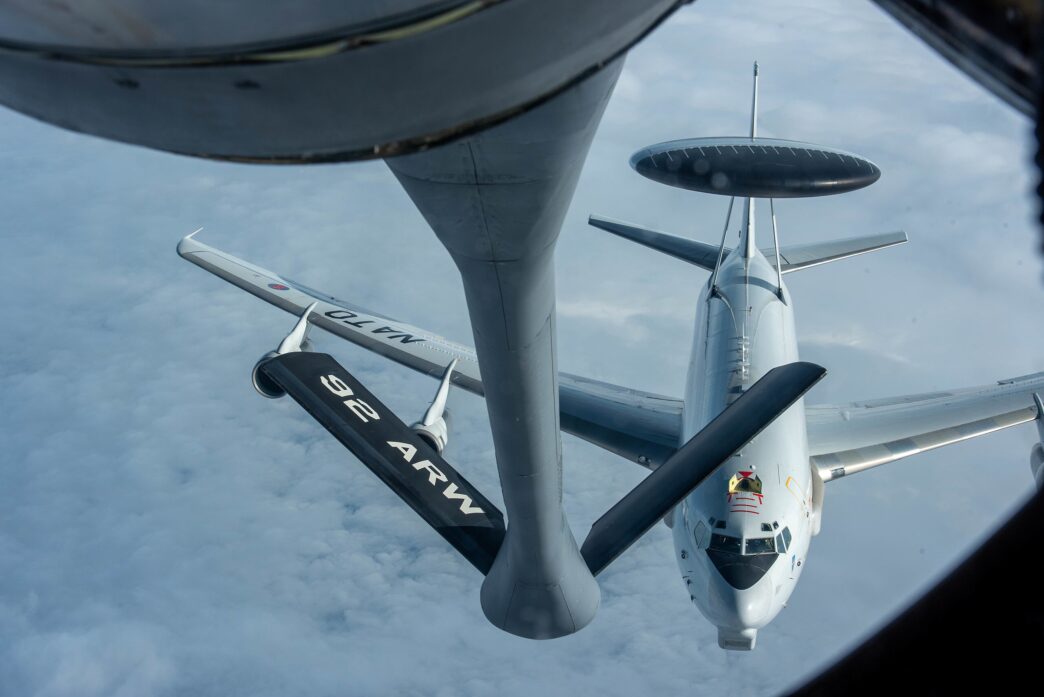
For the United States and its military allies in Europe and the Pacific, defense strategy often centers on ground denial and on making offensive operations prohibitively costly for any adversary. Within the NATO alliance and in cooperation with its Pacific partners, the United States plays a distinct and indispensable role. In addition to its nuclear umbrella, Washington serves as the primary provider of high-end capabilities. These strategic enablers make modern warfare, as it is conducted today, possible. They include intelligence, surveillance, and reconnaissance systems (ISR), including satellite networks, coordination of precision strikes to disrupt enemy logistics, complex command-and-control (C2) infrastructure, but also strategic air enablers like air-to-air refueling, air-based ISR and heavy transport capabilities for rapid forward deployment of mechanized companies. These so-called soft capabilities are essential for mobilizing and enabling allied forces to operate effectively and achieve their objectives on a multi-domain battlefield.
On land, the militaries of European NATO partners collectively field around 1.5 million active troops, which is more than Russia maintains at present. However, raw numbers mean little if the logistics of commanding a force spread across more than 20 nations falters under its own weight. The NATO command and control architecture is built on the assumption that the Supreme Allied Commander Europe is a senior U.S. general, with Allied Air Command and Allied Land Command being led by US officers as well. This arrangement functions effectively only if the United States assumes a leadership role in NATO and remains willing to intervene decisively in a continental crisis.
Equally critical is the question of societal resilience. Liberal democracies typically have limited political capital for prolonged or large-scale mobilization and are often less willing to accept high casualty numbers. In contrast, autocracies tend to integrate the military more deeply into national identity and historical narrative, making their societies more tolerant of military losses. This is another reason why the analysis should go beyond a basic comparison of active and reserve manpower. While Europe could, over time, replace the manpower that the United States has forward deployed to its territory, it remains highly uncertain whether it could realistically develop a politically viable and timely array of soft capabilities that are less dependent on U.S. support.
American Kill-Chain Dominance
In March 2025, the Trump administration suspended all military aid and intelligence sharing with Ukraine following a contentious meeting between President Trump and Ukrainian President Volodymyr Zelenskyy. This suspension, though short-lived, was intended to pressure Ukraine into peace negotiations with Russia, leaving European allies once again deeply concerned about the reliability and potential conditionality of U.S. support.
Starting with intelligence, surveillance, and reconnaissance capabilities (ISR), Europe reveals its greatest dependence on U.S. military structures. ISR is fundamental to modern operations, particularly in enabling effective kill chains. A kill chain in military terms refers to the sequence of actions needed to detect, identify, track, assess and ultimately engage a target. ISR systems provide the critical data at every stage of this process, using assets such as satellites, uncrewed aircraft such as drones, radar systems, and electronic sensors. Without timely and accurate ISR inputs, the kill chain cannot function properly, leading to delays, miscalculations, or operational failure. In high-intensity and especially high-precision conflict scenarios, the ability to rapidly close kill chains before the adversary does becomes vital.
Within NATO, the United States provides the majority of high-end ISR assets that enable such operations. This is particularly true for satellite capabilities such as military communications, where the alliance remains heavily dependent on U.S. systems. According to the Union of Concerned Scientists, as of 2023 the United States alone operated 246 military satellites, while all European NATO allies combined fielded only about one-fifth of that number.
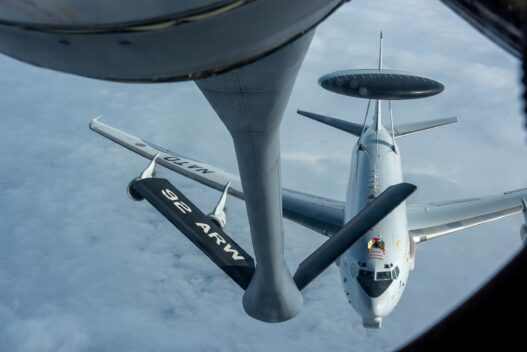
European NATO allies also remain heavily dependent on the United States for critical air enablers, which are support systems that make sustained air operations possible. A comparison of strategic enablers as of 2024 highlighted the persistent gap between the United States and its European NATO allies. Some capabilities, like the fleet of 14 Boeing E-3A AWACS aircraft, are operated jointly by NATO. In contrast, many critical enablers such as air-to-air refuelling, intelligence, surveillance and reconnaissance (ISR), suppression of enemy air defences (SEAD) and electromagnetic warfare (EW) are predominantly provided by individual member states, with the United States contributing the majority of these capabilities. The United States operated 171 military satellites, while European NATO members collectively maintained only 44. In the domain of ISR unmanned aerial vehicles (UAVs), the U.S. fielded 297 medium and heavy drones, compared to 249 in Europe. The disparity was even more pronounced in transport and tanker capabilities: the U.S. had 488 medium and heavy transport aircraft and 408 tanker or transport/tanker platforms, whereas European allies operated 281 and just 58, respectively. In airborne early warning and control (AEW&C) systems, the U.S. fleet stood at 78, while Europe’s totaled only 37.
While European alliance members obviously do not need to match U.S. numbers given their focus on regional defense, these figures nonetheless reveal significant capability gaps that would severely undermine Europe’s ability to conduct high-intensity air operations without U.S. support.
Given the extent of U.S. control and leverage over allied kill chains, particularly in relation to deep strike capabilities, Washington effectively holds a monopoly on escalation within the alliance. By extension and by design, this raises concerns that the United States could constrain European armed forces in a future crisis in order to broker a negotiated settlement, especially if the Kremlin attempts to radically alter the geopolitical balance in Eastern Europe following a conclusion of the War in Ukraine. If a future US administration judged Europe’s military engagement to be excessive or misaligned with U.S. strategic priorities, especially given a growing focus on the Indo-Pacific, it could withhold support. That possibility raises uncomfortable questions about Europe’s ability to respond independently in a high-end conflict.
Compounding these concerns, reports emerged that the U.S. could potentially indirectly disable F-35 fighter jets procured by allies. While rumors of a “killswitch” were partly dismissed, the U.S. does maintain control over critical software updates and integration capabilities and maintenance, leading to fears that withholding support could effectively ground the aircraft, which is NATO’s standard multirole fighter. Despite assurances, these concerns were significant enough that Portugal decided not to proceed with the procurement of F-35 jets for its own fleet.
Too little, too late?
Thus, the European pillar of NATO appears to remain deeply dependent on the United States in several critical areas required for complex multi-domain operations, and it is likely to stay that way for the foreseeable future despite renewed efforts to strengthen European defense in line with the U.S. objective of burden-shifting. Some sectors are more affected than others. While command and control (C2) capabilities could reach optimal levels within five years, analysts estimate that Europe would require significantly greater resources and up to ten years to develop and operationalize adequate space-based intelligence, surveillance, and reconnaissance (ISR) capabilities. The European Commission’s recent ReArm Europe White Paper acknowledges these persistent shortfalls in critical military enablers, including strategic lift, air-to-air refuelling, space-based communications and ISR capabilities. While the document outlines ambitious plans to address these gaps through coordinated investments, joint procurement initiatives and enhanced industrial capabilities, it also acknowledges that rebuilding these capabilities will take years. Despite recognising the strategic urgency, Europe’s ability to independently support complex, multi-domain operations by 2030, and more importantly, ahead of a potential conflict with Russia, remains highly uncertain.