








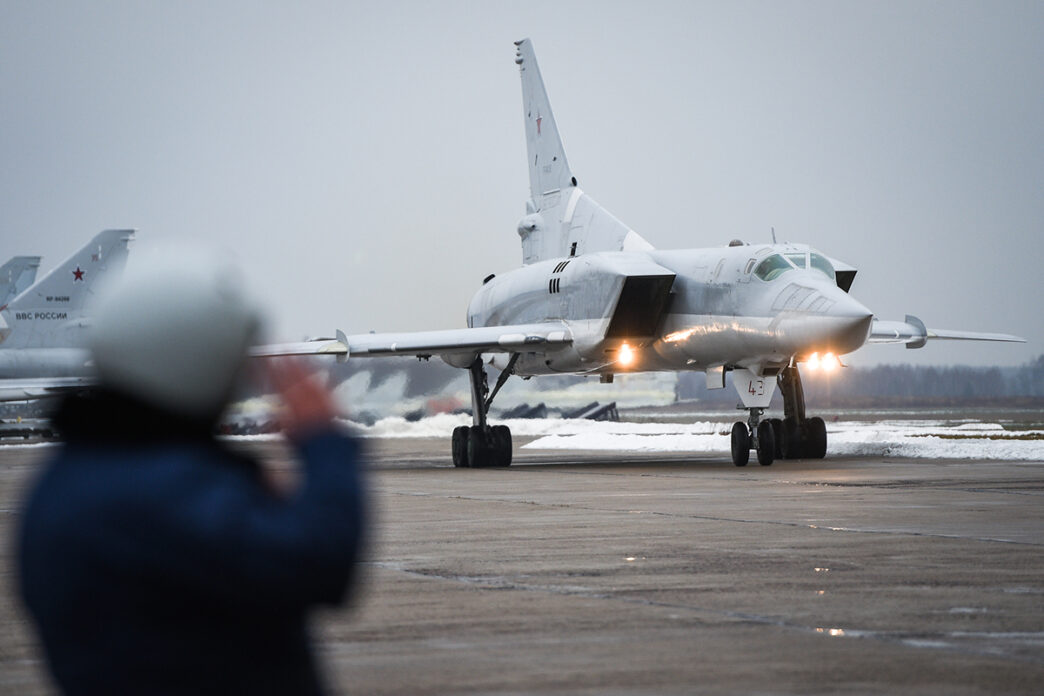
On June 1st, Ukraine launched an operation that may define the next phase of modern warfare. In an audacious act of deep strike capability, Ukrainian intelligence operatives coordinated the near-simultaneous assault on multiple Russian air bases across thousands of kilometers, some deep within Siberia, using 117 first-person-view (FPV) drones each with there own pilot, covertly assembled and launched from within Russian territory. The targets: Russia’s aging but still critical fleet of long-range strategic bombers, including the TU-95 “Bear” and TU-22M “Backfire”, aircraft capable of carrying both conventional and nuclear payloads.
The result, by U.S estimates: at least 20 aircraft destroyed and more damaged, with visual confirmation of 11 strategic bombers lost, especially grave, as Russia has not produced any new strategic bombers since the 1990s. But beyond the wreckage lies a question with implications that stretch far beyond Ukraine’s battlefields: What happens when a nuclear-armed state suffers a blow to its strategic deterrent?
The Strategic Bomber: Russia’s Flying Deterrent
Russia’s nuclear triad, the interlocking system of land-based missiles, submarine-launched ballistic missiles, and strategic bombers, is designed to ensure the survivability and retaliatory capability of its nuclear forces. While the TU-95 and TU-22M are regularly used to deliver conventional air-launched cruise missiles (Kh-101s and others) over Ukraine, they remain nuclear-capable. Their destruction does not just dent Moscow’s conventional capabilities; it weakens a key pillar of its strategic identity.
The Russian Federation has long prized its strategic aviation not only for deterrence but for political signaling. Flights near NATO airspace and long-range patrols over the Arctic serve to remind adversaries of Russia’s global reach. These aircraft are both military tools and symbolic instruments. Losing this many in a single strike undermines both. 
Operation Spiderweb: Surgical Strike or Doctrinal Provocation?
According to reports from Ukraine’s SBU, the operation, codenamed Pavutyna (Spiderweb), had been in planning for over a year. Drone components were smuggled into Russia, assembled domestically, and hidden in mobile prefabricated housings, reportedly transported by unwitting Russian civilian contractors. At a pre-selected moment, the launch compartments opened, and dozens of drones took off, many with small explosive payloads targeting the wings, fuselage junctions, and fuel tanks of exposed bombers.
The concept is as elegant as it is destabilizing. Ukraine demonstrated that a resource-limited state actor could degrade high-value strategic platforms using $500 drones instead of billion-dollar munitions. For the Ukrainian war effort, the message is clear: nowhere is safe for Russian aggression. But for global strategic planners, the message is more unsettling: even legacy nuclear platforms can be rendered vulnerable by asymmetrical methods.
Nuclear Doctrine and the Existential Question
Under Russia’s publicly declared nuclear doctrine (overhauled in 2020 and revised in 2024), nuclear weapons may be used not only in response to nuclear or WMD attacks but also in the event of conventional aggression that threatens “the very existence of the state.”
This doctrinal threshold has always been deliberately ambiguous. Yet Ukraine’s strike introduces a new variable: the destruction of nuclear-capable delivery systems without nuclear munitions. Are these aircraft symbolic tools, or existential assets? The answer may depend less on doctrine and more on Vladimir Putin’s perception of risk and power.
The direct Russian response has been verbally restrained but pointed. Officials called the operation a “terrorist act” and used the incident to justify rejection of a ceasefire proposal and launched massive attacks on Ukrainian cities. There has been no direct nuclear saber-rattling from the Kremlin, but indirect signaling is unmistakable. Official statements referenced “unacceptable damage” and “heavier indiscriminate bombing of Ukrainian cities and infrastructure,” while state media leaned into nuclear imagery and comparisons, calling for “grounds for a nuclear attack”.
A Case for Strategic Restraint?
Of particular interest is what wasn’t hit. Satellite imagery before and after the attack confirms the presence of several TU-160 “Blackjack” bombers, Russia’s most modern and nuclear-optimized strategic bombers, at the targeted air bases. Unlike the Bears and Backfires, these aircraft were left unscathed. Ukrainian drones flew past them. None were struck.
There are two explanations. One is simple luck. The other is more provocative: strategic signaling from Kyiv. By sparing the most nuclear-relevant bombers, Ukraine may have drawn a deliberate line between degrading Russia’s conventional strike force and provoking a doctrinal threshold. If so, it represents a remarkable, and rare, case of escalation management in a war full of miscalculations.
However, this line is already being tested. Reports suggest that, in the aftermath of the attack, Russia used TU-160s to launch cruise missiles at Ukrainian targets, potentially nullifying the tacit understanding. If the Blackjack enters regular conventional use, it risks becoming fair game. And if Ukraine chooses to cross that line in future strikes, it will raise the strategic temperature significantly.
A Doctrinal House of Cards?
The core of deterrence theory is survivability. The idea that no enemy can launch a first strike without facing unacceptable retaliation. But if strategic bombers, especially those based deep inside national territory, can be degraded by inexcpensivedrones launched from disguised trucks, then survivability becomes a variable, not a constant.
In the nuclear community, much attention has long focused on missile defense systems, hardened silos, and second-strike submarine patrols. But Operation Spiderweb introduces a threat below the threshold of traditional warfighting: what happens when nuclear delivery systems are threatened without triggering nuclear thresholds?
For NATO and other nuclear-armed powers, the implications are immediate. Hardened aircraft shelters, drone detection systems, and counter-sabotage security at distant air bases, previously low-priority defenses, now demand urgent investment. Because if the Russian VKS, with its vast geography, security apparatus, and wartime posture, can’t protect its bombers, who can?
The Future of Russia’s Bomber Fleet
Russia’s long-range aviation force was already in a slow-motion decline. Most TU-95 and TU-22M airframes date from the Cold War, and their production lines are long cold. Maintenance is expensive, parts are scarce, and flight hours are finite. The TU-160 production revival program has yielded just two new airframes in over a decade. A next-generation stealth bomber project, the PAK-DA, remains theoretical.
By visually confirmed counts, at least 15% of Russia’s operational strategic bombers have been lost since 2022, most in this single operation. Factoring in attrition, aging, and readiness rates, the real impact may be closer to 20–30% of available strike capacity.
The loss is not only material. It’s doctrinal. The credibility of any nuclear doctrine rests not just on the possession of warheads, but on the means to deliver them. Spiderweb exposed how brittle that delivery system can be.
A Warning to the World
The war in Ukraine has become a laboratory of modern conflict. From trench warfare to satellite-guided artillery, from cyberattacks to FPV drone tactics, it has reshaped military assumptions across the globe. But Operation Spiderweb is different. It reaches into the heart of global deterrence logic and rattles it.
This was not just an attack on Russian airfields. It was an announcement to the world that nuclear-capable states are not immune to low-cost innovation. That deterrent forces, no matter how symbolic, are not invulnerable. That strategic bombers, unprotected and aging, are as vulnerable to asymmetric ingenuity as tanks are to Javelins.
As states recalibrate their doctrines and defenses, one question looms: If Ukraine could do this to Russia, while under siege, outgunned, and resource-constrained, what might a better-funded actor accomplish under more favorable conditions?
The age of invulnerability may be over. And Spiderweb was the spark that made it clear.