








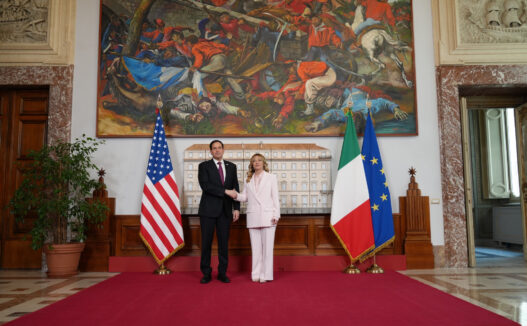
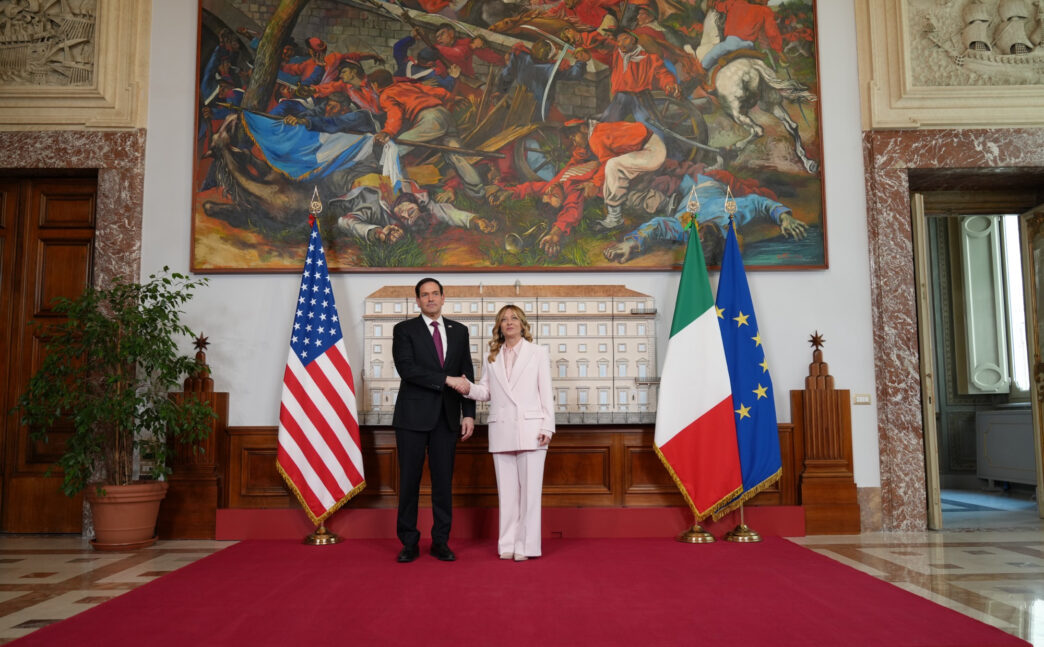
At the beginning of May 2026, US Secretary of State Marco Rubio carried out an official visit to Italy and the Holy See, which gained particular significance in light of the recent spats involving President Trump, on the one hand, and Pope Leo and Italian Prime Minister Meloni, on the other. Indeed, the initiative was read as Washington’s attempt to reconcile with Rome and the Vatican.
However, as far as bilateral relations with the Meloni government are concerned, the current diplomatic rift stems from national dynamics and from a deeper misalignment between American and Italian (European) interests. Therefore, diplomatic courtesy alone is unlikely to bridge the gap between the two sides of the Atlantic.
Ideological alignment and initial affinity
The MAGA movement and the political substrata behind the current Italian government share many similarities. The slogan of Vice-President Salvini, “Prima gli italiani” (Italians first), echoes the America First approach. Similarly, PM Meloni’s famous motto “Io sono Giorgia, sono una donna, sono una madre, sono italiana, sono cristiana” (“I am Giorgia, I am a woman, I am a mother, I am Italian, I am Christian”) synthesises a mix of sovereignist and identitarian programmes.
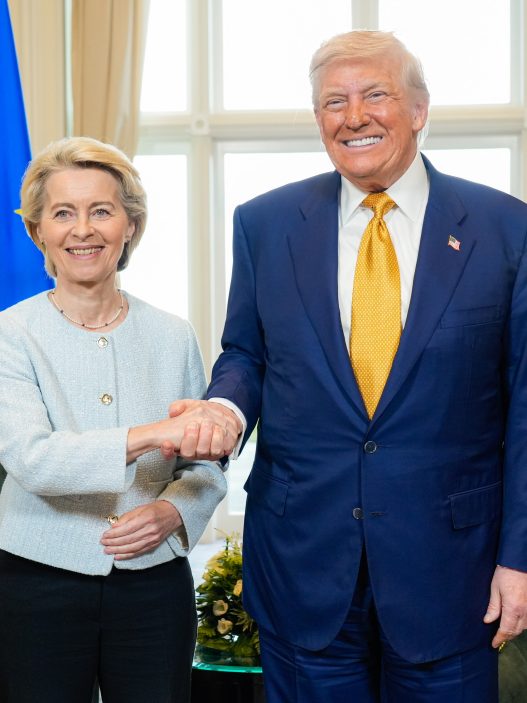
As a consequence, when Donald Trump was reelected President of the United States, the common ideological ground between the White House and Palazzo Chigi was seen as a great opportunity for the Italian government, which could have become a US privileged partner within the EU. For a while, diplomacy seemed to support this ambition. For instance, Meloni was the only European leader to attend Trump’s inauguration ceremony, and the only female leader on stage at the 2025 Gaza Summit in Sharm el-Sheikh. On that occasion, she received a public endorsement from the US president, who described her as a “very successful politician” and a “beautiful young woman”. 
The negative effects of MAGA’s foreign policy
However, the Italian public opinion would struggle to identify any tangible benefits from this alleged special relationship. For one, despite ideological alignment, EU membership did not shield Italy from Trump’s tariffs, as the bloc functions as a customs union. Secondly, the closure of the Strait of Hormuz is putting the Italian economy under significant stress, especially in terms of energy costs. In the aftermath of the 2022 Russian full-scale invasion of Ukraine, Rome had to progressively cut its ties with Moscow, which used to provide roughly 40% of all gas imports. Hence, Italy had to diversify its energy partners, with the Gulf countries playing a vital role in meeting national energy demand.
Against this backdrop, it is impossible to overestimate the effects of a prolonged closure of the Strait of Hormuz. Notably, as a manufacturing economy dependent on energy imports, Italy remains structurally exposed as a price taker on the international energy markets. Surging fuel prices immediately opened citizens’ eyes to the effects of Operation Roaring Lion. The government’s fiscal intervention postponed the problem, hoping for a quick solution, but not even the billion-euro excise cut measure could stop the growing trend in prices. Two weeks before the Israeli-American attacks, petrol and diesel were sitting below 1,70 €/L. By the end of May 2026, both prices had converged above 1,95 €/L, and by the end of August they both pierced the 2 €/L psychological threshold. Amidst the ongoing excessive deficit procedure, the Italian government lacks budgetary room to counter fuel price inflation, forcing it to try to negotiate looser fiscal rules for energy-related spending with Brussels.
The winds of change
It is precisely in this international environment that Meloni suffered her first real political defeat since she took office in October 2022. Her government, one of the longest-serving executives in the history of the Italian Republic, was pushing for a systemic constitutional reform of the Italian judiciary. However, on the 22nd and 23rd of March 2026, more than 53% of the voters rebuffed the reform, sinking one of the government’s flagship proposals. After this blow, it is hard to imagine how the governing coalition will be able to push its political agenda, whether in terms of tax cuts or in terms of systemic reforms, such as introducing the direct election of the head of government (so-called premierato), or implementing a differentiated regional autonomy regime (so-called autonomia differenziata).
The international setting has been recognised as one of the reasons behind the unexpected defeat of the Italian government. More specifically, the war against Iran and the subsequent closure of the Strait of Hormuz highlighted the growing disconnect between Meloni’s sovereignist mandate and the economic damage caused by her American ally. Accordingly, the government’s posture towards the US has started to change.
The rift between Rome and Washington
In the week following the referendum results, the Italian government denied the use of the Sigonella airbase to US aircraft involved in Iran-related operations. While the Italian government maintained to be simply acting “in full compliance with existing international agreements”, the decision reflects a change in posture towards the White House. After all, despite the government’s efforts, it is the US President himself who escalated the disagreement from a legal and procedural issue to an act of political treason, posting that: “Italy wasn’t there for us, we won’t be there for them”.
A similar (timid) change of posture can be appreciated in the bilateral relations with Israel. After tensions between Israeli forces and a convoy of Italian peacekeepers broke out, the Israeli ambassador to Rome was summoned by the Italian government. In turn, the Italian ambassador to Tel Aviv was summoned by the Israeli government after the Italian Minister of Foreign Affairs condemned the attacks on civilians in Lebanon. Remarkably, PM Meloni announced the decision to suspend the renewal of the defence agreement with Israel. While similar moves could be temporary and purely cosmetic, they do signal an attempt to appear more autonomous vis-à-vis Donald Trump and Benjamin Netanyahu.
The straw that broke the camel’s back
The Vatican represents the third dimension of the current transatlantic misalignment. After posting an AI-generated picture that represented him as a Jesus-like figure, President Trump criticised the Pope for not supporting the US military intervention. Among other things, he accused the Pope of “endangering Catholics” and of being fine with Iran having a nuclear arsenal.
Since Catholicism represents a pillar of Italian conservatives, Trump’s semi-blasphemous actions and repeated criticism of Pope Leo XIV did not go unnoticed by the Italian government’s electoral base. PM Meloni had to step in, defending the Holy Father and judging President Trump’s words as “unacceptable”. When Corriere della Sera, one of Italy’s most influential newspapers, asked the US President to comment on Meloni’s words, he replied that she was the one to be unacceptable, and that she is much different than he thought.
Conclusion: why the diplomatic crisis is here to stay
Rubio’s visit seems to have cooled off the diplomatic rift between Italy and the US. However, the previous exchange of negative comments did not represent innocent missteps in public communication. On the contrary, they are the result of political calculus and reflect a deep misalignment of national interest and foreign policy priorities. Indeed, Trump’s public attacks continued even after Rubio’s visit, as did Meloni’s attempts to distance herself from the US President, particularly in the eyes of the Italian people.
Similarly, Italian Foreign Minister Antonio Tajani (who belongs to Forza Italia, a more moderate party than Salvini’s Lega and Meloni’s Fratelli d’Italia) has been deflating the importance of ideological aspects in transatlantic relations. Accordingly, he clarified that “Atlanticism is not Trumpism, Bidenism, or Obamaism”, and stressed how the relationship between Italy and the US is “independent of individual presidents”.
More broadly, Italy presents a case study for the rest of Europe. Although with important differences, such as in national energy mixes, MAGA’s commercial and foreign policy has negatively impacted every EU Member State. The recent defeat of the four-time Hungarian PM Viktor Orbán, who was publicly endorsed by JD Vance, seems to demonstrate the continuation of what has been described as the “Trumplash” of right-wing European populist parties.
Crucially, the case of Italy demonstrates that a common ideological ground does not guarantee the convergence between European sovereignism and American nationalism. As PM Meloni admitted, “with Donald Trump I thought things would be easier, given our common ground”. While European conservative governments might try to swallow the bitter pill and hide the negative effects of US foreign policy, their national electoral base might demand a stronger posture towards those who hinder their national (European) interests.