











Air superiority, the concept of controlling airspace over a combat zone, is a cornerstone of modern warfare. While it typically does not lead to a military victory on its own, it is often a crucial “victory condition” for interstate warfare. In the 21st century, multirole fighter jets have become an indispensable tool for air superiority. In this regard, Europe has let itself be overtaken by the USA: American fighter jets are superior to anything Europeans can fly. This article will explain this capability gap and draw a political connection between air defense and politics.
The American “Lightning”
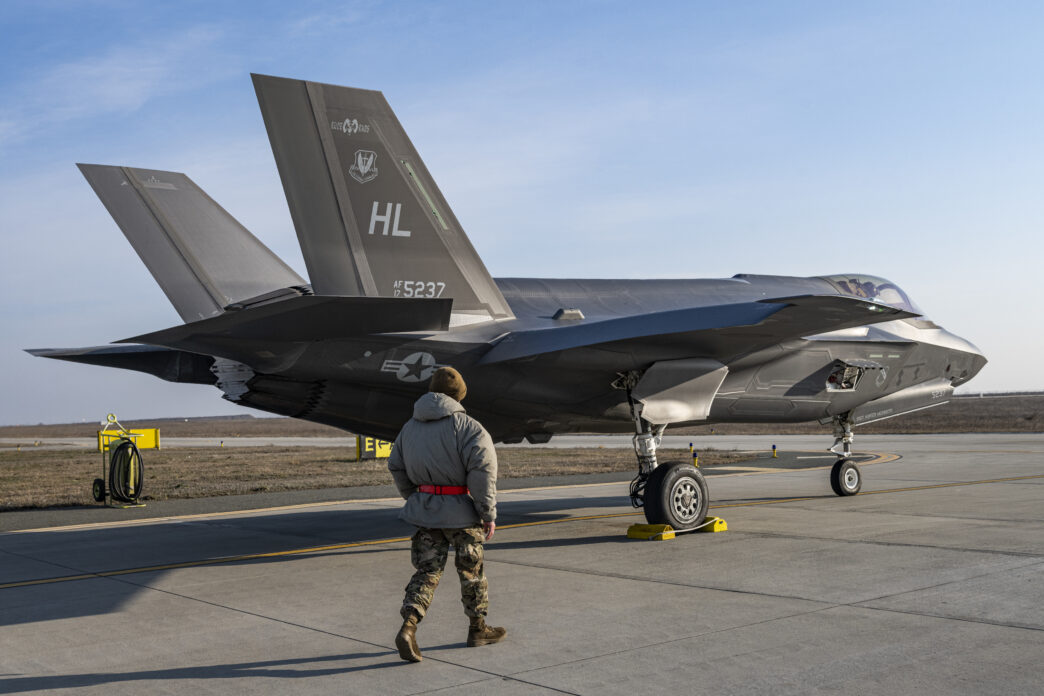
The “F-35 Lightning II Joint Strike Fighter,” simply known as F-35, is one of the United States’ most advanced aircrafts approved for international commercialisation. Although the F-35 programme includes 19 nations currently, the US owns and operates around 80% of all F-35s manufactured. A UK Ministry of Defense report from 2025 stated that the F-35 had better performance than any other aircraft ever fielded by the UK Royal Air Force.
The U.S. dominates not only in terms of sheer quantity, but also in quality. Typically, a jet fighter’s capabilities can be measured in “generations,” a concept which signifies a leap in technological development so significant that it cannot realistically be incorporated in the “current generation.” European defence industries have not managed to develop anything past “Generation 4.5.” On the other hand, the world’s great powers – USA, Russia and China – have long since reached Generation 5.
But what, exactly, makes the F-35 so powerful? 
F-35: A very expensive miracle with wings
Two main pillars contribute to the F-35’s appeal: stealth capabilities and highly complex network-integrated systems. In a research report determining whether the F-35’s abilities justified its cost, US Air Force researcher Jetta Abplanalp described the aircraft as being essential to American security due to its ability to match or even exceed Russia and China’s operational abilities in the skies.
Abplanalp goes on to detail the fighter jet’s greatest strengths as follows:
Network-integrated systems
Given its international nature as the product of a multilateral cooperation cost-sharing project, the F-35 was built with integrated tactics in mind. In other words, it is a holistic aircraft made to execute missions in teams. Previously, certain specific missions (beyond core aerial combat and close air support functions) were carried out by squadrons of specialised aircraft (reconnaissance, surveillance, electronic attack), a squadron of only F-35s is able to fulfill all of these requirements.
Its manufacturers adopted this standardised-approach philosophy so that the programme’s variants (A, B and C) would eventually replace other aircraft across the three branches of the military, such as the A-10 and F-16 for the Air Force or the F/A-18 for the Navy, among others. Originally, this was meant to make the F-35 more affordable in the long-term as the only machine used by the entire armed forces. However, its slow production and high cost trumped this plan.
Additionally, integrated systems enhance the capabilities of other older, “legacy” aircraft by several orders of magnitude:
“The integrated and fused sensor called the Multifunction Advanced Data Link (MADL) on the F-35 allows pilots to see a single integrated picture of the battlespace. The MADL also automatically shares data with other pilots on the network using the most modern data links. This feature allows the F-35 to automatically share situational awareness data while assuring a secure transmission”
In short, the F-35 acts as a mid-flight supercomputer with incredible surveillance and reconnaissance abilities, which it then shares with older aircraft, allowing them to overcome the ‘fog of war.’
F-35s boast extremely advanced detection and awareness systems incorporated into the pilot’s helmet.These include a “Distributed Aperture System (DAS),” which essentially allows a 360 degree view of the fighter’s surroundings and is able to detect incoming infrared tracking and IR-missiles from any direction. A sophisticated Helmet Mounted Display System works in tandem with the DAS to provide F-35 pilots with a unique ability to “see through” their own aircraft in real time, giving them almost absolute situational awareness capabilities.
Stealth
One of the programme’s most defining features is its emphasis on furtiveness. But what does it actually mean for an aircraft to be “stealthy”? To answer this, it is necessary to situate the concept of stealth within the broader dynamics of contemporary aviation. Jet engines, regardless of engineering refinements, remain inherently loud, and when combined with the sizeable airframes of modern combat aircraft, they would seem easy to detect. At first glance, therefore, the notion of a “stealth” aircraft appears counterintuitive.
During the Second World War, aerial combat was characterised by the deployment of large numbers of airscrew-based aircraft (known as “props,” short for propeller), which were generally slow moving. The fastest recorded speed that a WW2 “prop” plane managed to reach was 763km/h, which is slightly slower than a current-day commercial airliner.
In the second half of the 20th century, aerial warfare became a contest of speed and high-tech weaponry. Eventually, direct confrontations (dogfights) became extremely rare due to average speeds and the evolution of radar-born air-to-air missiles, and were ultimately replaced by “BVR” – Combat Beyond Visual Range.
Radar based air-to-air missiles became so sophisticated through the 1970s that they were able to launch and pursue their targets at distances over 20 kilometres. Since the late 1990s and 2000s, radars have become even more advanced, with ranges of over 100 kilometres. Aircraft are able to engage their targets without ever needing to approach them. As such, engine noise and physical size play a far less decisive role in air combat than they did during the early decades of fighter aviation. Engagements are now shaped primarily by long-range air-to-air missile capabilities.
It naturally follows, then, that the best defence against such technological death threats is stealth: better to hide from a missile than to attempt to evade it. This is why the F-35’s impressive stealth capabilities are especially important in today’s military conflicts.
European Fighter Aircraft
In Europe, the most considerable fighter jets today are the British-German-Italian-Spanish Eurofighter “Typhoon” (EF), the all-French Dassault “Rafale,” and the Swedish SAAB “Gripen.”
They share the same core traits: all three are 4.5-generation multirole fighters with delta wings and forward canards (small wings beside the cockpit for added manoeuvrability), a layout that delivers strong performance, agility and operational flexibility at a lower cost than the F-35. However, these planes come with the tradeoff of limited stealth and fewer advanced onboard systems.
The Eurofighter vs. Rafale Rivalry
While not as impressive as Generation 5 aircraft, the Eurofighter competes mainly with the Rafale for the top spot as the world’s most capable Generation 4.5 fighter. They are strikingly similar in numerous aspects.
According to a study simulation done on the two planes’ aerodynamic features, a high ratio of composite graphite and low ratio of metals makes them somewhat difficult to detect by most contemporary radars. The study also found that while the Eurofighter is able to endure longer flights at moderate to high speeds, the Rafale maintains better stability and flight performance at higher speeds.
A U.S. Air Force-sponsored research paper reported that both are capable multirole fighters. They are able to engage in air-to-air combat as well as deliver payload for ground support in the same mission. Both planes are fitted with twin-engines and have highly advanced flight controls as well as sensor suites, which gives them a high degree of threat awareness.
From a logistical and strategic point of view, the Rafale has the major advantage of uniform manufacturing. All of its parts and components are sourced within France, making its production and licensing more seamless.
At the same time, at over 100 million euros per plane, it has been ruled out in favor of the Eurofighter in many European countries, despite the latter being only slightly more affordable. Consequently, it also suffers from difficulties with NATO integration, as is often the case with the French military.
The Eurofighter, despite its multinational industrial process, is better integrated with overall NATO systems and frameworks and is better able to cooperate with F-35s, if required.
Although both the Rafale and the Eurofighter are described as “stealthy,” their stealth is far too situational to be consistently useful in combat, at least against more recent and sophisticated detection systems such as AWACS. In other words, their structural build inherently provides them with some ability to avoid legacy detection systems, but it is not enough for them to be considered “stealth aircrafts” like F-35s.
The Gripen
The original Swedish “Griffin” (variants A/B and C/D), while somewhat similar in role, appearance, and wing configuration to its European competitors, was smaller, lighter, and had only a single engine fitted into it. Its reduced size and weight allowed it a high degree of manoeuvrability and equipped it with a feature known as “Short Takeoff and Landing” (STOL), which allowed it to take off with a distance of only 500 metres, a strategic advantage in geographically adverse runways.
With a lower payload and flight performance capabilities relative to its counterparts, the Gripen is significantly cheaper at around 75 million euros per unit. Despite this, SAAB’s lesser known status and market share have contributed to making the Gripen the least favoured in Europe. Essentially, this means that Gripen’s sales suffer from low international clout.
However, the newer Gripen models E and F (set to be delivered in late 2025) promise to impress. SAAB claims its latest variants are entirely new aircraft. The most dramatic improvement will be an overhaul of the electronic warfare systems. The Gripen E/F’s new radar, target tracking, and sensors increase its engagement range and could even put it on par with its European rivals. It is perhaps due to such improvements that, earlier this year, the Canadian and Portuguese Ministries of Defence announced their intention to move away from F-35s and towards the Gripen E/F.
Why the F-35 is superior to the Euro Trio
The short answer to the question of F-35 superiority over the Euro Trio is that the F-35’s avionics, cutting edge integrated combat systems and stealth abilities make it extremely deadly and coveted in the current international security theatre. The table below provides context for the F-35’s stealth superiority, displaying its radar detectability (Radar Cross Section) measured in square metres.
|
Target / Object |
RCS (sqm) |
|
Navy cruiser (200m long) |
14000 |
|
F-15 “Eagle” |
10–25 |
|
SU-27 “Flanker” |
10–15 |
|
MiG-29 “Fulcrum” |
3–5 |
|
F-16C (Upgraded Version) |
1–2 |
Eurofighter “Typhoon “ |
0.1 |
|
F-18 E/F “Super Hornet” |
0.1 |
|
Bird |
0.01 |
|
F-35 “Lightning II” |
0.0015 – 0.005 |
|
F-22 “Raptor” |
0.0001 – 0.0005 |
|
Bug |
0.00001 |
Indicative and speculative table detailing objects’ RCS projection. Rough estimates for comparison; true values are classified. Source
A 2024 report ranking NATO’s best aircraft performers found that the F-35, although weaker than its European counterparts in lower top speed and agility due to the shape of its airframe, easily surpassed all three regarding the “data” side of warfare. Not only is the F-35 highly capable of lowering enemy access to real-time combat data, it is also much better at gathering data than its enemies. The combination of its virtual invisibility to radars and its extremely advanced computer systems give it an advantage in the modern battlefield that is much more important than pulling tough G manoeuvres or going several times the speed of sound.
It is also worth noting once more that, as a holistic weapon, the F-35 is meant to operate in a network, where it improves the capabilities of its teammates even if they are older or less capable models thanks to its combat information sharing systems. The only scenario in which the “Euro Trio” would be able to beat their American rival would be in a high pressure close combat situation, or a dogfight – a scenario which more and more, as we say, “only happens in movies.”
Implications for international politics
International politics have played an intriguing part in the commercial success of the F-35.
|
Country |
Preferred Domestic Fighter Aircraft Model |
Amount in Active Service |
Info source |
UK | EF (cooperates with F-35) | ||
|
France |
Rafale | ||
|
Turkey |
EF (ordered) |
N/A | |
Italy | EF (cooperates with F-35) | ||
Germany |
EF (F-35A to replace Tornado in 2027) |
Bundeswehr – Luftwaffe (Was fliegt in der Luftwaffe?) | |
|
Spain |
EF (F-35 order cancelled) | ||
|
Sweden |
Gripen C/D | ||
Greece |
Rafale (F-35 ordered) | ||
|
Portugal | Gripen E/F (ordered, F-35 plans cancelled) |
N/A | |
Czechia |
Gripen (F-35 ordered) |
Table showing top NATO users of EU-built fighter aircraft as of 2025, sorted by military ranking according to Global Firepower. Highlighted entries include nations currently manning the F-35 or planning to do so in the future.
In past months, the Trump administration has raised waves throughout the Atlantic Alliance. As fewer and fewer Europeans see the U.S. as a trustworthy ally, this has directly affected the F-35’s marketability in Europe.
Portugal and Spain have dropped their plans to purchase it for their Air Forces, citing political instability and purchasing costs. Swiss politicians have pushed to cancel three dozen ordered F-35s after the Trump administration imposed heavy tariffs on the country, although the government’s plan to purchase the aircraft is still in place. Across the pond, Canada has also started to reconsider its intent to purchase after continuous remarks from the Trump administration that put the country’s sovereignty in question and even hinted at a US invasion.
Conversely, despite the hiccups, the F-35 programme is decidedly not weakening in Europe. As the Russian war of aggression in Ukraine rages on, Germany has decided to increase its F-35 order from 35 to 50 units. Italy, the largest user of the F-35 in Europe, is set to acquire an additional 25 units, increasing its stock to 115 by 2035. The UK comes in second with 37 active units out of a planned 138. Except for Sweden, all Nordic countries operate the F-35 (with Denmark’s stock increasing to 48 after a recent deal, Norway currently manning 52 units and Finland set to begin receiving the first of its 64 ordered units by mid-2026).
Adding to the programme’s commercial success, F-35 production has become increasingly European as more European defence companies such as Rheinmetall or Patria contribute to its development and manufacturing, and as more European nations adhere to the programme.
The F-35 is largely seen as a successor to the Eurofighter, the Rafale and the Gripen, not a competitor. Europeans will have to commit to the next wave of 6th generation fighter jets and make sure they don’t miss the opportunity this time, or they will spend another 40 years chasing the Americans on competitive advantages.