







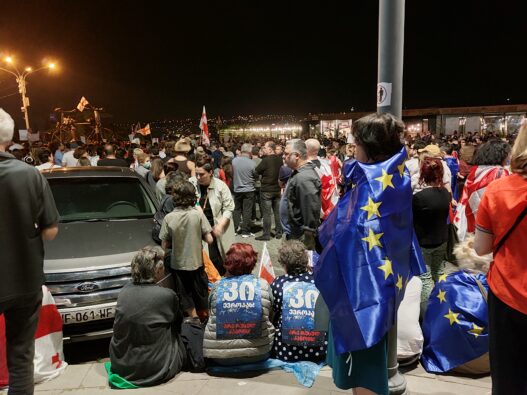
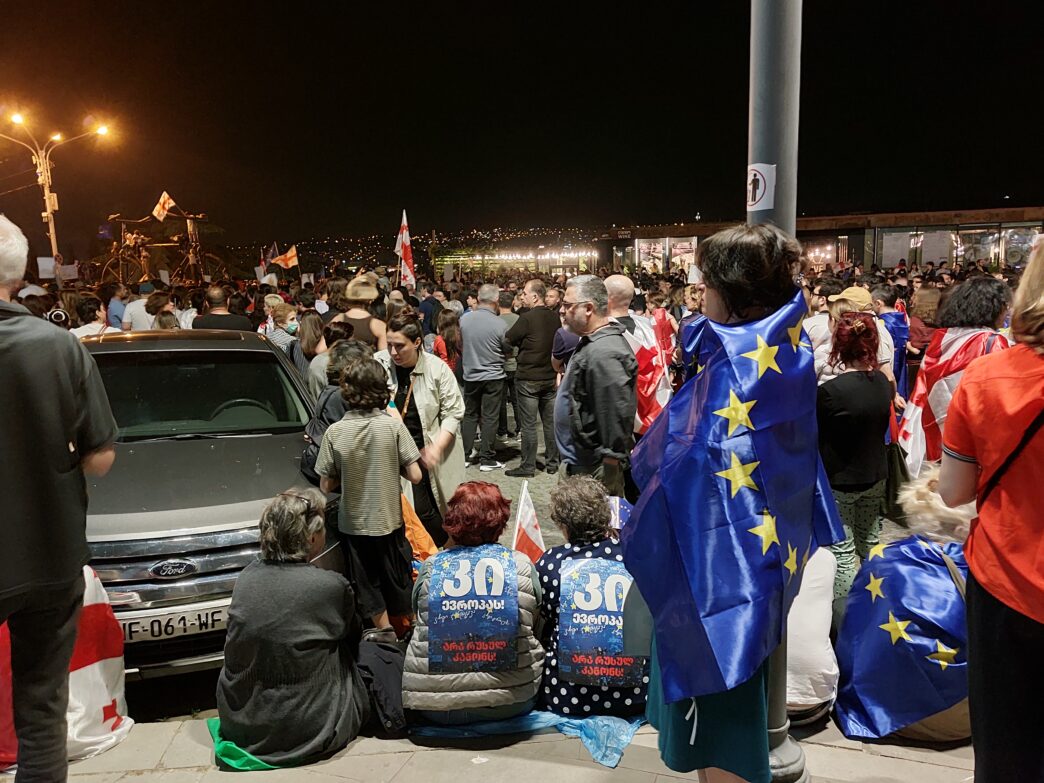
Once a symbol of post-Soviet democratisation, Georgia now embodies its most striking paradox. Since early 2023, the country has been shaken by recurrent protests against the government, whose pro-Russian turn appears more evident than ever.
On one side, Georgian citizens demonstrate a clear aspiration to integrate into Europe — a sentiment reinforced after the country obtained EU candidate status in 2023; on the other, their elected government leans ever closer to Moscow. The government’s public announcement in November 2024 that it would reconsider Georgia’s accession to the European Union, while not a formal suspension, it market the most explicit turn away from Brussels since candidate status was granted.
The question is thus to assess the extent to which Russia contributes to the weakening of Georgia’s political landscape—and what this reveals about the limits of Europe’s influence.
From Protest to Policy: The Making of a Crisis
Russia’s influence over Georgia’s political life is multidimensional, encompassing security, economic, and political dimensions. Militarily, the threat remains tangible: Russia invaded Georgia in 2008 and still occupies 20 percent of its territory, maintaining bases in Abkhazia and Tskhinvali. The war in Ukraine confirmed Moscow’s readiness to use force where it can. 
Beyond the military sphere, Russia has invested heavily in disinformation and hybrid warfare, projecting influence within Georgia’s political class and public discourse.
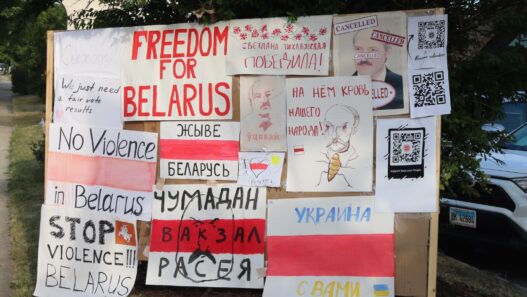
In March 2023, the first draft of the “foreign agents” bill triggered mass demonstrations and was eventually withdrawn. The law was not imposed by Moscow, yet it mirrored its 2012 legislation targeting NGOs and journalists. When a new draft resurfaced in March 2024, it was passed without public consultation and while overriding President Salome Zourabichvili’s veto. The ruling Georgian Dream party justified it as a defence of sovereignty from “foreign interference”, while opposition groups denounced it as a tool to silence civil society.
Brussels responded swiftly. Josep Borrell and Olivér Várhelyi warned that the law “does not align with EU norms and values” and would “negatively affect Georgia’s progress toward membership.” Yet Georgian Dream pressed ahead, announcing in November 2024 the suspension of Georgia’s EU integration process. This episode revealed how Russia’s influence can threaten state stability—not by directly constraining choices, but by shaping how political actors think about their options.
The Russian Variable: Threat, Pretext, and Political Resource
If Russia’s influence in Georgia seems self-evident, it operates on three interlocking levels: a threat, a pretext, and a political resource.
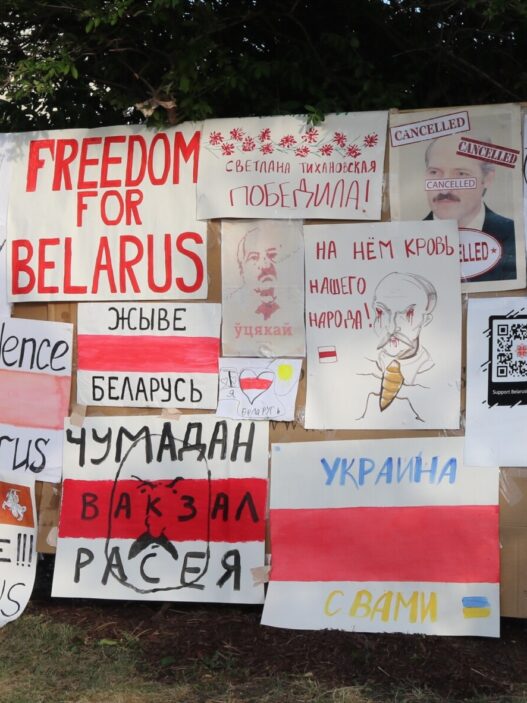
It first manifests as a threat that fuels opposition mobilisation. The invasion of Ukraine indeed reawakened Georgian fears of dependency and occupation. For many, protesting against the “foreign agents” law became a symbolic defence of sovereignty against Russia itself. In this sense, anti-government protests doubled as anti-Russian demonstrations by proxy. Social media amplified this dynamic, transforming the “anti-Russian” label into a civic identity among students, journalists, and NGOs.
Paradoxically, references to Russia also serve as a pretext for the Georgian government to tighten control. By invoking the threat of “foreign interference,” the Georgian Dream leadership frames its critics as part of a so-called “Global War Party” intent on dragging the country into conflict. This narrative justifies crackdowns on NGOs and independent media while maintaining the appearance of democratic norms. Labelling opponents as foreign agents or anti-nationalists reflects classic diversionary threat tactics—using external enemies to deflect attention from internal problems.
From this perspective, Russia’s indirect influence becomes a political resource that polarises and consolidates power. Each crisis reactivates the binary opposition between “us” and “them”. In this framework, one’s stance toward Russia determines political belonging and defines the boundaries of dissent. Polarisation becomes self-perpetuating—an instrument of power more effective than any external pressure.
The 2024 Mobilisation — Demonstrating the Structural Power of the Russian Factor
These dynamics—threat, pretext, and political resources—set the stage for the 2024 mobilisation, which reveals how such structural conditions play out in practice.
After the law’s reintroduction in April 2024, demonstrations filled Tbilisi’s streets. Yet by May, despite weeks of mobilization, parliament overrode President Zurabishvili’s veto and adopted the bill. The law’s success and the protest’s failure expose how the Russian factor works not through command, but through conditions: institutional asymmetry, civic fragility, and fear.
The 2024 protests indeed lacked organisational depth. They were spontaneous, urban, and digitally coordinated, driven primarily by students and young professionals. Without structured leadership, stable funding, or nationwide networks, the movement is not yet able to convert enthusiasm into endurance.
This scarcity of organisational resources was not accidental. It stemmed from years of state strategy designed to stigmatise and financially isolate NGOs—precisely the actors that could have provided coordination. The connective tissue of civil society is thus still fragile and lacks the political opportunities to consolidate itself.
Indeed, the political landscape was—and remains—equally unfavourable. The Georgian Dream party held a firm parliamentary majority and faced a fragmented opposition. International actors—including the EU and the United States—offered rhetorical condemnation but little tangible support. The absence of concrete consequences eroded public confidence in Western backing.
This raised the cost of dissent as repression intensified. Protesters faced surveillance, intimidation, and career repercussions. Meanwhile, the potential rewards—defending an uncertain EU candidacy—seemed distant and, since November 2024, largely withdrawn. The protest movement entered a rationality trap: individually, each citizen’s caution was logical; collectively, it ensured failure.
The European Dilemma
For the European Union, Georgia’s drift poses a twofold challenge: geopolitical and normative.
Geopolitically, the case exposes the limits of the EU’s soft power in its eastern neighbourhood. Despite overwhelming popular support for EU membership, the Union’s influence is now filtered through domestic elites, who use the language of sovereignty as a pretext against compliance with the EU’s norms. The EU’s cautious diplomacy—statements rather than sanctions—has failed to deter democratic regression.
Normatively, Georgia’s crisis reveals a deeper European problem. If a government can suspend accession talks, adopt Russian-style laws, and still claim democratic legitimacy, what remains of the EU’s moral leverage? The Georgian Dream’s rhetoric of “Europeanism on our terms” marks a shift from integration as transformation to integration as negotiation—a dynamic the EU has yet to confront.
Europe’s instruments were designed to reward compliance with its institutional setting. However, supporting democracy in Georgia now requires moving beyond technical conditionality — the mere fulfilment of procedural criteria — toward genuine political engagement: defending civic space, empowering independent media, and providing credible incentives for reform. Otherwise, Europe risks witnessing the slow normalisation of the Russian model on its very doorstep.
The Russian Factor as a Mirror
Georgia’s instability does not stem solely from Moscow’s manipulations. Russia weakens Georgia not through coercion, but by providing the political logic that domestic elites can instrumentalise—exposing the limits of EU influence when democracy is not institutionally defended.
Russia’s contribution to the weakening of Georgia’s political landscape is therefore structural rather than direct. It reshapes incentives, narratives, and the architecture of power itself. It erodes democratic capacity—the quiet substitution of participation with control.
For Europe, the lesson is essential, as what is happening in Georgia also tells us about the types of threats that polarise political life and generate social unrest. It shows how illiberalism spreads not when Russia advances, but when democracy is unequally supported.