


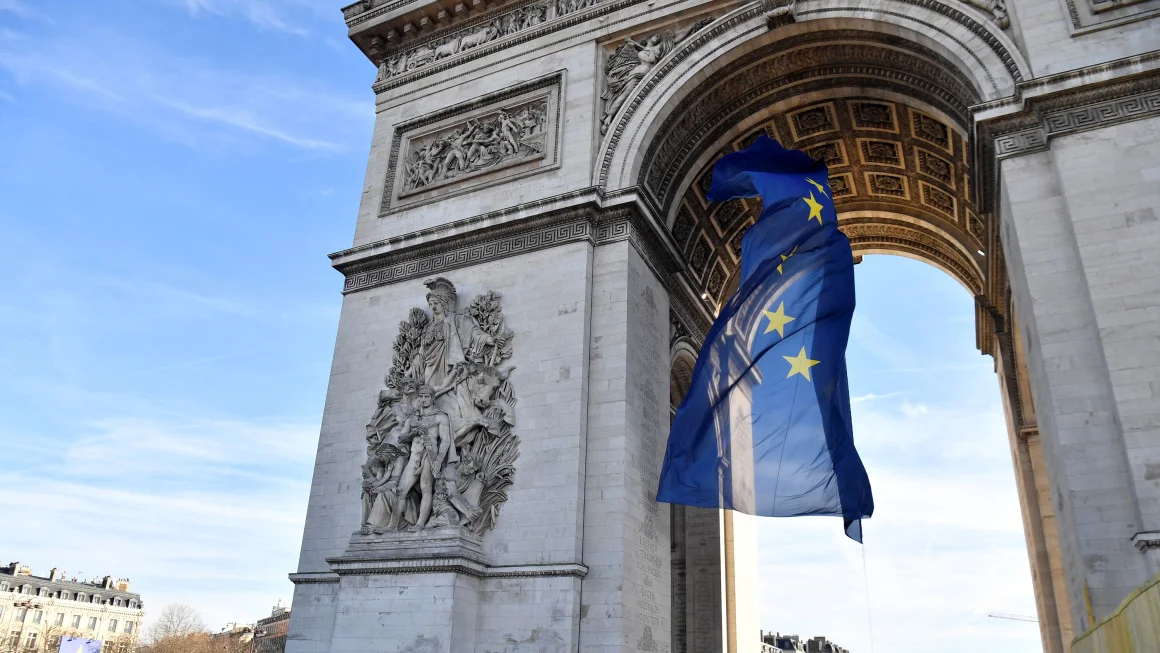

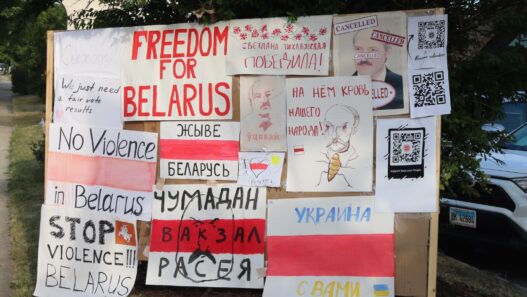




Arriving in Chișinău ahead of Moldova’s parliamentary election, I was struck once again by the sight of EU flags fluttering from government buildings, cafés, even small shops. It is a symbol of aspiration rarely seen so prominently even within the Union itself. This time, the capital felt charged. Campaign volunteers lined the streets, flyers changed hands at every corner, and there was a quiet sense that this vote would define Moldova’s future direction.
On election day, I was stationed in Comrat, in the autonomous region of Gagauzia, often described as more Russia-leaning. Driving to our first polling station, the early morning air felt charged not only with local political tension but with a broader awareness that Moldova’s democratic process was being watched closely at home and abroad.
Yet what also struck me was how closely this local act of voting was connected to a wider European ritual. The presence of observers from across the continent quietly ensures that democratic standards are upheld. In this piece, I explore what election observation means in Europe today, how it developed, what it seeks to achieve, and why it remains an essential, if often overlooked, pillar of democratic trust.
The Evolution of Election Observation in Europe
Election observation is one of democracy’s quiet but essential instruments, the systematic monitoring of electoral processes to assess whether they meet international standards of transparency, fairness, and credibility. Observers do not interfere in or certify election results; they record, analyse, and report on how elections are conducted — from campaign conditions and media access to voting, counting, and the resolution of complaints. 
In Europe, the practice is primarily led by institutions such as the OSCE Office for Democratic Institutions and Human Rights (ODIHR), the European Union, and the Council of Europe, often working alongside regional networks and domestic observer groups. These missions deploy both long-term analysts and short-term observers, combining technical assessment with political context to provide an independent evaluation of an election’s overall integrity.
The modern form of election observation emerged in the early 1990s, following the end of the Cold War. As post-communist states transitioned toward democracy, international observation became a way to accompany and assess those fragile processes. In Central and Eastern Europe, the Balkans, and the South Caucasus, observers provided transparency and confidence for some of the first competitive elections in the region for decades. The OSCE/ODIHR, created from the 1990 Charter of Paris for a New Europe, quickly became the leading institution setting standards for impartial, professional observation.
Over time, the practice has expanded and matured. What began as a form of democracy promotion directed toward newly independent or developing states now increasingly takes place within Europe itself. Observation missions have assessed elections not only in countries such as Moldova, Ukraine, and Georgia, but also in EU member states, including Hungary and Poland, as concerns about media pluralism, state resources, and public trust have spread closer to home.
Moldova’s elections have been observed regularly since its independence, serving both as a test of its democratic resilience and as a symbol of its European aspirations. Each mission, including the one I joined, forms part of a broader continental effort to ensure that democracy in Europe is not assumed, but continually examined and renewed.
In the Field: Observing in Gagauzia
The observation mission I joined in Moldova was organised by Silba, a Danish non-governmental organisation promoting democracy and civic participation, with support from the Danish Youth Council (DUF). Silba deployed several teams of international short-term observers across the country. Our two-person team, accompanied by a local driver and interpreter, was assigned to Comrat, the administrative centre of the autonomous region of Gagauzia in southern Moldova. We spent a week in Moldova, including election day, attending preparatory briefings, visiting polling stations, and observing both opening and closing procedures.
In many ways, the process was a model of calm professionalism. Polling officials often local teachers or civil servants followed procedures carefully, checking voter lists, sealing ballot boxes, and completing protocols that had clearly been rehearsed. At several stations, staff greeted us warmly and were proud to demonstrate their work, explaining each step without being asked. Others were more reserved, polite, but focused on their duties.
The atmosphere in Comrat reflected a mix of routine and attentiveness. Many voters arrived early, and the process generally unfolded in an orderly manner. Moldova’s elections are traditionally observed by international and domestic missions, as their conduct is seen as an indicator of democratic practice and institutional trust. Observation in this context is not only a technical exercise but also an opportunity to support transparency and confidence in the electoral process.
What stood out most was the professionalism of local staff and the consistency of procedures across polling stations. Observation helped make visible the everyday work that underpins credible elections. In Moldova, as elsewhere in Europe, the act of voting may seem routine, but the commitment to openness and accuracy remains essential to public trust in democratic institutions.
The Power and Limits of Observation
Election observation remains one of the most practical yet understated tools for protecting democratic trust. Its presence builds confidence among voters, reassures candidates that their grievances will be heard, and pressures authorities to follow due process. Even when its impact is subtle, it supports electoral reform and deters manipulation simply by existing as an impartial witness. The knowledge that outsiders are watching and will issue a public assessment changes behaviour in ways that laws alone often cannot.
Yet observation’s power is also its limitation. Observers cannot fix polarization, corruption, or unequal media access. They can only document them. Their mandate ends at visibility, not enforcement. In that sense, observation is both diagnostic and symbolic; it signals commitment to democratic standards even as it reveals how fragile those standards can be. The act of observing is not about control but about accountability, a reminder that democracy depends as much on being seen as on being practiced.
One of the most revealing insights from recent missions is that manipulation rarely happens on election day itself. The real contest unfolds long before voters reach the ballot box in the media environment, in the use of state resources, and increasingly online, where disinformation shapes perceptions weeks or months in advance. When irregularities do appear during voting, they often signal panic, not power. A desperate move when quieter tools of influence have failed. The calm of election day can therefore be misleading, as the integrity of a vote is determined by everything that precedes it.
This perspective is especially relevant in Europe today. Election observation is no longer confined to fragile democracies or post-conflict societies. It now extends to the European Union’s own members, where concerns about electoral fairness and state capture have emerged in places such as Hungary and Poland. Europe has, in effect, turned the lens inward. The continent that once exported democratic monitoring now subjects itself to the same scrutiny, a form of democratic self-awareness that acknowledges progress and vulnerability in equal measure.
Observation thus often faces criticism for being rather symbolic than truly effective. Some dismiss it as symbolic, biased, or overly diplomatic; others fault it for failing to produce consequences when standards are clearly breached. But its credibility depends precisely on that restraint. The legitimacy of observation comes from impartial reporting, not intervention. From Moldova, what lingers most is that quiet, deliberate presence of observers standing in classrooms, town halls, and village schools, watching democracy in motion. Even quietly, their presence helped uphold fairness by ensuring each step unfolded openly.
The Quiet Infrastructure of Trust
Election observation began as a way to accompany transitions to democracy after the Cold War. Today, it plays a quieter but equally important role inside Europe itself, reminding established democracies that transparency and accountability are never fully achieved but must be maintained through continual attention.
In Moldova, that principle was visible in the simplest of acts: a polling official carefully sealing a ballot box, a voter checking their name on a list, and observers noting each step. These moments may seem ordinary, yet they represent the quiet infrastructure that keeps elections credible. They show that trust in democracy is built not through grand declarations, but through patient, verifiable procedures carried out in public view.
Across Europe, observation has become part of this everyday democratic maintenance. It builds confidence where institutions are strong and offers reassurance where they are still tested. It cannot repair polarization or prevent disinformation, but it can make these challenges visible, and visibility itself is a form of protection.