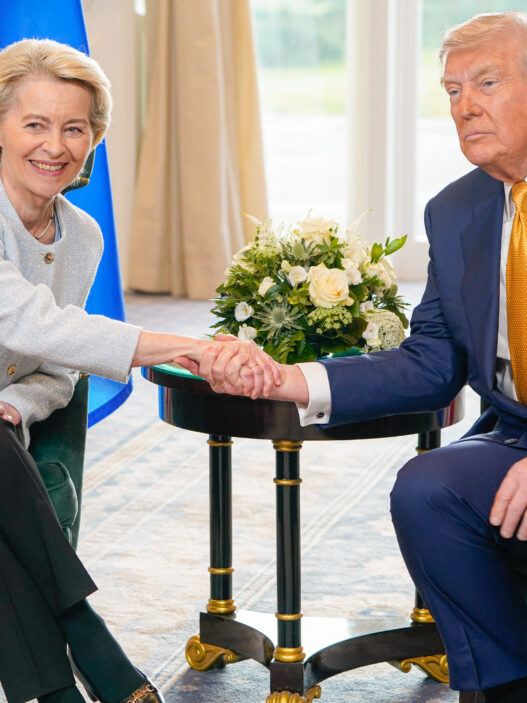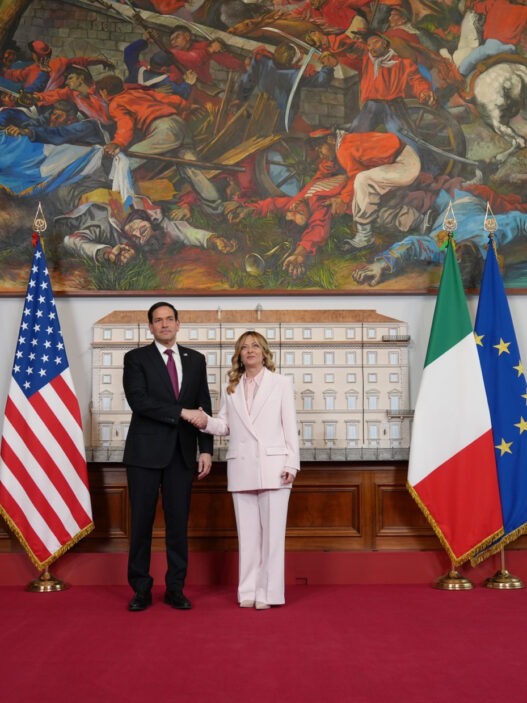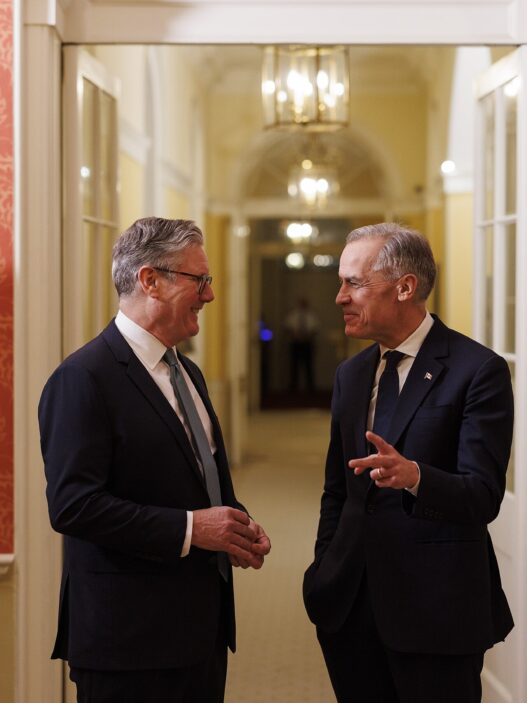












The Atlantic Ocean has never felt wider, as the Greenland crisis has further pulled its two shores apart. Borrowing the metaphor that emerged during an interview with Professor Nathalie Tocci, former director of Istituto Affari Internazionali (IAI), the Europeans went from playing second fiddle to the United States (US) to “no fiddle at all”. Washington not only seems to perceive the European Union (EU) as negligible, but also as burdensome. As US President Donald Trump stated, “the European Union was formed in order to screw the United States”.
Although tensions seem to have cooled off, the Greenland dossier is only the latest chapter of an overall unfriendly US posture towards European countries and the crucial institutions of their integration: the EU and the North Atlantic Treaty Organisation (NATO). At the moment, transatlantic relations have entered a period of frost, as reflected in the widespread coldness shown by Europeans towards the 2026 “Epic Fury” operation in Iran.
To protect itself, the EU needs to reduce its dependency on the US. In a post-rules-based international order, defence partnerships, energy supplies, market access, supply chains, financial and digital services are weaponised into geopolitical leverage. Naturally, autonomy is not something that can be achieved overnight, but the EU must start to lay the groundwork to gradually achieve greater resilience on the global stage.
This article will first analyse the US unsympathetic attitude towards European integration. It will then turn its attention to the possible interpretations of US assertiveness, seeking to shed light on the White House’s overall aim. Finally, it will argue for the necessity of geopolitical autonomy, comparing the current Greenland predicament with the 1956 Suez crisis, and maintain that two factors will be crucial: external diversification and deeper internal integration. 
Europe through American eyes
American intolerance towards European integration has never been as vocal as it is now. The “America First” approach, paired with the economic interests of the biggest US companies, brought issues such as NATO burden-sharing, economic competition, and the EU’s normative barriers to centre stage. For instance, after the social media platform X was sanctioned, its owner and former head of the Department of Government Efficiency (DOGE), Elon Musk, called for the abolition of the EU.
Yet the overall coldness towards European countries is not entirely new. In the post-World War II era, the bottom line has always been the same: the US pays for continental defence through NATO, while European countries thrive through their economic integration, damaging American companies. Although in different terms and in a radically different context, this issue was already raised in the early 1960s by US President Kennedy. During a National Security Council meeting, he argued that “we cannot continue to pay for the military protection of Europe while the NATO states are not paying their fair share and living off the fat of the land… the Europeans will not do anything for us simply because we have in the past helped them”.
While this reveals a certain continuity in US foreign policy, the current resentment towards European integration has gone beyond any previous mistrust. This is reflected in academic and political debates over NATO, where the expression “burden-sharing” has been gradually replaced by the more assertive “burden-shifting”.
In this context, no weight is accorded to the fact that the collective defence mechanism enshrined in Article 5 of the Atlantic Treaty has only been triggered once, in the aftermath of the 9/11 terrorist attacks. This led to the creation of the International Security Assistance Force (ISAF) mission in Afghanistan, which constitutes NATO’s “most challenging mission to date.” Notwithstanding the more than a thousand non-US service members killed in the conflict, President Trump dismissed the contribution of allied troops, claiming they “stayed a little off the frontlines.”
This evident lack of mutual recognition and courtesy has become a defining feature of current transatlantic relations. Despite European efforts to accommodate US demands in the framework of NATO and the EU, from increased defence expenditure to deregulation and asymmetric tariffs, relations have not improved. On the contrary, a reportedly private version of the 2025 US National Security Strategy (NSS) allegedly suggested closer cooperation with some EU Member States to distance them from the EU. This would only reinforce an already general and manifest pressure on European cohesion, which constitutes the precondition for European autonomy.
The logic of American assertiveness
What do the claims over Greenland reveal about the American long-term objectives in foreign policy? Professor Tocci has suggested that the American administration would be pursuing a sort of “imperial collusion,” whereby the US interprets itself “as the first of the empires and recognises for other empires (Russia, and partly China as well) a legitimate sphere of their own.” Adopting this logic, Europe would be “on the menu”, and Greenland would fall into the American sphere of influence.
The island is of strategic importance to the US in terms of defence, resources, and Arctic trade routes, but it is also another stress test for European cohesion. The pressure on Denmark’s territorial integrity forces all the Member States to ask themselves how much they are willing to risk supporting each other. Furthermore, the US would corner the EU on shaky grounds, since Greenland voted not to be part of the EU, and the Danish sovereignty over the island can be framed as a colonial legacy.
The threat of additional tariffs on those countries that oppose US claims over Greenland strikes right into Europe’s soft underbelly, and might have the final aim of supporting EU division. After all, a divided Europe is easier to divide, leaving the EU no choice but to increase its internal integration and avoid dependency on external powers, including the US.
Yet, something in this “imperial collusion” does not quite add up. Russia’s supposed sphere of influence remains ill-defined, and American interests in Asia show little signs of retreat. From the bombing of Iran in 2025 and 2026 to the reinforcement of economic ties with Central Asian countries following last November’s C5+1 summit, US engagement remains extensive.
Going back to Russia, the Kremlin has let down its historical allies in the Caucasus region and in the Middle East. Christian-Orthodox Armenia lost the Nagorno-Karabakh region to Azerbaijan, and former Syrian dictator Bashar al-Assad had to flee to Moscow. Notably, the provisional peace agreement between Yerevan and Baku was signed in the presence of President Trump, while Ahmed al-Sharaa became the first Syrian president to ever enter the Oval Office.
Consequently, rather than an “imperial collusion,” the “America First” approach in foreign policy translates to a recalibration of the American informal empire. In this perspective, the overall aim is to minimise the cost of maintenance and maximise the extraction of privileges, as demonstrated by the US – Ukraine Minerals Deal. Accordingly, unilateral tariffs are preferred to free trade, while the boots on the ground are replaced by targeted operations, such as the capture of Nicolás Maduro or the B-2 raids in the so-called “twelve-day war”.
Instead of capitalising on its soft power to attract countries by delivering growth and stability, the US now demands control over other international actors’ foreign policy, such as Panama’s and Greenland’s. Meanwhile, European allies are pressured to deregulate, raise military spending, and accept unfavourable trade terms. In sum, whether the US is pursuing an imperial collusion strategy or seeking rent-extraction, relying on the White House constitutes a structural risk.
Different interests require independence
History offers a revealing parallel. In 1956, the Suez Crisis brought Washington and Moscow on the same side. After its nationalisation by Egyptian President Abdel Nasser, France and the UK tried to regain control of the Suez Canal through a military action. The Soviet Union naturally opposed this intervention, but what was quite unexpected was that the US also condemned the initiative of London and Paris. Without the support of their patron, France and the UK eventually had to back off. This historical precedent reveals the risk of overreliance on the US, which pursues its own political agenda.
Seventy years later, the Europeans realise once again that their interests and those of the White House do not necessarily rhyme. Yet, the Greenland crisis marks a significant difference from the Suez one. While in 1956 the US avoided a possible large-scale conflict and refused to support the perpetuation of colonial logics, today the US turns against its allies to impose its own imperialism at their expense. Whether the US is seeking some sort of imperial collusion or remodelling the forms and methods of its own sphere of influence, the EU needs to reduce its dependency on the US. In a weaponized world economy, trade relations cannot be solely interpreted through the lens of economic benefits anymore, as they have become powerful means of coercion.
American aggressiveness could not have come at a worse time, as Europe is still trying to recalibrate its position after cutting most ties with the Russian economy, especially in terms of energy imports. While leaning towards the US appeared a reasonable choice, the EU now risks having jumped out of the frying pan into the fire. Nothing in the Trump administration’s behaviour can guarantee that no economically unfriendly measures will be taken after the signing of the 2025 US – EU Trade Deal, which already contained asymmetrical tariffs, commitments towards deregulation, and the promise of European investments in the US economy for hundreds of billions of US dollars in fields like energy, AI, and military and defence equipment.
Diversification is key. In a fast-moving global scenario, Europe should not depend on one single actor. Notably, it should not trade the past reliance on Russian fossil fuels for a new dependency on the US, which risks being the case with the steep increase in American LNG imports. As far as trade is concerned, diversifying market access is crucial. Although with different results, the recent boost in negotiations towards Free Trade Agreements with Mercosur, India, and Australia goes in the right direction, and represents a serious response to Washington’s increasingly transactional foreign policy.
Conclusion
The US has become an unpredictable and unreliable partner for several evident reasons. While everyone wishes for a thaw in the iced transatlantic relations, it takes two to tango. In the meantime, the EU needs to take geopolitical leverage away from the White House, reducing its overreliance on the US across different domains: energy, technology, finance, and defence.
In order to achieve this ambitious goal, a long-term strategy needs to be launched. The recent EU activism in diversifying economic partnerships is welcomed, but deepening European integration is equally vital.
In the wake of the 1956 Suez crisis, the founding six countries realised that they needed to strengthen their cooperation. The following year, the Treaties of Rome were signed, giving birth to the European Economic Community. Seventy years later, the Greenland crisis may prompt a similar response. If the US is determined to play solo, the EU must learn to play its own tune.