











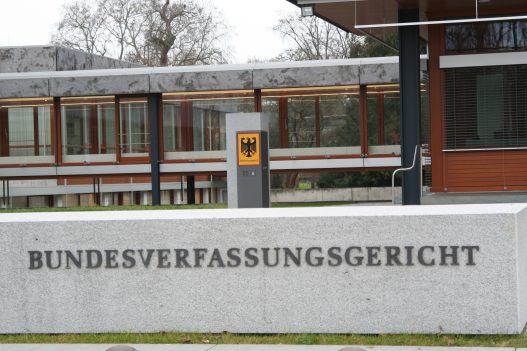
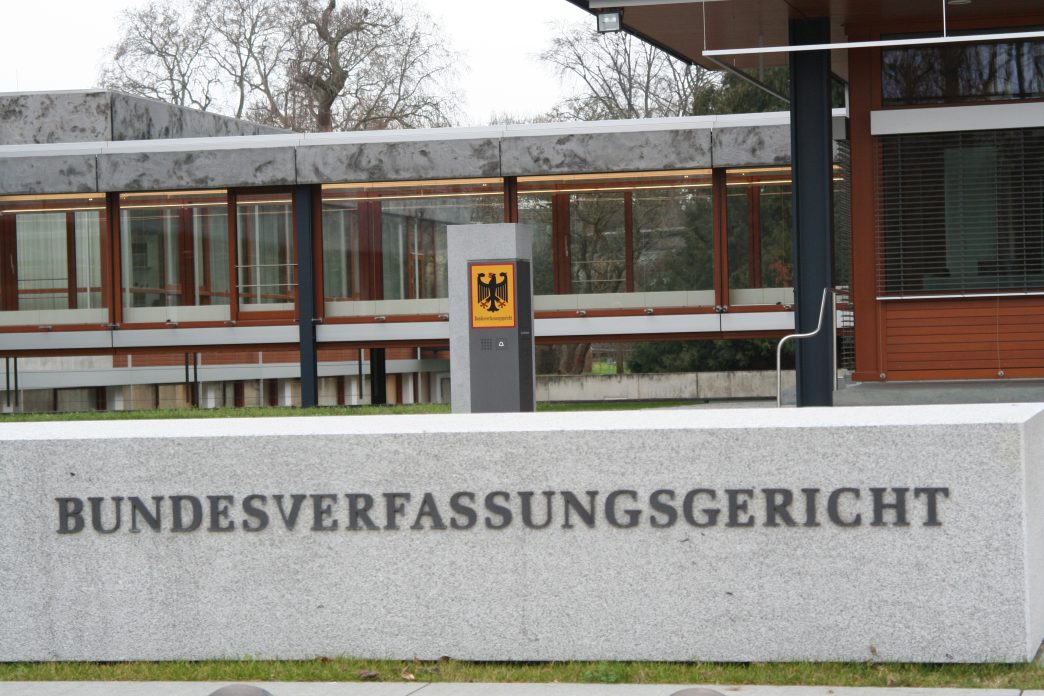
On July 11, the German parliament failed to reach consensus on appointing three new judges to the country’s Constitutional Court. A usually seamless, behind-closed-doors process soon became subject of intense media discourse, centered around a female candidate’s views on abortion and mandatory vaccinations. The culture wars appear to have finally arrived in the traditionally rather dry landscape of German jurisprudence. What many see as a miscalculation of parliamentary majorities may well be the result of an alt-right campaign–not least to the benefit of a political entrepreneur with thinly-veiled admiration for the emerging political methodologies across the Atlantic.
The Facts: Investigative reporting by journalists and researchers has revealed what many describe as a coordinated campaign targeting Frauke Brosius-Gersdorf, details of which can be found here. Leading up to the election, right-wing and alt-right media outlets published a series of articles portraying her as a left-wing extremist. Conservative and right-wing opinion makers identified abortion as the issue with the highest mobilization potential, and her scientific inquiry into the constitutional dilemma between protecting unborn life and protecting the lives of women who carry unborn life was transformed into allegations such as ‘Brosius-Gersdorf supports abortion at 9 months’(https://x.com/jreichelt/status/1945208968642752852). These claims do not reflect her actual position, which aligns closely with mainstream German legal thought over the past three decades.
The Backdrop: A political player that was simultaneously the subject of extensive media coverage (because of alleged misconduct regarding a 6-billion-euro mask deal in the early days of the pandemic) was Jens Spahn, group leader of the conservative faction in the German parliament. His person is crucial in the election fiasco for two reasons:
First, as head of the faction, he is the chief whip, meaning Spahn is responsible for ensuring his faction colleagues toe the line of the CDU/CSU/SPD coalition. He translates political compromise reached between the leaders of the government into parliamentary votes within his ranks. The three candidates were the result of such a political compromise, and the election was meant to be rather symbolic. Given that the vote failed despite its largely symbolic nature, many observers hold Spahn partly accountable—whether due to negligence, political maneuvering, or simply accidentally. 
This brings us to reason number two: Spahn represents a younger generation of conservatives and is known for his political ambitions and populist tendencies. He repeatedly has called for a new way of engaging the far-right, an effort that some have claimed would lead to their normalization and eventually pave the way for political cooperation. Notably, Spahn is one of the few mainstream German politicians with apparent ties to the U.S. alt-right. He expressed alignment with Donald Trump’s political platform during the 2024 Republican National Convention in Milwaukee, noting “many commonalities”. More importantly, he is reportedly a close associate of German billionaire investor and Trump-family-friend Christian Angermayer, while he has also had contact with, and reportedly admires, alt-right kingmaker Peter Thiel.
It is especially the latter that has raised eyebrows in the Federal Republic, particularly since the public broadcaster DLF’s immensely successful series on billionaire-turned-political puppet master Thiel. Thiel is known as an early supporter of Trump and as the person without whom J.D. Vance’s vice presidency would not have been possible. He is also a devout Christian and openly gay. His ideology, an amalgamation of libertarian politics, an unleashing of technological progress, and fundamentalist Christian belief, underpins his strategic political investments and appears to be in a somewhat reciprocal relationship with the evangelical movement which, and here we close the circle, first and foremost campaigns against abortion rights, not just in the United States but increasingly global. One export is the ‘March for Life’, in Germany hosted and supported by an array of organizations under the umbrella of the Bundesverband Lebensrecht (Federal Association for the Right to Life), some of which now participated heavily in the campaign against Brosius-Gersdorf – and which receive material and intellectual support from U.S.-American evangelicals.
What emerges is a convergence of populist conservatism, alt-right ideology and evangelical talking points, a conflation that is inspired if not maintained by a transatlantic network with implicit but far-reaching political ambitions. For now, the liberal and democratic fundamental order of the Federal Republic may withstand the pressures emanating from these strategies, but the éclat surrounding the elections of July 11 shows that judicial institutions are only thinly protected from the ideological reach of well-connected political entrepreneurs with illiberal missions. It is going to take the combined efforts of a liberal political establishment, civil society and independent media to withstand being force-fed the polemical language of imported culture wars. The direct aftermath of July 11, dominated by talk shows and editorials debating abortion rights and the subsequent dissection, and therefore repetition, of false claims vis-à-vis Brosius-Gersdorf, offers limited reassurance. Rather than defusing imported culture war narratives, much of the media inadvertently amplified them. Unless liberal and democratic forces can more effectively recognize and reject the poisoned bait of right-wing populist networks, further erosion of institutional neutrality and political culture may follow.
Political entrepreneurs and tumblers like Spahn, whose involvement in the pandemic-era mask procurement scandal has largely faded from the public eye, have much to gain and little to lose in allying themselves with these networks. His ambitions are long-term, and his current position in the faction is but a pit stop on his way to a larger role within German politics. Should his strategy bear fruit, the political culture of Germany would face tremendous change, encaptured by thought makers of the alt-right and crippled by an absence of evidentiality as is foreshadowed by U.S. political discourse.
Curiously central to Thiel’s belief is the advent of the Antichrist, a biblical figure that subjugates the world under the guise of benevolence. And where one might expect a mythical image to emerge, or a monstrous overlord, Thiel warns of the European Commission or the United Nations and its agencies as the modern incarnations of the Antichrist. Should this imaginary equally gain traction amongst the ideologues and their political henchmen across the Atlantic, it is not just the foundation of the Federal Republic of Germany that requires reinforcement.