









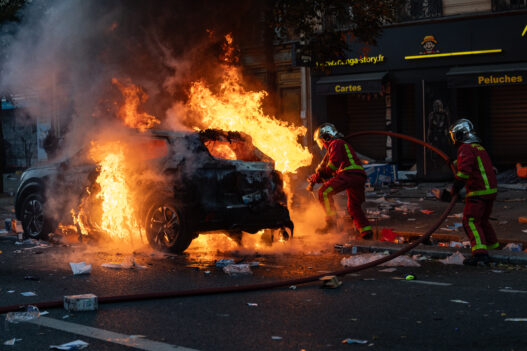
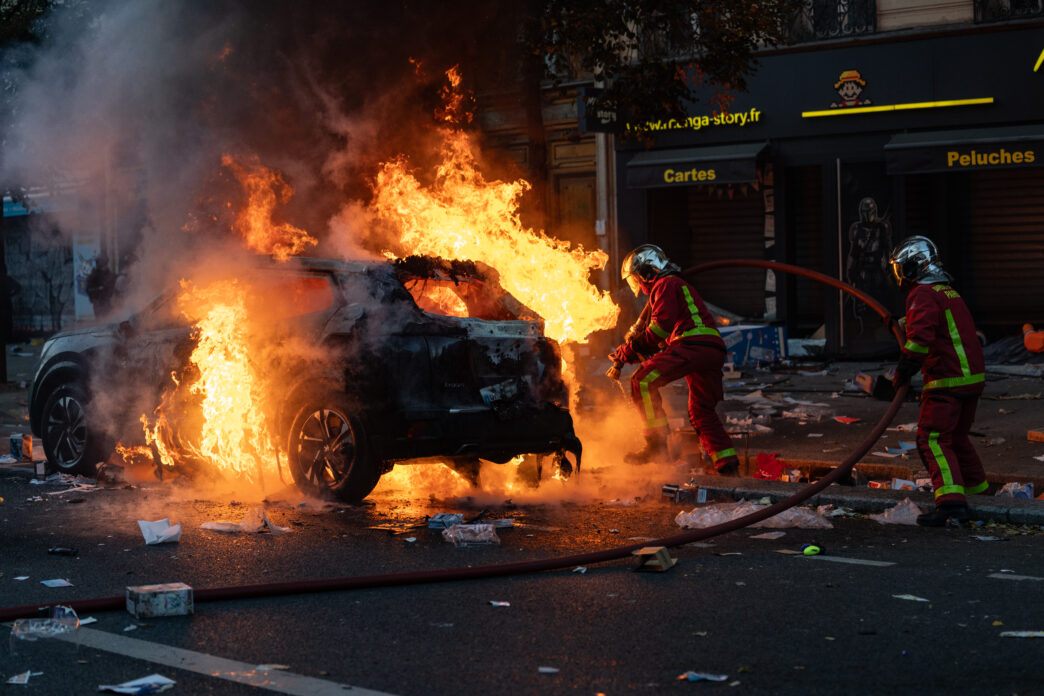
France’s worst unrest in years has spread to Brussels and Milan. The flames are real, but the greater danger is internal: states that cannot integrate, protect and enforce at the same time.
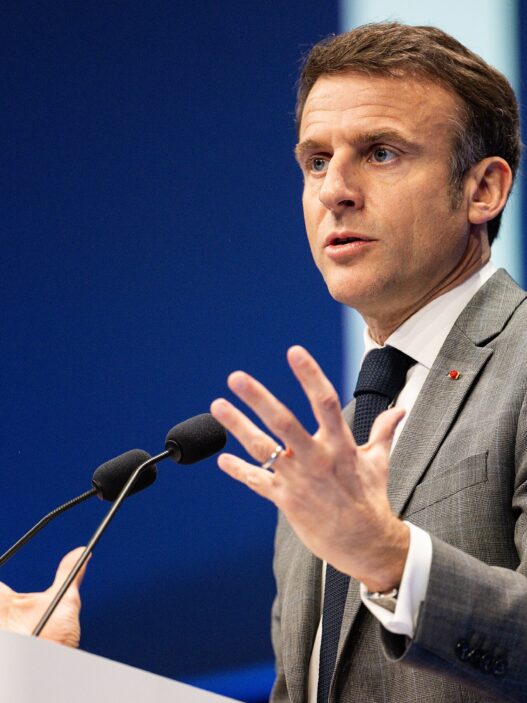
France spent last weekend watching its own streets burn. On 17 October, authorities said about 550,000 people marched against rising living costs and failing schools, while organisers said 800,000. Students led the mobilisation, and most went home peacefully. Others did not. Masked groups looted hundreds of businesses, attacked police and set fire to public buildings from Paris to Marseille. Police arrested more than 2,300 people over the weekend, and more than 500 police officers, gendarmes and firefighters were injured. On Sunday evening, President Emmanuel Macron told the nation that “we all feel anger and shame” and blamed “insurrectionist elements from radical far-left groups, joined by numerous criminals.” The fire crossed borders without becoming one blaze. In Brussels, several hundred mostly young protesters clashed with police and chanted anti-fascist slogans, and in Milan hooded protesters set fires and vandalised shops for a second day.
Three Fires, Not One
The first is political violence. French authorities had warned that ultra-left groups would turn the march into a battlefield. They did. Small, mobile units used half a million peaceful citizens as cover and stretched the police across a dozen cities. Brussels showed the same tactic on a smaller scale. A democracy cannot treat organised violence as protest because its perpetrators claim a progressive cause.
The second is opportunism. Le Monde describes a crowd in layers: students, organised militants, young men from the quartiers populaires, and looters who noticed that the police were elsewhere. A militant with a Molotov cocktail, a teenager chasing adrenaline and a man stealing trainers are not one phenomenon. Nor is there any evidence that “immigrants” as a category lit this fire. Living in a quartier populaire proves nothing about origin, and French authorities have said as much.
The Wiring Nobody Inspected
The third problem is more structural, and easier to discuss badly: integration.
Its relevance to the present unrest is not that migration explains who rioted. It does not. The relevant question is whether European states have been sufficiently successful at integrating large migrant populations into the same labour markets, schools and neighbourhoods as the rest of society.
That matters because disorder does not erupt in a vacuum. In some urban areas, unemployment, educational disadvantage, residential segregation and distrust of public institutions overlap. These conditions do not turn people into rioters, nor do they tell us who committed the violence. But when such gaps persist across generations, they weaken social cohesion and make the state’s job harder long before the first stone is thrown.
France’s own statistics show that in 2025, unemployment stood at 12.4% among immigrants and 11.7% among their descendants, against 6.5% among people without direct migrant ancestry. For immigrants from Africa, it reached 13.8%. The second generation does move closer to the national average, which matters: integration is taking place. But the remaining gaps are still substantial.
Info box
The French statistics office INSEE defines immigrants as people born abroad with foreign nationality at birth and residing in France, and descendants of immigrants as people born in France with at least one immigrant parent. “Quartiers populaires” is an informal term. The official designation, quartiers prioritaires, refers to priority urban-policy areas identified on the basis of concentrations of low-income residents.
Geography reinforces them. The OECD finds migrants in Greater Paris disproportionately concentrated in neighbourhoods with higher unemployment and extensive social housing. Flanders faces a related challenge: school segregation remains high, while among jobseekers born outside the EU, 47.3% are long-term unemployed, compared with 18.4% among those born in Belgium.
None of this proves that migration caused the riots. The point is broader: a state that struggles to integrate parts of its population will also struggle to maintain trust, opportunity and authority in places where social tensions are already concentrated.
Europe has no shortage of integration plans. It has a shortage of integration. A plan is an intention. Integration is when origin gradually stops predicting which school you attend, whether you find work and whether you feel part of the same society.
A Fire-Brigade State
Europe spends much of its energy scanning the horizon for external threats. This weekend’s fires were lit and fed at home. Critics will retort from two sides. The left will say this is inequality and police brutality, and that talking about arson only distracts from it. The right will say this is migration, and that talking about wiring only excuses the arsonists. Both insist on one fire when there are three. Deprivation can explain alienation, but it cannot excuse arson. Discrimination can corrode trust, but it confers no licence to attack police.
Authority is also eroding at a more basic level. In Brussels, violence has increasingly been directed not only at property but at the people representing the state itself. During the 17 October unrest, projectiles were thrown at police, and five officers were injured. After earlier riots on 9 October, seventeen minors were brought before the prosecutor. Prosecutors sought placement in youth institutions for eight of them, but a shortage of places meant that several had to be released. One sixteen-year-old had been found near seven ready-to-use Molotov cocktails and admitted that he intended to take them to the demonstration.
That is not proof that an entire generation has lost respect for the uniform. It shows a state struggling to make authority credible, from the first police intervention to the final judicial response. Arrest without timely consequence weakens deterrence. Punishment without guidance merely postpones the problem.
Belgian youth judges have made the same point from both directions. Antwerp youth magistrates have warned of increasing aggression towards emergency workers and a broader erosion of norms among some young offenders. At the same time, youth judge Herman Dams has stressed that sanctions work only when they are combined with supervision and guidance. In Antwerp’s electronic-monitoring programme for minors, Dams described guidance as at least half of what makes the measure work.
The lesson is uncomfortable but straightforward. A serious response to youth violence cannot be reduced to heavier policing. It requires parents who set boundaries, schools that keep young people connected, enough places in youth institutions, effective supervision and justice that responds quickly when those boundaries are crossed. Prevention without consequence becomes permissiveness. Consequence without reintegration becomes a revolving door.
You cannot ask citizens to trust a state that arrives only for the fire. You cannot ask them to respect its authority if it shows up after the town hall has burned. You cannot ask newcomers to join institutions that never quite opened for their children. Max Weber defined the state by its monopoly on legitimate force. Europe has run it like a fire brigade: heroic at the scene, absent at the building inspection.
The political temptation is to isolate each incident: firearms as a weapons problem, riots as a public-order problem, youth offending as a justice problem and segregation as an integration problem. But the weakness lies precisely in treating them separately.
Why This Matters for Europe
The riots do not prove how Europeans will vote. They do raise the price of failing to answer. France was already polarised before 17 October. A poll conducted between 5 and 8 October put Marine Le Pen at 35–37% in first-round scenarios, with Jean-Luc Mélenchon reaching the second round in every configuration tested. Germany’s state elections last month showed the same squeeze from both flanks: the AfD won 38.2 percent in Mecklenburg-Western Pomerania and the Left won Berlin.
Burning town halls hand such parties their simplest argument. They need not prove that migration lit every fire. They only need to persuade voters that governments lost control first of the borders, then of integration, and now of the streets. The radical left will tell the same story with different villains. Mainstream parties cannot answer with a firewall alone. A firewall can keep a party out of government. It cannot make voters trust the government that is left.
What to Watch Next
Macron has promised “full transparency” over the security response and asked Interior Minister Laurent Nuñez to draw lessons from possible failures in intelligence and anticipation. He has also asked the government to convene students, teachers, trade unions, lawmakers and business representatives to develop “concrete proposals” in response to the grievances that triggered the mobilisation.
That addresses two immediate challenges: restoring order and responding to the original anger over schools, purchasing power and public services. It does not yet resolve the third problem identified here: whether governments can reach the neighbourhoods where exclusion, weak labour-market integration and segregation have become persistent rather than temporary.
The immediate French test is therefore twofold. Authorities must isolate violent groups without turning hundreds of thousands of peaceful demonstrators into a security problem. At the same time, the government must determine whether another round of consultation produces measurable change or merely another set of programmes.
Belgium offers a parallel test. Defence Minister Theo Francken and Interior Minister Bernard Quintin are discussing a new mobile brigade, trained with Defence support and placed under Interior, which Francken describes as a form of “gendarmerie 2.0”. The proposal remains under discussion, but it reflects the same concern: whether existing police structures can absorb repeated and simultaneous outbreaks of serious disorder.
Yet increasing coercive capacity solves only part of the problem. France can deploy more police. Belgium can create more youth-detention places or additional reserve capacity. Governments can announce new integration programmes. None of those measures, taken separately, repairs the chain from family and school, through employment and integration, to policing, prosecution and punishment.
The next phase will therefore show whether European governments respond to the fires individually, or finally inspect the wiring that connects them.
Sources
- France 24 – Macron says ‘nothing justifies’ violence after French protests lead to 2,300 arrests. 18 October 2026.
- Associated Press – France’s Macron vows to hold accountable those who ‘sought to bring down the Republic’. 18 October 2026.
- CNN – Buildings torched and over 1,000 detained after half a million protesters sweep France. 17 October 2026.
- CBS News / AP – French police arrest more than 1,800 people after violent protests erupt across country. 18 October 2026.
- Reuters – Protesters clash with police in Brussels. 17 October 2026.
- Reuters – Milan police clash with protesters on second day of unrest. 18 October 2026.
- Reuters – reporting on Macron’s demand for transparency and possible intelligence and security failures following the unrest. 19 October 2026.
- Le Monde – Mobilisation du 17 octobre : des manifestations d’ampleur conclues dans le chaos. 18 October 2026.
- BRUZZ – reporting on approximately 150 arrests, projectiles thrown at police and five injured officers during the Brussels unrest. 18 October 2026.
- BRUZZ – reporting on 17 minors brought before prosecutors following the 9 October riots. 10 October 2026.
- BRUZZ – reporting on requested placements of minors and shortages in youth institutions following the Brussels riots. 11 October 2026.
- BRUZZ – reporting on discussions between Defence and Interior over a new mobile reserve or “gendarmerie 2.0”. 19 October 2026.
- INSEE – Inactivité, chômage et emploi des immigrés et des descendants d’immigrés par origine géographique. 2025 data, published 22 June 2026.
- INSEE – Être né en France d’un parent immigré (définitions d’immigrant et de descendant d’immigrant).
- OECD – Working Together for Local Integration of Migrants and Refugees in Paris.
- OECD – Skills and Labour Market Integration of Immigrants and their Children in Flanders.
- European Relations – Germany’s Political Centre Under Pressure. 21 September 2026.
- Steunpunt Werk – Trendrapport 2024: Kwetsbare groepen op de arbeidsmarkt.
- VRT NWS – “Steeds meer normvervaging bij jongeren en geweld tegen hulpdiensten”: Antwerpse jeugdrechter geschokt na diefstal ambulance. 9 September 2024.
- VRT NWS – reporting on Antwerp’s electronic monitoring programme for minors and youth judge Herman Dams’ emphasis on intensive guidance. 9 November 2024.
- Reuters – Le Pen, Mélenchon head for run-off as France’s political divide deepens, poll shows. 12 October 2026.
- Reuters – Macron condemns “shocking” scenes of violence across France. 18 October 2026.
AI Transparency Note: Artificial intelligence supported research, source comparison, and the structuring of this briefing. Editorial decisions, source selection and the final assessment remain subject to human review.