










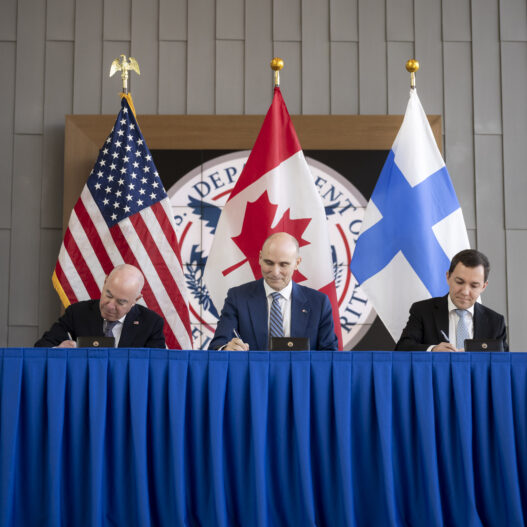

The United States and Finland signed a memorandum of understanding on October 9th for the sale of 11 fourth-generation Arctic icebreakers. A sheer glance at the figures that illustrate this strategic capability between China, Russia, and the United States reveals the Trump Administration’s motivation behind the deal: Russia operates 49 icebreakers, China 6, and the U.S. only 3. The invaluable yet increasingly rare expertise in icebreaker construction has positioned Finland as a strategic actor in contemporary great-power competition. Finland’s expertise in building icebreakers has been shaped by the annual freezing of the Baltic Sea and by decades of constructing vessels for the Soviet Union and later Russia. During the Cold War, mainstream policies of neutrality and Finlandization set the backdrop for the cooperation. In 2025, the context is far more strategic: the Arctic is transforming under the pressures of climate change and Chinese interest in the region, while Finland’s loss of neutrality through NATO membership has redefined its geopolitical identity.
Evolution of the Role of the Arctic
Icebreakers are instrumental for a wide range of purposes in the Arctic, from scientific exploration and resource extraction to surveillance, intelligence gathering, and rescue operations. During the Cold War, the region held immense geostrategic importance: it represented the shortest distance between the two superpowers and served as a hub for strategic bombers and nuclear submarines. Since the collapse of the Soviet Union, that strategic prominence has gradually declined. A symbolic turning point came with Mikhail Gorbachev’s 1987 speech in Murmansk, where he proclaimed, “Let the North of the globe, the Arctic, become a zone of peace,” and called upon Arctic states to cooperate in protecting northern lands and waters. This first prompted bilateral partnerships between the Arctic states, focused largely on scientific research and environmental issues. The momentum eventually culminated in 1996 in the establishment of the Arctic Council: a high-level forum created to promote “cooperation, coordination, and interaction among the Arctic States,” though without the authority to issue binding regulations. Another concession secured by the U.S. was the exclusion of all matters related to military security from the agenda of the Council.
Yet the effects of climate change have returned the Arctic to the security agenda. As access to natural resources and emerging maritime routes expands, so too does the prospect of regional competition, including overlapping territorial claims and disputes over the governance of Arctic waters. The threat of individual Arctic states, or the near-Arctic state, pursuing increasingly assertive territorial and resource policies heightens the risk of a renewed militarization of the region.
In harnessing the growing opportunities of the Arctic and monitoring the actors that seek to do so, icebreaking ships are indispensable. For decades to come, many Arctic routes will remain accessible only with the assistance of icebreakers. While Russia naturally maintains the world’s largest fleet, China has accelerated its efforts to build its fleet, particularly under the framework of the Polar Silk Road. Not only does China operate six icebreakers to open northern trade routes, but it has also declared itself a near-Arctic state in its pursuit of polar-power status, an essential step in its ambition to become a great maritime power. 
Beijing has begun to match these ambitions with concrete demonstrations of presence and power in northern waters. In August 2022, China joined Russia in a joint naval presence near America’s Aleutian Islands, and in 2024, Chinese and Russian long-range bombers conducted coordinated patrols over the Chukchi Sea, the Bering Sea, and the North Pacific. Later in 2024, two Chinese icebreakers also traversed an area of seabed claimed by the United States on the coast of Alaska. The U.S. Navy now anticipates growing Chinese naval activity in, under, and above Arctic waters.
These incidents draw critical attention to the Bering Strait, the narrow passage separating Russia and Alaska. The Polar Route, part of China’s Belt and Road Initiative, aims, among other objectives, to diversify geostrategic dependencies such as those of the Strait of Malacca. However, the Polar Route itself also relies on access to a narrow chokepoint: the Bering Strait. China’s growing activity in and around this passage underscores its Arctic ambitions and its increasing confidence to project power. Its rapid expansion of icebreaker production enables these ambitions to materialize, prompting the United States to finally confront its acute shortage of such vessels.
Building Finnish Expertise in Icebreaker Building
Addressing this gap led Washington to Finland, historically a neutral state, and now a committed NATO ally with a proven record of icebreaker expertise. The President of Finland, Alexander Stubb, in a press conference from Washington D.C., following the successful signing of the MoU between Finland and the U.S., referred to the original initiator of the icebreaker deal, Urho Kekkonen. Serving as Finland’s president for most of the Cold War (1956–1982), Kekkonen came to symbolize the delicate balancing act between the West and the East. Finland’s policy of active neutrality was maintained through Finlandization, an arrangement characterized by close personal ties between Kekkonen and Soviet leaders in Moscow, the consolidation of presidential power, and, more broadly, Soviet influence over Finland’s domestic politics and media censorship of views deemed unfavorable to its eastern neighbor.
During the Cold War era, Finland honed its icebreaker industry by supplying vessels to the Soviet Union, a trade relationship that originated from war-reparation demands after the Second World War. This trade later continued with the Russian Federation until the invasion of Ukraine. As Russia’s economy depends heavily on its northern maritime route, icebreakers are essential to ensuring year-round access to global resource markets. The role of the Northern Sea Route has become even more prominent under Western sanctions, as Russia seeks greater access to Asian markets.
Driving the Deal Forward
Before the invasion of Ukraine, an icebreaker deal between the United States and Finland appeared unlikely for two main reasons. The first is straightforward: Finland had yet to join NATO. Finland applied for membership in response to the shifting European security landscape and was formally admitted to the Alliance in April 2023. The agreement between Finland, Canada, and the United States to cooperate on icebreaker production, the so-called “Ice Pact,” signed in 2024, has been attributed precisely to the shiny, new NATO membership of Finland. The primary goals of the Pact are to facilitate information-sharing, collaborate on workforce development, and invite allies and partners to procure icebreakers built in American, Canadian, or Finnish shipyards. More broadly, the Biden Administration’s initiative seeks to elevate awareness of the United States’ insufficient icebreaker fleet.
The second challenge to cooperation, now superseded by the President’s authority to permit foreign construction on national-security grounds, is the Jones Act. The nearly 100-year-old law protects the U.S. maritime industry by requiring that American ships transporting cargo between U.S. ports be built domestically. Despite these efforts to maintain domestic shipbuilding capacity, the United States has experienced a steep decline: from the world’s leading producer in 1975 to 19th place by 2024. Today, the U.S. accounts for just 0.1% of global shipbuilding, while China has steadily expanded its share to 53.3%. Alongside this loss of market share, the specialized expertise required to build icebreakers suited to Arctic conditions has also disappeared. As a result, the U.S. The Coast Guard’s Polar Security Cutter program has faced delays and escalating costs with domestically built icebreaker ships, with the first vessel expected to arrive five years behind schedule at a cost of $1.9 billion.
Considering these challenges, it is evident why Finnish icebreakers have become attractive to the United States. Polaris-type Finnish icebreakers have historically been built for approximately $147 million, only a fraction of the cost of vessels procured under the Polar Security Cutter program. Their construction timeline is equally compelling: Finnish shipyards can promise delivery in as little as 24 months. The current agreement aims to ensure delivery of the vessels to the United States by 2028 at the latest, at an overall cost of $6.1B. These competitive advantages are a clear reflection of Finland’s dominant status as an ice breaker builder: Finland has designed 80% of the world’s ice breakers and built 60% of them.
With the Coast Guard’s and U.S. Navy’s ability to procure foreign ice breaker ships or know-how constrained, their calls for co-production with foreign shipyards have been answered by the recent agreement.
Lasting Impact of the Deal
Finland also clearly benefits from the high-profile deal. The most tangible advantage comes in the form of economic stimulus at a time of sluggish growth. The estimated employment impact of producing four of the icebreakers domestically has been set at 10,000 man-hours. In terms of GDP, the value of the order approaches 1%, though distributed across several years. Beyond the economic impact, as Finland’s Deputy Foreign Minister Pasi Rajala noted, it is in Finland’s strategic interest to support the access of its Allies to Arctic capabilities, demonstrating the concrete value Finland brings to the Alliance. Lastly, in redirecting its shipbuilding capacity from Russia to its Western partners, Finland gains not only strategic credibility but a round of good press.
It is clear that the deal solidifies Finland’s break from its historical continuity of neutrality. The deal is concluded as a NATO Ally, not as an actively neutral state navigating coexistence with its eastern neighbour. At the same time, the agreement highlights Finland’s strategic value within the Alliance and signals its emergence as an active actor in a renewed era of great-power competition. Yet, what does reflect historical continuity is the importance of high-level presidential relations in closing the deal.