








Brussels has not exactly enjoyed favourable media coverage in recent years. The outside viewer or temporary visitor may thus be excused for believing the blasphemous image of Brussels as a lawless breeding ground for moral corruption. However, while her real inhabitants know that our capital is much more than this ‘hellhole’ described by projecting xenophobes, it is unwise to wave away any and all criticism. Indeed, a handful of interconnected trends in Brussels are simply inexcusable and thus require immediate and bold political action. Needless to say, the increasing frequency and intensity of drug-related violence is such a trend that strongly harms the lives of citizens and the reputation of not only the city and country, but the European Union at large.
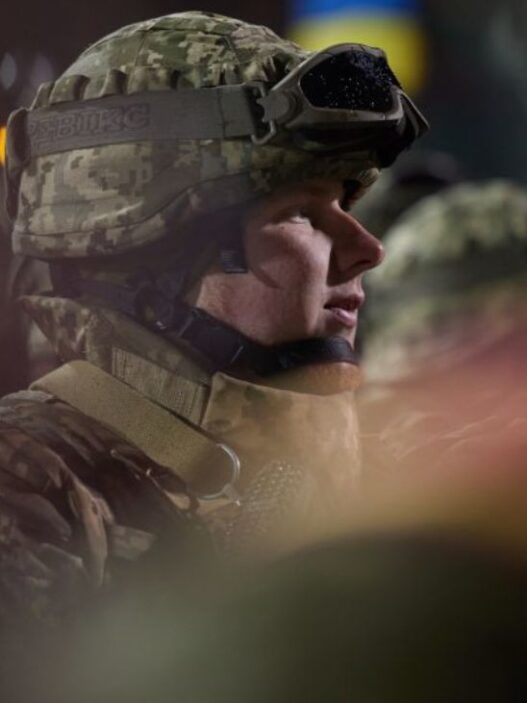
Seeing this problem, especially since the new record of 96 (increasingly visible) shootings of the past year, the Belgian government has pledged to respond. The plan? Increase military presence on the streets with an extended mandate to assist in police duties in order to intimidate criminals and reassure citizens. At first glance, this may seem like a good idea: if criminals look out their window to see khaki uniforms with rifles rather than navy ones with pistols, they may think twice about that vengeance killing they were planning. Concerned citizens may, in turn, rejoice and feel safer thanks to military personnel patrolling the neighbourhood.
To others, however, this sounds more like yet another symbolic and inefficient instrumentalization of the military for political ends. In other words: security opportunism. When remembering the similar response to the wave of terror attacks across Europe in 2015 (the much-critiqued Operation Vigilant Guardian (OVG), one is indeed tempted to look for more profound solutions to drug-related crime in our metropoles. This policy brief thus aims to lay out the drug-related violence in Brussels and its root-causes, and critically analyses the Belgian so-called Arizona government’s current policy proposal for its capacity to sustainably tackle and solve the problem. It ends with an alternative three-pronged policy, which it sees as a more suitable way of solving the issue. While tailored toward the Belgian case, the arguments provided are also applicable in broader terms to other international metropoles.
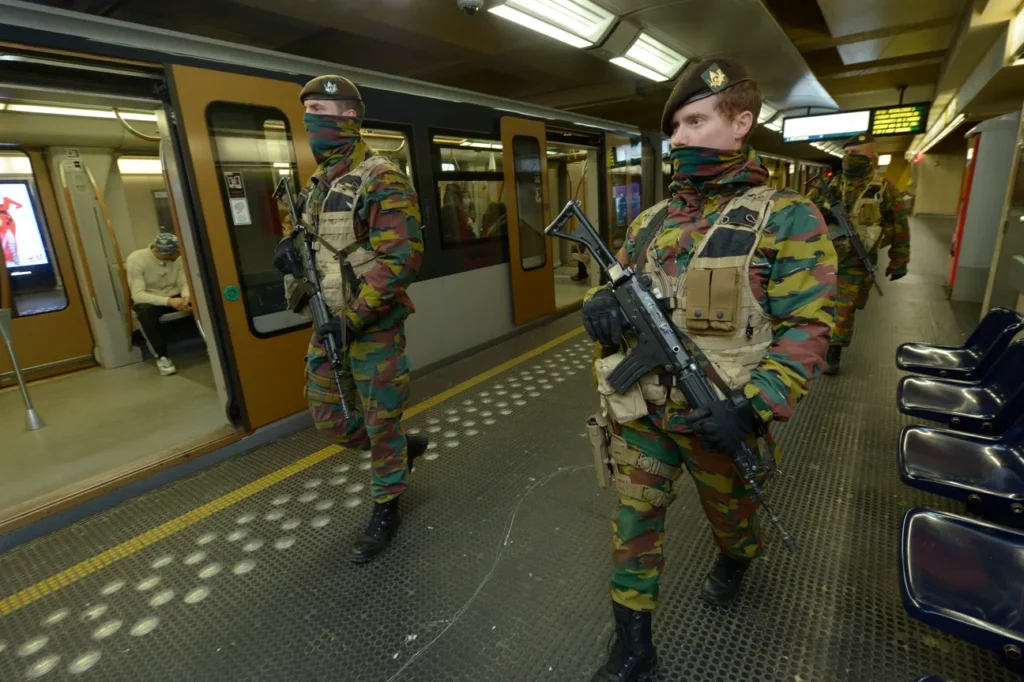

Image 1. © Photonews. Soldiers in the Brussels metro during Operation Vigilant Guardian. https://www.bruzz.be/actua/veiligheid/nog-geen-akkoord-over-militairen-brusselse-straten-2025-12-10
Setting the Scene
Brussels is home to a growing number of emboldened and vindictive organised drug gangs that are in the middle of active turf wars. Given that dominance in a particular territory can be a matter of remaining profitable or going out of business, and the inherently illegal nature of the activities, these gangs resort to open violence to compete in this booming market where demand is on the rise. As highlighted by the Flemish Peace Institute, this violence increasingly takes place in the form of assassinations in broad daylight and thus harms and sometimes kills innocent bystanders as collateral damage.
What’s worse is that these gangs often hire young (even underage) men who, in part thanks to their low socio-economic status, are easily misled into doing the dirty work for what is (to them) good and easy money. Such dirty work is often the only visible option for these men to maintain their lives and families. On top of this, they are frequently coerced into taking the job, as well as threatened when trying to leave the ‘drug game’ behind. All of this is happening in a context where firearms are seemingly increasingly available at even the lowest level (even if exact numbers are difficult to obtain) and where such assassinations are even starting to be offered as a professional service, only leading to more accidental and innocent victims.
In light of these developments, the Arizona government quickly developed a remarkably militaristic, muscular reaction in line with its broader philosophy of boosting societal resilience. In September of this year, more detailed statements surrounding the ‘Major City Plan’ set out an explicit intention to involve the military in what is largely an effort to increase camera surveillance and police patrols in Belgium’s major cities. While some public statements have suggested that the deployment of the military could already meet early Spring, there is a reported holdup within the government.
On top of this, some conflicting interpretations exist within the government on what exactly these soldiers are meant to do. While the Interior Minister (Bernard Quintin, MR) suggested they ought to merely replace police officers in guarding certain buildings (embassies, nuclear plants etc.), freeing up officers for police work, the Minister of Defence (Theo Francken, N-VA) claims to be working on a bill which would grant soldiers certain policing competences like the right to detain and make arrests. However, both gentlemen do seem to agree that blue and khaki uniforms ought to march the streets together to ensure further safety, regardless of whether soldiers get an expanded mandate or not.
In either case, this approach has bumped into quite some criticism, highlighting the unsuitability and possible excesses of this policy. Below, these critiques are compiled to inform a set of alternative policies that should be better suited for solving the problem at hand.
Security Opportunism
There are three main problems that come with this policy. The first one is a simple mismatch between the desired ends (a safe city) and the instruments used to achieve them (military patrols). As shown by the Flemish Peace Institute, the key drivers of the violence at hand are mainly economic and market-related dynamics (e. g. long production chains, impoverished youths being recruited, small independent criminal networks, increasing competition and market entry due to rising demand, lack of funding for the judicial system, etc.). In this sense, deploying the military within an effort toward stronger surveillance and police presence is not really attacking the root causes of the issue. Instead, this seems to be an effort at fighting the most visible symptoms of a failing system and propping up a false sense of security. In other words, security opportunism rather than security policy.
The second argument claims that, if anything, rather than suppressing the violence on the streets, a heavily armed military patrol may have unforeseen escalatory consequences, which would only exacerbate the situation. On the one hand, as mentioned by Belgian ex-general Marc Thys, the criminal gangs could decide to put newly arrived patrols to the test by opening fire, resulting in a firefight with automatic weapons in the streets, with all the undesirable destruction and collateral damage that comes with it. On the other hand, there is the risk of the military personnel being confronted with situations that require years of police and first-responder training. Something which, of course, they lack. It is not a pretty picture if one imagines how a soldier, trained principally to eliminate ‘the enemy’, would go about de-escalating a manic episode of a homeless person, for example. Even if a crash course on such matters is provided, the chances of that rewiring the so-called ‘military mindset’ are concerningly low.
Finally, one could raise questions about the specific message that is being sent through this policy. Is this how we ought to deal with our problems? Is it a good reflex to always reach for the military in light of problems of insecurity? Surely European countries, so proud of their supposedly superior system, should be able to come up with more evidence-based solutions to their problems rather than relying on instincts more attributable to authoritarian nations like Russia or, at this point, the United States?
Systemic Solutions for Systemic Problems
Therefore, I argue that the solutions for this systemic issue are, indeed, systemic rather than militaristic. Instead of the flawed idea of deploying the military on the streets to solve a crisis of drug-related violence, this policy brief suggests a three-pronged approach to tackling this issue in a preventive and goal-oriented manner.
The first aspect any policymaker in this dossier should consider is the social. The core reason that this violence has become so rampant is that the demand for drugs is high. The reasons people take and become addicted to drugs vary widely, but always come back to some form of a lack of sober social connection. Without reorienting ourselves towards policies that can revitalise our fraying social fabric, where communities help each other get through the hardships of life and individuals don’t have to always fend for themselves so much, there is no reason to expect a fall in demand for drugs among citizens. The military can play a role in reconstructing the social fabric, but rather through voluntary (civil) service than any kind of heavily armed patrolling duty. Funnily enough, then, recent efforts to get more young Belgians to join the military may be more effective in combating this issue in the long run than the currently proposed policy.
The second aspect of solving the drug-related violence is economic. Indeed, without tackling the dynamics of the black market, as well as the precarious socio-economic situation in which the young men who are coerced into this system find themselves, it is unlikely that a few more uniforms in Anderlecht will do the trick. The most immediate impact could be generated through government projects that provide readily available employment and upward social mobility to the young men who now have to resort to the ‘good and easy money’ of the drug world. It is an alarming systemic failure that an economy with a significant labour shortage cannot offer these men the jobs they need to provide for themselves and their families. And again, not something which can be solved with more patrols.
The third and final aspect crucial in tackling this issue in Belgium specifically is legal. Indeed, while the military budget has recently received new (and much-needed) funding, the Belgian judicial system has been complaining about an endemic lack of resources for years now. Our prisons are so over-full that even human rights organisations have raised the alarm, and public prosecutors are, if you’ll excuse the expression, criminally understaffed. Without a well-oiled and efficient judicial system, there is little hope that the criminals we end up catching are dealt with in a just way. Granted, the Belgian Minister of Justice is holding her ground in this regard, as her party will only go along with the deployment of soldiers once there is “a consensus” about prison overpopulation within the coalition. Even so, one is permitted to doubt how much this impending compromis à la Belge would solve the problem in the longer term.
Conclusion: We Need the Right People in the Right Places
The current policy of the Arizona government pays little attention to any of the above-mentioned factors. Instead, it risks implementing a policy which could drastically escalate the security situation in Brussels (and the other major Belgian cities envisaged by it), while also rolling back social policies. The ‘War on Drugs’ policies that have been so typical of the United States seem to have found their way onto the Old Continent, which is to the detriment of effective public policy. It has been the argument of this brief that instead of reaching for the military as a ‘quick fix’, it would be wise to look at the root causes of the systemic issue at hand. While the military can surely play a role, through strengthening the social fabric, for example, it seems that the violence on the streets of Belgian cities is best dealt with through the Ministry of Justice or Social Affairs, rather than the Ministry of Defence. As cliché as it may sound at this point, we live in unpredictable times. Our military is thus probably most effective in ensuring our security when deployed for missions they actually signed up and trained for.