









In early 2026, reports emerged that Iran may have targeted the joint UK-US military base on Diego Garcia with two ballistic missiles. While Tehran dismissed the claim as a “false flag,” such a development, if confirmed, would indicate a significant expansion of Iran’s strike capabilities, potentially extending to a range of nearly 4,000 kilometers.
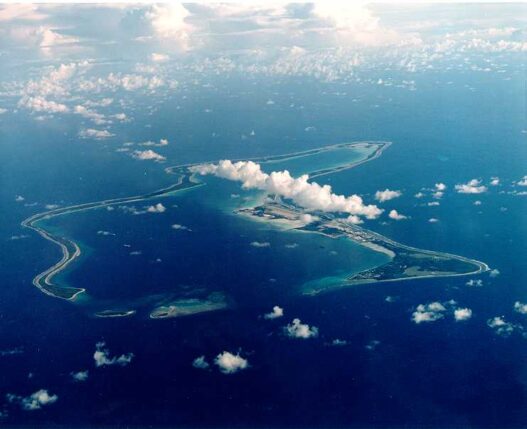
This narrow strip of land, part of the Chagos Archipelago, has long been nicknamed the “Footprint of Freedom” by the US military. Today, it is a footprint caught between a complex sovereignty game, a renewed “America First” foreign policy, and the widening scope of the ongoing war in the Middle East.
The Strategic Jewel: Why Diego Garcia?
The strategic significance of Diego Garcia is defined by its geography. Located roughly 3,000 kilometres from both the Bab-el-Mandeb Strait and the Strait of Malacca, the atoll serves as a crucial point along some of the world’s most important energy routes. With 80% of China’s crude oil imports passing through the Malacca chokepoint, the base’s deep-water port and vast airfields provide the United States with a key platform for military operations and regional presence.
Since the Cold War, the US has viewed it as an unsinkable aircraft carrier. It served as a key launchpad for B-52 bombers during the 1991 Gulf War and the 2003 Iraq invasion. More recently, it has been the staging ground for operations against Houthi rebels in Yemen and a critical node for monitoring the Strait of Hormuz. 
The reported Iranian missile strike exposes the island’s latest vulnerability. Traditionally, Diego Garcia was considered beyond reach for regional powers. If Iran has indeed demonstrated the capability to strike the atoll from its own borders, it breaks the 2,000 km missile range moratorium Iran had previously claimed to respect, shifting the base from a relatively secure outpost to a potential frontline target.
The UK, Mauritius, and the 2025 Deal
In 1965, the UK detached Chagos from Mauritius to create the British Indian Ocean Territory (BIOT). However, in May 2025, following international pressure, the UK government, led by Keir Starmer, ratified a treaty to recognize Mauritian sovereignty. In exchange, the UK secured a 99-year lease on Diego Garcia, with an option for a 40-year extension, at a cost of roughly £101 million per year (totaling £3.4 billion).
However, the agreement has faced increasing political and strategic challenges in 2026. President Donald Trump, after initially describing it as the “best” available option, reversed his stance. He criticised the agreement, describing it as a “very woke thing” and an “act of great stupidity,” linking what he perceives as British strategic weakness to broader discussions about control over key territories such as Greenland.
Trump argues that if the UK cannot hold its own territory, the US must secure strategically critical assets like Greenland to ensure hemispheric control. The tension reached its peak following the recent US-Israeli strikes on Iran that killed their Supreme Leader, Ayatollah Ali Khamenei. President Trump expressed being “very disappointed”, claiming the UK took “far too long” to grant permission for US forces to use Diego Garcia for these strikes due to British concerns over the “legality” of preemptive hits.
For Trump, this delay proved that British sovereignty is a “roadblock”, not an asset. This aligns with the emerging “Donroe Doctrine,” where the US strategy emphasises hegemony in the Western Hemisphere but also views influence in the Indian Ocean as vital. The future of the base is also evolving technologically, as it becomes a hub for Autonomous Undersea Vehicles and “supercarrier” ships operating unmanned systems, extending US power projection across the entire region.
The Trump U-Turn and the ” Russia-China Factors”
Despite the US State Department initially backing the deal, President Donald Trump has labelled the sovereignty transfer an “act of total weakness” and “great stupidity”, linking the issue to his own ambitions.
The geopolitical tension is further complicated by the growing strategic footprints of Moscow and Beijing, and the shifting alliances in the region. While China’s “String of Pearls” strategy targeting India has focused on the development of ports in Pakistan and Myanmar, some analysts argue that Mauritian sovereignty could, over time, open avenues for increased Chinese economic and strategic influence in the region. India, by contrast, has sought to counter China’s strategy with the “Necklace of Diamonds” in the Indo-Pacific, featuring ports in Chabahar, Duqm, Sabang etc.
Simultaneously, the Reciprocal Exchange of Logistics Support (RELOS) pact between Russia and India opens up a new dimension. Russian access to Indian ports for refueling and repairs through this pact bolsters Moscow’s maritime capabilities in the Indian Ocean. Moreover, the RELOS agreement also paves the way for deeper Indo-Russian cooperation in the Arctic, a development that may escalate Washington’s concerns over the control of the potential trade routes (opening up due to global warming and rapid glacial retreat) in the resource-rich Arctic Circle, which, coupled with the strategic significance of Greenland, further intensifies strategic geopolitical rivalry over the region.
Beyond the Russia-China factors, the deal has exposed underlying tensions regarding operational control. Recent friction between the Trump administration and the Starmer government over strikes on Iran highlighted a significant strategic hurdle: the UK’s hesitation to allow the base to be used for preemptive operations due to domestic constraints. If Washington cannot use its most vital asset in the Indian Ocean without requiring approval from London, the current arrangement may be perceived in Washington as a threat to American hegemony.
This struggle does not exist in isolation, as the broader Indian Ocean region is becoming increasingly crowded and contested. India, for instance, is currently expanding its own footprint by constructing a major airbase and naval jetty on Agaléga Island, which belongs to Mauritius. For India, a stable multipolar system ensures that the central Indian Ocean remains a buffer zone against Chinese maritime expansion.
France also remains a formidable power in the region, maintaining roughly 7,000 personnel across its territories in Mayotte and La Réunion. Paris is watching the UK-Mauritius deal with extreme caution, primarily because it faces its own sensitive sovereignty disputes with the Comoros over the island of Mayotte. The precedent of a colonial power to hand back territory based on international court rulings could have implications for France’s own legal position in the region. Consequently, the fate of Diego Garcia is being watched not just as a bilateral treaty, but as a major determinant for the future of maritime power and territorial integrity across the entire Indian Ocean.
The reported Iranian attack has only added fuel to the fire. For the UK, the deal serves to maintain its legitimacy in a post-colonial world. For the US, the island is a crucial pillar of its hard power.
The future of Diego Garcia reflects broader shifts in global power politics, where strategic geography, legal disputes, and great power competition increasingly intersect. As the “Donroe Doctrine” seeks to reassert American control over strategic nodes, the 99-year lease that once looked like a certainty is now looking like another casualty of a troubled international order. While the atoll has long served as a cornerstone of Western military presence in the Indian Ocean, its role is becoming more contested, and the Indian Ocean continues to remain a centre of geopolitical churning. Whether the “Footprint of Freedom” remains a Western stronghold remains to be seen, but one thing is certain: Diego Garcia is no longer just a remote outpost. It has turned into one of the most important theatres of geopolitical rivalries, and the debates over sovereignty and security continue to influence the region.