






Introduction
While Israel launches deadly air strikes on Gaza, concern over the possibility of a genocide grows among EU citizens and political parties, opening a long-standing debate that is currently dividing public opinion and politicians. Simultaneously, social movements keep taking over public spaces, organising peaceful demonstrations and pressuring politicians to end diplomatic relations. But so far, the European Union has done little to alter the situation, and High Representatives of the EU, who coordinate the Union’s foreign policy, have not been able to find consensus among member states, remaining politically divided and incapable of delivering a unified, coherent response to the genocide. However, there have been two High Representatives since October 7th, 2023, each with a different approach to the issue. Through this article, we will analyse the evolution of their discourse and how internal and external factors influence their decisions.
Contextualising mandates
The High Representative of the EU, and Vice-President of the EU Commission, is in charge of the EU’s diplomatic relations, building consensus between member states and coordinating the Common Foreign and Security Policy (CFSP) to ensure consistency of external action.
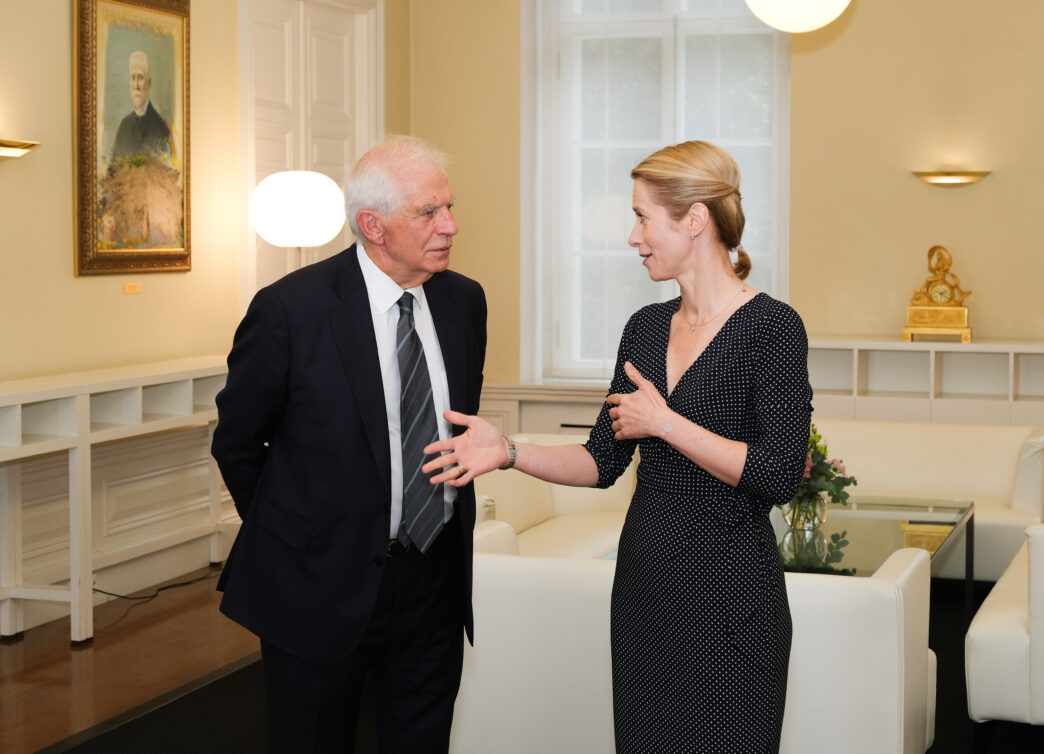
Since October 7th, the day Hamas launched an unexpected attack on Israel, killing nearly 1,200 people and taking over 200 hostages to Gaza, the EU has had two High Representatives: Josep Borrell, a Spanish diplomat from the SPD, who served during the first von der Leyen Commission (2019-2024), and Kaja Kallas, an Estonian politician from Renew Europe who currently serves in the second von der Leyen Commission since December 2024.
Throughout both mandates, the conflict in Gaza worsened: more than 68,000 Gazans killed, many of them women and children, the destruction of nearly all infrastructure, starvation, and man-made famine. This mortality had a huge impact on the media, prompting protests and putting international pressure on Israel to end the conflict. Despite efforts by Arab States and the US to broker peace, the cycle of violence continues. 
How has the EU officially positioned itself? How have HRs described the conflict, and what were their stances? In the following paragraphs, we describe the evolution of their discourse by analysing statements, press releases, and other communications, paying particular attention to the term “genocide”.
Borrell’s hard approach
During his mandate, Borrell faced many challenges, from Russia’s invasion of Ukraine to conflicts in Sudan, Myanmar, and Yemen. But the worst was Hamas’s attacks on Israeli civilians on October 7, 2023, triggering retaliation in Gaza, a spiral of violence where more than 68,000 Palestinians have died in what has been widely considered a genocide.
Borrell had to find consensus among member states to respond to Gaza and define future actions with regard to Israel, a long-standing key trade and financial partner, and the Palestinians. Besides condemning Hamas’s terrorist attacks and calling for an immediate release of hostages, what else did he remark? How did his approach evolve?
In the first two months, Borrell justified Israel’s right to self-defence under international law. However, already in his early statements, we find a growing disagreement with Israel’s actions, which had already killed thousands of Gazans, with bombings of hospitals and shelters, displacing a significant part of the population. He condemned Israel’s blockage of aid and electricity cuts, which left Gazans without water, food, and medicine, as well as civilian killings. Despite his calls for a ceasefire, respect for international law, protection of civilians, and the opening of humanitarian corridors, Israel continued its war.
At this point, he already expressed deep concerns over the state of Gaza, defining the war as a collective punishment. He insisted that not all Palestinians are terrorists, while urging the need to dialogue and coexist in peace through the Two-State Solution. Nevertheless, he also stressed the need for new long-term approaches, noting how past accords, such as the Oslo Accords, had never been fully implemented and that further efforts were required to ensure a permanent peace.
As months passed and Gaza faced famine, Borrell hardened his stance, holding the Israeli Defence Forces (IDF) responsible for restricting humanitarian aid, killing journalists and humanitarian workers, restricting foreign media and opening fire at civilians trying to seek food. As the destruction continued, he compared Gaza to German cities during WWII, calling it an unsafe place to live in.
In the context of the International Criminal Court (ICC) issuing an arrest warrant for Benjamin Netanyahu and his foreign minister, Yoav Gallant, and the order of the International Court of Justice (ICJ) to stop all military operations in Gaza, some member states questioned the EU-Israel Association Agreement and called for a Council as Israel had breached its obligation to respect human rights under article 2. Despite his efforts to suspend a part of the agreement, unanimity was required, and the proposal did not advance due to internal division.
Borrell was not silent on the illegal occupation of the West Bank and Jerusalem either, accusing Israel of having a colonial agenda and a part of the government becoming radicalised. He described the occupation as fragmenting the West Bank into an archipelago that would prevent a Palestinian State, denouncing breaches of international law.
His mandate ended with a soaring death toll and a worse situation than when the war started, leaving him frustrated at being unable to stop it. Since then, Borrell has continued condemning Israel’s actions, recently defining them as a genocide and ethnic cleansing – terms he never used while in office.
Kallas’s soft approach
Since taking over in December 2024, Kallas has also managed many of the same conflicts as Borrell. But the situation in Gaza has worsened, with many of the war crimes committed by Netanyahu’s far-right government amounting to genocide. Kallas, like Borrell, had to find consensus among member states and overcome internal political division, which shaped her handling of the conflict.
Immediately after taking office, Kallas called for a ceasefire, the release of hostages, and unimpeded delivery of humanitarian aid, at a time when Gaza is starving to death. Like Borrell, she endorsed the two-state solution and dialogue as paths to peace and security, but unlike him, she did not question the efficiency of past accords. While she committed to the reconstruction of Gaza after the conflict, highlighting cooperation with the Palestinian Authority, she also noted Palestinian political groups’ refusal to recognise Israel, without mentioning Israel’s rejection of the PA in Gaza or Palestine as a whole.
In January 2025, Hamas and Israel reached a ceasefire with mediation from Qatar, Egypt, and the US, welcomed by Kallas, who also emphasised Palestinians’ right to return to their homes. But when the truce collapsed in March due to Israeli attacks and Hamas’s refusal to release the rest of the hostages, she blamed Hamas for breaking the agreement.
As violence resumed, she held Israel accountable for the attacks on foreign diplomats, demanding an investigation into the matter. She also condemned the use of lethal force at food distribution sites, stressing the obligation to protect civilians and humanitarian and medical workers, as well as Israel’s air strikes in Qatar.
Kallas also convened several Councils with Israel to review Article II of the Association Agreement. In some of these meetings, she highlighted cooperation with Israel in trade and investments, but also insisted on respect for humanitarian law, particularly proportionality. However, unlike Borrell, she opposed ending diplomatic and trade ties: “My predecessor stopped the Association Council. Did it make the situation better? It did not”, she argued, stressing the need to improve conditions for Gazans rather than punishing Israeli citizens. Still, division persisted, with many states acting individually by sanctioning Israeli ministers, suspending arms exports, or recognising Palestine’s statehood – being the most recent, France, Belgium, and Portugal. Only by September 2025 did the Commission propose a partial suspension of the Agreement, sanctioning Hamas, Israeli ministers, and West Bank settlers.
On the West Bank, Kallas mentioned concern over the West Bank, strongly condemning settler violence, new illegal settlements such as E1, and provocative actions in East Jerusalem, stressing how it undermines the Two-State Solution and the city’s special status.
Like Borrell, Kallas expressed her frustration over Gaza, but refers to it as a conflict and not a genocide. Unlike her predecessor, she has never used the term, leaving it to the ICJ to decide and emphasising states’ right to arrest Netanyahu and Gallant following the ICC’s ruling.
Continuity or disruption?
Several similarities can be inferred from their discourse, including a common condemnation of the Hamas attacks and Israel’s brutal actions in Gaza and a call for a ceasefire, the urgent delivery of humanitarian aid, the release of hostages, and the Two-State Solution, which both constantly mention as the only solution to permanent peace.
Furthermore, both received backlash from MEPs in the European Parliament and the Global South, being accused of double standards. While Borrell equally condemned both Hamas and Israeli actions, his early definition of Israel’s actions as war crimes and not a genocide was strongly criticised by left-wing MEPs and parts of civil society, while the far-right accused him of being too harsh. On the other hand, Kallas also faced criticism, especially from The Left, for not defining the conflict as a genocide and exposing the EU’s failure to act – even from fellow Commission member Teresa Ribera, VP for Clean, Just and Competitive Transition.
However, analysing both the content and the tone of their discourse reveals a disruption in the EU’s approach. While both condemned Hamas and Israel, Borrell was more outspoken on Gaza’s suffering, calling it a genocide after leaving office, and more critical of Western interference in the region, admitting Europe’s double standards. This is not to say that Kallas is pro-Israel and has not condemned Israel’s actions, but she adopted a softer posture, stressing EU-Israel trade and financial relations, especially in technology, machinery, or pharmaceuticals. The contrast is starker as the conflict grows deadlier for Gazans.
Assessing the disruption
To fully understand the change in the EU’s discourse on Gaza, we must consider other factors, both internal and external, that influence their position. According to Kemal Inat (2024), we identify three levels of affiliation if we examine their identities: their duties as High Representatives, their country of origin, and their political affiliation.
While High Representatives shape the Foreign Affairs Council’s agenda and contribute through proposals to the development of the EU Foreign and Security Policy, they are limited by the decisions of foreign ministers, requiring consensus to successfully pass policies such as ending diplomatic relations, imposing sanctions, or defining the conflict as a genocide. As both HRs have expressed, there is a division among EU member states, affecting their capacity to deliver a coherent response. This fragmentation hinders the EU’s power to act at the same level as other states in the international arena, losing influence in a regionalised, multipower system.
But High Representatives are also linked to their country and political affiliation. Borrell is a Spanish politician from the Spanish Socialist Workers’ Party (PSOE), a centre-left party known for opposing Israel’s genocide in Gaza and standing up for human rights and international law, including its Secretary-General and Prime Minister of Spain, Pedro Sánchez. This also affects his affiliation with Spain, whose foreign policy since 2018 has been largely shaped by PSOE and fellow left-wing coalition partners. Since the conflict started, the government recognised Palestine in 2024 and approved an arms embargo on Israel.
Conversely, Kallas is an Estonian politician from the Reform Party (RP), a centre-right liberal party. The RP condemned Hamas’s attacks, endorsed the Two-state Solution, and called for respect of international law, but claimed to be neutral and has not proposed any measures against Israel to prevent friction. Estonia’s foreign policy is also determined by Estonia 200, a centrist party governing since 2023, after the centre-left Social Democratic Party (SPD) was expelled from the coalition in March 2025. Since then, Estonia has remained relatively silent, calling for respect of international law and often voting with the EU or the US. So far, it has not recognised Palestinian statehood and is reluctant to use the term genocide.
But the High Representative is also influenced by external actors, such as Israeli lobbies, transnational corporations, and US companies, who enjoy financial and trade relations with the EU. As some media outlets have reported, many Israeli lobbying entities have been increasingly active inside EU institutions, prompting high-ranking officials to support Israel by promoting trade agreements or ignoring illegal occupations in the West Bank. These lobbies pressure governments by threatening to discourage investment or warn of economic consequences if sanctions are imposed. Thus, Israel exerts financial power over EU decision-makers, forcing top officials to act cautiously.
If we consider all of these factors, we can identify four types of actors: (1) those directly tied to lobbies and actively anti-Palestinian; (2) those linked to lobbies and repeating Israel’s discourse; (3) those cautious in the face of threats; and (4) those confronting Israeli and Zionist lobbies by criticising Israel’s genocide and endorsing human rights and justice. Under these categories, Borrell belongs to the fourth group, openly condemning the genocide and assuming the risks it entails, while Kallas falls into the third group, neither acting against Israel nor admitting the conflict as a genocide.
The EU’s struggle
As violence in Gaza increased over time, so did international pressure on the EU to end diplomatic and trade relations with Israel, with many non-Western countries accusing the EU of being hypocritical and using double standards regarding the usage of international law and the definition of the conflict. Added to the spread of mass protests in European countries, some of which have been repressed by their governments, the EU is losing credibility, both internally and externally.
If the previous top EU diplomat spoke out on Israel’s genocidal acts, can we consider Kallas to be in denial? How will Kaja Kallas overcome the deep differences among member states to restore the EU’s credibility? When will the EU abandon its spectator role and act in a unified way?