










AI and the Gulf States – Assessment of Economic Opportunities Across the Technology’s Value Chain and Resulting Prospects for European AI Ambitions
It is described as the largest AI campus in Europe, and it is located in the beating heart of Europe‘s AI ambitions: the UAE‘s AI-dedicated sovereign wealth fund, MGX, partners with French and US companies (including NVIDIA) and entities to build a 1.4 GW data centre and a surrounding AI ecosystem in Paris.
This agreement is far from a coincidence – major Gulf states like the UAE and Saudi Arabia have for years pursued the goal of becoming global leaders in AI and are rapidly enhancing investments in European nations like Italy, Germany, or France.
The following article aims to elaborate on the thesis that a closer EU-GCC cooperation on AI is mutually beneficial in critical fields. It is therefore important to first analyse the current situation concerning AI in the GCC, and subsequently outline fields of cooperation in AI.
The GCC’s strategy, opportunities, and challenges across the AI value chain
Before analysing the as-is state, it is of utmost importance to examine the (global) perception of these countries as AI players. 
Building momentum in AI is critically important for the GCC nations. Aggressive marketing allows for a head start when it comes to attracting talent, investments, and technology to a region that, as we will see later, still has a long way to go in some fields.
For the UAE, the country with the most progress on AI, this is even stated as objective number one in their AI strategy: “Achieving this objective [to become a global AI leader] will require a brand that is built on what differentiates the UAE: its established reputation as a bold innovator.” Occasions to project this image are, e.g., high-level business events like the WEF at Davos, where the UAE is usually omnipresent at numerous AI-related activities. Saudi Arabia and Qatar are following similar aggressive patterns.
The as-is state will be analysed along the AI value chain, which is derived from McKinseys GenAI value chain with the foundational models and ML ops, as well as the application and service layer merged – it can now be split into 4 consecutive levels: hardware, cloud services, foundational models, and applications.
A mixed picture in AI hardware
The hardware layer includes the manufacturing/availability of components like semiconductors that form the foundation for data centres.
In manufacturing, specifically, the UAE has been trying to lure investments into a local semiconductor industry for years with underwhelming results. The country is in current conversations with TSMC to build a gigafab in the country, with US officials and its $100bn AI-only sovereign wealth fund MGX being involved. Even though financial support would often not be an issue, more components, like a highly specialized local supply chain, must come together to build up an integrated AI hardware ecosystem – something the Gulf states are lacking overall.
The picture is different, however, for the availability of AI hardware: The GCC nations sense an opportunity in the anticipated rise of computing power driven by AI and are investing massively, with $7bn of data centres being under construction and $13bn being in the pre-execution phase across the region. This is underpinned by the new US foreign policy allowing access to huge quantities of the most advanced chips.
Investments in data centres are carried out by local, partially state-owned companies like DataVolt (KSA), Ooredoo (Qatar), or Khazna (UAE), increasingly in partnerships with tech companies like Amazon, OpenAI, and US-based private equity. Remarkably, data centres and related infrastructures like sub-sea cables are already a vital source of foreign direct investment in some GCC nations.
The overall business calculus stems from recent experiences: nations in the region, and particularly the UAE, have a very successful history of taking significant sovereign financial risk to build infrastructure platforms that attract and enable businesses to thrive on later – an approach that has shown to be hugely successful in logistics, tourism, finance, aviation and increasingly manufacturing.
To utilise these computing resources, partnerships with large American AI companies have been forged. The target market for the computing power will be AI companies active in the MENA region and the so-called “global south”, with some US companies like xAI signalling general interest due to commercial advantages generated through very low energy prices, particularly with renewables.
Building partnerships to excel in the cloud business
Access for entrepreneurs and institutions will be provided through cloud platforms. Therefore, partnerships with large US cloud companies like AWS, Google Cloud, and Azure have been built, providing access to AI tools like Amazon Q and sovereign cloud capabilities for sensitive sectors. Most notably, Chinese cloud companies like Tencent, Alibaba, and Huawei are very active in the GCC, albeit to a lesser extent than US competitors.
Remarkable progress developing foundational models, but challenges persist
Regarding foundational models (core models on which AI can be built), some first successes can be seen in the GCC nations, for LLMs specifically in the UAE and partially in Saudi.
Models like the UAE-developed Falcon and JAIS or Saudi Arabia’s ALLaM focus heavily on Arabic language and related accents, an untapped but lucrative market being the fifth most spoken language in the world with more than 360 million speakers.
Claimed to perform better than competing models from e.g., META, these open source models are mainly being developed by (partially) state-owned players in the local ecosystems.
The UAE’s Falcon-7B model developed by TII shows a remarkable adoption rate, but trails popular open-source models like the Mistral-7B by several orders of magnitude in monthly downloads. For the UAE and Saudi Arabia, it would simply not be realistic to keep up with the financial firepower of American tech-giants, also given the fact that the dominating consumer interface is in many cases controlled by the very companies that develop the models, resulting in huge amounts of data collected to train those models.
Besides the UAE, the absence of other significant model developments in e.g., Bahrain, Kuwait, or Oman can in part be attributed to a comparably weak scientific ecosystem, with the highest ranking nation in the H-Index, which compares scientific productivity, ranked 33 globally (Saudi Arabia).
The private sector, which is the main driver of model development on a global stage ( 90% of all notable AI models), has not kept up either in the GCC. R&D spending is low by global standards, Saudi Arabia achieves merely 0,46% of GDP (2.7% is the OECD average), with private sector contribution being particularly low in some countries, carrying only 38,5% of total R&D spending in Saudi Arabia (64% in Germany).
The countries, specifically the UAE, Saudi Arabia, and Qatar, have recognized that public and private R&D capabilities, especially in AI, will be critical. Besides building partnerships with international institutions, disappointing experiences with American universities have shifted the leadership’s mind to focus on home-grown capabilities.
Most Gulf states have ambitious plans to significantly increase (AI-) R&D spending and private sector engagement and focus heavily on applied research. Saudi Arabia and the UAE are building centres of excellence around their elite Universities like KAUST or MBZUAI. The latter, an AI-dedicated university and the epicentre of AI research in the Gulf, attracts scientists from leading US institutions and students from around the world. Even though only one-fifth of the 400 graduates come from the Emirates, up to 70% of them stay in the country, feeding AI companies and institutions in the UAE. Scientific reputation is respectable, and MBZUAI is planning to expand rapidly. In order to accelerate progress, both countries are clustering state-owned and private companies around these universities.
The Gulf’s core strength: the application layer
Where prospects for the Gulf states are bright is on the application layer, which summarizes the adoption and development of B2B, B2C, or B2G products that are built on foundational models.
Regarding AI-adoption, GCC nations will capture a disproportionate share of global AI value creation. According to PWC, this includes a $78bn contribution to the energy industry, and a $59bn contribution to public sector services, driven by either productivity gains or product enhancements. Other than the differences in the other layers, all GCC nations are projected to benefit from these developments.
The reasons for this are manifold: first, the GCC nations do not show high levels of productivity overall. The best performing nation (Qatar, $56.8/h worked) is considerably behind Western Europe or the US (Germany, $80.5/h worked). In addition, productivity growth has been disappointing for years. Therefore, the GCC has much more to gain from AI, specifically in the public sector, where a majority of nationals are employed.
In order to gain an international competitive advantage in AI, it is helpful to apply it in already very competitive and digitized existing industries – and, as outlined in most AI strategies, that’s what the Gulf states are doing.
Deep dive: Leveraging national champions – the energy industry
For the very large and competitive GCC energy industry, AI applications promise further enhanced competitiveness, efficiency and profits through improved resource discovery, operations automation, and predictive maintenance. From Saudi Aramco’s industrial AI to ADNOC’s (UAE) ENERGYai, Bahrain’s Bapco cooperation with Palantir, and Kuwait Petroleum Corporation’s “Big Data Galaxy”, energy firms are already applying AI, sometimes even via dedicated AI subsidiaries cooperating with US tech giants.
Deep dive: meeting upcoming headaches with AI – healthcare
A further field where AI can create value for the GCC is healthcare. Given their overall exploding healthcare costs (between 4% and 7% growth annually in the next few years), AI applications built locally or in partnerships will be crucial in optimizing healthcare operations.
The nation’s genome databases could be foundational (the UAE’s genome database is already more extensive than its very successful British counterpart). Local companies like M42 are utilising this data, building partnerships with global healthcare companies, and aim to put Abu Dhabi on the AI-powered healthcare map.
Deep dive: fast-growing but still comparably small local (AI) ecosystems
The GCC’s private entrepreneurial ecosystem that ideally develops these solutions is, however, behind those in the US, China, and even Europe.
The GCC’s largest AI ecosystem, the UAE, records only 11 newly founded AI companies in 2023. Funding remains comparably low, with AI companies in e.g., the UAE attracting only 406.6 million dollars of private investment in 2024.
Despite sovereign wealth funds in nearly all GCC nations deploying enormous sums of capital in AI investments around the world, funding remains an issue in local ecosystems.
Research capabilities remain underdeveloped, with only 2 AI patent applications in Saudi Arabia, compared to 143 in Israel.
Talent remains an issue as well, with Saudi Arabia and the UAE trailing global and regional leaders like Israel.
Alongside their AI strategies, countries are successfully addressing these issues, specifically in terms of talent. The two largest economies (UAE and KSA) have started to attract thousands of AI talents each year, and other countries are trying to upskill their local populations.
In addition, the GCC’s overall startup ecosystem is recording rapid growth and currently defying global developments.
Deep dive: the geopolitical swing states – leveraging the Gulf’s geopolitics in the age of AI
Not all of the needed AI applications will be built within the Gulf states, and the leaders are capitalizing on this. In fact, the region could benefit from the so-called Wimbledon effect, whereas a place can become a global hub in certain activities even if it has only a few domestic players.
The GCC countries are considered to be “geopolitical swing-states”, staying neutral on most matters like the war in Ukraine, and thereby being able to offer market access to a particularly large number of companies from around the world.
An example is the case of Uber (US) and WeRide (China) cooperating to deliver autonomous taxis to Abu Dhabi. With PonyAI and Baidu announcing plans to expand in the region, the country is expected to become a battleground between US and Chinese companies in autonomous driving.
A symbiotic relationship: the opportunities and implications of a GCC-Europe Tech Corridor
Given all this information, it is striking how symbiotic the GCC and Europe seem to be in the matter of AI.
Europe boasts a wealth of AI talent that, in many cases, end up working for US companies in Europe or the USA. For the Gulf states, which are actively looking to expand and retain their local AI workforce, European AI talent and (potential) founders are of high interest and already being targeted through specialised programs and generous visa regulations.
The European strength in AI-related intellectual property and its robust scientific ecosystem is of high interest to the GCC. European-GCC scientific cooperation on AI is planned with Qatar, but systematic approaches can also be seen in Saudi Arabia and the UAE.
As the region is developing pockets of excellence in AI, this is far from a single-track matter. As an example, M42, the Cleveland Clinic in Abu Dhabi and the UAE Biobank are gaining momentum in developing an integrated medical ecosystem with a focus on AI, underlined by partnerships with public and private institutions, specifically from the USA, and the UK – an opportunity for more European engagement, as the life science sector remains comparably innovative in Europe, particularly in AI drug discovery.
Funding remains a huge issue for European AI ventures, with only $19bn of private AI investment in 2024 (US: $109bn).
Especially late-stage funding (Series C and ongoing) remains a problem ($5.6bn across technologies in the EU vs $65.2bn in the US in Q1 2025). This has many reasons, particularly the financial capabilities of European investors to deploy large amounts of capital, specifically in later mega-rounds ($250m+), and the limited amount of exit opportunities through, e.g., IPOs. Gulf investors could alleviate some pressure here, given their financial firepower with hundreds of billions in AUM, the willingness to fund mega-rounds (in AI), and most importantly, their strategic positioning.
Public Gulf state investors not only aim for financial returns (through exits) but also drive their countries’ economic diversification by building partnerships through investments and establishing local industries in their countries. Money invested in European AI ventures (including AI infrastructure) would have a clear perspective on collaboration and setting up local capabilities.
This can be beneficial to Europe since the GCC can be attractive for sophisticated, especially B2B AI products that drive economic development in key sectors like healthcare, manufacturing, energy, and logistics.
France is one of the first nations to tap this opportunity, with the UAE investing up to $50bn in an AI campus in Paris with core French and UAE AI companies closely integrated. Its national AI champion, Mistral, is reportedly in talks to raise $1bn from investors, including MGX, the UAE’s dedicated AI sovereign wealth fund. Saudi Arabia’s collaboration with France is mostly focused on AI in defense, but PIF’s Office opening in Paris may be a sign of more to come.
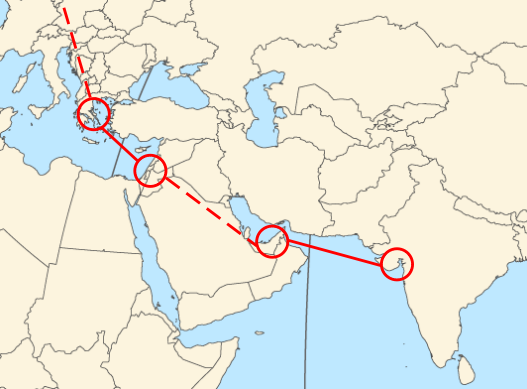
Most importantly, a closer cooperation would offer Europe geopolitical leverage and enhance its AI sovereignty. Getting access to resources, markets, and partners to lock in the EU AI ecosystem is critical, and the GCC could be an important part of this. It is also an integral part of a new axis of countries forming to enhance trade relations, ranging from East Asia to Southeast Asia, over the GCC and Europe. Structural issues in the EU and the GCC, however, need to be tackled, and the political nature of the GCC remains, as with other trading partners, not without risks. An emerging EU-GCC AI corridor could, however, be an important, vital, and mutually beneficial part of an emerging new economic order.