






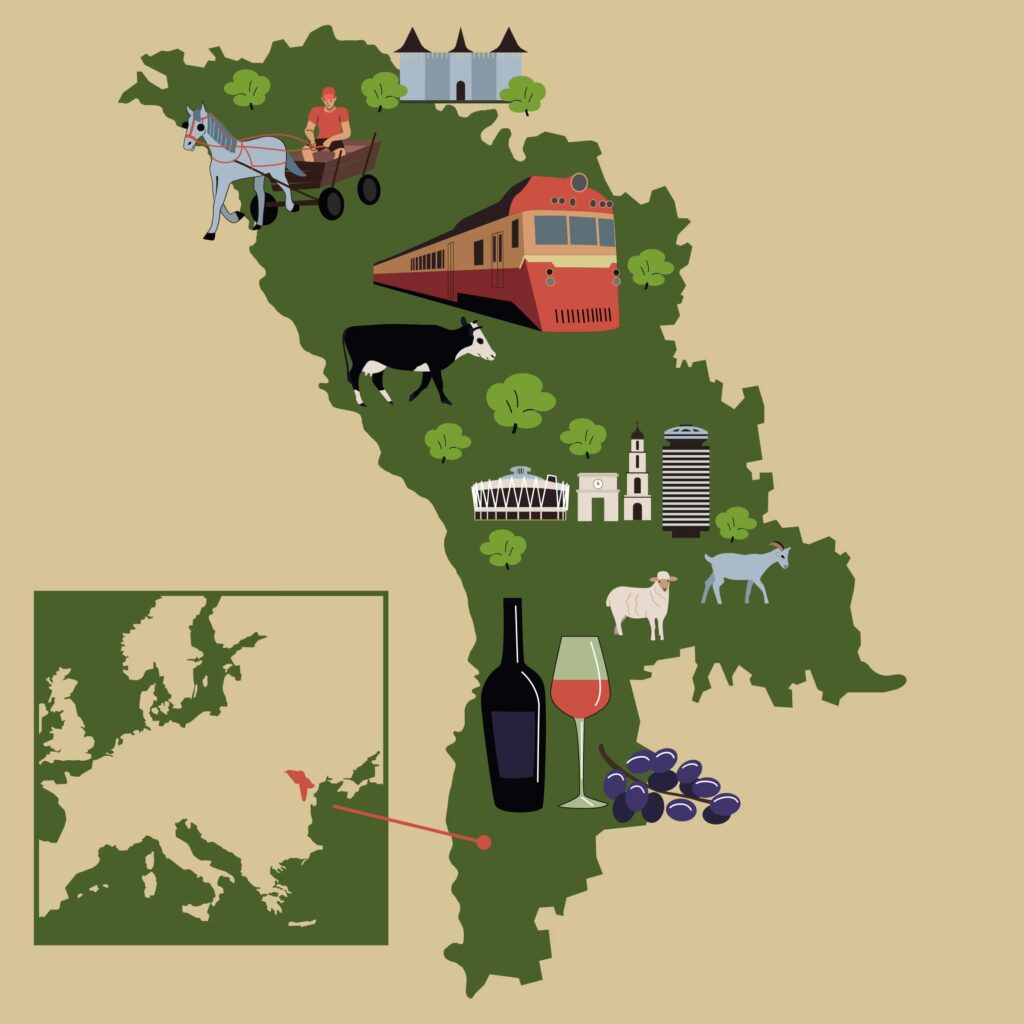
Info Map by Tizian Stocker:
Yelizaveta Landenberger is a German-Russian journalist, translator, and expert on Eastern Europe. She was born in 1994 in Novosibirsk and works as a research assistant at the Institute of Slavic Studies at Humboldt University in Berlin. She writes regularly about Russia, Ukraine, Moldova, and Eastern Europe.

Tizian Stocker is a German political scientist and expert on EU and European policies and politics. His work focuses primarily on democracy within the EU. He works as a media editor and briefing analyst for the European Relations Association.
Info Box provided by Tizian Stocker:
Transnistria is a pro-Russian breakaway region of Moldova located along the eastern bank of the Dniester River. It declared independence in 1990 after the collapse of the Soviet Union, but is internationally recognised as part of Moldova. Since a brief war in 1992, it has functioned as a de facto state with Russian military support and the presence of approximately 1,500 Russian troops.
Geopolitical significance of Transnistria
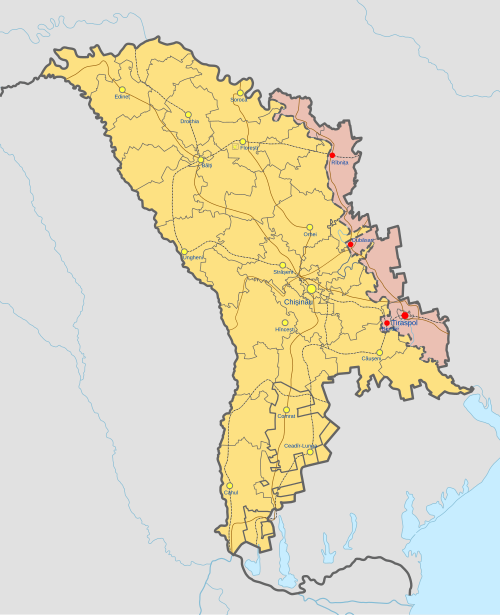
Yellow: Controlled by Moldova
Red: Controlled by Transnistria and Russia)
Tizian Stocker: What should we in the West understand by Transnistria, and how would you describe its political and geopolitical significance?
Yelizaveta Landenberger: When Russia launched its full-scale invasion of Ukraine on 24 February 2022, the Republic of Moldova found itself in a precarious position. Had Russian forces captured Odesa and advanced westward toward Moldova’s pro-Russian breakaway region of Transnistria, a thin strip of land located on the left bank of the Dniester river, Moldova could have become the next target of Russian aggression in an effort to restore Moscow’s influence in the region.
With around 1,500 Russian troops stationed in Transnistria and a large Soviet-era ammunition depot at Cobasna, such a scenario was widely discussed at the time. It never materialised. Instead, Ukraine closed its border crossings with the breakaway region for security reasons, further isolating it and thereby increasing its dependence on Chişinău [capital of Moldova].
The trilateral relationship: Moldova, Transnistria and Russia
Tizian Stocker: What are the current relations between the Republic of Moldova and Transnistria, and what role does Russia play in this relationship?
Yelizaveta Landenberger: It is important to understand that, despite the 1992 war between Moldova and Transnistrian separatists backed by the Russian army, and despite decades of anti-Moldovan and pro-Russian propaganda, most people in Transnistria have little interest in becoming involved in a new military conflict. Nor does the local oligarch Victor Gușan, owner of “Sheriff Holding,” which controls much of the left bank’s economy. The authorities in Tiraspol, aligned with both Gușan and the Kremlin, have generally avoided war rhetoric or even mention of the war in neighbouring Ukraine. War is bad for business and threatens their own existence.
Info Box provided by Tizian Stocker:
Victor Gușan is a former KGB (Committee for State Security in English from the Russian Komitet Gosudarstvennoy Bezopasnosti) officer and the founder of Sheriff Holding, the dominant conglomerate in the breakaway region of Transnistria. Through Sheriff, he has built a business empire spanning retail, fuel, telecommunications, banking, media, and construction, making him widely regarded as the region’s most influential businessman and political power broker.
Yelizaveta Landenberger: Against the backdrop of Russia’s aggression, the Republic of Moldova was granted EU candidate status in June 2022 alongside Ukraine. At the end of 2023, the European Council decided to open accession negotiations, which officially began in June 2024. Reflecting this pro-Western course, Moldova’s parliament voted in April this year to leave the Russian-dominated Commonwealth of Independent States (CIS). A few weeks ago, the first negotiation cluster was opened, marking the start of substantive EU accession talks. Chişinău has set 2030 as its target date for EU membership.

Yelizaveta Landenberger: While Russia has been unable to threaten Moldova through direct military intervention, it continues to employ hybrid tactics to destabilise the country in efforts to regain influence. These include interference in elections, disinformation campaigns, and the use of Transnistria as a political instrument, all of which complicate Moldova’s path toward EU integration. At the same time, Chişinău is using its growing economic and political pressure to encourage the reintegration of the left bank and restore control over the territory. Moldova holds significant leverage, as Transnistria depends on access through Moldovan-controlled territory for its exports.
The balance of dependency is clearly shifting in Chişinău’s favour. In the past, Russian gas was supplied to Transnistria and used to operate the Cuciurgan power plant. Although the gas was consumed in Transnistria, the costs were formally attributed to Moldova, making it effectively free for the separatist region. At the same time, Moldova purchased a large share of its electricity from the left bank. In response to Russia’s war against Ukraine, however, Moldova has increasingly turned to European suppliers.
A turning point for the separatist regime came with the gas crisis that began in early 2025, after Ukraine declined to extend the transit agreement for Russian gas. This triggered a severe energy crisis in Transnistria. Moscow now purchases gas for the region through an intermediary scheme, resulting in delays, uncertainty, and economic decline. The separatist regime’s golden times of free Russian gas are over. From Chişinău’s perspective, this increases pressure on the Transnistrian authorities and could act as a catalyst for reintegration.
Reunification and the EU
Tizian Stocker: Do you believe reunification with the Republic of Moldova is realistic, particularly in light of Moldova’s possible accession to the European Union?
Yelizaveta Landenberger: While in theory, Moldova could join the European Union without Transnistria, following the “Cyprus model,” this is neither the EU’s nor Chişinău’s preferred option. The Moldovan government continues to pursue reintegration, which, in light of the increasing hardships on the left bank, seems to get closer and closer. Yet the social challenges involved are considerable. How does one reintegrate roughly 350,000 people who have lived under an authoritarian system for more than three decades, consumed state propaganda, and primarily speak Russian? The experience of eastern Germany suggests that such a process requires time, resources, and, above all, will not happen automatically.
Info Box provided by Tizian Stocker:
Cyprus model: A country can join the European Union despite an unresolved territorial dispute, with EU law applying only to the territory controlled by the internationally recognised government. Cyprus joined the EU in 2004, even though the northern part of the island remains outside the government’s control.
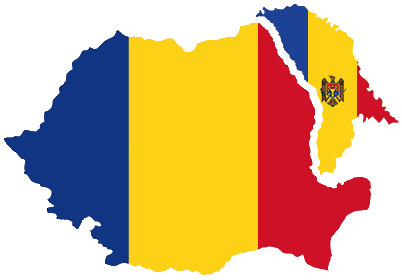
Yelizaveta Landenberger: At the same time, Chişinău appears to be keeping another option in reserve should the EU accession process stall: reunification with Romania. Moldova’s president, Maia Sandu, has stated that, if a referendum on the issue were held, she would vote in favour. She has argued that it is becoming increasingly difficult for small countries such as Moldova to navigate the new geopolitical reality with crumbling international law.
Yelizaveta Landenberger: How Moldova and Transnistria will eventually, in fact, develop remains uncertain for now. As for the region as a whole, much will depend on the course and eventual outcome of the war in Ukraine.
We thank Yelizaveta Landenberger for her insightful contribution and for her fantastic cooperation with the European Relations Association.
Interested in the topic? Check another expert commentary here and here.
And here and here is an analysis of the topic.
Here you can find an opinion article about the topic.
Recent News from Romania: