











The European Union has submitted observations in Lithuania’s case against Belarus before the International Court of Justice. The dispute asks whether a treaty created to combat migrant smuggling can cover state-organised migration pressure used for geopolitical ends.
A border crisis reaches The Hague
On July 20th, 2026, the European Union furnished observations to the International Court of Justice in proceedings brought by Lithuania against Belarus. The EU participates as an international organisation.
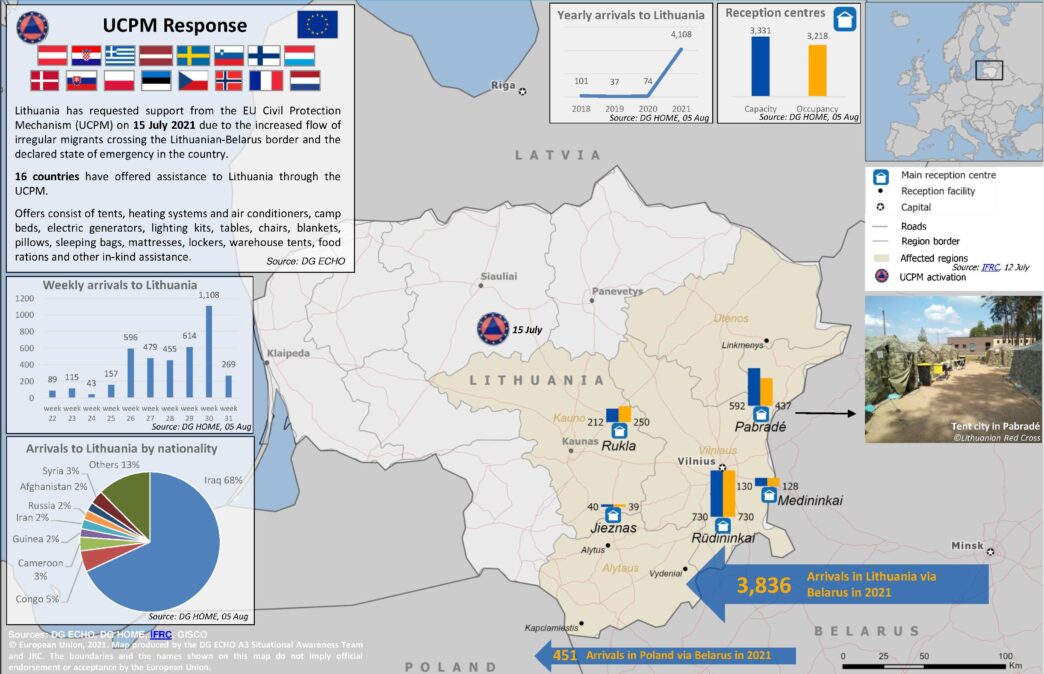
Lithuania opened the case in May 2025. Its application alleges that Belarusian authorities organised and supported the movement of migrants towards the Lithuanian border from 2021 onwards. Lithuania claims that Belarus facilitated travel into the country, transported people towards the frontier and assisted irregular crossings into an EU Member State.
Lithuania describes the operation as migrant smuggling on a large scale, and accuses Belarus of breaching the United Nations (UN) Smuggling of Migrants Protocol. The case now places a European security dispute before the UN’s principal judicial organ.
The legal question extends beyond the events at the border. The Protocol targets the facilitation of irregular entry for financial or another material benefit. Lithuania is asking the Court to apply that framework to an operation allegedly directed by a state and designed to exert political pressure on the European Union.
Instrumentalisation and smuggling
For context, let’s take a look at the terms used in this case. Migrant instrumentalisation describes the use of migration flows to pressure or destabilise another state. Migrant smuggling means procuring illegal entry in order to obtain, directly or indirectly, a financial or another material benefit. The concepts may overlap, though they rest on different legal foundations.
The legal gap
This distinction sits at the centre of the case. Lithuania’s application describes an organised system involving travel routes into Belarus, transport towards the border and assistance with irregular crossings. Some individuals and companies allegedly received payments for their role in the operation.
These details resemble the conduct covered by the Smuggling of Migrants Protocol. But the wider strategy presents a harder question. Lithuania argues that Belarus used migration to retaliate against European sanctions and place pressure on the European Union. Political leverage differs from the financial or material gain that shaped the Protocol’s original focus.
The Court may have to decide how these two levels fit together. It could examine the benefits received by individual actors, the role of Belarusian state bodies and the political purpose of the operation as parts of a single system. The answer will show how far an existing criminal-law treaty can reach when a state adopts methods usually associated with private smuggling networks.
Why this matters for Europe
The case could give international legal weight to a concept already embedded in the EU’s migration framework. A ruling in Lithuania’s favour would strengthen Europe’s claim that state-organised migration pressure can trigger international responsibility. At the same time, European responses must preserve access to asylum, non-refoulement and protection against collective expulsion. Europe faces a dual task. It must confront the state directing the movement while protecting the people caught within it.
Info boxes provided by Laksmitha Anindyanari:
Non-refoulement is a principle of international refugee and human rights law that prohibits states from returning or transferring people to a country where they face a serious risk of persecution, torture, or other serious harm. It is a fundamental protection for refugees and asylum seekers and means that governments must consider the risks individuals may face before removing them from their territory.
Collective expulsion refers to the removal of a group of people from a country without individually examining the circumstances of each person’s case. International human rights law generally prohibits collective expulsions because authorities must assess each individual’s situation before removing them, particularly where people may face persecution or other serious harm upon return. This principle is intended to prevent governments from summarily removing groups of migrants or asylum seekers without due process.
What comes next
The proceedings before the ICJ are at an early stage. The Court will first address procedural and jurisdictional questions before reaching the merits. Its eventual ruling may expand the reach of the UN Smuggling Protocol or expose the need for a more specific international framework.
Sources
- https://www.icj-cij.org/index.php/node/206457
- https://www.icj-cij.org/case/200
- https://icj-cij.org/sites/default/files/case-related/200/200-20250519-app-01-00-en.pdf
- https://www.unodc.org/documents/middleeastandnorthafrica/smuggling-migrants/SoM_Protocol_English.pdf
- https://www.unodc.org/documents/human-trafficking/Migrant-Smuggling/Issue-Papers/UNODC_Issue_Paper_The_Profit_Element_in_the_Smuggling_of_Migrants_Protocol.pdf
- https://fra.europa.eu/en/publication/2025/countering-instrumentalisation-of-migrants
- https://www.europeanpapers.eu/system/files/pdf_version/EP_EF_2023_I_010_Mirko_Forti_00648.pdf
- https://eur-lex.europa.eu/legal-content/EN/TXT/PDF/?uri=OJ:L_202401359