







European Relations | Policy Briefing
Executive Summary
A sudden surge of irregular arrivals in the Spanish enclave of Ceuta has once again brought one of Europe’s most sensitive external borders into the spotlight. While Spanish authorities have largely restored control, the events have reignited debates over border security, humanitarian responsibilities and the future of European migration policy.
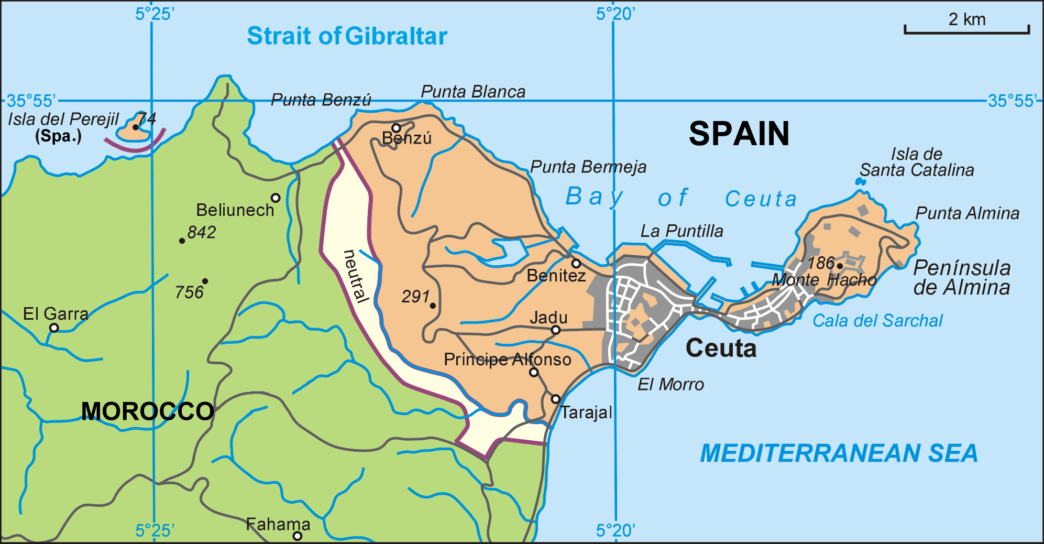
For decades, Ceuta has represented one of Europe’s most complex geopolitical realities. The small Spanish enclave on the North African coast has repeatedly become a focal point for migration towards the European Union. In late July and early August 2026, it once again moved to the centre of international attention after an unprecedented surge in irregular arrivals transformed what initially appeared to be a local border incident into a broader European political challenge.
According to Spanish authorities, tens of thousands of migrants attempted to enter Ceuta from neighbouring Morocco within a short period of time. Many reportedly swam around coastal barriers or used other irregular routes to reach Spanish territory. Spanish emergency services and security forces launched extensive rescue operations while reinforcing border controls. Authorities later reported dozens of fatalities, underscoring the severe risks associated with dangerous migration routes into Europe.
Sources: Reuters, BBC
Spain’s immediate priority was to regain operational control while preventing further loss of life. Additional security personnel were deployed, and emergency services remained active throughout the crisis. According to Reuters, Spanish and Moroccan authorities also cooperated to restore border controls and facilitate the return of many migrants after the initial crossings. Prime Minister Pedro Sánchez argued that the situation should not be viewed solely as a national issue, emphasising that Spain was protecting one of the European Union’s external borders.
A political response soon followed the operational one. European Commission President Ursula von der Leyen expressed solidarity with Spain, describing the situation as a challenge that concerned the European Union as a whole.
“Europe stands with Spain.” — Ursula von der Leyen
Beyond expressions of solidarity, however, the crisis also exposed continuing divisions within Europe over migration policy. While several governments emphasised the need for robust external border protection, others argued that recent events demonstrated the importance of ensuring that border management remains consistent with international humanitarian and asylum obligations.
Sources: SUR in English, Politico Europe
Gerald Knaus, a migration specialist, urged caution against treating the events as an isolated episode. The Expert interviewed by Channel 4 News argued that sudden migration surges rarely result from a single cause. Instead, they tend to reflect a combination of regional instability, economic pressures, changing border enforcement practices and cooperation between neighbouring states. They also noted that Ceuta has experienced similar periods of heightened pressure in the past, making broader structural analysis more valuable than focusing exclusively on short-term political reactions.
This longer-term perspective is important because it places the latest developments within the wider context of migration across the Western Mediterranean. Rather than representing an entirely new phenomenon, the events illustrate how rapidly conditions at Europe’s external borders can change and how quickly local developments can acquire European significance.
Sources: Channel 4 News, ZEIT
Alongside the political debate, the humanitarian consequences remained impossible to ignore. The reported deaths highlighted the dangers faced by people attempting irregular crossings, whether motivated by conflict, persecution or economic hardship. Although the United Nations High Commissioner for Refugees (UNHCR) did not issue a dedicated statement on the Ceuta events, the agency maintains a permanent operational presence in Spain, including work related to Ceuta, where it supports authorities in identifying people who may require international protection. Only days before the crisis, UNHCR had warned that increasingly dangerous migration routes towards Europe continue to claim lives.
Morocco’s position also deserves careful consideration. At the time of writing, the Moroccan government had not published a comprehensive political statement on the events. Nevertheless, Reuters reported that Moroccan authorities cooperated operationally with Spain to restore border controls and facilitate returns following the initial surge. Distinguishing between documented government actions and official political positions remains important in assessing the bilateral response.
Sources: Reuters, UNHCR
The crisis has also renewed discussion about the broader architecture of European border management. While the European Border and Coast Guard Agency (Frontex) did not publish a specific statement on the events, its broader mandate illustrates how migration at the Union’s external borders increasingly requires coordination between national authorities and European institutions. Operational responsibility for Ceuta remains with Spain, yet developments there inevitably influence debates across the European Union about border management, asylum policy and cooperation with neighbouring countries.
Why this matters for Europe
The developments in Ceuta extend far beyond a single border crossing. They demonstrate how events at one of the European Union’s external frontiers can rapidly evolve into questions of European security, humanitarian responsibility and foreign policy.
The crisis illustrates several challenges confronting the European Union simultaneously: protecting external borders, ensuring access to international protection for those entitled to it, maintaining effective cooperation with neighbouring countries and preserving political cohesion among member states despite differing approaches to migration.
More broadly, Ceuta serves as a reminder that migration is rarely confined to the state where it first occurs. Decisions taken in Madrid, Rabat or Brussels have implications that resonate across the Union. As debates over migration continue to shape domestic politics in many European countries, developments at Ceuta are likely to remain relevant well beyond Spain’s southern coastline.
What to Watch Next
- Whether Spain and Morocco deepen operational cooperation following the crisis.
- Possible discussions within EU institutions on external border management.
- Any future statements by UNHCR, Frontex or other international organisations.
- Updated humanitarian assessments and confirmed casualty figures.
- Whether the events influence wider negotiations on European migration and asylum policy.
Sources
- Reuters — Spain and Morocco halt deadly rush into Spanish enclave after 49,000 cross in a day
https://www.reuters.com/world/africa/spain-morocco-halt-deadly-rush-spanish-enclave-after-49000-cross-day-2026-07-31/
Accessed: 2 August 2026 - BBC News — Ceuta migration coverage
https://www.bbc.com/news/articles/c62vl925dqdo
https://www.bbc.com/news/videos/c171nnql1j4o
Accessed: 2 August 2026 - SUR in English — Von der Leyen describes situation in Ceuta
https://www.surinenglish.com/spain/leyen-describes-situation-20260731140602-nt.html
Accessed: 2 August 2026 - Politico Europe — Ceuta crisis: 22 EU leaders challenge Spain’s migration policy
https://www.politico.eu/article/ceuta-crisis-22-eu-leaders-letter-spain-pedro-sanchez-migration-policy/
Accessed: 2 August 2026 - Channel 4 News — Migration expert reacts to extraordinary number of migrants entering Ceuta
https://www.channel4.com/news/migration-expert-reacts-to-extraordinary-number-of-migrants-entering-ceuta
Accessed: 2 August 2026 - ZEIT — Ceuta-Migrationskrise: Spanien, Marokko und Schengen
https://www.zeit.de/politik/ausland/2026-07/ceuta-migrationskrise-spanien-marokko-schengen
Accessed: 2 August 2026 - UNHCR — Spain – Country Information
https://www.unhcr.org/where-we-work/countries/spain
Accessed: 2 August 2026
For further updates on the topic, check the quick brief by ERA here
Transparency Note: Use of AI
AI-powered language models were used selectively as tools to structure the research and formulate the text. The research, selection, and evaluation of sources, as well as all content analyses, assessments, and conclusions, were conducted independently.