










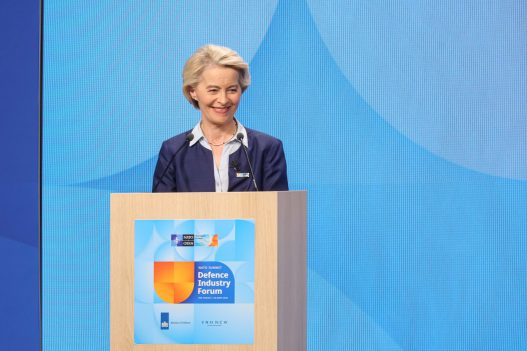
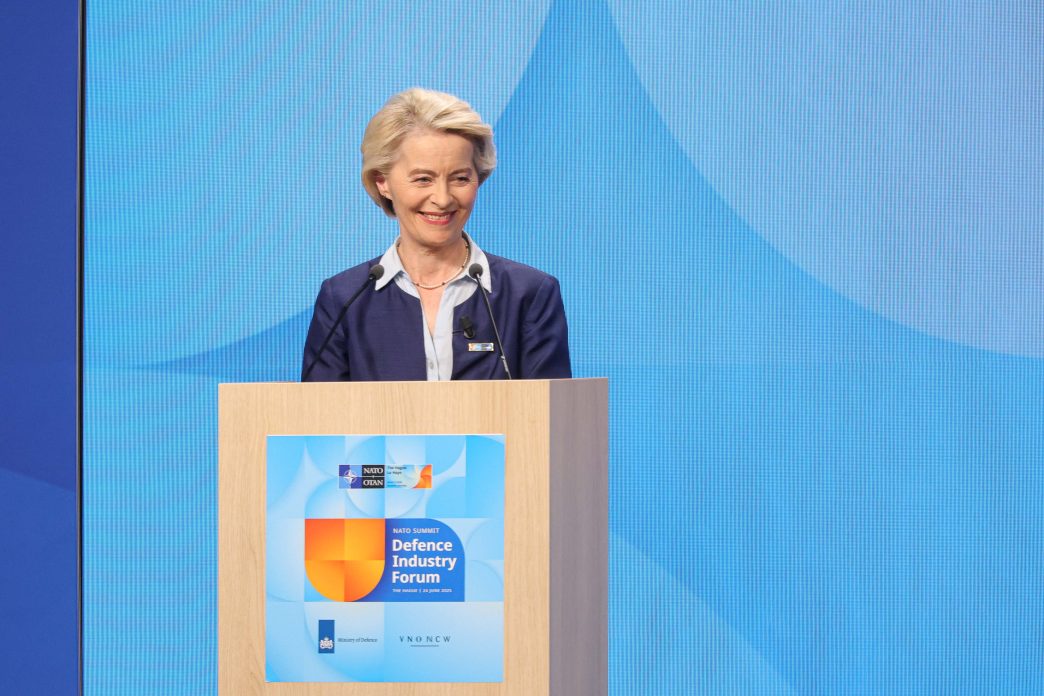
At the 2025 NATO Summit in The Hague, the Allies committed to investing 5% of their Gross Domestic Product (GDP) annually by 2035 in core defence requirements and broader security-related spending. This includes allocating at least 3.5% of GDP annually for core defence based on NATO’s agreed expenditure definition, with an additional 1.5% earmarked for critical infrastructure protection, cybersecurity, resilience, innovation, and strengthening the defence industrial base. Against this backdrop, in the opening session of the NATO Defence Industry Forum of the Summit, Commission President Ursula von der Leyen highlighted the Security Action for Europe (SAFE) instrument. “With our SAFE loans,” she stated, “we incentivise joint procurement and long-term contracts. This will give you the predictability you need to scale up production.” Promising support for joint procurement and predictability certainly seems attractive. But in the face of many Member States with worrying debt trajectories, differing operational needs, and social trade-offs in sight, can this instrument truly succeed and provide a model for the future of EU investments?
SAFE, the Pillar to Rearm Europe
SAFE, launched in May 2025, is a financial instrument that provides up to €150 billion in loans backed by the EU budget. The instrument promises on-demand loans with favourable rates, with the important stipulation of carrying out projects with two or more Member States. With this, the Commission aims to reduce industrial fragmentation, particularly the duplication and inefficiencies stemming from nationally siloed procurement, which has been identified as a major barrier to building a competitive and scalable European defence sector. It is important to note that SAFE differs from earlier instruments like NextGenEU in a key structural way. While both involve EU-level borrowing, SAFE loans are repaid by the individual Member States that take them on. Although the EU guarantees these loans via its budget, making SAFE formally a form of joint debt, each state is solely responsible for its share. This stands in contrast to instruments like NextGenEU, where all Member States are collectively responsible for the debt, and some may ultimately contribute more or less than what they initially received.
The NATO 5% pledge brought clearly into daylight the differences in EU Member State priorities. Most notably, Spain objected to the 5% target ahead of the summit, with Economy Minister Carlos Cuerpo warning that “the discussion about the percentage is misguided.” Ultimately, Prime Minister Pedro Sánchez did sign the NATO statement, arguing that it was a “sufficient, realistic and compatible” compromise. Furthermore, Slovakia expressed concern over the rapid defence spending increase, and the Belgian government also expressed reservations.
Spain’s caution is especially significant given the role of the National Escape Clause (NEC). As part of the EU’s Stability and Growth Pact, the NEC permits temporary deviations from fiscal rules, effectively allowing Member States near the deficit threshold to tap into SAFE loans without facing penalties. This mechanism offers legal flexibility for governments to expand defence spending through SAFE while remaining formally compliant with EU fiscal regulations. 
Twelve Member States have already requested to activate the NEC, yet Spain, despite fitting the profile of likely beneficiaries, has not followed suit. Economists Marco Buti and Marcello Messori suggest that Spain’s decision could prove decisive. Precisely because of its reluctance to expand defence spending, a Spanish endorsement of the NEC would carry outsized symbolic weight. As they argue, it could represent “a first step towards the creation of more advanced EU instruments for both defence and competitiveness.”
Economic Constraints on Collective Ambition
Beyond explicit objections to the 5% pledge, one of the main barriers to such a substantial increase in defence spending is the wide economic disparity among EU Member States. As noted by John R. Deni and Ryan Arick of the Atlantic Council, the majority of NATO countries are not in a financial position to allocate 5% of their GDP to defence. For many, sluggish growth and existing fiscal constraints mean that boosting military budgets would likely require sacrificing other priorities, particularly in social welfare. Only a small number of countries have the borrowing capacity needed to expand defence spending without triggering serious tradeoffs.
Mounting fiscal pressures are also undermining several Member States’ ability to use debt as a lever for increased defence investment. France’s public debt reached 112% of GDP by the end of 2024, while Italy’s soared to 135%. At the same time, the annual spending needed to meet the 5% target is estimated at $221 billion for France and $158 billion for Italy. With debt levels rising, both countries have seen their credit ratings downgraded, and the International Monetary Fund has urged Italy to undertake significant fiscal reforms.
Even under current fiscal conditions, France would see only limited short-term budgetary relief if EU funding through SAFE were used to offset national defence spending. Paradoxically, this modest gain could make France’s involvement all the more influential. Buti and Messori argue it is precisely the decision to participate despite minimal immediate benefit that could legitimise the instrument and encourage others to follow. They go so far as to suggest it might prompt countries like Germany, with debt servicing costs below those provided by SAFE, to join in, “sacrificing short-term benefits in favour of a long-term European commitment.”
In the short term, however, Germany is comparatively well-positioned to take on additional debt to fund increased defence spending. Following a 2025 amendment to its constitutional debt brake, Berlin now has greater fiscal flexibility to respond to rising defence commitments. With public debt hovering around 60% of GDP, Germany stands in a stronger position than many of its peers. Still, the scale of the challenge remains significant: reaching the 5% target would require annual defence spending of approximately $329 billion by 2035.
The Politics of Willingness
It must be considered, though, that capability alone does not guarantee commitment; political will matters just as much. The motivation to reach the 5% target varies widely depending on geography and threat perception. Countries bordering Russia, such as Poland, Finland, and the Baltic states, view the security landscape with greater urgency and have demonstrated a stronger willingness to increase defence spending. Lithuania, for example, recently announced plans to raise its defence budget to between 5% and 6% of GDP starting in 2026, citing heightened concerns over Russian aggression. President Gitanas Nausėda called it a “historic decision,” with the increased funding expected to continue through 2030. In contrast, states further west and south, including Spain and Slovakia, remain more reserved. Spanish Prime Minister Pedro Sánchez described the 5% goal as “incompatible with our welfare state,” while Slovak officials emphasised the importance of reducing debt and improving living standards over rapid defence build-up.
Fulfilling these operational needs through joint action is still politically sensitive. Instruments such as SAFE could alleviate these political pressures. SAFE is considered more politically palatable to right-wing parties than mutualised debt mechanisms like NextGenEU. In Finland, for instance, the distinction between jointly taking on debt as a Union versus jointly procuring debt for willing participants, as with SAFE, is politically significant. The True Finns, a right-wing party currently in government, have supported SAFE precisely because it maintains national accountability: each country borrows only what it uses and repays its own share. In contrast, the redistributive nature of NextGenEU has proven far more controversial. True Finns representatives, such as Petri Huru and Vilhelm Junnila, have gone so far as to claim that through the program, Finland is unfairly footing the bill for “window repairs in Italy”, a narrative that contributes to polarising the domestic debate.
One Step Closer to Common European Defence Financing
Shared incentives have been reinforced by growing uncertainty over the future of the U.S. conventional military presence in Europe. As this potential vacuum emerges, SAFE offers a pathway for European states not only to increase their defence spending but to do so more strategically. By encouraging joint procurement, SAFE promotes interoperability among national armed forces, reduces inefficiencies from duplication, and supports the expansion of the European Defence Technological and Industrial Base (EDTIB). This approach also directly responds to the concerns raised by Former Italian Prime Minister Enrico Letta in his report Much More than a Market, which highlights the EU’s limited economic integration in the defence sector. Letta argues that “coupled with underinvestment, this fragmentation prevents the realisation of potential economies of scale that could arise from pooling defence equipment production efforts across European companies.” To address this gap, he urges both EU institutions and Member States to explore innovative financing mechanisms capable of supporting collective defence initiatives, exactly the type of logic underpinning instruments like SAFE.
For many Member States, SAFE loans offer a cost-effective means of scaling up defence spending, providing access to financing at lower rates than typical national borrowing. Just as important, the activation of the National Escape Clause (NEC) enables countries to temporarily bypass EU fiscal constraints, a crucial mechanism for those eager to invest in defence but constrained by budgetary rules. Together, SAFE and the NEC help bridge the gap between political willingness and financial capacity.
Collectively, the mix of fiscal constraints and uneven political incentives has created fragmented momentum behind the 5% defence pledge, complicating efforts to align national policies under a shared strategic vision. In this context, the emergence of a mechanism like SAFE, one that enables fiscally constrained states to move from political willingness to practical capability, marks a step in the right direction. Crucially, SAFE bridges NATO’s strategic imperatives with the EU’s industrial policy goals. The longer-term impact will depend heavily on the choices of key actors like Spain and France. Their engagement could help embed instruments like SAFE more firmly into the European policy landscape, not only as tools for joint procurement, but as early models for more flexible and coordinated approaches to common European defence financing.