








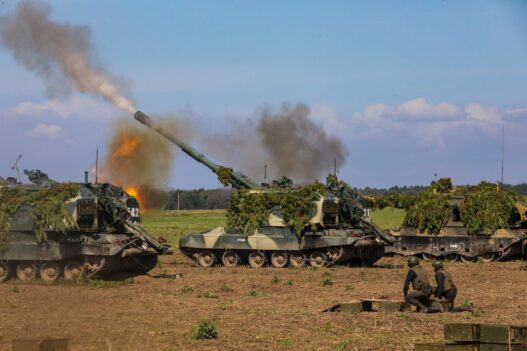
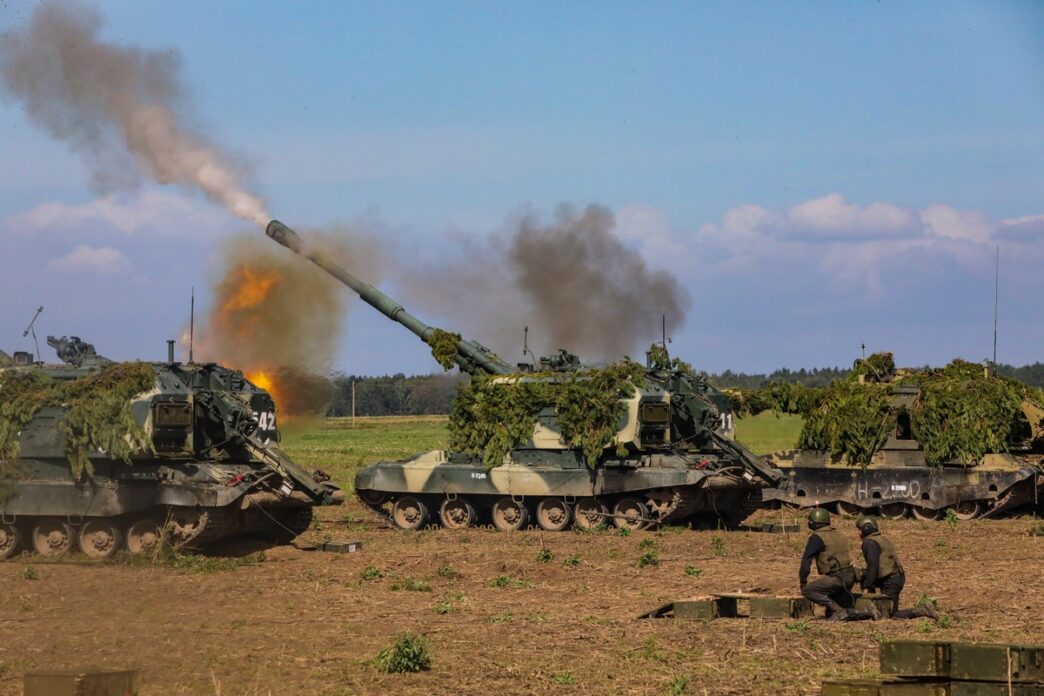
Between 12-16 September, Russian and Belarusian forces are conducting a joint military exercise in Belarus: Zapad-2025. Zapad exercises date back to 1977, held every four years between the Warsaw Pact countries to demonstrate their strength to NATO and test their weapons and command systems. After a hiatus beginning in the late 1980s (due to the end of the USSR), post-Soviet Zapad exercises resumed in 1999 following the NATO bombing of Yugoslavia. The last Zapad exercise took place in 2021; Russian forces, amassed for the exercise, invaded Ukraine through Belarusian territory the following February.
This year, approximately 13,000 troops will participate. Belarusian authorities have assured that the number of troops participating has been reduced (down from the 200,000 troops that participated in 2021) and the exercise’s location has been pushed further into Belarus, away from the Lithuanian and Polish borders. Belarus Major General Valery Revenko claimed this shows the “peace-loving position” of his country.
Experts in the West are divided: military historian Sönke Neitzel said “the summer of 2025 could be the last summer in peace,” suggesting the exercise could be used as a pretence to assemble Russian troops at NATO borders. Lithuanian Prime Minister Gintautas Paluckas, on the other hand, has insisted that Zapad-2025 “does not pose additional threats.” NATO Secretary-General Mark Rutte is also not concerned, speaking to Belsat Poland at the NATO Summit this June: “it would be very, very unwise […] to try anything against us.”
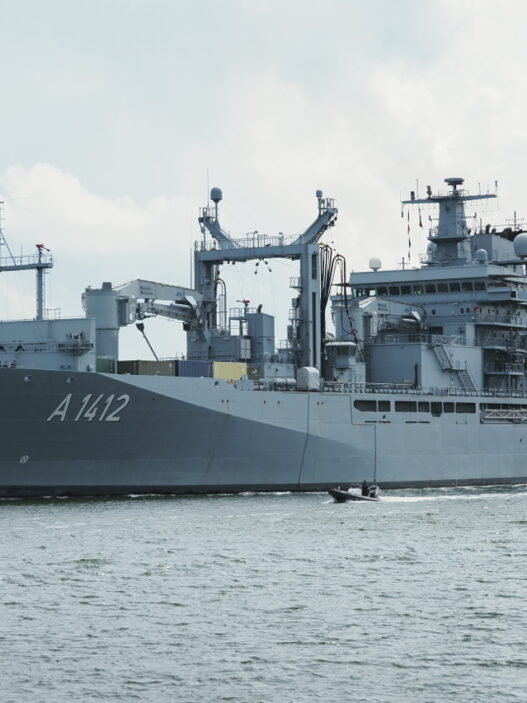
Parallel exercises, however, will take place around the NATO Baltic in September. Poland is preparing Żelazny Obrońca (“Iron Defender”), featuring troops from the US, Turkey, and possibly Slovakia, Finland, and Canada. Germany will host NATO exercise Red Storm Bravo, rehearsing the rapid transfer of reinforcements through Hamburg into Poland and the Baltics in the event of an invasion. 800,000 troops may participate. The first such exercise already took place last year. The Hamburg State Command has insisted that Red Storm Bravo has no connection whatsoever with Zapad-2025. 
The Rearmament of the Eastern Flank
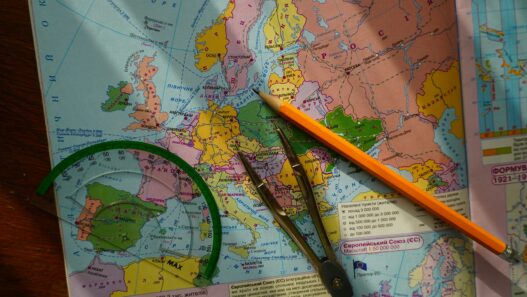
Estonia, Latvia, and Lithuania have warned since 2022 that if Ukraine is defeated, Vladimir Putin’s attention may turn to them next. Former members of the Kremlin’s inner circle, Kasyanov and Khodorkovsky, have also predicted that the Baltics, as former Soviet republics, may be an imminent target of Russian aggression. Looking at the map, the Baltics appear vulnerable to a military confrontation. They share a 1064.3km border with Russia and Belarus, including Russia’s Kaliningrad exclave. They are connected to the rest of Europe (by land) only via the Suwałki Gap – a 70km-wide corridor between Belarus and Kaliningrad. If this narrow corridor was cut off by invading troops, NATO land reinforcements would need to reroute via the Baltic Sea and risk being targeted by powerful anti-ship missiles off Kaliningrad’s coast.
Recognising this vulnerability, the Baltic states quickly accelerated their defence spending, expelled their Russian diplomats, and even reintroduced compulsory military service. Estonia, Lithuania, and Latvia were second, third, and fourth globally in government aid to Ukraine by percentage of GDP (after Denmark) last year, and began building the Baltic Defence Line, a project to jointly enhance and integrate national military defence infrastructure along their eastern borders.
Estonia has even moved to a doctrine of pre-emptive defence, outlined by its Defence Ministry, that will “counter threats before they reach Estonian territory.” Wargaming exercises have shown that Estonia is considerably exposed and could be taken in as little as 48 hours. General Karus says that Estonia cannot wait until it is attacked first and so must “neutralise the enemy on its own territory.” Just a few years ago, it would have been considered extreme to propose hitting Russian forces on their own territory.
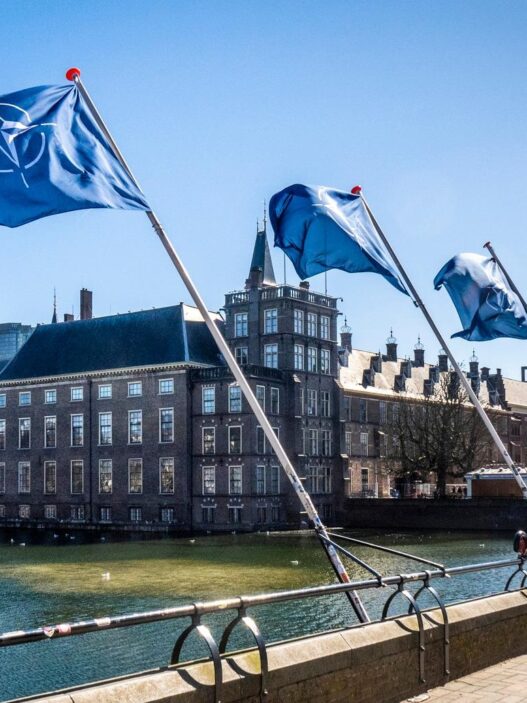
The Baltics’ alarm was mirrored in EU and NATO headquarters. In June, The Hague’s NATO Summit confirmed the alliance’s pledge to raise defence spending to 5% of GDP, just after Ursula von der Leyen announced ReArm Europe/Readiness 2030 to facilitate EU member states’ defence investment. Having none of their own air forces, NATO countries have supplied the Baltics with air policing. NATO has also enhanced its forward presence (eFP), establishing “tripwire” deterrence forces in each Baltic state: multinational battlegroups led by the UK, Canada, and Germany, under the command of Polish headquarters led by the US. If Russia was to invade the Baltics, the troops they would be shooting at would be from all over NATO, not only Baltic troops. Their home countries would be forced to respond.
‘Bolshaya Igra’: Geopolitics through the Eyes of the Kremlin
The fact that the Baltic states used to be part of the Russian Empire and the Soviet Union does not work in their favour. Putin has called the fall of the USSR the “greatest geopolitical catastrophe of the [20th] century.” Russian irredentism, a revisionist doctrine held by the Kremlin elite, sees the losses of Soviet territory as a historic mistake that ought to be rectified. This is essential to understanding Russia’s foreign policy.
The Kremlin, in classic realpolitik thinking, sees the world as organised into strong and weak states. The strong dictate terms to the weak, who have little choice but to accept. In return, they may receive protection and patronage, like in a feudal system. Strong states respect the ‘turf’ of other strong states and refrain from interfering in their affairs. (This, notably, is also aligned with the approach of the Trump administration, which suggests why Putin and Trump get along).
Even if the Kremlin could begrudgingly accept its Soviet republics gaining independence, it still expected them to remain within Russia’s sphere of influence. It certainly expected the collective West to respect such an arrangement, though the West has repeatedly insisted that no such agreement ever took place. Unsettled when its former republics drifted towards Western influence instead, Russia showed itself willing to resort to military force to maintain a privileged position in this space. Since 1991, Russian forces have remained stationed in numerous post-Soviet frozen conflicts (in Transnistria, Abkhazia, South Ossetia, and Nagorno-Karabakh), invaded Georgia in 2008, and most recently attacked Ukraine.
The “catastrophe” was not only the loss of territory but the loss of Moscow’s position as a Great Power, a sore spot for a nation that once commanded vast influence and has been knocked down a peg. Putin, keen to reassert Russia, has learned that using or threatening military force compels the West to take it seriously and earns it a seat at the table where it would otherwise be excluded. It also sends the message to Russians, many of whom continue to hold imperialistic visions of Russia’s strength, that their country is back on the scene. This is certain to shore up significant domestic support for Putin’s regime.
Hypothetically, Why the Baltics?
‘Pre-empt’ an attack by NATO. Russia has a ‘besieged’ mentality, seeing itself as surrounded by enemies that are hostile not only to its thriving, but to its existence. The Kremlin believes it is already in an existential state of war with its primary enemy, NATO, through proxy in Ukraine, which may escalate at any time. Russia’s military theory and strategic thinking offer a big role to pre-emption, specifically “active defence:” better to hit first than to be surprised. If the Kremlin believes that it will have a direct military confrontation with NATO soon anyway, it might choose to initiate it, so that it can select when and how it happens to better suit its interests.
Create a buffer zone between Russia and NATO. Now that Sweden and Finland have also joined NATO, the Kremlin considers the Baltic to be a ‘NATO Sea,’ making Moscow even more vulnerable than before. Russia also lacks natural boundaries: its major cities are in Western Russia, an open and flat expanse of land that has historically not stood up well to land invasion. The Kremlin wishes to have a sphere of influence so it can use its neighbours as buffer zones. It may wish to control the Baltic states in order to create such a ‘wall’ around itself, to reinforce itself and hold off future attacks that may come towards Moscow.
Test (or discredit) NATO’s Article 5. Seeing NATO’s existence as a threat, the Kremlin aims to create tension and fissures within NATO. The alliance’s main principle is that of collective defence: that an attack upon one member state is considered an attack upon all. In the event of an invasion of one of its members, NATO would be compelled to respond or risk discrediting both its raison d’être and strategic deterrence posture. Putin may aim to test NATO’s resolve and unity, seeing whether it is all talk or whether it can be relied on to act.
Distract the Russian populace from discontent at home. Russia has a history of uprisings after wars. After the Russo-Japanese War, Russia saw the Revolution of 1905. After WWI, the February Revolution of 1917. After Brest-Litovsk, the execution of the Romanovs. After the Soviet-Afghan War, the fall of the USSR. None of these revolutions or mass upheavals were caused exclusively by wars, but the return of aggrieved troops to Moscow didn’t help their prevention, either. Eduard Topol argues that Stalin only avoided a coup in 1945 by keeping his army as occupiers in Europe, and now, having placed his country on a war footing, Putin may need to keep his military engaged elsewhere to keep them away from Moscow. This final argument lends itself more to further invasions in general rather than in the Baltics specifically, so must be weighed against the possibility of invasions elsewhere in the post-Soviet space, such as in the Caucasus or Central Asia.
“Rightsizing” the Threat: Russia’s High Aims and Low Capabilities
Think tanks around the world – Clingendael, Quincy, RAND – have tried to “rightsize” the Russia threat, looking at Russia’s capabilities when weighed up next to its aims. The conclusion has been, in almost all cases, that Russia’s aims far outweigh its capabilities. According to the Institute for the Study of War (ISW), “Russia is not weak, but it is weak relative to its goals.”
The latest estimates of the International Institute for Strategic Studies (IISS) in London show that European NATO forces, even without the US and Canada, are still collectively stronger than Russia’s. Though they require integration to work effectively together, they are still twice the size of Russia’s active ground forces, four times the air power, and twice the sea power. Moscow is trying to rebalance: its military spending in 2025 outpaced the combined defence budgets of all European nations.
Moscow is also trying to ‘close the gap’ from the other side: ISW argues that “the Kremlin uses cognitive warfare to close gaps between its goals and its means, […] to generate a perception of reality [in the West] that allows Russia to win more in the real world than it could through the force it can actually generate.” This means that not only is the Kremlin trying to increase its own (military) capabilities, but also to decrease the capabilities of the West by undermining its resolve from within.
Under the Radar, Under the Threshold: Hybrid Warfare
If Putin wants to test NATO, an overt military invasion using conventional means is not necessary to do this. Hybrid warfare, of which cognitive warfare is an important subset, is a much cheaper alternative to conventional, with significant effectiveness. Hybrid warfare includes methods like disrupting communications, manipulating the information space, sending spies and Manchurian candidates, and otherwise creating discord within the target countries. It’s a win-win for Russia: it can cause damage while flying under the radar (and thus not inciting an all-out war). It tests the boundaries of what can be ‘gotten away with’, without being called an attack.
NATO’s Article 5 does not stipulate precisely how members must react, only that its members will assist an attacked member “by taking […] such action as [each member] deems necessary.”
NATO is not only vague on what its response ought to be, but also what exactly constitutes a ‘triggering’ of Article 5. Oscar Jonsson (Swedish Defence University) has argued that the idea of ‘hybrid warfare’ is actually just a convenient dance-around for NATO to frame Russia’s actions as ambiguous and justify their unwillingness to respond, hiding their lack of an effective deterrence strategy behind quibbles over exact definitions of what constitutes ‘sufficient’ warfare actions.
The fact is, he argues, Russia has already been conducting hybrid warfare against NATO for some time, even escalating its campaigns in recent years, so NATO is arguably already in a state of war with Russia. But it is as much in the benefit of NATO as for Russia to keep things ‘under wraps’ and not be compelled to the actions necessary in a state of overt, declared war.
Not Sensationalist, But Vigilant
Since Ukraine is not a NATO member, in 2022 the alliance could avoid being dragged into a state of war with Russia, which, as a nuclear-armed adversary, could be disastrous. The Baltics are already NATO members, and an overt invasion would unleash an unstoppable chain reaction. All-out war is not in the immediate interest of NATO, which suffers from internal fissures and a lack of structural military cohesion.
It would also not be in the interest of Russia. The Russian army is spent. Putin believed he could take Kyiv in 2 days and the rest of the country in 6 weeks, but he has only succeeded in capturing a fifth of Ukrainian territory after 3 years. According to ISW, it would take Putin another 100 years at his current pace to capture the rest of Ukraine. NATO would also have a chance to prepare in case of invasion: modern satellite imagery can detect military movements around and towards borders weeks or even months in advance, lowering the chances of a truly ‘surprise’ confrontation.
It cannot be discounted that the Kremlin may act against its own rational interest, out of paranoia, desperation, or a misreading of the situation. This is a notable possibility. Kalev Stoicescu (International Centre for Defence and Security) says that “many of Russia’s recent actions have achieved the exact opposite of what they were intended to do.” The invasion of Ukraine was already arguably a miscalculation. Until recently, Finland held stable relations with Russia, and Sweden had a 200-year history of neutrality, but they both responded to the war in Ukraine by joining and strengthening NATO.
Escalation during Zapad-2025 is unlikely. No matter how much Putin would like to test and discredit NATO, it is unlikely that he would wage this serious gamble unless he was (1) certain of success or (2) had nothing to lose. But that’s why we should be vigilant. Just because it probably won’t happen this September doesn’t mean it’s completely implausible in the next few years.
Vadim Mozheyko (Kastiuška Security Studies Institute) argues that provocations like this will become more frequent, aiming to provoke military analysts to keep raising alarm and eventually be discredited as “the boy who cried wolf”, as a false sense of security blankets and assuages Europe. That’s when the real confrontation could happen. If NATO showed a window of weakness or opportunity, it could be capitalised upon.