












Introduction
A handheld phantom continues to creep across the European continent, flying under the radar of law enforcement and proving as elusive as its spectral name suggests. “Ghost guns” – untraceable guns without serial numbers – are being constructed with readily available 3D-printed components using unique blueprints.
Since 2020, police agencies across Europe have seized increasing numbers of these illegal firearms, exposing the adverse effects of the sluggish bureaucratic response to advanced, unregulated emerging technology. 3D printing isn’t necessarily new, as initial development began in the 1980s. 3D-printed ghost guns themselves have been prevalent for nearly a decade. However, new technology and legal loopholes have created an environment which facilitates the distribution of 3D firearm blueprints, allowing virtually anyone to cheaply construct their own 3D-printed firearm.
The European Union currently has extensive gun regulations, as outlined in the current iteration of the EU Firearms Directive adopted in 2021. Notably absent from the directive, however, is a common framework explicitly banning the production and distribution of 3D firearm blueprints. This has created a significant legal loophole, facilitating the spread of easily-accessible online firearm blueprints, able to be constructed with a combination of legally acquired metal and 3D-printed materials. Moreover, jurisdictional inconsistencies and the digital nature of ghost gun blueprints make EU-wide regulation of the illicit online marketplace even more difficult.
To close these loopholes, the European Commission must act, specifically by first updating the Firearms Directive to ban the possession and distribution of 3D firearm blueprints in a similar way as child exploitation material. This revision is expected by the end of 2025 or the beginning of 2026, as Article 17 in the current Directive mandates a report on its effectiveness every 5 years. Coupled with the rapid development of new technologies, the same tools that facilitate this threat may be part of the solution. Artificial intelligence has shown massive promise in its detection capabilities, able to sort through terabytes of online data and flag suspicious activity. AI research initiatives currently funded by the EU may soon bear fruit, and further investment in adjacent technology can drastically improve cross-jurisdictional cooperation. These two actions would be an effective start for the EU in its fight against untraceable 3D-printed ghost guns, strengthening its oversight over the online ghost gun market and maintaining European stability and security. 
Background
The proliferation of ghost guns began more than a decade ago, with one of the first significant arrests taking place in the United Kingdom in 2013. Since then, the incidence of 3D-printed firearms has risen rapidly, particularly after 2020. This trend began during the Coronavirus pandemic, where increased internet usage during lockdowns expanded awareness of 3D-printed ghost guns. Online communities became more common, where information and technical know-how were exchanged between interested users.
The situation is further exacerbated due to advertisements on social media platforms like Meta (formerly Facebook), where hundreds of posts promote 3D-printed ghost gun sales. Despite the advertisements being against Meta’s post policy, they remain in the company’s ad database. On messengers like Telegram and WhatsApp, sellers advertise services ranging from manuals for building 3D printed weapons to selling individual parts. Despite having among the world’s strictest gun laws, Europe saw the second-highest occurrence of 3D-printed ghost guns, behind only North America. In Europe, organised crime syndicates and politically motivated terrorists are most frequently responsible.
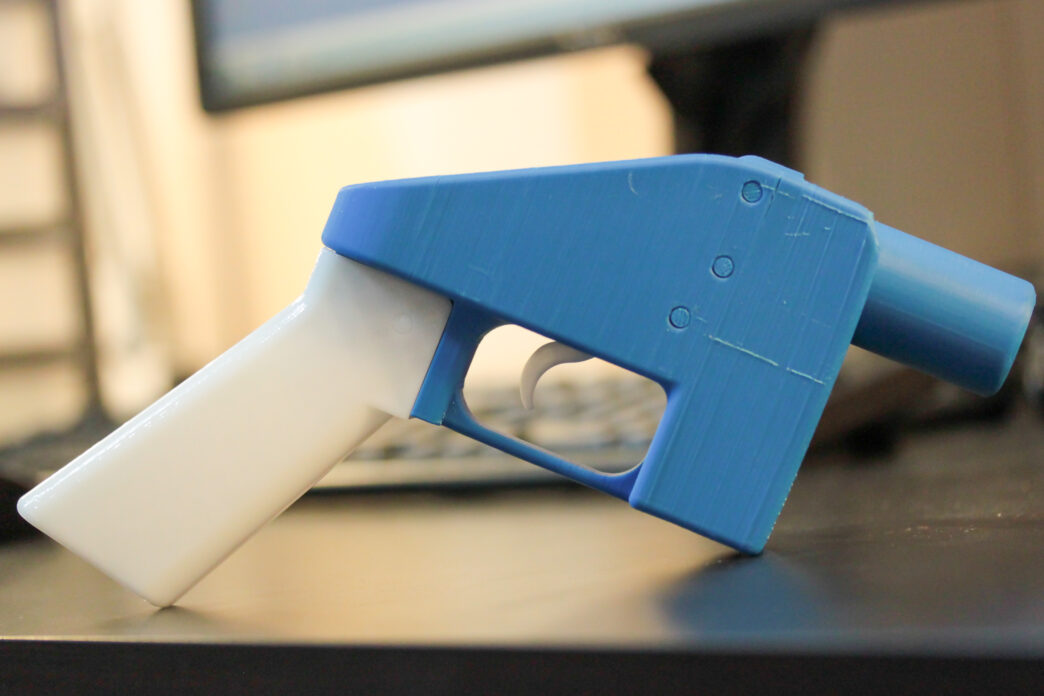
The most popular 3D-printed gun model is the FGC-9 (“F*** Gun Control, 9mm), created by an individual under the online pseudonym JStark. JStark – who passed away in 2021 – was a self-described “gun nut” who advocated for broad gun ownership among the general population. He had no prior engineering or software experience, and trained himself with computer aided design (CAD) to create the FGC-9. In 2020, the blueprints for the FGC-9 were made publicly available, with the updated FGC-9 Mk II being released the following year.
The FGC-9, comparable to a semi-automatic pistol, can be composed with up to 80 per cent 3D-printed components. The 20 per cent of the firearm composed of metal can be acquired legally, such as from steel tubes. The design is among the most used worldwide, and is used by rebel insurgencies in Myanmar, as well as by organised criminals and violent extremists in Europe.
Current EU Firearms Law
The FGC-9 is one of many readily available blueprints accessible worldwide, due partly to the lack of concrete EU regulations that prevent the proliferation of such blueprints. Current EU firearms law is mandated by EU Directive 2021/555, which was adopted in 2021. It provides a robust legal framework that sets minimum standards for private acquisition, ownership, maintenance, and transferral of firearms between member states.
The recent implementation of EU Directive 2025/41 complemented the regulations set by 2021/555. It restricts specific firearm components and ammunition, and requires compulsory marking and licensing regulations. Enforcement of these laws is handled primarily at the national level, with Europol providing crucial support by linking investigations across jurisdictions.
Where the Loopholes Remain
Despite substantial firearms regulations, 3D-printed guns continue to proliferate within Europe. The most glaring issue is the lack of language explicitly mentioning 3D-printed firearms and accompanying blueprints. When the current Firearms Directive was adopted in 2021, 3D-printed guns like the FGC-9 were still relatively new and had not yet become mainstream. Upon final implementation in 2021, no explicit article or section regulating 3D-printed firearms and blueprints was included, despite the growing popularity of the FGC-9 and updated variants.
The lack of an explicit ban on blueprints and 3D-printable components made it harder for Europol and national agencies – whose countries often lacked similar language in their gun laws – to prosecute illegal activity. For example, when Finnish police arrested a 3D-printed gun manufacturer in 2022, the prosecution had to rely on existing firearms legislation. This meant that they had to prove both the weapons’ functionality and danger levels. Moreover, the possession of a 3D printer and firearms blueprints alone was not a prosecutable offense, as illegal intent under Finnish law wasn’t sufficient to prosecute.
Areas to Address
Amending Current Laws
The most actionable (and most achievable) next steps would be the introduction of measures to explicitly ban the production, distribution, and usage of 3D firearms blueprints. Additional guidelines for cross-EU detection of these firearms should also be implemented to stem the online distribution of blueprints. These measures will likely be implemented in the next iteration of the EU Firearms Directive, which is anticipated to occur in late 2025 and early 2026 as stipulated by Article 17 of EU Directive 2021/555.
Additional revisions should also be considered to the European Regulation 2021/784, the anti-terrorism laws that mandate social media companies to remove content flagged as terrorist content. Similar to the EU Directive 2021/555, this Regulation doesn’t explicitly prohibit the posting of 3D firearm blueprints, creating a legal grey area. This means that posting or sharing advertisements for blueprints seen on Meta, WhatsApp, and Telegram is not automatically illegal. Ideally, the Terrorist Online Content Regulation should be revised with the Firearms Directive to mandate social media companies immediately take down posts sharing, or otherwise advertising, 3D firearms blueprints in the same way child exploitation and terrorist manuals are regulated.
Investment in New Technology
With the implementation of such measures, improved means to enforce them must also be considered. Artificial intelligence has become an emerging tool in the fight against ghost guns, and the EU Commission has already taken steps to research its impacts. The CEASFIRE Project was started in 2022 and is a 3-year project funded by the European Union’s Horizon Europe. Using advanced AI technology, the CEASEFIRE System aims to stem illegal firearms trafficking. It consolidates multiple technologies into one platform for law enforcement and supports intelligence gathering, seizure registration, online monitoring, and blueprint detection.
CEASEFIRE is a multifaceted operation, blending cyber patrolling, offline and online analysis, and information fusion to surveil the darkweb, detect weapons and components in parcels, and monitor trafficking activity online. CEASEFIRE also integrates with EU, Europol, and Interpol detection systems to enhance cross-border intelligence sharing. It integrates five use-case scenarios in its training, one of which focuses on the online distribution of 3D weapons blueprints.
Building a comprehensive detection network like CEASEFIRE will effectively address the challenges of monitoring online 3D weapons blueprints. AI tools can sort through massive datasets, and establishing a shared intelligence network with advanced AI tools will make effective monitoring of trafficking activity more achievable. Other promising ongoing projects include SIDE, which is a 3D printing fingerprint system designed to brand 3D-printed weapons components to make it easier for law enforcement to trace back to an offender.
SIDE either physically embeds information into the print or invisibly changes a component’s structure to track it throughout its lifespan. It also contains protections called a Trusted Execution Environment, which shields against any third-party attempts to tamper with its embedding procedure. Upon experimental testing of SIDE, simulations showed a 100 per cent success rate in fingerprint extraction, even when components and prints were 75 per cent destroyed.
While SIDE doesn’t replicate the work of CEASEFIRE, which aims to monitor and stem online sharing of 3D firearms blueprints, it is highly effective at tracing components to their sources. In other words, SIDE and similar systems have the potential to make untraceable ghost guns traceable. Despite still being in the research phase, European investment into a project similar to SIDE – in a manner akin to the CEASFIRE grant investment – would provide EU law enforcement agencies with another powerful AI tool in the fight against ghost guns.
Conclusion
3D-printed ghost guns continue to pose a security threat to European countries, and the problem is only getting worse. Despite having some of the world’s strictest gun laws, criminals and violent extremists continue to build 3D weapons in their own homes using easily accessible online blueprints.
With the looming revision of the Firearms Directive coming at the end of 2025 or the beginning of 2026, the EU Commission has the opportunity to close its current legal loopholes in both EU Directive 2021/555 and EU Regulation 2021/784 to stem the distribution and possession of 3D firearms blueprints. Once these loopholes are closed, further investment into new AI-supported systems like CEASFIRE and SIDE should be implemented to support European law enforcement agencies. The EU has the means to tackle this problem, and must use it to take decisive action to demystify the untraceable enigma of 3D-printed ghost guns, and prevent them from becoming the future generation’s most dangerous blindspot.