











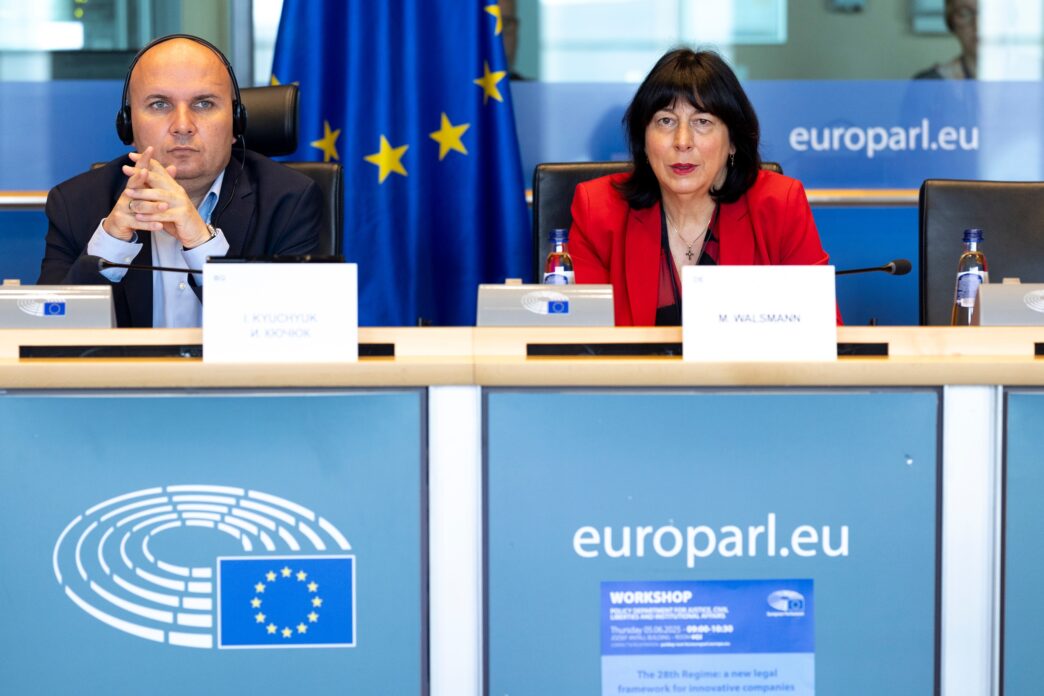
In her 2025 State of the Union address, Ursula von der Leyen promised to make life easier for European startups. Alongside the usual pledges on competitiveness, clean tech, and digital ambition, she unveiled something less headline-grabbing but potentially far more consequential: a legal shortcut. Dubbed the “28th regime”, this optional, harmonized framework would allow innovative companies to operate across the EU without having to navigate 27 national systems. It’s not the first time the EU has flirted with legal opt-ins, but it might be the boldest.
The idea is deceptively simple: create an EU-level alternative that exists alongside national frameworks, giving companies the option to plug into a streamlined set of rules. In theory, that means less friction and more growth. Von der Leyen’s broader political guidelines lean heavily on simplification, digitalization and the promise of a nimbler Single Market. In this sense, the 28th regime is as much a symbol as it is a tool – nod to Europe’s ongoing identity crisis between deepening and widening, between harmonizing and flexibly governing.
But symbols don’t build legal certainty, and shortcuts often come with trade-offs. Civil society actors like ECAS have already flagged concerns about transparency and democratic legitimacy. Others see the regime as a necessary adaptation, a legal workaround in an integration system increasingly hamstrung by unanimity and political inertia.
So, is this a genuine fix to Europe’s regulatory maze or a quiet admission that deeper integration is off the table? This article examines the idea, evolution, and implications of the 28th regime. From its legal foundations to its political optics, from past failures to future potential, it asks: Is Brussels finally thinking outside the box? 
Historical and Legal Design of the 28th Regime
Optional harmonization isn’t new to the EU. In fact, the 28th regime is something of a déjà vu moment for legal integration. Long before startups became the darlings of the Single Market, Brussels experimented with bespoke legal frameworks designed to operate alongside national systems, most of which quietly fizzled out. Remember the European Private Company Statute? No? That’s because it never passed.
The idea behind these regimes was simple: bypass the political quagmire of full harmonization by offering a parallel EU-wide framework. Instead of imposing uniformity, the EU would let companies voluntarily opt into a supranational model. These frameworks were meant to simplify cross-border activity, cut red tape, and offer legal certainty particularly in company law, taxation, and even foundation statutes. But they rarely succeeded.
What went wrong? As Martin Gelter shows, EU company law has always struggled to reconcile with the national economic models it’s meant to streamline. Varieties of capitalism, divergent legal traditions, and entrenched institutional interests made a truly unified business law environment a hard sell, especially to member states protective of their legal ecosystems. Even when proposals seemed useful in principle, like the Common Consolidated Corporate Tax Base (CCCTB), political will often evaporated during implementation.
Legally, 28th regimes function as optional instruments: EU laws that don’t replace national frameworks but offer an alternative legal route. This design creates a curious form of legal coexistence; the EU adds a new legal layer without removing the old ones. Blockmans describes this as functional differentiation: integration deepens in targeted areas without requiring treaty reform. It’s legal innovation by stealth, built on Article 352 TFEU or other flexible legal bases.
But that flexibility cuts both ways. As Markakis argues, differentiated integration can be both a tool for progress and a recipe for fragmentation. It allows the EU to move forward when consensus is elusive, but also risks creating a patchwork legal order, where legal certainty depends on which regime a company happens to choose. Zhelyazkova et al. add that even when harmonized rules exist, their implementation across member states varies significantly, weakening the idea that “one regime fits all” ever really applies.
Still, the logic behind reviving the 28th regime in 2025 is pragmatic. Full harmonization remains politically toxic, but the demand for cross-border simplicity is more urgent than ever. The Commission seems to be betting that companies, especially digital-first startups, will take the path of least resistance if it’s made attractive enough. Unlike its predecessors, the current proposal is framed not as a niche tool for legal technicians, but as a user-friendly, innovation-focused response to real economic frictions.
Whether this regime will fare better than its ancestors remains to be seen. But one thing is clear: in legal terms, the EU is now chasing usability rather than uniformity. And in that shift, the 28th regime might just be the most honest form of integration Brussels has attempted in years.
The 2025 Proposal: Scope, Goals and Governance Logic
What makes this 28th regime different from its forgotten predecessors? If the Commission is to be believed, quite a lot. Unlike earlier proposals that drowned in technocratic ambition, the 2025 version is sharply tailored, politically strategic, and unmistakably branded as pro-startup. It reflects a broader shift in the EU’s internal market strategy, from harmonizing rules to reducing friction.
At its core, the new regime offers an optional, digitally native legal pathway for cross-border business. The target audience isn’t legal departments of multinational giants, but the small and agile firms struggling with 27 different company registration rules, reporting obligations, and compliance procedures. By allowing them to opt into a modular, streamlined framework anchored in EU values, the regime promises faster scaling and fewer bureaucratic bottlenecks.
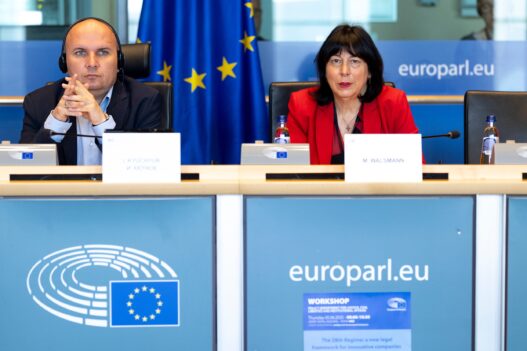
Presentations by Anne Sanders, J. Scott Marcus and Apostolos Thomadakis, all involved in the drafting process, lay out the ambition clearly: the regime is meant to function like a legal plug-in, interoperable with national systems but avoiding their complexity. It would provide EU-wide recognition of legal identity, harmonized transparency requirements, and simplified procedures for setting up shop in multiple member states. Crucially, it sidesteps treaty reform by relying on existing legal bases, Articles 114 and 352 TFEU, to justify regulatory approximation in the name of market efficiency.
Yet for all its legal cleverness, the regime is just as political. Von der Leyen presents it as a flagship simplification tool. It aligns with other Commission priorities: the SME Relief Package, the revived Capital Markets Union, and wider Single Market reforms. In that sense, the 28th regime is as much a response to Draghi’s 2024 competitiveness report as it is a legal initiative. It signals that the EU is serious about making the Single Market work for new economic actors.
And it’s not just about law or growth; it’s also about optics. Europe has long been criticized for lagging behind the US and China on innovation-friendliness. The 28th regime offers a counter-narrative: that Brussels, too, can be light-touch, agile, and business-minded, without abandoning its legal DNA.
Still, agility doesn’t mean an absence of structure. As Moeslein argues, the regime is not about deregulation, but about coordinated simplification. Digital registration, interoperable business identifiers, and streamlined compliance are all part of the package, as are transparency rules, baseline accountability, and traceability standards. Schimmelfennig might call this instrumental differentiation: integration not for its own sake, but in pursuit of targeted policy outcomes. The EU isn’t trying to rewrite its legal identity, just make it usable.
Yet this form of functional legal minimalism comes with risks. Who sets the default rules? Will national administrations embrace a framework that bypasses their registries and oversight mechanisms? And how voluntary is “optional” when market pressure makes it the de facto standard? These questions aren’t just legal, they are political. And they lead straight to the institutional trade-offs this regime introduces.
Legal Tensions and Institutional Trade-Offs
For all its sleek branding and startup-friendly messaging, the 28th regime is still a legal construction, one that reconfigures the relationship between EU law and national authority. “Optional” doesn’t mean apolitical. Behind the language of simplification lie deeper tensions: subsidiarity vs. usability, uniformity vs. flexibility, and innovation vs. institutional coherence.
First, subsidiarity. EU law isn’t supposed to elbow into domains best handled at the national level, unless doing so clearly improves cross-border outcomes. The Commission justifies the regime on these grounds, citing overlapping national rules that make market access harder, especially for small firms. But critics might argue this amounts to a soft bypass of subsidiarity. Instead of coordinating national systems, the EU is offering an alternative that could, over time, render them obsolete.
That logic raises enforcement questions. If the regime is opt-in, who ensures its rules are applied, and where? Unlike harmonized directives transposed into national law, the 28th regime exists alongside domestic legal orders. Zhelyazkova et al. show how implementation of EU law already varies significantly between member states. Adding an optional legal layer may widen this compliance gap, not close it.
Then comes legitimacy. As Mehlhausen et al. warn, differentiated integration is not just a technical fix, but a political move. The more Brussels leans on opt-ins to bypass deadlock, the more it risks weakening the shared sense of a European legal community. If business law becomes increasingly defined by regimes like this, what happens to the idea of one European legal space?
Civil society voices echo this concern. ECAS argues that simplified frameworks may entrench asymmetries, favouring better-equipped actors, both states and firms, and sidelining smaller administrations or less digitally mature companies. Legal simplification, after all, is not neutral: it reflects the preferences of those best placed to shape and navigate it.
From a governance standpoint, there’s also the matter of administrative buy-in. Member states will be asked to recognise a new category of company that didn’t originate in their own system, wasn’t registered through their procedures, and may not conform to domestic oversight models. Legal recognition at the EU level doesn’t guarantee practical acceptance by tax authorities, labour agencies, or banking regulators. Fragmentation may shift from law to implementation.
Markakis captures the paradox well: differentiated integration works best when it’s the exception, not the norm. If every complex area gets its own optional regime, the EU risks becoming a legal archipelago, one market, yes, but at many speeds.
Even the designers acknowledge this tension. Sanders, Marcus and Thomadakis emphasise that this isn’t a standalone construct, but a “regime with bridges”, one that aims to integrate rather than isolate. But those bridges aren’t automatic. They depend on trust, mutual recognition, and a willingness by national actors to embrace something they didn’t design.
In that sense, the 28th regime is less a technical solution than a political test: can the EU innovate legally without hollowing out its institutional coherence? Can it simplify without splintering? And what does this regime reveal about the evolving nature of European integration itself?
Function Over Form? Rethinking Integration Models
Strip away the jargon, and the 28th regime tells a bigger story: the EU is no longer betting on legal unity to drive integration. It’s betting on usability.
This marks a subtle but significant shift. For much of its history, European integration followed a familiar playbook: identify a shared problem, harmonise national rules, and enforce common standards. But that model is creaking under the weight of political fragmentation, divergent national interests, and institutional inertia. Instead, Brussels is experimenting with what Baroncelli et al. call adaptive governance, integration that prioritises output over architecture, flexibility over uniformity.
We’ve seen this logic emerge across sectors. Defence policy under Permanent Structured Cooperation (PESCO), the European Public Prosecutor’s Office (EPPO), and enhanced cooperation in areas like divorce law or financial transaction taxes all reflect a pattern of voluntary alignment. As Houdé and Wessel argue, this creates a “layered Europe”, where not every member state participates equally, but integration advances where it can. The 28th regime is not an exception to this trend. It’s a civilian, commercial reflection of it.
But here’s the twist: while many differentiated mechanisms carve out opt-outs for laggards, the 28th regime is an opt-in for front-runners. It’s built for those who want to move faster, scale quicker, and cut through the procedural undergrowth.
Still, function over form has consequences. As Schimmelfennig reminds us, the more the EU integrates through functionality rather than formal treaty change, the more it risks drifting from its founding vision of a common legal order. Integration by design becomes integration by workaround.
Yet perhaps this is the only kind of integration that still works. Markakis describes this as the realist turn in EU law, one that treats fragmentation not as failure but as a structural condition to be managed. Legal pluralism, once feared, becomes the cost of staying operational in a political union grounded in national democracies.
The 28th regime doesn’t resolve these tensions. It reflects them, and in doing so, shows a growing maturity in how Brussels manages them. It acknowledges that uniformity isn’t always feasible, but that optionality, if well-designed, can still deliver public value. It turns legal minimalism into strategic ambition.
Whether this model should become the norm is still up for debate. Too many 28th regimes, and the EU risks turning into a supermarket of legal tools rather than a polity of shared rules. Too few, and it may slide back into gridlock. The real challenge is finding the right balance and building the trust to sustain it.
In the end, the 28th regime is less a blueprint than a bellwether. It shows how the EU is adapting its legal imagination to a messier, faster world. And in that sense, it may be one of the most honest and quietly radical ideas Europe has produced in years.