






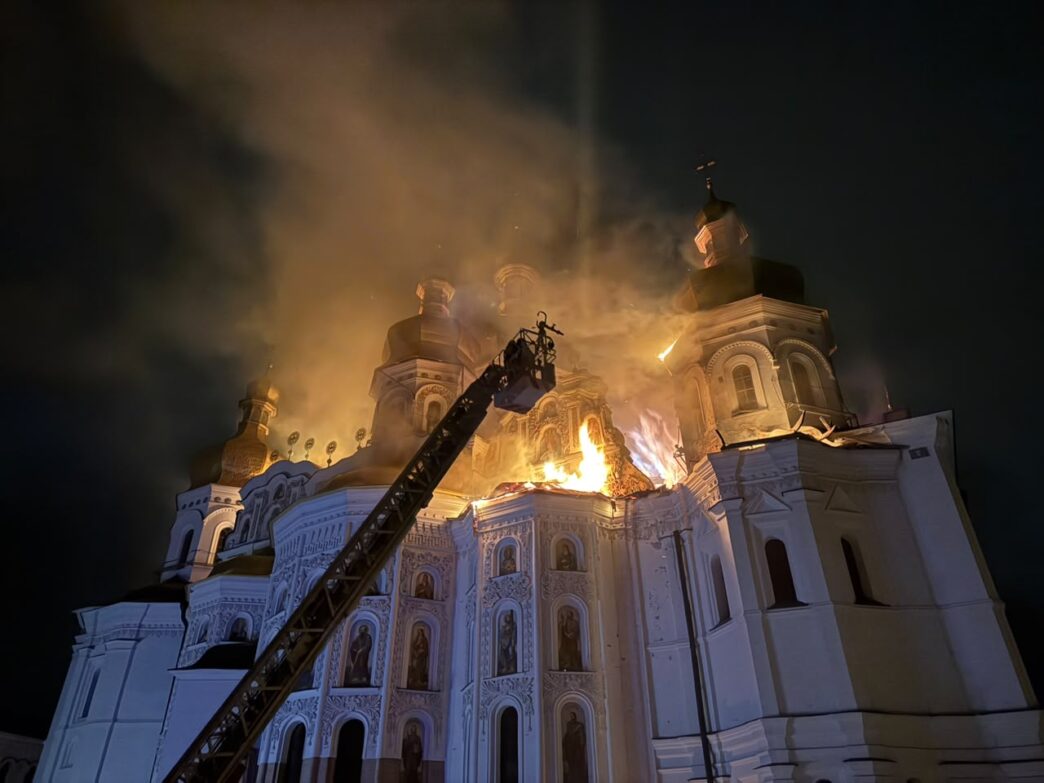
Millions of books have been destroyed, and hundreds of cultural sites have been damaged. But Ukraine’s struggle to preserve its culture reaches beyond what Russian strikes can physically destroy.
Just days before Ukrainian children returned to school, another part of the country’s cultural infrastructure went up in flames. A Russian strike on the logistics centre of Ukrainian publisher Ranok in August destroyed around eight million books, according to Ukraine’s Ministry of Culture. More than 620,000 were school textbooks. The ministry says Russian attacks destroyed more than 10 million books during the summer of 2026 alone. BBC News puts the recent total at around 12 million.
The losses illustrate a dimension of Russia’s war that extends beyond territory and military infrastructure. Libraries, museums, churches, archives, publishing houses and schools carry language, history and collective memory. Their destruction raises a broader question: what happens to a country’s identity when the institutions preserving it become part of a war?
More Than Buildings
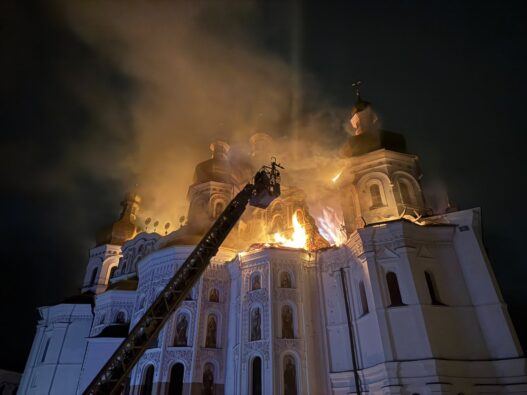
As of 29 July, UNESCO had independently verified damage to 545 cultural sites since Russia launched its full-scale invasion in February 2022. They include 43 museums, 22 libraries, five archives, 156 religious sites and 281 buildings of historical or artistic importance. Among them is the Kyiv-Pechersk Lavra, one of Ukraine’s most important religious and cultural landmarks and a UNESCO World Heritage Site. Russian strikes in June damaged several structures within the historic complex.
During a visit to Ukraine in August, UNESCO Director-General Khaled El-Enany described what the site represents:
“For nearly a millennium, this site has carried the faith, memory and cultural identity of generations.”
- Khaled El-Enany, UNESCO Director-General
The consequences extend beyond internationally recognised monuments. Local libraries, printing facilities and archives determine whether books remain available, historical records survive, and Ukrainian cultural life can continue during wartime. For schools, that impact is immediate. Figures published by the Ukrainian parliament’s education committee show that recent attacks destroyed hundreds of thousands of textbooks intended for the new academic year. Authorities and publishers must replace them while the war continues.
Identity Under Occupation
Physical destruction is only one part of the picture. UN human rights monitors have documented changes to education, language and cultural expression in Russian-occupied areas of Ukraine. Russian curricula have replaced Ukrainian ones in schools, while occupation authorities have promoted Russian language, history and state narratives.
The UN has also documented pressure on teachers and parents to accept the Russian education system. These changes have been accompanied by patriotic and military education centred on Russian state identity. For some families, education has become a reason to leave. One Ukrainian father, whose family fled the Russian-occupied part of the Kherson region in 2025, told UN human rights monitors:
“Our children do not want to study in Russian language. We had to leave.”
- Ukrainian father interviewed by UN human rights monitors
According to his testimony, occupation authorities had also threatened to remove the children from the family. This distinction matters. Damage caused by a missile or drone does not by itself establish an intention to destroy a national culture. Policies governing language, schooling and public life raise a different set of questions because they directly influence how identity can be expressed and passed to the next generation. UN High Commissioner for Human Rights Volker Türk warned that Russian actions had “ruptured the social fabric of communities”, pointing to consequences that could persist long after individual towns or territories change hands.
Ukraine describes these developments as part of a broader attempt to suppress its national identity. Foreign Minister Andrii Sybiha made that connection following the recent attacks on publishing infrastructure, arguing that the destruction targets Ukrainian language, memory and history. Russia rejects that interpretation. In comments reported by BBC News, the Russian embassy in London accused Ukraine itself of damaging cultural heritage through the removal of monuments and renaming of streets. It also claimed that some cultural facilities had been used to conceal military activities.
These claims do not change the independently verified scale of damage to Ukrainian cultural sites. They do, however, demonstrate how history and cultural identity have themselves become part of the political conflict surrounding the war.
Europe Moves to Protect Culture
Europe’s response increasingly treats cultural preservation as part of Ukraine’s resilience and recovery. EU support has included emergency equipment for cultural heritage sites, digital documentation of museum collections and training for Ukrainian professionals responsible for protecting endangered objects. In June 2026, the EU also provided €2 million through UNESCO to help safeguard Ukraine’s documentary heritage and improve digital access to collections. The European Commission said in 2025 that it had mobilised more than €50 million for Ukraine’s cultural and creative sectors since the beginning of the full-scale invasion, including more than €11.5 million for cultural heritage. The Team Europe Initiative for Cultural Heritage in Ukraine brings together the European Commission, EU Member States and Ukrainian partners. Its work ranges from emergency protection and training to longer-term recovery and reconstruction.
Info box provided by Laksmitha Anindyanari:
Documentary heritage refers to recorded materials that preserve the knowledge, history and cultural memory of a community or society. It includes materials such as manuscripts, books, archival records, photographs, films, sound recordings and other documents with lasting cultural or historical value. Protecting documentary heritage helps ensure that information and collective memories remain accessible for future generations, particularly when cultural institutions are threatened by conflict or disaster.
Culture is therefore moving beyond emergency assistance into a wider European policy question: what should be restored, what needs to be digitally preserved, and how can Ukrainian cultural institutions remain resilient during and after the war?
Why This Matters for Europe
Ukraine demonstrates why cultural heritage cannot be separated from security. A missile can destroy a printing press or museum in seconds. The consequences last much longer: fewer books, missing archives, damaged religious sites and communities losing places through which their history was preserved. Education makes that connection even more significant. Language, curricula and historical narratives influence how future generations understand the country to which they belong. Policies affecting them in occupied territories therefore reach beyond cultural administration into questions of political identity.
For Europe, protecting Ukrainian culture is consequently about more than reconstructing monuments. Ukraine is an EU candidate country whose cultural heritage forms part of Europe’s wider historical landscape. Supporting its preservation also reinforces the principle that military occupation should not determine which language, history or identity a population is allowed to maintain. The struggle over Ukraine’s future is therefore being fought not only over territory. It is also being fought over what can be remembered, taught and passed on.
What to Watch Next
The immediate challenge is replacing books and educational materials destroyed before the new school year while protecting cultural institutions from further attacks. In the longer term, reconstruction will require difficult choices. Ukraine and its European partners will have to determine how damaged heritage should be restored, how collections and archives can be digitally protected and how cultural institutions in formerly occupied territories can be rebuilt. UNESCO verification and UN human rights monitoring will remain important in distinguishing documented cultural destruction from broader political claims about intent – and in preserving evidence for potential future accountability.
Sources
- UNESCO – Damaged cultural sites in Ukraine verified by UNESCO. Updated 29 July 2026. Original source. Accessed 31 August 2026.
- UN Human Rights Office / Human Rights Monitoring Mission in Ukraine – Reporting on human rights, education and cultural identity in Russian-occupied Ukraine. Original source. Accessed 31 August 2026.
- Ministry of Culture of Ukraine – Reporting on attacks against Ukrainian publishers and the destruction of books. 28 August 2026. Original source. Accessed 31 August 2026.
- European Commission – Support for Ukraine’s cultural and creative sectors and cultural heritage. Original source. Accessed 31 August 2026.
- BBC News – Russian strikes destroy 12 million books ahead of Ukraine’s first week back at school. August 2026. Article. Accessed 31 August 2026.
AI Transparency Note: Artificial intelligence was used to support research, source comparison and the structuring of this briefing. Editorial decisions, source selection and the final assessment remain subject to human review.