










On the 5th of February 2026, the final legally binding agreement on the world’s two largest nuclear arsenals lapsed. The expiration of the New START now means that for the first time in more than five decades, Washington and Moscow operate without negotiated, enforceable caps on their deployed strategic nuclear forces. Since the early 1970s, through successive arms control arrangements, formal agreements structured the US-Russian strategic balance. That architecture has now formally dissolved.
This development is not just bureaucratic or symbolic. It impacts the operational, political, and psychological foundations of doctrines of Mutually Assured Destruction (MAD) and deterrence between the United States and Russia, while accelerating a broader transition towards a multipolar nuclear environment being increasingly shaped by China’s rapid expansion and innovation, Russia’s qualitative modernization, and shifts in the US strategic doctrine.
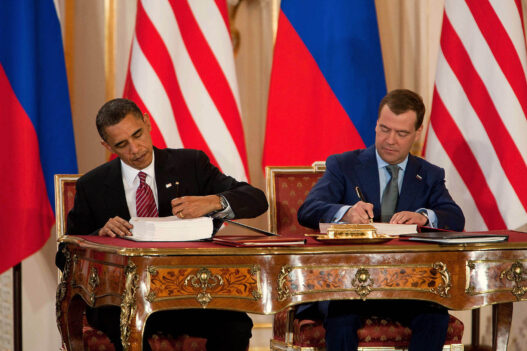
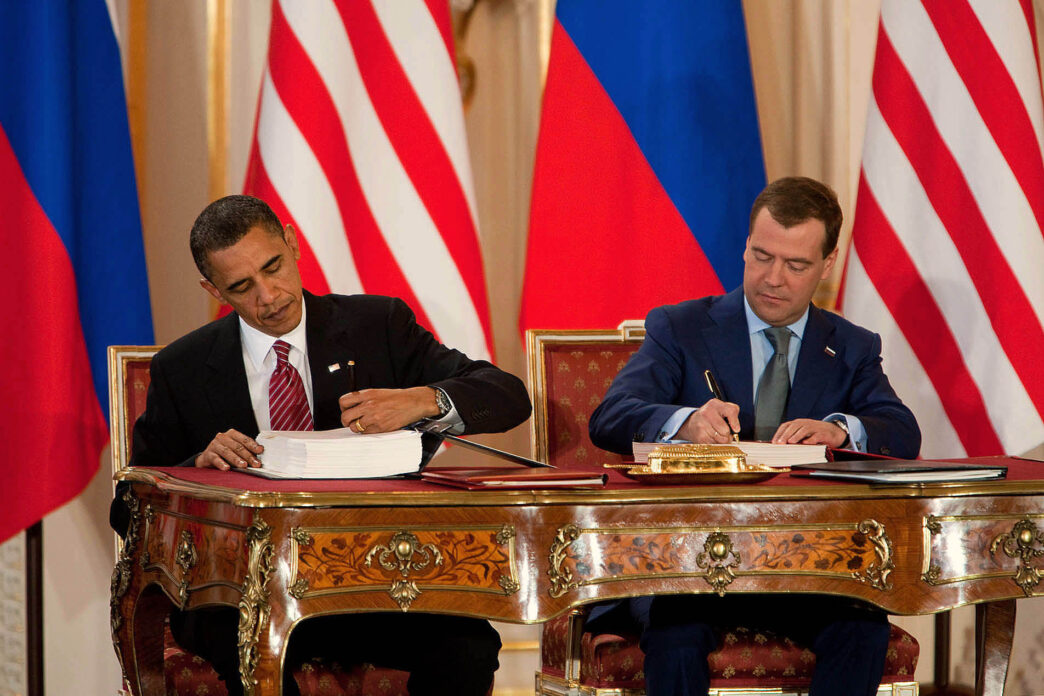
Signed in 2010 under President Barack Obama and President Dmitry Medvedev, New START represented a new dawn in the post-Cold War arms control framework. It imposed three central quantitative ceilings: 1,550 deployed strategic nuclear warheads, 700 deployed strategic delivery vehicles such as intercontinental ballistic missiles, submarine-launched ballistic missiles, and heavy bombers, and 800 total deployed and non-deployed launchers. Equally consequential were its verification mechanisms, as the treaty mandated regular data exchanges, notifications, telemetry sharing, and on-site inspections. Hence, these transparency provisions reduced uncertainty, limited worst-case force mobilisation, and stabilized crisis signaling.
The agreement was extended in 2021 for five years. However, it did not elaborate on further extension beyond February 2026. Despite attempts at diplomatic engagement, no successor framework could be reached before expiration. With this lapse, numerical ceilings have disappeared and, more critically, so have structured verification regimes. Strategic assessments of both countries now depend on national technical means, including satellite imagery, signals intelligence, and analytic inference, rather than cooperative transparency. 
According to the current US administration, the structural weakness of the New START was its bilateral nature. It did not include China, and this omission has now become a major obstruction for the US, which is increasingly wary of Beijing’s nuclear advancement and expansion; this is also reflected in the Department of Defense’s 2025 Annual Report to Congress on Military and Security Developments Involving the PRC. According to some open-source estimates and recent US defense assessments, China possesses approximately 600 nuclear warheads as of 2025. While still substantially below the US and Russian totals, each estimated to hold roughly 5,000 total warheads, including reserve and non-deployed stockpiles, Beijing’s rate of expansion is unprecedented in its nuclear history.
China has constructed more than 300 new ICBM silos across multiple missile fields and reportedly loaded more than 100 intercontinental ballistic missiles into its newly built complexes. Analysts estimate that Beijing has been adding close to 100 warheads annually since 2023 and could exceed 1,000 nuclear warheads by 2030 if current trends continue.
The 2025 annual report to the US Congress on military and security developments involving the People’s Republic of China highlights this structural shift. It assesses that Beijing is moving beyond a traditionally restrained “minimum deterrence” posture toward a more diversified and flexible nuclear triad. China now fields road-mobile ICBMs such as the DF-31 and DF-41, submarine-launched ballistic missiles deployed aboard Jin-class nuclear submarines, and an expanding air-delivered nuclear capability. Thus, this modernization is both quantitative and qualitative. Silo construction enhances survivability through dispersal and uncertainty. Solid-fueled missiles increase readiness and reduce launch preparation time. MIRV capabilities allow multiple warheads per missile, multiplying delivery potential without proportional launcher growth.
Washington has therefore insisted that any future strategic arms control framework must include China. Beijing rejects this premise, arguing that its arsenal remains numerically far below those of the United States and Russia, and the dangerous thresholds have not yet been reached. From China’s perspective, it should not be bound by ceilings designed for superpower arsenals that are several times larger. From Washington’s perspective, however, a bilateral regime is strategically obsolete in a three-actor nuclear environment. Last but not least, other players like North Korea are on the path of expansion too. This structural impasse complicates prospects for a successor agreement.
While China expands its capabilities, Russia continues to invest in the latest delivery systems designed to evade missile defenses and reinforce second-strike credibility. Among the most discussed systems is the 9M730 Burevestnik, a nuclear-powered cruise missile intended to possess effectively unlimited range. Russian authorities have claimed successful long-duration tests, including flights reportedly exceeding 14,000 kilometers over approximately fifteen hours. The strategic message from the Kremlin is clear: Russia seeks capabilities that circumvent traditional ballistic missile defense architectures through unpredictable trajectories and extended endurance.
Moscow has also advanced the testing of its Poseidon nuclear-powered unmanned underwater vehicle, an autonomous torpedo reportedly capable of carrying a multi-megaton nuclear payload. Poseidon represents a significant departure from the traditional delivery systems, targeting coastal infrastructure and naval assets while exploiting underwater stealth. Together, Burevestnik and Poseidon reflect Moscow’s strategy of diversification in response to perceived American technological advantages in missile defense.
Washington, for its part, has adjusted its strategic posture under President Donald Trump’s administration. Central to this shift is the proposed “Golden Dome” missile defense initiative, a layered defensive architecture designed to intercept intercontinental ballistic missiles and emerging threats. The concept envisions an expanded interceptor capacity, integrated early-warning systems, and potential assets in strategically significant regions such as Greenland, triggering threats of invasion earlier. Proponents argue that such defenses enhance deterrence by reducing vulnerability; however, critics counter that expansive missile defense systems may undermine strategic stability by pushing adversaries to increase their warhead numbers.
The potential resumption of underground nuclear testing has become a renewed discussion within the US political circles. Any return to testing by the United States would likely prompt reciprocal actions by Russia, North Korea, and potentially China, further eroding the long-standing norms sustaining the global nuclear testing moratorium.
The expiration of New START also unfolds within a broader geopolitical environment marked by deepening coordination among China, Russia, Iran, and North Korea. North Korea continues to expand its missile inventory, including solid-fuel intercontinental systems, while Iran maintains advanced enrichment capabilities within the framework of the Nuclear Non-Proliferation Treaty. Although direct evidence of nuclear warhead transfers remains absent, strategic convergence among these actors complicates deterrence and reinforces perceptions of bloc-based partnerships in the US.
The consequences of New START’s expiration are both immediate and structural. The loss of inspections and mandated data exchanges increases reliance on intelligence assessments, which, while technologically sophisticated, cannot fully substitute for cooperative verification. Reduced transparency heightens the risk of worst-case planning assumptions and misinterpretation of force movements during crises. The absence of legally binding ceilings may also generate incentives for quantitative expansion, particularly if one actor perceives a disadvantage in a three-way strategic environment.
European NATO members face particular uncertainty. They remain under the US nuclear umbrella, yet the American strategic discourse has increasingly emphasized the regional priorities in the Western Hemisphere; this is reinforced by the “Donroe doctrine”. If Washington’s posture shifts toward a more hemispheric or selective engagement model, NATO’s confidence in the extended deterrence could erode. This, in turn, may intensify debates within Europe regarding autonomous deterrent capabilities.
The broader non-proliferation regime may also experience strain. The Nuclear Non-Proliferation Treaty rests partly on the commitment of recognized nuclear-weapon states to pursue disarmament. Allowing the last major bilateral strategic arms control treaty to lapse without replacement risks weakening normative commitments embedded within that framework.
Yet the expiration of New START does not foreclose future diplomacy. Temporary and parallel commitments could cap deployed warheads to an extent, even without a formal treaty. Phased multilateral discussions might incorporate China initially through transparency measures rather than immediate ceilings. Expanded negotiations could address tactical nuclear weapons, missile defense systems, hypersonic delivery platforms, and emerging autonomous technologies. Technological innovations in remote sensing and data analysis may also provide modernized verification mechanisms suited to a multipolar nuclear environment.
The lapse of New START marks the end of a stabilizing chapter in nuclear governance. It occurs amid China’s accelerated buildup, Russia’s development of new delivery systems, US missile defense expansion, and shifting alliance politics. The strategic landscape is evolving toward a complex three-actor nuclear dynamic. Whether this transition yields a structured deterrence equilibrium or unconstrained competition will depend on political choices made in Washington, Moscow, and Beijing. Arms control historically emerged not from idealism but from recognition of mutual vulnerability. That logic remains intact. The central question is whether leadership will act upon it before miscalculation substitutes for diplomacy.