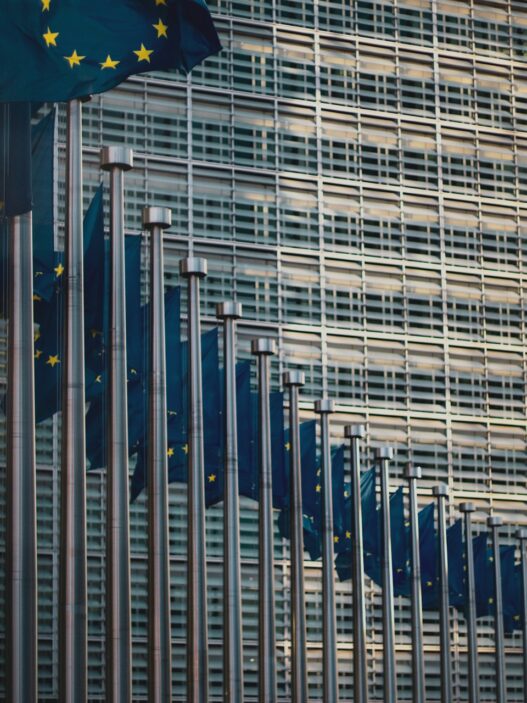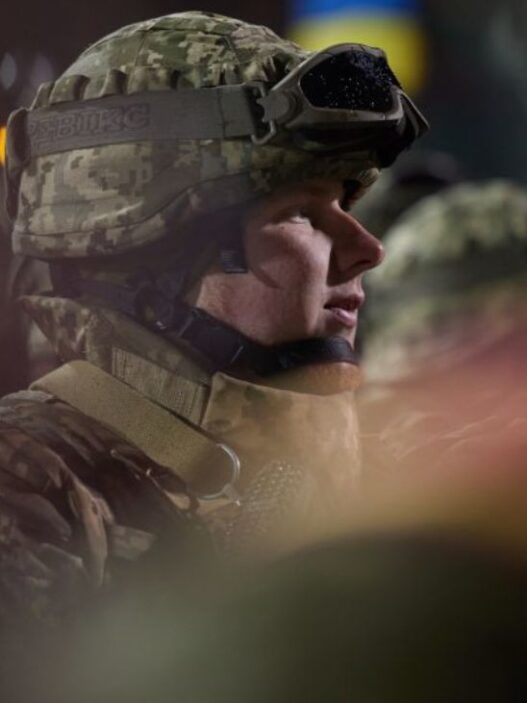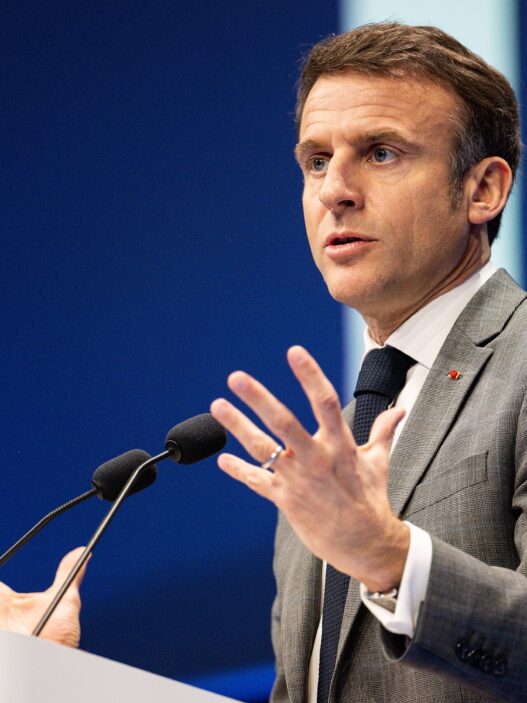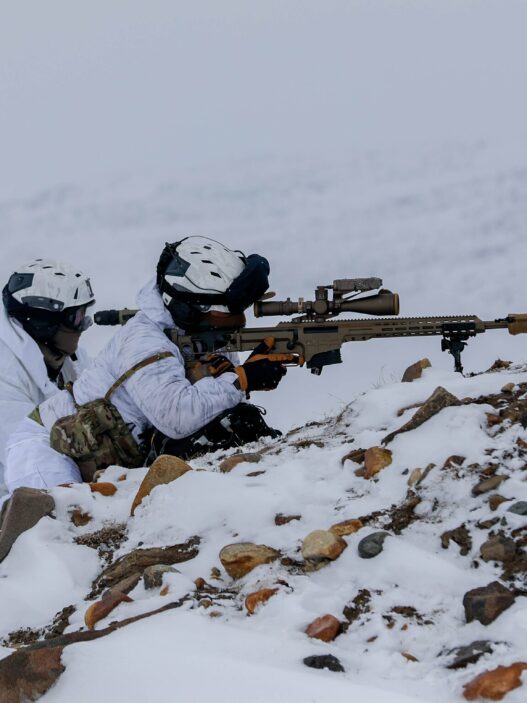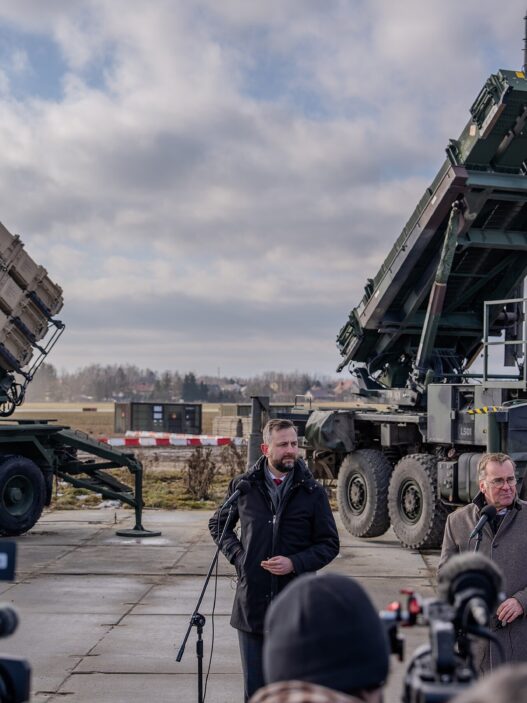







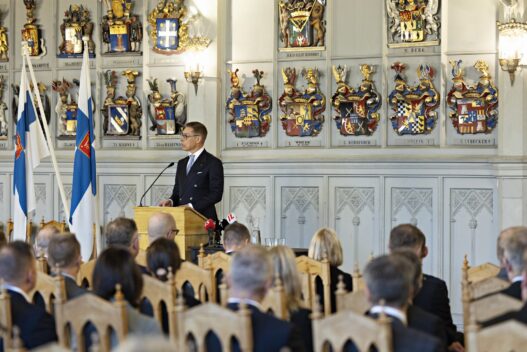
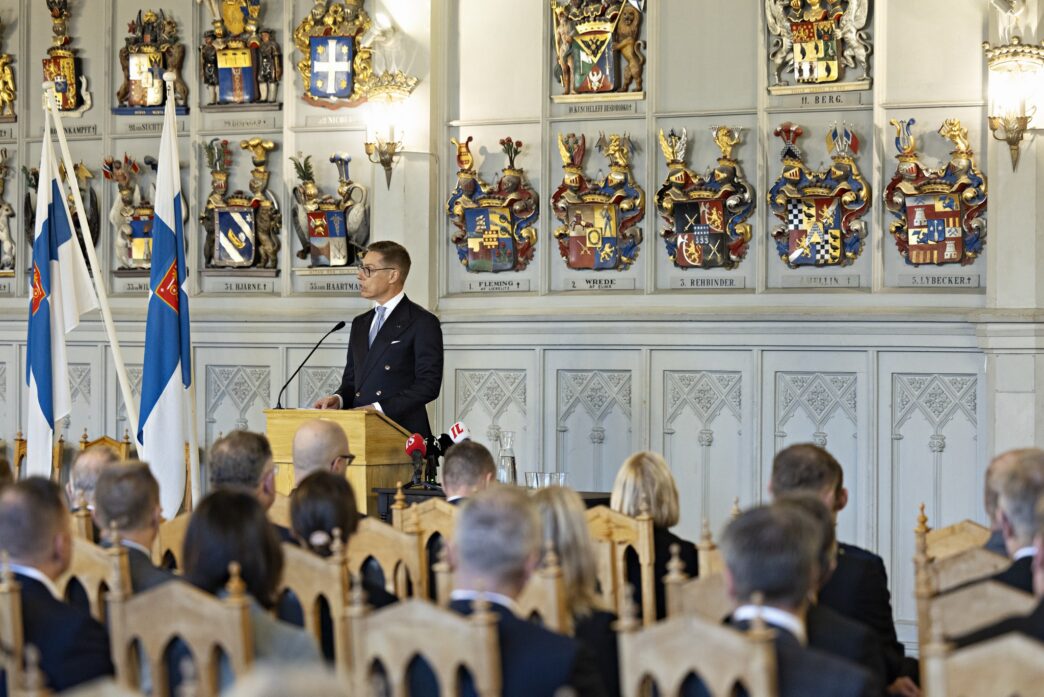
Stubb expects Russian sabotage and other hybrid attacks to continue, arguing that Moscow is seeking to destabilise Europe and weaken its support for Ukraine
Finland sees Russian activity but no imminent conventional military threat to NATO, despite sharing the alliance’s longest border with Russia
Stubb warns that overreacting can serve Russia’s strategy, saying Europe should remain vigilant while responding calmly and proportionately
He praised Germany’s attribution of the attempted Leipzig airport drone attack to Russia as the right approach: publicly identify responsibility and impose consequences rather than allowing intimidation to dominate the response
Sources: POLITICO Europe, Tagesschau, Le Monde
Transparency Note: Use of AI
More Quick Briefs:
·Russia·Ukraine·War in Ukraine·Euroclears·European Defence·Russian frozen assets
·Russia·Ukraine·War in Ukraine·Euroclears·European Defence·Russian frozen assets
Europe Reopens Russian Assets Debate ↗︎
Ukraine’s worsening funding gap is reviving Europe’s unresolved debate over whether frozen Russian central bank assets should be used to finance Kyiv - despite major legal and financial risks.
→Update (23.09.2026): Interview: Andersson calls for using frozen Russian assets to support Ukraine (POLITICO)
→Update (17.09.2026): News: Russian central bank appeals to EU court over Euroclear dispute (Reuters)
→Quick Brief, 11. September 2026:
→Ukraine says it needs an additional €27 billion for defence in 2026, increasing pressure on European partners to find new funding
→Around €210 billion in Russian central bank assets are frozen in the EU, with most held through Belgium-based Euroclear
→Countries including the Netherlands, Poland, Spain and Sweden want to reopen discussions on using the assets, while Belgium continues to warn about legal and financial risks
→Europe faces a strategic dilemma: using the assets could provide Ukraine with major new resources, but keeping them frozen preserves leverage over Moscow in future negotiations
→Sources: EUobserver, Reuters
→Transparency Note: Use of AI
·National Politics·Security·Elections·Liberals·Magdalena Andersson·Sweden·Ulf Kristersson
·National Politics·Security·Elections·Liberals·Magdalena Andersson·Sweden·Ulf Kristersson
Sweden: Slight win for Andersson ↗︎
Sweden votes on 13 September in an increasingly close contest between the centre-left opposition and Prime Minister Ulf Kristersson’s governing bloc, amid concerns over foreign disinformation.
→Update (23.09.2026): Interview: Magdalena Andersson calls for stronger Swedish role in EU foreign policy (POLITICO)
→Update (21.09.2026): Analysis: 11 lessons for Europe from the far right’s failure in Sweden (POLITICO)
→Update (17.09.2026): Analysis: How Sweden’s far right stopped winning (Reuters)
→Update (17.09.2026): News: Sweden’s left wins razor-thin election victory (POLITICO)
→Update (15.09.2026): Analysis: Sweden Democrats’ ‘era of deportations’ leaves lasting mark across Europe (EUobserver)
→Update (15.09.2026): Analysis: Elisabeth Thand Ringqvist emerges as Sweden’s most powerful woman (POLITICO)
→Update (14.09.2026): Interview: Expert warns Sweden faces ‘very messy’ political situation after election (YouTube)
→Update (14.09.2026): News: Preliminary results give Swedish opposition three-seat majority (AP)
→Update (14.09.2026): Analysis: Sweden’s election remains very close (Euractiv)
→Update (13.09.2026): News: Early poll suggests Swedes reject far-right party in election (EUobserver)
→Update (11.09.2026): Analysis: Sweden’s fractured left holds narrow lead ahead of election (Reuters)
→Update (10.09.2026): Analysis: Sweden’s election could bring far right into heart of government (Reuters)
→Update (10.09.2026): News: Sweden warns Russia is targeting elections in France and Germany with disinformation (POLITICO)
→Update (09.09.2026): Analysis: Swedish Voter Barometer (Novus)
→Quick Brief:
→Swedes will elect the Riksdag as well as regional and municipal councils on 13 September, with Prime Minister Ulf Kristersson seeking another term
→The centre-left led by Social Democrat Magdalena Andersson remains ahead, but the governing right-wing bloc has narrowed the gap significantly in recent polls
→The Liberals could be decisive: a recent Novus poll puts them at 4.3%, just above the 4% threshold needed to remain in parliament - potentially improving Kristersson’s chances of retaining power
→The election also takes place under heightened security concerns. Swedish authorities say Russia is not prioritising the vote, but pro-Russian networks have already spread fabricated claims about electoral fraud
→Sources: EUobserver, Reuters, Swedish Election Authority
→Transparency Note: Use of AI
·Diplomacy·Russia·Security·War in Ukraine·“Russia Sanctions”·21 sanctions package·Alisher Usmanov·France·Latvia·Luxembourg·Mikhail Fridman·Unanimity·Valdis Dombrovskis
·Diplomacy·Russia·Security·War in Ukraine·“Russia Sanctions”·21 sanctions package·Alisher Usmanov·France·Latvia·Luxembourg·Mikhail Fridman·Unanimity·Valdis Dombrovskis
EU Faces “Russia Sanctions”Fatigue ↗︎
EU Economy Commissioner Valdis Dombrovskis is urging member states to maintain economic pressure on Russia as disputes between capitals increasingly complicate the bloc’s sanctions policy.
→Dombrovskis warns of growing “sanctions fatigue” after almost five years of war, arguing that weakening European pressure would benefit Moscow
→The EU has adopted 21 sanctions packages since Russia’s full-scale invasion, targeting energy, finance, trade and Russia’s military-industrial complex
→Internal divisions are becoming more visible: France secured the removal of Alisher Usmanov from the sanctions list, while Luxembourg pushed for Mikhail Fridman’s delisting. Latvia initially blocked the moves before lifting its veto
→Changing the system is difficult because EU sanctions require unanimity. Dombrovskis says removing that requirement is not currently realistic, leaving political unity among all 27 governments essential
→Sources: Euractiv, European Commission - EU sanctions against Russia
→Transparency Note: Use of AI
·Europe in the world·Middle East Relations·Security·Aspides·Bab al-Mandeb·European Union·Houthis·Italy·Kaja Kallas·Red Sea·Suez Canal·Yemen
·Europe in the world·Middle East Relations·Security·Aspides·Bab al-Mandeb·European Union·Houthis·Italy·Kaja Kallas·Red Sea·Suez Canal·Yemen
Houthis Tighten Grip on Red Sea ↗︎
Houthi gains along Yemen’s Red Sea coast are increasing the threat to a crucial Europe-Asia trade route, pushing the EU and countries such as Italy to strengthen their naval response.
→Update (22.09.2026): News: Belgium to send frigate to EU’s Red Sea Aspides mission in late October (Euractiv)
→Quick Brief:
→The Iran-aligned Houthis have seized Yemen’s Red Sea coastline, strengthening their position around the strategically vital Bab al-Mandeb Strait
→Around 12% of global trade passes through Bab al-Mandeb, connecting the Indian Ocean to the Red Sea and the Suez Canal - making disruption particularly important for European supply chains
→The EU’s Aspides mission currently operates with six warships, but foreign policy chief Kaja Kallas says more than ten are needed to respond to the growing threat
→Italy is pushing for a stronger response: already active in Aspides, Rome is preparing an additional naval deployment to protect shipping as around 40% of Italian trade passes through the Suez Canal
→Sources: EUobserver, Reuters, Italian Navy
→Transparency Note: Use of AI
·Europe in the world·EU·European Commission·European Union·ICC·USA
·Europe in the world·EU·European Commission·European Union·ICC·USA
The EU Backs ICC After US Sanctions ↗︎
The EU has joined growing international criticism of US pressure on the International Criminal Court after Washington sanctioned its president and a senior prosecutor.
→Update (22.09.2026): News: Pressure mounts on EU to shield ICC from new US sanctions (EUobserver)
→Update (20.09.2026): News: Trump administration prepares sanctions against entire International Criminal Court (Reuters)
→Update (09.09.2026): News: US pressures NATO allies to oppose ICC (POLITICO)
→Quick Brief:
→EU leaders backed the International Criminal Court after the US imposed sanctions on its president and a senior official
→Secretary of State Marco Rubio accused the ICC of targeting officials from countries that reject its jurisdiction
→The EU, Germany and the Netherlands defended the court's independence and right to operate without political pressure
→Washington has vowed to further weaken the ICC's ability to pursue cases involving Americans and other non-member states
→Source: POLITICO
→Transparency Note: Use of AI
·Economic Policy·Monetary Policy·Security·Budget·Council of the EU·EU Borrowing·European Commission·General Affairs Council·Multiannual Financial Framework
·Economic Policy·Monetary Policy·Security·Budget·Council of the EU·EU Borrowing·European Commission·General Affairs Council·Multiannual Financial Framework
EU Budget Battle Intensifies ↗︎
Six fiscally conservative EU countries are demanding major cuts to Brussels’ proposed €2 trillion budget for 2028–2034, setting up a difficult fight over Europe’s future spending priorities.
→Update (22.09.2026): News: France opposes cuts to foreign aid in next EU budget (POLITICO)
→Update (22.09.2026): News: Germany rejects Costa’s push for new EU budget taxes (POLITICO)
→Update (22.09.2026): News: EU ministers meet in Brussels for General Affairs Council (Council of the EU)
→Update (21.09.2026): Analysis: EU budget could strengthen rule of law safeguards but member states may blunt reforms (CER)
→Update (21.09.2026): News: Costa says EU budget needs new taxes governments are not already raising (POLITICO)
→Update (18.09.2026): News: Germany and Spain go head-to-head in EU budget fight (POLITICO)
→Update (17.09.2026): News: MEPs deadlocked over CAP’s place in next EU budget (Euractiv)
→Update (15.09.2026): News: Metsola urges Europe’s political centre to hold against extremes (Euractiv)
→Update (14.09.2026): News: EU plans cuts to staff and salaries in next long-term budget (POLITICO)
→Update (14.09.2026): News: EU countries split over scale of long-term budget cuts (Euractiv)
→Update (09.09.2026): News: Germany calls for hundreds of billions in EU budget cuts (Reuters)
→Update (09.09.2026): News: Costa says new EU taxes would reduce national contributions (POLITICO)
→Update (08.09.2026): News: France backs business tax to fund EU budget (Euractiv)
→Update (07.09.2026): News: Le Pen backs tobacco retailers against EU tax hikes (Euractiv)
→Update (07.09.2026): News: Ireland secures EU tax deal on carbon imports and e-waste (POLITICO)
→Update (04.09.2026): News: Spain urges EU climate adaptation fund and binding targets (Reuters)
→Update (04.09.2026): Commentary: EU budget could loosen China’s grip on critical raw materials (Euronews)
→Update (03.09.2026): News: EU budget negotiators criticise frugal states over cuts (EUobserver)
→Update (03.09.2026): Interview: Lithuania says eastern flank needs must shape EU budget (Euractiv)
→Update (02.09.2026): News: Spain worried by EU budget debate (Euractiv)
→Update (02.09.2026): News: EU budget camps remain deadlocked (EUobserver)
→Update (31.08.2026): News: Ireland seeks to break EU budget deadlock (POLITICO)
→Update (27.08.2026): Europe’s defence promise meets budget reality (ECFR)
→Quick Brief:
→Germany, Denmark, the Netherlands, Austria, Finland and Sweden want cuts of several hundred billion euros
→The European Commission has proposed a nearly €2 trillion seven-year budget for 2028–2034
→The six still want priority spending on defence, competitiveness, migration and European sovereignty
→They reject new joint EU borrowing and demand cuts across spending areas as national budgets face consolidation
→Sources: Euractiv, Reuters, Council of the EU
→Transparency Note: Use of AI
·International Right·National Politics·Security·Ukraine·War in Ukraine·24 February 2022·Diplomacy·Hard Winter·Russia·USA
·International Right·National Politics·Security·Ukraine·War in Ukraine·24 February 2022·Diplomacy·Hard Winter·Russia·USA
Russia’s Invasion of Ukraine ↗︎
More than four years after Russia launched its full-scale invasion, Ukraine continues to resist as the war has evolved from Moscow’s failed attempt at a rapid victory into a prolonged conflict with no political settlement in sight.
→Update (22.09.2026): Analysis: Russian Ministry of Defense falsely claims encirclement of Dobropillya as part of cognitive warfare campaign (ISW)
→Update (22.09.2026): Analysis: Western tech helps funnel foreign recruits into Russia’s war (POLITICO)
→Update (21.09.2026): Analysis: Ukraine’s largest Moscow air raid overwhelms defences and hits key oil refinery (EUobserver)
→Update (20.09.2026): Analysis: Russia secretly plans to massively expand kamikaze drone production (POLITICO)
→Update (20.09.2026): News: Ukrainian drones hit Moscow oil refinery, killing two (Reuters)
→Update (19.09.2026): Analysis: Russian Ministry of Defense exaggerates battlefield gains ahead of UN General Assembly (ISW)
→Update (18.09.2026): Analysis: Tusk reveals classified estimates of Ukrainian battlefield casualties (EUobserver)
→Update (18.09.2026): Analysis: Kremlin denies post-election mobilization amid fears of public backlash (ISW)
→Update (18.09.2026): Podcast: Ukraine faces mounting pressure ahead of wartime winter (ECFR)
→Update (17.09.2026): Analysis: Russia pushes to capture Dobropillia before autumn conditions worsen (EUobserver)
→Update (17.09.2026): Analysis: Russia continues deporting Ukrainian female political prisoners to distant penal colonies (ISW)
→Update (17.09.2026): News: Russia targets passenger trains to undermine Ukraine’s economy and morale (POLITICO)
→Update (16.09.2026): Analysis: Ukrainian forces reportedly advance beyond Zherebets River (EUobserver)
→Update (16.09.2026): Analysis: Putin frames Duma elections as referendum on Ukraine war (ISW)
→Update (15.09.2026): Analysis: Ukraine hits record number of Russian refineries as Trump pushes energy ceasefire (EUobserver)
→Update (15.09.2026): Analysis: Ukraine’s Operation Vivaldi disrupts Russia’s Fortress Belt encirclement (ISW)
→Update (14.09.2026): Analysis: Ukraine races to counter Russia’s jet-powered drones (POLITICO)
→Update (14.09.2026): Analysis: Zelensky reiterates readiness for mutual energy strikes moratorium (ISW)
→Update (13.09.2026): Analysis: Russian strikes near Polish border signal growing escalation (ISW)
→Update (12.09.2026): Analysis: Ukraine disrupts Russia’s Donbas offensive plans (ISW)
→Update (13.09.2026): Analysis: Anthropic AI joins Ukraine war after Russian exploitation (EUobserver)
→Update (11.09.2026): Analysis: Russian Offensive Campaign Assessment (ISW)
→Update (10.09.2026): Analysis: Russia spent over €110bn on Ukraine war so far in 2026 (EUobserver)
→Update (10.09.2026): Analysis: Russian Offensive Campaign Assessment (ISW)
→Update (10.09.2026): Analysis: Russian Occupation Update (ISW)
→Update (10.09.2026): Analysis: Zelenskyy gambles on pressure to force Putin into peace talks (POLITICO)
→Update (09.09.2026): Analysis: Russia’s claimed Kharkiv encirclement lacks evidence (EUobserver)
→Update (09.09.2026): News: Zelenskyy’s plane nearly hit by drone en route to Oslo (Euronews)
→Quick Brief:
→Russia launched its full-scale invasion on 24 February 2022, expecting rapid military gains, but its attempt to seize Kyiv failed as Ukrainian forces resisted
→The failed initial offensive developed into a long war of attrition, with Russia occupying Ukrainian territory while Ukraine continues to defend itself and strike Russian military and economic targets
→Winter has repeatedly intensified pressure on civilians: Russia has systematically targeted Ukraine’s electricity and heating infrastructure, causing widespread outages and disruption
→Diplomacy has not ended the war: renewed US-led efforts have so far failed to bridge fundamental differences between Moscow and Kyiv, while Russian military operations continue
→Sources: UN Human Rights Monitoring Mission in Ukraine, Reuters, Associated Press
→Transparency Note: Use of AI
·Diplomacy·Economic Policy·European Governance·National Politics·Technology and Digital Policy·Transatlantic Relations·Canada·European Union·Mark Carney·SAFE·Unique Alliance·USA
·Diplomacy·Economic Policy·European Governance·National Politics·Technology and Digital Policy·Transatlantic Relations·Canada·European Union·Mark Carney·SAFE·Unique Alliance·USA
Canada Eyes Closer EU Alliance ↗︎
Canada is exploring an unprecedented new relationship with the European Union as Prime Minister Mark Carney seeks to reduce dependence on the United States and deepen economic and security ties with Europe.
→Update (22.09.2026): News: EU and Canada to unveil new partnership, but it may not be ‘associate membership,’ says ambassador (POLITICO)
→Update (20.09.2026): News: Costa says EU wants ‘closest possible relationship’ with Canada (POLITICO)
→Update (18.09.2026): Analysis: EU-Canada partnership could become model for other democracies (Euronews)
→Update (17.09.2026): News: Details emerge on Canada’s EU associate membership offer (EUobserver)
→Update (17.09.2026): News: EIB chief heads to Ottawa as EU-Canada ties deepen (POLITICO)
→Update (17.09.2026): News: Trump calls potential EU-Canada associate membership a ‘hostile act’ (Financial Times)
→Update (17.09.2026): Address to the European Parliament by Mark Carney (YouTube)
→Update (16.09.2026): News: Canada keeps EU ‘associate membership’ label at arm’s length (Euractiv)
→Update (15.09.2026): Analysis: How far can EU-Canada alliance go? (Euronews)
→Update (14.09.2026): Commentary: Canada’s unique alliance with EU is already taking shape (EUobserver)
→News: Canada eyes EU associate membership amid US tensions (Euronews)
→Commentary: EU should offer Canada deeper defence ties (ECFR)
→Quick Brief
→Carney says Canada is not seeking EU membership, but wants a “unique alliance” that could bring the country substantially closer to the bloc
→Ideas under discussion include easier movement of goods, services and workers, alongside deeper cooperation in defence, AI, energy and critical minerals
→Canada is already moving closer to EU structures: it became the first non-European country to participate in the EU’s SAFE defence instrument in 2026
→The shift comes as Canada-US trade tensions intensify, pushing Ottawa to diversify beyond its traditionally dominant economic relationship with its southern neighbour
→Sources: Reuters, Prime Minister of Canada, Council of the European Union
→Transparency Note: Use of AI
·Inside Europe·National Politics·AfD·Berlin·CDU·Friedrich Merz·Germany·Left Party·Mecklenburg-Western Pomerania
·Inside Europe·National Politics·AfD·Berlin·CDU·Friedrich Merz·Germany·Left Party·Mecklenburg-Western Pomerania
German State Elections Test Merz: CDU out of State Parliament ↗︎
Voters in Berlin and Mecklenburg-Western Pomerania head to the polls on 20 September, putting Chancellor Friedrich Merz’s CDU under renewed pressure two weeks after the AfD’s breakthrough in Saxony-Anhalt.
→Update (22.09.2026): Analysis: Merz faces dilemma over whether to redraft or defend Germany’s economic reforms (POLITICO)
→Update (22.09.2026): Commentary: Germany’s political crisis raises a new question for Europe (Euractiv)
→Update (21.09.2026): News: Merz vows to keep coalition together for Germany’s ‘democratic future’ (BBC)
→Update (21.09.2026): Analysis: Germany’s political centre under pressure (European Relations)
→Update (20.09.2026): News: Merz vows to keep fighting AfD after far-right victory in Mecklenburg-Vorpommern, CDU falls out of state parliament in Mecklenburg-Western Pomerania (POLITICO)
→Update (20.09.2026): News: Merz calls CDU’s worst postwar state election result a ‘disaster’ but vows to continue reforms (Reuters)
→Update (20.09.2026): News: AfD edges SPD in Mecklenburg-Western Pomerania as Berlin swings left and CDU suffers losses in both states (Euractiv)
→Quick Brief:
→Berlin and Mecklenburg-Western Pomerania vote on the same day, electing new state parliaments in the latest major tests of Germany’s shifting political landscape
→In Mecklenburg-Western Pomerania, the AfD is leading while Merz’s CDU is polling around 6%, putting it at risk of a historically weak result and potentially even missing the 5% threshold
→In Berlin, the Left Party leads the race, while the AfD has also gained support. Housing shortages and high rents have emerged as major issues for voters
→The elections come after the AfD won 43.8% in Saxony-Anhalt on 6 September, intensifying pressure on Merz and the established parties’ refusal to form coalitions with the AfD
→Sources: Reuters, Federal Returning Officer, Euractiv
→Transparency Note: Use of AI
·European Law·Sports and Politics·European Commission·FIFA·UEFA
·European Law·Sports and Politics·European Commission·FIFA·UEFA
Infantino Under Fire: FIFA World Cup Rights Sale Could Breach Competition Rules ↗︎
The European Commission has warned that FIFA's planned sale of commercial rights linked to the FIFA World Cup could violate EU competition law.
→Update (21.09.2026): News: Infantino says he is open to talks over FIFA reform (BBC)
→Update (06.09.2026): News: Infantino wants another term as FIFA president (BBC Sport)
→Update (27.08.2026): UEFA prepares case against Infantino (Sky Sports)
→Update (10.08.2026): Infantino faces growing opposition (ZEIT)
→Update (03.08.2026): Infantino under scrutiny on investment deal (ZEIT)
→Update (01.08.2026): Gianni Infantino ‘has lost UEFA’s confidence’ (The Guardian)
→Update (01.08.2026): FIFA chief Infantino abandons World Cup sell-off plans after threat of future World Championship boycott by UEFA (DW)
→Update (July 30, 2026): UEFA to hold emergency meeting today over FIFA plan to sell $4bn stake (Sky News UK)
→Quick Brief:
→The Commission raised concerns over FIFA's planned commercial rights sale
→EU officials warned the process may restrict competition and market access
→FIFA could face regulatory scrutiny if the sale breaches EU antitrust rules
→The case highlights the EU's willingness to apply competition law to major global sporting organisations
→Source: Euractiv
→Transparency Note: Use of AI
·Human Rights·Migration·National Politics·EU's Southern Border·European Governance·Marocco·Migration Policy·Spain
·Human Rights·Migration·National Politics·EU's Southern Border·European Governance·Marocco·Migration Policy·Spain
Thousands of Migrants Reach Spain’s Ceuta Enclave From Morocco ↗︎
Thousands of migrants have attempted to reach Spain's North African enclave of Ceuta by swimming from Morocco.
→Update (21.09.2026): News: Spain and Morocco move to prevent new mass crossing into Ceuta on election day of Marocco (Euractiv)
→Update (18.09.2026): News: Police begin moving migrants from Ceuta beaches (BBC)
→Update (18.09.2026): Analysis: Ceuta border crisis fuels Europe’s far right despite falling migrant arrivals (Reuters)
→Update (17.09.2026): Analysis: Ceuta crisis exposes dangerous erosion of trust within Schengen (CER)
→Update (17.09.2026): Commentary: Europe must clean up Spain’s Ceuta migration mess (POLITICO)
→Update (09.09.2026): Analysis: Ceuta migration crisis fuels Spain’s and Europe’s far right (EUobserver)
→Update (08.09.2026): News: Ceuta mayor urges tougher EU stance on Morocco (Euractiv)
→Update (06.09.2026): News: Torres calls for consensus over Ceuta migration crisis (RTVE)
→Update (06.09.2026): News: Sánchez stands alone in defence of Morocco over Ceuta (Euractiv)
→Update (03.09.2026): News: Spain seeks full EU integration for Ceuta and Melilla (Euractiv)
→Update (03.09.2026): News: Commission questions Spain’s Frontex expansion request in Ceuta (EUobserver)
→Update (03.09.2026): News: Protests in Spain against government’s handling of Ceuta migrant crisis (BBC News)
→Update (02.09.2026): Commentary: Solve the crisis without undermining democracy (elDiario.es)
→Update (02.09.2026): News: Spanish police point to Morocco’s role in Ceuta crisis (Euractiv)
→Update (31.08.2026): News: Italy extends border checks on Spain (Euractiv)
→Update (31.08.2026): News: Sánchez says no evidence Morocco drove Ceuta surge (Euractiv)
→Update (30.08.2026): Spain announces €165m Ceuta emergency package (Euronews)
→Update (28.08.2026): Editorial: Racist attacks in Ceuta must stop (CTXT)
→Update (28.08.2026): Ceuta struggles to identify victims (ZEIT)
→Update (28.08.2026): Spain seeks Frontex and Europol help (Euronews)
→Update (27.08.2026): Bogus Ceuta videos go viral (EUobserver)
→Update (27.08.2026): Spain tightens migration rules (Euractiv)
→Update (26.08.2026): Intelligence missed Ceuta surge warning (Euractiv)
→Update (25.08.2026): Sánchez fast-tracks Ceuta crisis response (Euractiv)
→Update (25.08.2026): Sánchez convenes National Security Council (El País)
→Update (23.08.2026): Ceuta exposes EU migration failure (Exxpress)
→Update (20.08.2026): Ceuta crisis fuels far right (El Confidencial)
→Update (20.08.2026): Spain plans two refugee camps in Ceuta (ZEIT)
→Update (15.08.2026): Spain prepares for new Ceuta influx (ZEIT)
→Update (15.08.2026): Spain allegedly ignored Ceuta warnings (Reuters)
→Update (12.08.2026): Morocco reinforces Ceuta border security (AP News)
→Update (11.08.2026): Meta, TikTok agree to Ceuta fact-checking (Reuters)
→Update (11.08.2026): Meloni, Frederiksen reshape refugee policy (La Stampa)
→Update (10.08.2026): Ceuta exposes Europe’s leadership crisis (Diário de Notícias)
→Update (09.08.2026): Spain’s migration debate intensifies (El Mundo)
→Update (08.08.2026): Does Sánchez use his domestic policy towards Italy? (El Mundo)
→Update (08.08.2026): Nationalism spreads across Europe (La Repubblica)
→Update (08.08.2026): Human rights groups expect more deaths (ZEIT)
→Update (08.08.2026): EU urges platforms to act (DW)
→Update (07.08.2026): Ceuta tests European solidarity (The Brussels Times)
→Update (07.08.2026): Spain imposes checks on Italy (RFI)
→Update (06.08.2026): EU can’t depend on neighbours for border control, migration chief says (POLITICO)
→Update (06.08.2026): Rightwingers attack Spanish ministers for skipping EU meeting on Ceuta in European Parliament (Euractiv)
→Update (06.08.2026): Spain warns of new influx (Euractiv)
→Update (06.08.2026): Analysis/Opinion: Ceuta reveals migration policies hypocrisies and far-right-fuelled fears (PubAffairs Bruxelles)
→Update (04.08.2026): Migration expert Gerald Knaus on populism, disinformation, the power of images, and solutions about preserving control over migration and guaranteeing Human Rights (The Rest Is Politics)
→Update (04.08.2026): Ceuta demands lasting solutions (Diario de Cádiz)
→Update (04.08.2026): EU calls borders “shared responsibility” (DW)
→Update (04.08.2026): Morocco says it warned Spain after court ruling on migration (Euronews)
→Update (04.08.2026): EPP frames Ceuta crisis as a threat to European sovereignty (La Vanguardia)
→Update (04.08.2026): Rome and Madrid Clash Over Ceuta Migration (ESdiario)
→Update (04.08.2026): Ceuta under pressure from growing child migration (ZEIT)
→Update (03.08.2026): Luxembourg backs Spain's Ceuta response (100,7)
→Update (03.08.2026): Von der Leyen demands tighter border checks (Euronews)
→Update (03.08.2026): Spain seeks EU solidarity (Cadena SER)
→Update (03.08.2026): Morocco blames Ceuta migration influx on social media and human trafficking (New York Post)
→Update (02.08.2026): Death toll from migrant rush into Spanish enclave rises to 72, Morocco speaks of 11 deaths (Reuters)
→Update (02.08.2026): How Spain's migrant crisis created a political storm - whipped up by social media (BBC)
→Update (01.08.2026): The Spanish prime minister accuses EU partners of taking “selfish” and “unlawful” stances (Politico EU)
→Update (01.08.2026): According to authorities, approximately 50,000 migrants have returned to Morocco (Zeit, Reuters)
→Update (31.07.2026): Europe's solidarity questioned (ECFR)
→Update (31.07.2026): 57 migrants die in border rush (Reuters)
→Update (31.07.2026): Gerald Knaus, chair of the European Stability Initiative, a think tank focused on EU enlargement and integration, defends Spain over the Ceuta migration crisis and asks critically about Morocco's part in this (Channel 4)
→Update (31.07.2026): Andy Burnham speaks of a 'concerning situation' of Ceuta's migrants (Sky News UK)
→Update (31.07.2026): Migrants in Ceuta cannot move to other countries, EU says (Euronews)
→Update (31.07.2026): Von der Leyen calls Ceuta migration crisis 'unacceptable' and demands 'swift' returns (SUR in English)
→Update (31.07.2026): European leaders turn on Spain's Sánchez over Ceuta migrant crisis (Euractiv)
→Update (31.07.2026): Ceuta calls for national emergency (Euro Weekly News, SUR in English)
→Update (30.07.2026, 31.07.2026 ): Italy and Denmark call for Schengen closure to Spain, considering the case as a threat to national security (Euronews, Euractiv)
→Update (30.07.2026): Spain mobilises troops to Ceuta (Euronews)
→30.07.2026
→Spanish authorities increased border surveillance and rescue operations
→The incident highlights persistent migration pressures at the EU's southern border
→The crossings are likely to intensify debate over EU migration policy
→Source: Euronews
→Transparency Note: Use of AI
→Here is a briefing by ERA about the topic
·EU Public Policy·EU KIDS Act·European Commission·KIDS Act·Social Media
·EU Public Policy·EU KIDS Act·European Commission·KIDS Act·Social Media
EU KIDS Act Propose Age-Dependent Restrictions on Social Media Use ↗︎
The European Commission proposes an age-dependent use of social media for kids and teenagers in the EU.
→Update (21.09.2026): Analysis: Can the EU protect children from social media harms? (Euronews)
→Quick Brief:
→The European Commission introduces a new KIDS Act to shape an age-dependent approach to social media use for children in the EU
→Under 13: children will not be able to access social media services. They can still use child-friendly video-sharing services through an account managed by a parent or guardian.
→Age 13 to under 15: children can use social media through a mini account managed by a parent or guardian, with limited features and a time restriction of 1 hour per day.
→From age 15 onwards: children will be able to open and manage their own social media account.
→Source: European Commission, EUObserver
→Further Sources:
→13.07.2026 - Analysis: EU expert panel recommends banning social media access for children under 13 (European Commission)