









On May 7, 2025, the new German Chancellor Friedrich Merz made waves by stating his intention to withdraw Germany’s opposition to the classification of nuclear energy as renewable in EU legislation. Merz has also expressed an openness to investing in new nuclear technology, potentially allowing for a future reversal. These moves come after both Merz and French President Emmanuel Macron encouraged greater European autonomy from U.S. influence.
Merz’s comments and Germany’s pivot have raised questions about a possible German nuclear comeback. Germany has a long history of anti-nuclear activism, culminating in the 2023 shutdown of its last operational nuclear powerplant. However, new technological advancements in small modular reactors (SMR) and shifting geopolitical dynamics may open new opportunities for a limited reentry into the nuclear energy space.
Despite potential opportunities, contradictions from officials in Merz’s government complicate any reintroduction of nuclear power. If a nuclear reversal were to occur, political constraints would likely make it limited in scope. The Chancellor must therefore navigate a web of political opposition and shifting geopolitical dynamics before a nuclear reconciliation is possible.
Origins of German Anti-Nuclear Politics
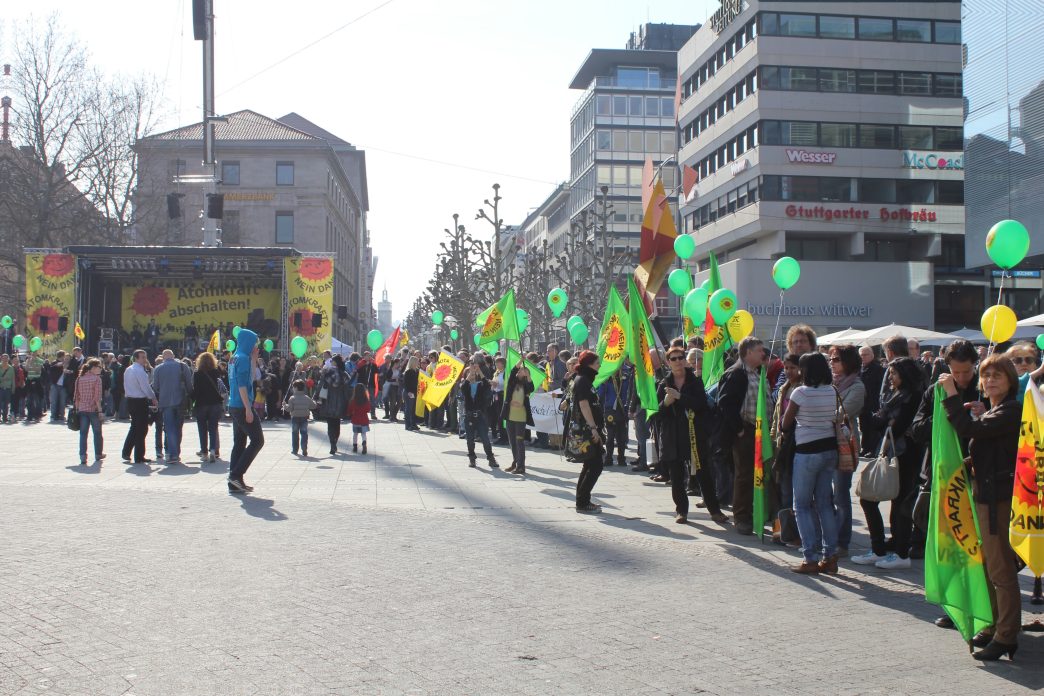
The German debate on nuclear energy can be traced back to the 1970s in West Germany. Originally grassroots in scale, the popularity of the anti-nuclear movement surged following the accident in 1979 at the Three Mile Island nuclear plant in the United States. Amid this wave of protests, the Green Party (Bündnis 90/Die Grünen) was founded in 1980 as a single-issue party against nuclear energy. Their popularity surged into the 1990s, especially after the 1986 Chernobyl disaster, where the widespread nuclear fallout across Europe drove fear and political opposition to nuclear power across all parties. 
In the 1990s and 2000s, governments led by a coalition of the Social Democrats (SPD) and Die Grünen initiated measures to limit the lifespan of nuclear power plants and eventually phase out nuclear energy by 2022. The conservative opposition party, the Christian Democratic Union (CDU/CSU), promised to reverse these policies if elected. The CDU and FDP coalition followed through with this promise in 2010, extending the operating timelines of the remaining nuclear power plants. However, the Fukushima meltdown in 2011 again saw a multi-party consensus against nuclear power, and CDU Chancellor Angela Merkel oversaw the passage of the current phaseout resolution.
Economic Impacts of German Denuclearization
Germany’s denuclearization had a notable economic impact, which worsened after Russia invaded Ukraine. Unlike its neighbour France, which invests heavily in nuclear energy infrastructure, Germany has focused on transitioning to renewable energy. The Renewable Energy Sources Act kickstarted the implementation of Germany’s long-term energy transition program (Energiewende) in 2000. The Hydrogen Strategy was added in 2020 to help facilitate the transition to green hydrogen energy, but was reversed in 2025, allowing the construction of new gas-fired power plants without the hydrogen conversion requirement.
Despite the success of the Energiewende, which results in renewable energy providing around 62% of net public electricity generation, there has been a sharp increase in energy prices. This can be attributed to three main factors:
- Feed-in tariffs, auctions, and grid installation: From 2000 to 2017, the German government used feed-in tariffs to support the growth of renewable energy. Feed-in tariffs are government offers to purchase clean energy at fixed prices above the market value. In 2017, the government switched to auctions, where corporations bid on large renewable energy projects instead of the government subsidizing them. Additionally, Germany has prioritised complex and expensive underground high-voltage cable installations. These policies have all led Germany to have the fifth most expensive household energy prices at 38 cents per kilowatt hour compared to the global average of 15 cents.
- External Energy Dependence & the Russo-Ukrainian War: Before the Russian invasion of Ukraine in 2022, only 29% of Germany’s energy was produced domestically. Germany’s heavy reliance on Russia for oil and natural gas imports forced it to quickly diversify after Western sanctions were levied against Russia. This led to costlier imports of liquefied natural gas from other sources, as well as a reversal to burning coal. Without a consistent backup source of natural gas, the cost of maintaining wind and solar power grid reliability dramatically increased, reflecting higher consumer prices.
- The loss of nuclear power: Prior to 2011, about 22% of Germany’s total electricity came from nuclear energy sources. In the absence of nuclear-generated electricity, Germany needed to hasten its transition to renewable energy at marginal costs. Nuclear decommissioning and reactivation of coal energy sources have an estimated social cost of 12 billion U.S. dollars per year. As Germany’s electricity needs increase, the loss of nuclear power may limit its ability to react to geopolitical instability rapidly, and highlights the challenge of replacing low-emission, baseload power.
The Politics of Nuclear Energy in Germany
Traditionally, the partisan opposition to nuclear energy has been led by Bündnis 90/Die Grünen, the center-left Social Democrats (SPD), and the left-wing Left Party (die Linke). Conversely, the center-right Christian Democrats (CDU/CSU), centralist Liberals (FDP), and far-right Alternative for Germany (AfD) are generally pro-nuclear. Recently, public opinion polls have seen a shift, with the majority supporting a reversal in German nuclear policy.
Internationally, Germany is an outlier among other major powers. France has long been an advocate of nuclear energy, generating nearly 70% of its electricity from nuclear power. Outside of Europe, the United States and China are leaders in nuclear energy capabilities. The U.S. operates the largest nuclear power plant fleet in the world, generating 19% of its total electricity generation. Meanwhile, China has tripled its nuclear capacity in the last decade as President Xi Jinping seeks to achieve net-zero carbon emissions by 2060. Even countries like South Korea and Japan—that have restarted 14 reactors since the 2011 disaster—have embraced nuclear energy as an alternative to fossil fuels.
Germany’s unique adherence to its Energiewende reflects its political environment and anti-nuclear history. While interest in a nuclear reversal seems to be reemerging, external pressure and rising energy prices continue to muddle the path forward. Despite Merz’s tentative support, there are questions about whether a turnabout is possible and what it would look like within current political, economic, and technical frameworks.
Opportunities for Re-entry
The high cost and lengthy timeline of traditional nuclear energy projects are significant economic obstacles to new, fully-funded projects. Progress in small modular reactor (SMR) technology could serve as a solution. Internationally, Merz might be able to leverage geopolitical dynamics by forging a deeper cooperative relationship with the United States. The U.S. has actively petitioned the World Bank to renew funding support for nuclear projects, opening the door for potential cooperation to counter Chinese economic influence. Given existing energy ties, the most realistic opportunity for reentry is increased cooperation with France. A hypothetical agreement could see German firms supporting French SMR developers to secure cheaper electricity imports. This limited approach may be more politically feasible, making up for the loss of Russian natural gas imports and increasing European energy autonomy in the process.
Small Modular Reactors (SMR)
Recent developments in small modular reactor (SMR) technology seek to address the traditional problems of nuclear energy. SMRs carry potentially massive benefits in improving modularity, meaning reactor components can be shipped and assembled on-site. Thus, reducing capital investment costs and enhancing safety. SMRs are also built below grade for safety, giving them longer lifetimes and allowing them to be safely sealed and transported for defueling at the end of their life cycle.
China recently installed the first main pump for its ACP100 project, six years after it began. This significantly shorter timeline exhibits the potential for SMRs to streamline grid installation. In Europe, Romanian energy companies RoPower and SN Nuclearelectrica partnered with U.S. company NuScale to proceed with investments in SMR construction in Romania. In February 2025, British company Rolls-Royce selected German firm Siemens to supply materials for its SMR development project.
However, SMRs still struggle with similar issues as traditional nuclear power, especially with regard to costs. In 2023, the construction cost of NuScale’s SMR project was 75% higher than expected, and the projected power price was 53% higher than expected. The U.S. isn’t planning on opening any new reactors this year, and the first commercial SMRs won’t be operational until 2030. Despite the apparent economic advantages of SMRs, political barriers remain, as CDU Energy Minister Reiche ruled out any reintroduction of nuclear energy, making their implementation in Germany unlikely.
International Partnerships
Merz can also leverage Germany’s position between the U.S. and China to secure funding for nuclear projects. Washington is concerned about China and Russia, which have financed nuclear energy projects both within their borders and in other countries. China, in particular, seeks to become a key nuclear exporter, aiming to sell thirty nuclear reactors by 2030. In comparison, there are currently two European projects backed by U.S. firms: the aforementioned NuScale contract in Romania, and a reactor project in Poland supported by U.S. firm Westinghouse.
U.S. policymakers went further by introducing the International Nuclear Financing Act earlier this year. This legislation aims to counter Russian and Chinese influence by promoting more U.S.-backed nuclear energy projects. Merz, who campaigned heavily in favor of “de-risking” from China, may be a suitable candidate for U.S. support. China invests heavily in Germany, with 21% of its investments going into the energy sector. Partnering with U.S. firms would be mutually beneficial to U.S. and German strategic goals against China, and would also reduce the cost burden for advanced nuclear technology projects in Germany. Similar to SMR investments, however, this is unlikely in the short term due to political opposition to nuclear energy installations in Germany.
Franco-German Cooperation
Ultimately, if a German nuclear recalibration were to take place, it would be limited in scope. The obstacles mentioned above to SMR development and U.S.-German cooperation likely disqualify any domestic installation of nuclear power. Therefore, increased cooperation with France is the most probable scenario for a German nuclear reentry. France, which derives 70% of its electricity from nuclear energy, exported a record amount of carbon-neutral electricity in 2024. Yet it still grapples with the same problems that typically plague nuclear projects. The Flamanville 3 European Pressurised Reactor (EPR)—which began construction in 2007—was switched on in 2024, twelve years later and €15.8 billion over budget. The project was marred by maintenance delays and safety concerns, both of which were targets of heavy criticism.
Germany could build on its recent rapprochement with France to initiate a soft reentry into nuclear power. With Germany no longer opposing the EU Commission’s classification of nuclear energy as “green,” countries like France will now have the possibility to fund these projects at a lower cost. Access to green bonds, public and private financing would drive down borrowing costs and make capital more accessible. Germany could point to this decision as a leveraging tool, helping secure a favorable energy deal with France.
In 2024, Germany imported 23% of its electricity from France and might benefit from further increasing its imports from there. A potential energy agreement could see German-backed financing of French nuclear energy projects, similar to the agreement Siemens made with Rolls-Royce. In exchange, France would provide Germany with larger amounts of cheaper, nuclear-generated electricity. This hypothetical arrangement could supply Germany with the baseline electricity it currently lacks, facilitating its Energiewende in the long term and weaning them from Russian gas dependence.
Such an agreement would also have strategic value, allowing Germany to enter the French nuclear umbrella and enhance European energy security. Furthermore, there wouldn’t be any direct construction of nuclear projects in Germany, making it a more politically viable option. It would also promote Merz’s key goal of increased European cooperation. Even with the promise of such an arrangement, German political hesitancy remains. In July 2025, German representatives rejected an EU proposal to use 2 trillion euros to finance nuclear energy projects from 2028-2034.
This rejection highlights the continued political contradictions Chancellor Merz faces within his governing coalition. Internal pressures will force Merz to tread carefully on politically divisive issues like nuclear energy. Recently, the large coalition has somewhat faltered, and Merz’s objective of maintaining unity in his “firewall” against the far-right AfD would take precedence over nuclear power politics. Deeper Franco-German collaboration is ostensibly more realistic for the nuclear-conscious Germany, but internal political division will likely still complicate the path forward.
Conclusion
Germany finds itself at a unique crossroads. Despite its success in transitioning to renewable energy, its capacity can’t meet its current electricity needs. New Chancellor Friedrich Merz has signaled his willingness to reverse the previous closure of nuclear power plants, but faces significant political, financial, and technical barriers. Even with the potential of SMRs and mutual interest in U.S.-German cooperation, a speedy turnaround is unlikely when considering the current state of SMR technology and the complex political circumstances. This ensures that any German nuclear energy resurgence would be limited and is likely to come from deeper Franco-German cooperation.
A hypothetical energy agreement could see German firms materially or financially supporting French nuclear energy projects in exchange for favourable rates on increased electricity imports. Such an agreement would detach Germany from its reliance on Russian gas and ensure German access to a carbon-neutral, baseload energy source to support its long-term transition to renewable energy. It would also create a tighter European electricity market, enhance European energy autonomy, and allow Germany to enter the French nuclear umbrella, all of which achieve Merz’s ideological goal of a more independent Europe.
Ultimately, internal political forces within and outside of Merz’s governing coalition will be the deciding factor in whether any action is taken on his tentative support for nuclear energy. Even if a nuclear reversal comes, Germany’s future likely still lies with its renewable energy and green hydrogen goals. Nuclear energy, if reintroduced at all, would probably serve in a transitional capacity—substituting the role of liquefied natural gas until renewable energy becomes the sole provider of electricity in the German energy grid.