








New Chapter or New Playbook?
When the European Council gave the green light to open accession negotiations with Ukraine in December 2023, it was hailed as a historic move, an act of strategic resolve amidst a grinding war on the EU’s eastern flank. By the time the intergovernmental conference was formally launched in June 2024, the message was clear: enlargement was back at the heart of European politics.
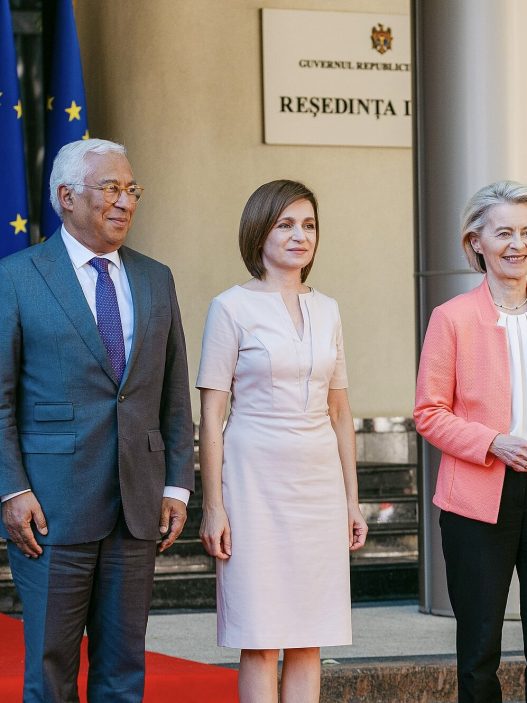
But behind the choreography of flags and press releases lies a deeper transformation. Ukraine’s accelerated trajectory, moving from association to negotiation in record time, raises the question of whether the European Union is still playing by its traditional rules. For years, enlargement followed a predictable script: candidate countries would align with the acquis communautaire, meet Copenhagen criteria, and pass through a long tunnel of institutional reform before catching a glimpse of membership light. Yet Ukraine’s journey, born of war and framed as a geopolitical necessity, doesn’t quite fit this model.
Is the Union bending its rules to meet the moment or rewriting them altogether? And what does this mean for the queue of other would-be members, many of whom have been treading water for decades?
This article explores whether the EU is shifting from a conditionality-based enlargement regime to a more political, geostrategic logic. Drawing on Ukraine’s case, but also those of Moldova, Georgia, and the Western Balkans, it examines whether a new paradigm is emerging and, if so, whether it can be squared with the EU’s self-image as a community of law. 
Ukraine’s Path: Fast-Tracked but Not Standardized
If enlargement once demanded patience, Ukraine’s case rewrote the calendar. Just over two years after receiving candidate status in June 2022 and six months after the European Council’s green light, the country opened accession negotiations in June 2024. While much of this speed was driven by the extraordinary context of Russia’s full-scale invasion, the shift also signals something deeper: a recalibration of what constitutes preparedness, and how readiness is politically interpreted.
The foundation for Ukraine’s candidacy was laid in 2014 with the signing of the EU–Ukraine Association Agreement (AA), coupled with the Deep and Comprehensive Free Trade Area (DCFTA). These instruments brought the country into partial alignment with the EU’s acquis, particularly in areas like trade, competition, and regulatory standards. Yet, as Peter Van Elsuwege argues, the AA was not designed as a pre-accession tool; rather, it institutionalized a form of integration without membership, reflecting the EU’s caution about overpromising.
That caution has since been overtaken by crisis. With the AA serving as a de facto blueprint, Ukraine has leapfrogged earlier bureaucratic sequencing, supported by robust political backing from the European Council and key member states. The 2020 revision of the enlargement methodology, designed to streamline negotiations through thematic clusters, remains technically in place, but Ukraine’s treatment suggests selective application. In Brussels, officials speak less of benchmarks and more of signals.
Moldova, which opened negotiations alongside Ukraine in June 2024, mirrors some of this momentum. Yet it is Ukraine, larger, at war, and far more symbolically embedded in the European political imaginary, that drives the sense of rupture. Moldova’s case, while impressive, appears additive; Ukraine’s feels disruptive.
What’s emerging is a shift from rule-based accession to context-based inclusion. That shift is not yet codified, but it is already reshaping expectations, not only in Kyiv, but in Skopje, Tbilisi, and Sarajevo too.
The Others: A Tale of Stagnation
While Ukraine and Moldova surged ahead, the rest of the EU’s candidate countries remain stuck in slow motion. North Macedonia and Albania opened negotiations in 2022, but have yet to make substantive progress in any of the thematic clusters introduced by the revised methodology. Bosnia and Herzegovina was granted candidate status in December 2022 but has not met the key legislative or judicial benchmarks required to open talks. And Georgia, once considered a frontrunner, saw its trajectory reverse in 2023 amid democratic backsliding and EU criticism of “foreign agent” legislation modeled on Russia’s authoritarian playbook.
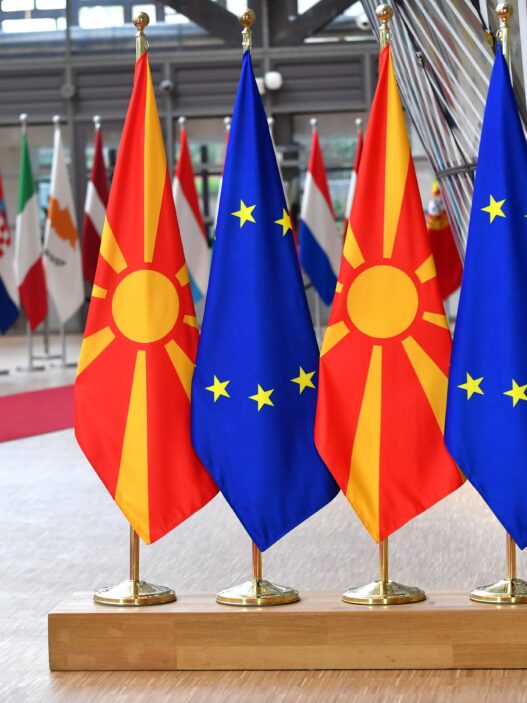
The Western Balkans in particular remain trapped in what some scholars describe as a credibility crisis, where enlargement is still promised, but no longer expected. North Macedonia, for instance, has completed major reforms and even changed its constitutional name, only to face continued roadblocks from bilateral disputes, first with Greece, then Bulgaria. Albania, often coupled with North Macedonia, suffers from political instability and weak rule-of-law reforms, as detailed in the European Commission’s 2023 report.
This long stagnation is not merely the fault of the candidates. The EU itself has been hesitant to deepen engagement, especially since the 2014–2016 enlargement fatigue following the economic and migration crises. The resulting ambiguity has bred frustration, democratic erosion, and a new generation of political elites less invested in the European path.
The contrast with Ukraine could not be sharper. As Frank Schimmelfennig observed, the EU traditionally used external incentives, credible rewards for compliance with democratic and institutional reforms to encourage transformation. But when the reward becomes uncertain, so too does the motivation. For candidates stuck in limbo, Ukraine’s fast-tracking is both inspiring and destabilizing. It raises a blunt question: Is merit still the metric, or is momentum all that matters?
The New Enlargement Logic
For most of the EU’s history, enlargement followed a painstakingly legalistic rhythm. From the 1993 Copenhagen Criteria to the complex screening of the acquis communautaire, membership was not merely political; it was conditional. Candidates were expected to democratize, liberalize, and institutionalize their way into the club. The EU’s promise was clear: follow the rules, and you will be rewarded.
This model came to define what Frank Schimmelfennig famously termed the “external incentives” approach to enlargement, where credible conditionality was the engine of transformation. In the 2000s, it worked. Central and Eastern European countries restructured entire political systems to gain entry. But in the decades since, the model has faltered. As credibility declined, so did influence.
Now, Ukraine’s fast-tracking is forcing a reckoning. The war created a moral and strategic imperative that trumped bureaucracy. As Peter Van Elsuwege has argued, the EU has shifted from offering “integration without membership” to “membership without full integration”. Today, it is political alignment that opens the door, with legal harmonization expected to follow.
This is not just about speed. It is about selectivity. While Ukraine and Moldova are being ushered through a streamlined process, Georgia is being held back over democratic backsliding, and Bosnia and Herzegovina is still awaiting the opening of negotiations. The Western Balkans watch as their compliance-heavy accession tracks stall, while Ukraine’s war-forged candidacy accelerates with less formal conditioning.
To justify this asymmetry, the Commission and Council have begun to speak in the language of geopolitics. As the 2023 Enlargement Package frames it, enlargement is now a “strategic investment in peace and security”. Similarly, the 2020 revised methodology prioritises political steering and early deliverables over strict sequencing. But does this flexibility signal reform or drift?
On the one hand, this evolution is defensible. As the Centre for European Policy Studies notes, the old enlargement model had become “detached from power realities” and prone to sabotage by veto-wielding member states. The geopolitical turn has allowed the EU to reassert control over its strategic periphery. A cluster-based, political-first approach could restore dynamism and help candidates progress in areas where they show readiness, without being hostage to lagging sectors.
But the downsides are considerable. As Kochenov and Basheska warn, fast-tracking without real checks may erode the EU’s credibility as a rule-of-law actor. When rule of law benchmarks become “negotiable” for geopolitically convenient partners, the EU risks reproducing the very governance gaps it claims to export stability against. There is also the danger of setting a precedent for differentiated membership where some countries are politically in, but legally incomplete.
A further concern is institutional overload. As Barbara Lippert points out, enlargement on strategic grounds cannot succeed without internal reform. Absorbing Ukraine, a vast, war-torn country with structural corruption and fragile institutions, will require more than goodwill. It will require treaty change, budget redesign, and a new vision of what EU governance entails. Strategic urgency must not become a substitute for institutional realism.
The geopolitical logic of enlargement is thus double-edged. It restores momentum and offers a clearer narrative to EU citizens and candidates alike. But unless paired with meaningful reform and consistent standards, it may deepen divisions between old and new members, between candidates treated as exceptions and those mired in expectation fatigue.
What we are witnessing, then, is not the end of conditionality, but its mutation. Conditionality no longer operates as a legal checklist, but as a flexible, sometimes ambiguous tool in a broader geopolitical playbook. The question for the Union is whether it can manage this evolution without losing its core identity as a community of law.
Rethinking Enlargement’s Identity
The European Union’s decision to fast-track Ukraine’s accession process is not simply a response to war. It is a signal of something larger: a recalibration of how the EU understands its borders, its identity, and its responsibility in a fractured geopolitical order. Enlargement, long treated as a technocratic process of rule transmission, has re-emerged as a strategic tool. But this shift carries consequences, both promising and perilous.
As Ukraine and Moldova proceed with negotiations, the Union faces a delicate balancing act. The geopolitical imperative to anchor vulnerable neighbours within the EU’s orbit is real. Russia’s aggression has turned enlargement from a distant promise into a security necessity. But necessity cannot become an excuse for incoherence. If the EU abandons conditionality entirely, it risks losing its soft power and becoming indistinguishable from the very power politics it sought to transcend.
The new enlargement logic, faster, more political, and selectively flexible, may well be necessary in a world of strategic threats and systemic rivalry. But it must be codified, not improvised. Without clear criteria, consistent benchmarks, and transparent communication, this new approach could foster resentment among long-standing candidates and confusion among EU citizens. As the European Council on Foreign Relations warns, shifting the logic of enlargement without internal reform risks opening the doors without reinforcing the house.
Nowhere is this tension more visible than in the Western Balkans. Countries like North Macedonia, which complied with extensive EU demands only to face delay after delay, may question the Union’s credibility if newer candidates surpass them based on geostrategic convenience. Similarly, Georgia’s recent struggles with democratic rollback raise the question of where the red lines now lie. If enlargement becomes entirely political, what happens to the rule-of-law foundations that once defined the EU?
Institutionally, the Union is ill-prepared to take in Ukraine as it stands. As Barbara Lippert notes, future enlargement requires not just external momentum but internal readiness including qualified majority voting, budgetary reform, and possibly treaty change. Without these, the Union may inherit new members without the tools to integrate them. A larger, more diverse Union will also face rising centrifugal pressures unless decision-making becomes more agile and transparent.
Public perception is another challenge. Enlargement has never been a purely elite-driven project; it depends on public legitimacy. The last wave of enlargement in 2004 enjoyed broad support because it was framed as a return to Europe for Central and Eastern states. Today’s narrative is murkier. Voters already wary of immigration, economic competition, or institutional strain may resist further expansion unless it is clearly communicated and responsibly managed. As Lippert suggests, reframing enlargement as part of a grand bargain by linking it to internal reform and strategic autonomy may help rebuild that legitimacy.
One possible path forward is differentiation not in values, but in sequencing. The idea of gradual integration, where candidate countries gain partial access to funding, markets, or institutional participation before full membership, is gaining traction. Ukraine, for example, is already deeply integrated through the DCFTA, the European Political Community, and extensive military and economic support mechanisms. Formalizing these bridges while maintaining clear pathways to full membership could create a more resilient, layered Europe.
But differentiation must not become discrimination. The EU must resist the temptation to offer shallow partnerships to difficult cases and deep integration to favoured ones. The strength of the Union lies in its promise of equal dignity through shared rules. If enlargement becomes a menu of ad hoc options, that promise will erode.
Ultimately, enlargement is not just a foreign policy. It is a reflection of what kind of political community the EU aspires to be. The war in Ukraine has reminded Europeans of the value of unity, sovereignty, and democratic self-determination. Now, the challenge is to extend that unity beyond symbolism into governance, law, and public trust.
The path ahead will not be linear. Some candidates will advance, others will falter. But the logic guiding the process must be clear, fair, and future-proof. In this respect, the EU’s task is not to choose between power and principles, but to find a way to reconcile them.