











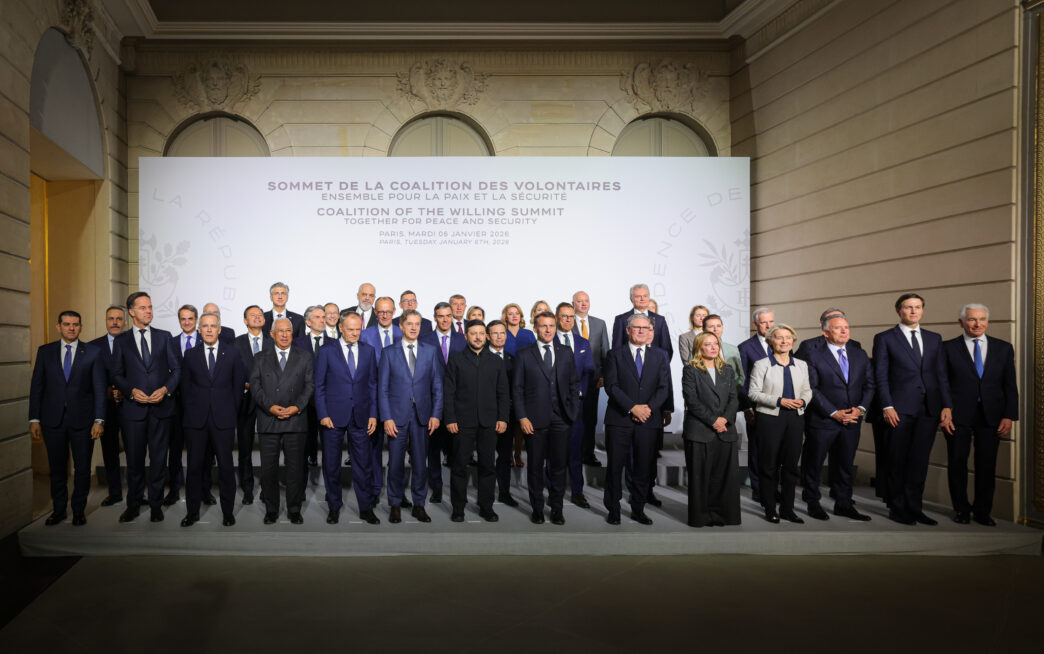
When the EU launched Operation ASPIDES in the Red Sea, it was doing more than escorting commercial vessels through a dangerous corridor; it was rehearsing a political reflex that is becoming harder to avoid: acting in tighter, more flexible formations when the full machinery of institutions is too slow, too divided, or too exposed to vetoes. In a world that is not yet neatly multipolar, cooperation increasingly looks like a crowded map of overlapping initiatives rather than a single, orderly system. It is what scholars describe as a regime complex, where smaller arrangements proliferate because comprehensive frameworks prove politically impractical. That reality is now colliding with the EU’s self-image. Europe still brands itself as a rule-of-law power, yet it increasingly needs formats that deliver quickly: coalitions, taskforces, ad-hoc alignments and minilateral groupings that can move while larger bodies argue about mandates, competence and unanimity. This is not necessarily a betrayal of multilateralism; informality can keep cooperation alive when formal channels jam. But it is also where Europe’s credibility can quietly leak away.
Coalitions work because they lower the costs of agreement. Controversial outcomes, however, can make them look like using selective legality, especially when external partners read flexibility as discretion. The question, then, is not whether Europe should choose between institutions and coalitions, but whether it can develop a disciplined alliance logic that treats coalitions as accelerators rather than substitutes: anchored in law, transparent enough to be legible, and built with a pathway back into institutions once the crisis stops demanding improvisation.
That is the core wager of this article: Europe can be more flexible without becoming less predictable, but only if it starts designing coalitions with the same care it once reserved for treaties.
Why coalitions are back
In a special address at Davos, Canada’s prime minister Mark Carney argued that the rules-based order is fading and that middle powers should respond through variable geometry, through different coalitions for different issues, assembled around shared interests and enough common values to act. Europe’s turn toward coalitions is less a sudden ideological shift than the European version of that same structural diagnosis. Not yet is there a stable multipolar order with settled rules, but it is already too fragmented for the old assumption that big institutions will reliably arbitrate disputes and coordinate collective action. In such environments, governance tends to thicken rather than consolidate. Instead of one coherent framework, policymakers operate inside a regime complex of overlapping venues, partial agreements and issue-specific arrangements that can be assembled, paused and recombined as politics change. 
This is amplified by what some describe as a polycrisis, where simultaneous shocks overload formal processes and reward formats that can deliver faster, even if they are less comprehensive. The practical consequence is a preference for minilateralism: smaller groups that are not necessarily anti-multilateral but pragmatically designed to reduce coordination costs and move when universal consensus is unobtainable.
For the EU, that logic is especially tempting because its strengths in legality and procedural legitimacy often coexist with procedural friction, such as unanimity constraints, competence debates and the slow choreography of aligning 27 positions. Informal and ad-hoc formats can therefore function as lubricants, keeping cooperation alive and enabling action while formal channels negotiate the precise terms of common policy. Yet the same informality that makes coalitions useful also raises the central governance dilemma. The more coalitions substitute for formal processes, the harder it becomes to track accountability, maintain coherence, and sustain trust among insiders and outsiders alike.
In other words, coalitions are returning because they solve a real problem, capacity and speed, but they also create new problems of legibility and legitimacy. And this is where Europe’s challenge becomes distinct. While other powers may treat coalitions as pure instruments, the EU’s political brand depends on being seen as predictable and principled, not merely effective, even if effectiveness stands high on the wish list of its citizens and observers. One lesson from the broader world of clubs is that small-group formats can be ambitious and impactful precisely because they are selective. That selectivity though, inevitably invites questions about representativeness, rule-setting authority and who gets left out. Europe’s new alliance logic, then, is not simply about building more coalitions; it is about deciding what kinds of coalitions it can build without eroding the legal and normative foundations that make European power credible in the first place.
The Efficiency of Informality
The main selling point of coalition politics is not ideology; it is plumbing. Marianna Lovato shows that informal groupings can fasten and simplify many aspects of taking action. For the EU, that matters because speed is not just a convenience; it is often the difference between shaping events and reacting to them. Yet informality earns its efficiency dividend by relaxing the very features that make institutional action trustworthy: fixed procedures, clear mandates, and visible oversight.
That is why scholars describe a governance dilemma at the heart of informal cooperation: as actors lean on informality to get things done, the channels that make decisions accountable and contestable can thin out, especially once informal bargains begin to steer, pre-empt, or substitute for formal processes rather than merely preparing them. The most practical way to manage this trade-off is not to abolish informality but to connect it through institutional inter-linkages such as formal reporting lines or review clauses. These can preserve flexibility while reducing the opacity that makes coalitions politically vulnerable.
The deeper risk, however, is temporal. Coalitions are often presented as emergency scaffolding, but informality has a way of sticking. Over time, members can increase delegation, routinise coordination, and accumulate authority in ways that were deliberately avoided at the outset, producing something institution-like without the corresponding safeguards. In a world where cooperation is increasingly assembled from overlapping pieces, this drift is reinforced by the logic of patchworks. New initiatives keep being added because building a single, comprehensive framework is hard under pressure, and once patches exist, the temptation is to keep stitching rather than rebuild. The upshot for Europe is that coalitions must be designed with discipline from the start, because the shift from usefully informal to quietly unaccountable is rarely announced; it simply becomes the default.
The EPC’s cautionary tale
The EU’s most telling experiment in coalition logic without membership is the European Political Community. A deliberately flexible forum meant to foster political dialogue, cooperation, and to strengthen the security, stability, and prosperity of the continent by bringing EU and non-EU leaders into the same room, the EPC is exactly the kind of instrument a fragmented order rewards. It has low entry barriers, high political signalling, and enough informality to enable side-deals, deconfliction and rapid alignment when formal tracks are blocked. But the EPC is also a reminder that informality does not automatically translate into impact. Even sympathetic observers have noted that the format has moved faster than its internal design, leaving it inaugurated before it acquired a clear purpose, agenda, or framework, a recipe for summits that generate photographs and atmospherics but struggle to produce follow-through.
Without reform, the EPC risks becoming irrelevant, warns the European Policy Centre. Strategic weight in European diplomacy is ultimately measured by whether a forum can sustain momentum, define priorities and translate dialogue into durable cooperation rather than one-off coordination. The deeper point for Europe’s emerging alliance logic is that broad coalitional formats buy inclusivity and legitimacy, but often at the price of operational clarity; tighter coalitions of the willing can deliver faster, but risk looking exclusive or politically selective. The EU, therefore, needs to treat the EPC as a diagnostic tool for the trade-off it cannot escape.
The danger of legal ambiguity
If coalitions are the EU’s emerging instrument of speed, another question is how to use them in a way that strengthens partnerships with states that may not share Europe’s legal instincts without turning every initiative into a seminar on values.
One answer is to treat rule-of-law alignment less as a binary membership test and more as a spectrum of cooperation that is still structured by benchmarks, transparency, and reciprocity. The EU can work with imperfect partners on specific objectives while keeping the normative baseline explicit and non-negotiable in areas where it matters most. This is precisely the logic behind values-centred groupings like the Alliance for Multilateralism, which frames cooperation as a defence of the multilateral method rather than as a bloc against particular states, and which explicitly ties the project to international law and the UN-centric order.
Yet Europe should not assume that invoking multilateralism automatically produces legitimacy. How the EU is perceived externally matters, and perception is often shaped less by institutional architecture than by whether partners experience Europe as consistent, respectful, and materially useful. In practice, that means coalition-building must internalise a basic reputational reality: Europe’s normative leadership is unevenly recognised, and in contested forums it is evaluated through the lens of double standards, selective outrage, and unequal attention. A coalition logic that works for a rule-of-law power, therefore, needs a diplomatic tone as well as a legal skeleton. Fewer moral monologues, more jointly defined deliverables; fewer abstractions, more clarity about who contributes what, and what the coalition will not do. Done well, this approach would allow the EU to preserve its identity without demanding ideological convergence as the entry ticket for cooperation, which is often the difference between a coalition that scales and a coalition that stays European.
Rule-of-Law coalitions: Partner without preaching
Coalitions scale if they feel like a proposition rather than a performance. For the EU, that means learning how to work with partners that do not share Europe’s legal instincts without turning every initiative into a referendum on values. The practical fix is to treat the rule of law in EU external relations less as a binary membership test and more as a structured spectrum of cooperation. The EU can pursue specific objectives with imperfect partners while keeping the normative baseline explicit, bounded, and measurable where it matters most, rather than smuggling conditionality into every dossier and calling the result principle.
Formats such as the Alliance for Multilateralism make strategic sense here, defending the multilateral method, tying cooperation to international-law language, and keeping like-minded coordination alive when formal institutions are gridlocked or openly contested.
Partners increasingly read European initiatives through the lens of strategic interest, regulatory export, and unequal bargaining power, which can make even rules-based narratives sound like disguised hierarchy. That reputational constraint is especially visible in arenas where Europe’s normative self-image is tested by others, such as the UN system, where research on EU leadership in the eyes of others underscores that recognition is uneven and that claims to lead are constantly evaluated against consistency, selectivity, and the politics of double standards.
Credibility then comes from design as much as from rhetoric. Less moral monologue, more co-owned objectives, and more clarity about mandates, limits, and accountability. Done well, this would preserve Europe’s identity without turning partnership into a values exam.
A coalition doctrine for Europe
Europe’s coalition habit is no longer an occasional workaround; it is becoming a default setting. That makes it worth treating coalition-building as a design problem with predictable failure modes, not as a series of improvisations that happen to work until they don’t. In principle, coalitions should be temporary accelerators, not permanent substitutes.
To keep flexibility compatible with Europe’s rule-of-law brand, three guardrails matter.
First, coalitions need hard and soft law-aware design. The EU will often rely on softer instruments to move fast, but it should be explicit about what that choice trades away in precision, obligation, and delegation, and then reintroduce discipline through clear mandates and review clauses once coalitions operate in sensitive security or sanctions settings.
Second, coalitions should be built for complementarity rather than competition. The safest version is inside minilateralism: coalitions connected to broader regimes through institutional inter-linkages, so they deliver speed without creating a parallel governance universe that no one oversees.
Third, legitimacy has to be designed early, because informality does not stay light by default. Over time, members may increase delegation, routinise coordination, and accumulate authority in ways that outgrow the safeguards originally avoided. Minimum transparency about who decides and what the coalition will not do, participation options that reduce the optics of an exclusive club, and a clear re-entry ramp into wider frameworks are therefore not bureaucratic ornaments; they are political insurance.
The point is not to abolish selectivity as clubs can be ambitious precisely because they are selective, but to manage the representation dilemma that selectivity creates. Once the coalition type is clear, safeguards can be matched to function: capability coalitions need tight mandates and oversight; norm coalitions need openness and broad signalling; bridge coalitions need transparent benchmarks and pathways back toward fuller alignment. In a world of regime complexes and institutional congestion, a rule-of-law actor avoids the trap of looking ad-hoc by making coalitions become a way to protect the multilateral method when the old enforcement machinery weakens, rather than a quiet drift into ambiguity.
The EU will still need its institutions, alliances, and treaties; it just cannot assume they will always be sufficient. The choice is not institutions versus coalitions, but disciplined flexibility versus arbitrary flexibility, and Europe’s credibility depends on picking the former.