










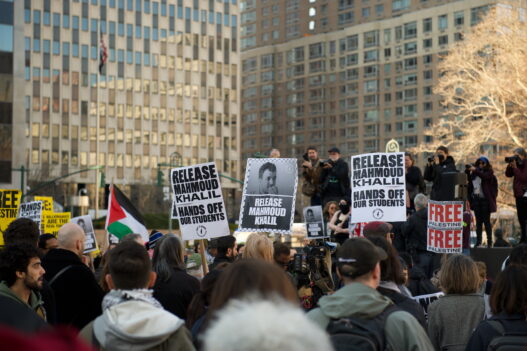
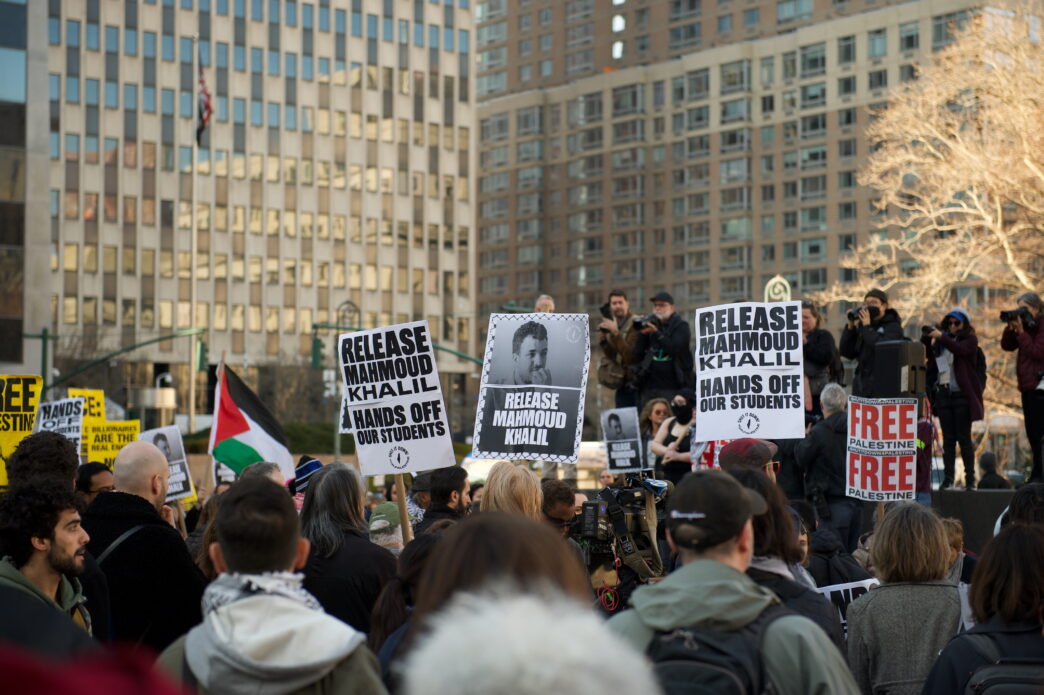
In March 2025, Columbia University student Mahmound Khalil, a U.S. permanent resident, was arrested by Immigration and Customs Enforcement (ICE) and flown to a detention facility thousands of miles away in Louisiana. Khalil, a prominent spokesman and activist with the Gaza Solidarity Encampment, was threatened with deportation under an obscure Cold War-era law. A few weeks later, Rümeysa Öztürk, a Tufts University doctoral student from Türkiye, was arrested by ICE in Massachusetts for writing an op-ed in the Tufts’ student paper criticizing the university’s response to the Gaza war. Much like Khalil, Öztürk was whisked away to Louisiana and threatened with deportation.
Though Khalil and Öztürk were released after months-long detentions, their arrests were just the beginning of the Trump Administration’s extraordinary attacks on higher learning, with protests against Israel’s invasion of Gaza and accusations of antisemitism used to justify funding cuts and arrests. The results have been unsurprising: U.S. universities saw a 17% decline in international enrolments this fall, news that was celebrated by the White House.
In the wake of Trump’s attacks on higher education, Europe sought to entice students and researchers with promises of generous funding and academic freedom. But a recent OECD survey of fall enrolment has shown mixed results, with some countries, including Germany and the Netherlands, experiencing sizable increases in the percentage of international students while others, like France and Belgium, only saw modest gains or negative growth, respectively. As unappealing as the U.S. has become for some students and researchers, European universities face their own challenges in the form of tightening national budgets, visa restrictions, and conflicting positions on academic freedom and human rights, which has created an uncertain environment for students wondering if Europe is the right place for them. As with the U.S., Israel’s invasion of Gaza has centered key questions about free expression and academic freedom in Europe amidst crackdowns on pro-Palestinian protesters.
Both Europe and the United States have prominent traditions of left-leaning activist movements facing violent, sometimes deadly government crackdowns. Students protesting Israel’s invasion of Gaza, which has resulted in 69,000 deaths and charges of genocide, have joined this long history of anti-war and pro-democracy demonstrations. Across Europe and North America, students have faced unfriendly university administrations and local governments impatient with pro-Palestinian protests and activism. 
The Trump Administration has tested a new strategy for chilling dissent by targeting international students. Part of this strategy is reflected in the administration’s treatment of Khalil and Öztürk: weaponising the federal government’s immigration authority to detain and deport international students involved in the protests, while using unfounded and patently absurd accusations of antisemitism and “terrorist” sympathies as justification. But the brunt of immigration enforcement is not uniformly felt. Not accidentally, the Trump Administration has publicly targeted students with Middle Eastern and Muslim backgrounds. By making examples of Khalil and Öztürk, Trump is flexing his vast discretionary power over immigration tools to chill dissent and student activism while servicing his anti-immigrant and white supremacist base.
As a result, international students have been put in an uncomfortable bind as a result of a fierce anti-immigrant ideology that has continued to cement itself across Europe and North America. Top universities vie for their talent (and money), but international students are increasingly treated as sources for civil unrest and antisemitism, in addition to the myriad challenges they face related to housing, cost-of-living, and language.
However, Trump has not been satisfied with targeting individuals. In May, his administration took the unprecedented move of revoking the ability of Harvard University to enroll international students in a major escalation of its feud with the Ivy League institution. Though it was quickly halted in U.S. District Court, Trump’s order was another broadside against the country’s most high-profile university, intended as retaliation for Harvard’s refusal to cave to his demands. Only a few days later, the State Department ordered U.S. embassies and consulates to pause student visa appointments while it worked to expand “social media screening and vetting.” Then in June, the Trump Administration sought to revoke the accreditation of Columbia University, another Ivy League school, on the grounds that it had “failed to meaningfully protect Jewish students against severe and pervasive harassment on Columbia’s campus,” claims stemming from student protests against Israel’s invasion of Gaza.
The administration has also frozen or cutfederal education and research grants, threatened to pull funding from universities over DEI (Diversity, Equity, and Inclusion), and elevated fringe voices to major government posts on science, technology, and healthcare, including vaccine-skeptic Robert F. Kennedy Jr. as head of the Department of Health and Human Services. Whether intentionally or not, the Trump Administration has weakened American universities by attacking a lucrative source of tuition revenue: international students. The government’s broader crackdown on immigration (both regular and irregular) threatens to drive away global talent. While only 6% of the university student population in the United States is from abroad, higher tuition costs for international students mean billions in revenue for public and private universities alike, especially for Harvard, where a quarter of the student population is international.
By stifling the ability of U.S. universities to attract and recruit international students, the Trump Administration is undermining an integral source of revenue for universities. For decades, the U.S. has attracted top talent from around the world thanks to a combination of globally prestigious institutions, academic freedom, and extensive research funding, but the Trump Administration’s open hostility to both immigration and academic freedom has chilled student and researcher enthusiasm for studying and working in the country. A survey of U.S.-based researchers in the journal Nature revealed that 75% of respondents had considered leaving the country in response to Trump’s funding cuts, resulting in warnings from some commentators of a new, self-inflicted brain drain that threatens to reverse nearly a century of American academic dominance.
Trump’s weaponisation of his immigration authority against higher education is but one component of the Republican Party’s attempts to radically remake the political and cultural landscape of the United States by targeting what the party perceives as foreign elements and overly “liberal” institutions in American life, even if the country’s global standing and prosperity has been built by a robust research and academic environment capable of attracting international students that contribute billions of dollars to the economy. As evidenced by the detention of Khalil and Öztürk, the Gaza war has been used by the Trump Administration to undermine free speech, the right of public protest, and academic freedom. In turn, Trump’s attack on the independence of universities has shown the extent to which immigration and U.S. foreign policy interests are deeply intertwined with higher education.
Crucially, the increased reliance on international student fees has vested Trump with a diffuse and extraordinary form of power over universities. By threatening deportations, limiting the number of visas, and restricting the capacity to enroll international students, Trump can wrench large concessions from universities looking to avoid a damaging legal fight or lose access to lucrative tuition fees. In the process, the Trump Administration has opened up a new front for managing or chilling student activism that sets a dangerous precedent. Not only do international students become popular targets for right-wing grievances, but their high enrolments give the government increased power over the makeup and direction of higher education.
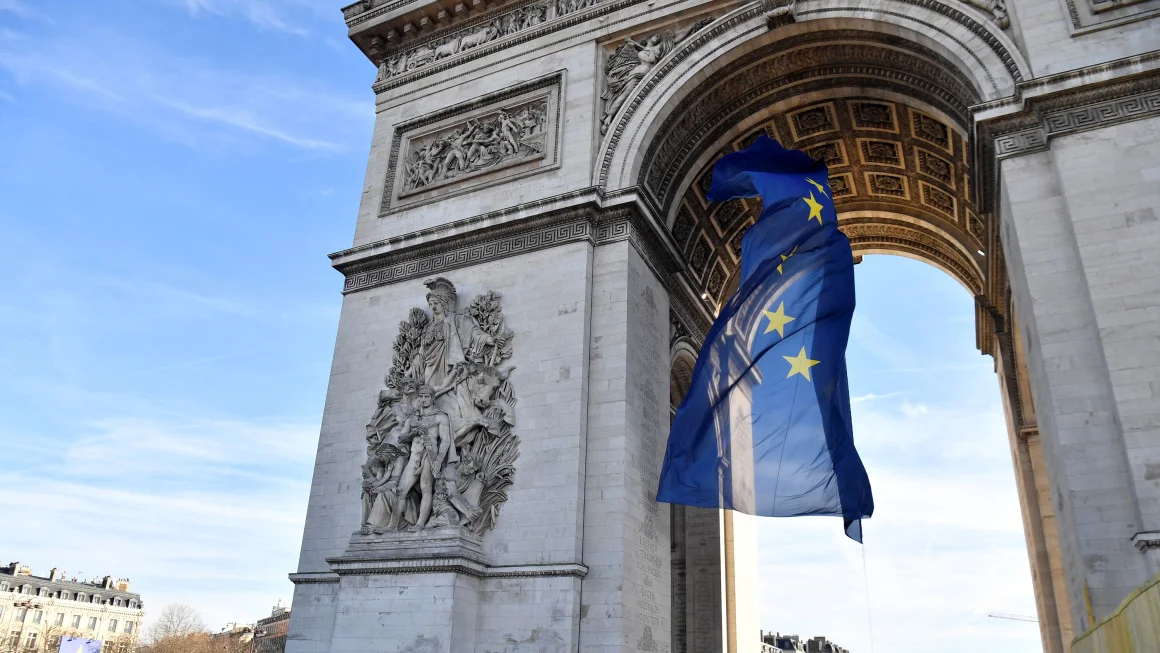
Various EU officials, both in government and education, have made some attempts to position Europe as a premier destination of research talent in the wake of Trump’s attacks on universities and international students. In May, as part of announcing 1.25 billion EUR for Marie Skłodowska-Curie Actions(MSCA), Ekaterina Zaharieva, the European Commissioner for Startups, Research and Innovation, made comments that had clear reference to Trump’s shakeup of American higher education:
Science has no passport, gender, ethnicity or political party. We want Europe to be the best and most attractive place in the world for science and researchers. We want Europe to continue to be at the forefront of fundamental research. To be a leader in priority technologies that will shape the world of tomorrow.
As part of the same announcement, Ursula von der Leyen, President of the European Commission, made similar comments:
Europe has chosen to start a new age of invention and ingenuity. We put research and innovation, science, and technology at the heart of our economy. Universities are pillars of our societies and our way of life. We are the continent where innovation serves humanity, where global talent is welcomed. So, to every researcher, at home or abroad, to every young girl and boy who dreams of life in science, our message is clear: Choose Science. Choose Europe.
Yet these lucrative funding announcements come at a time when universities across Europe face an existential crisis from funding cuts that threaten their ability to retain academic staff and, in turn, offer an attractive study environment for both domestic and international students. The European International Students Association (EISA) warned in June that national budgets in France, the Netherlands, Germany, Italy, and Finland would erode “fair working and research conditions, which are preconditions for the exercise of academic freedom.” Tighter budgets will likely lead to a reduction in academic staff or worsen the culture of long work hours already endemic to universities by shifting to lower pay, temporary contracts for teachers and researchers. In short, the EU’s rhetoric on attracting and retaining global talent is undermined by a series of austere budgets that threaten the long-term future of higher education, which not only impacts the ability of Europe to attract researchers but to cater to the needs of domestic students as well. In the process, already overworked academic staff are saddled with even more responsibilities that reduce the amount of time they have for students and research.
Additionally, though EU officials have touted academic freedom and generous research investments, the reality has been far less rosy for students and academics alike who, much like Khalil and Öztürk, have spoken out against Israel’s invasion of Gaza. While the Trump Administration has clamped down on protests, Germany has been similarly hostile towards students and foreign nationals participating in pro-Palestinian activism. In April, Berlin’s Department for Interior and Sport sought to deport four foreign activists(three of whom are EU citizens) for participating in a pro-Palestinian sit-in at Freie Universität Berlin “despite hesitation from Berlin’s immigration office”. One of the activists, Kasia Wlaszczyk, in an article for The Guardian characterized Berlin’s attempt to deport them as “not the first instance of Germany weaponising migration law,” referring to a pause in the processing of asylum applications from Palestinians by Germany’s Federal Office of Migration and Refugees that started in January 2024 and was eventually lifted in July 2025. Even before Trump was elected, Palestinian authors, intellectuals, and academics in Germany had seen their events, prizes, and job offers cancelled. As in the U.S., the Gaza war has tested Europe’s purported values, with student-led protests putting added pressure on universities and governments to not just tolerate dissent but to intervene on behalf of the principles of human rights they’ve espoused.
In the short term, some European universities will benefit from Trump’s brazen attack on America’s international standing among students and researchers. But as this new immigration and education reality occupies at least the next three years of his administration, longer-term questions of academic freedom and financial sustainability will still linger. Europe cannot simply rely on American self-sabotage to underwrite a portion of its appeal as an education and research destination, especially in the shadow of the Gaza war, which has laid bare the humanitarian failure of Europe’s relationship with Israel. The ability of students and academics alike to draw attention to atrocities both now and across history has become even more urgent and necessary as new images of Gaza’s destruction and evidence of war crimes continue to accrue.