








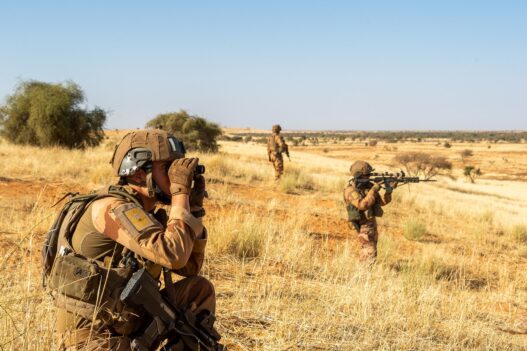
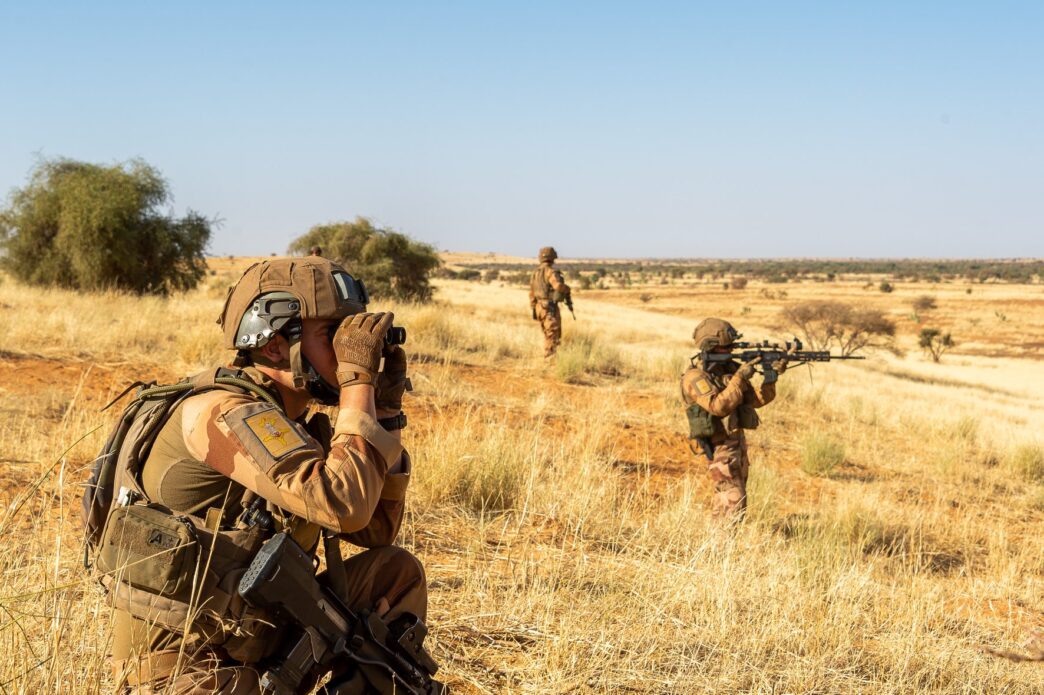
On July 18th, France signed over its last military base in the Sahel to the Senegalese government, marking the end of France’s postcolonial regional military influence. It also represented the failure of its counterterrorism mission Operation Barkhane, which was unable to achieve the meaningful security improvements it promised at its inception in 2014. By the end of the eight-year operation, its primary targets, al-Qaeda affiliate Jama’at Nasr al-Islam wal-Muslimin (JNIM) and the Islamic State of Greater Sahel (ISGS), still controlled large areas of Mali, Burkina Faso, and Niger.
The final straw for France’s counterterrorism work in the Sahel came as new military juntas took over the governments in Mali (2021), Burkina Faso (2022), and Niger (2023). The French military and diplomatic establishment’s longstanding working relationship with each of those states ended abruptly as the juntas, rife with anti-French sentiment, forced the departure of its troops. Almost immediately, the juntas turned to Russian private military company Wagner Group to fill the new gap in counterterrorism operations. Its influence predated its formal deployment in 2021, however.
“What the world witnessed as [France’s] expeditious exodus from the Sahel was really Wagner igniting long-existing dynamics over terms of engagement by colonizing powers,” said Tammy Palacios, Senior Fellow at the Center on Terrorism, Extremism, and Counterterrorism (CTEC) and the CEO of Priority Sustainable Solutions LLC. “Prior to their arrival on-the-ground, Wagner Group’s associated information companies had set the foundation for anti-French and anti-Western sentiment, as well as pro-Wagner support. Wagner then set into motion this domino event which began in 2022 when they riled and rallied the masses through payments to participate in protests, and via control of the news and information space.”
Wagner Group, staffed by mercenaries and closely connected to the Kremlin, has served Russian interests in usurping Western influence in Africa since 2017, often providing support to fragile, pro-Russian regimes that face domestic and transnational security threats. Its security contributions in the Central African Republic made it an obvious partner for the Sahel juntas looking for non-Western military assistance. For its part, the paramilitary force has gained access to valuable mineral resources in Mali, a key source of revenue for the organization. Wagner has been unable to effectively combat regional terrorist organizations in the Sahel, though, and operations have proven costly as militants frequently carry out targeted attacks against Wagner personnel.
After Wagner’s founder, Yevgeny Prigozhin, died following a brief rebellion and march toward Moscow in June of 2023, the Russian government created a new paramilitary group, Africa Corps, to replace Wagner’s operations in Africa, part of a broader strategy to rein in Wagner’s influence. Africa Corps subsumed much of the existing Wagner personnel and command structure in the Sahel, supporting claims by some foreign observers that the organization is more a rebrand of Russian paramilitary presence than a new regional player. In July 2025, plagued by the frequent attacks and no longer Russia’s key force in the region after the partial absorption of its personnel by the Africa Corps, Wagner announced that it was ending its operations in Mali and fully withdrawing from the Sahel.
It remains unclear if Wagner’s withdrawal will meaningfully impact the security environment in the region, especially as Africa Corps’ operations differ little from Wagner’s. It will likely face the same difficulties, though.
“Wagner is leaving Mali, but Africa Corps is staying in the hopes of saving profits made by offering regime security, and through mining,” said Palacios. “Even if the impacts of Wagner’s information prep dissipate with the rebrand, Africa Corps will still be impacted by the persistent targeting by al Qaeda-affiliate JNIM and ISGS. A rebrand will not trick al Qaeda into ending attacks on Russian mercenaries, which date back to 2022.”
The military juntas have shown signs of discontent with the paramilitary groups’ lack of success, and Palacios believes the counterterrorism cooperation between the juntas and Russia is doomed to fail because “Russia has left a state matter to a for-profit company [operating as an arm] of the Russian Federation.”
According to Palacios, civilian engagement is the key to a successful counterterrorism strategy in the Sahel. “The successful countering of JNIM and ISGS in the Sahel will require mature counterterrorism intelligence and demands a context-driven strategy,” Palacios said. “Currently, JNIM and ISGS are the better bet for civilians. Civilians are forced to pay them taxes, comply with al Qaeda and ISIS directives on how to live, and face an abhorrent rate of kidnapping – but if they comply, they don’t all die.”
“Al Qaeda and ISIS will not be effectively countered in the Sahel with a solely military approach because the terrorist groups’ success leverages community survivability and access to livelihood. Effective counterterrorism in the Sahel will require reinstituting strong civilian government structures in order to uproot JNIM and ISGS from the community-level. It requires sacrifice by the junta leaders of the power they fought to hold in order to build a government that can counter al Qaeda and ISIS from the bottom-up. This strengthening of civilian government and building of positive civilian government presence across Mali, Burkina Faso, and Niger will have to be built in strong coordination with military counterterrorism and disengagement policies and programs that engage civilians – giving everyday people who are only complying for their and their family’s survival a choice to survive outside of the forcible umbrella established by JNIM.”
Tammy Palacios is a Senior Fellow at the Center on Terrorism, Extremism, and Counterterrorism (CTEC), Fellow at the Modern War Institute at West Point, serves on the Steering Committee at the Atrocity Prevention Lab at Harvard Humanitarian, and is the CEO of Priority Sustainable Solutions LLC. Palacios is the founder of the Priority Sustainable Counterterrorism Model. For this article, she provided exclusive expert commentary to European Relations Editor Wilson Daily.