









Table of Contents
Stay informed with European Relations‘ updates on the latest news and developments from EU institutions and organisations.
European Commission
CC BY-SA 2.0 © Photo by Amio Cajander on 26 October 2007 (Berlaymont building, European Commission)

- CC BY 4.0/ © Photo by Ministry of Culture of Ukraine (Dormition Cathedral of the Kyiv Pechersk Lavra in Kyiv, Ukraine on fire following the Russian attack on 15 June 2026.)
What Ukraine Is Fighting to Preserve
- Tizian Stocker
Millions of books have been destroyed, and hundreds of cultural sites have been damaged. But Ukraine’s struggle to preserve its culture reaches beyond what Russian strikes can physically destroy.
Just days before Ukrainian children returned to school, another part of the country’s cultural infrastructure went up in flames. A Russian strike on the logistics centre of Ukrainian publisher Ranok in August destroyed around eight million books, according to Ukraine’s Ministry of Culture. More than 620,000 were school textbooks. The ministry says Russian attacks destroyed more than 10 million books during the summer of 2026 alone. BBC News puts the recent total at around 12 million.
The losses illustrate a dimension of Russia’s war that extends beyond territory and military infrastructure. Libraries, museums, churches, archives, publishing houses and schools carry language, history and collective memory. Their destruction raises a broader question: what happens to a country’s identity when the institutions preserving it become part of a war?
More Than Buildings
As of 29 July, UNESCO had independently verified damage to 545 cultural sites since Russia launched its full-scale invasion in February 2022. They include 43 museums, 22 libraries, five archives, 156 religious sites and 281 buildings of historical or artistic importance. Among them is the Kyiv-Pechersk Lavra, one of Ukraine’s most important religious and cultural landmarks and a UNESCO World Heritage Site. Russian strikes in June damaged several structures within the historic complex.
During a visit to Ukraine in August, UNESCO Director-General Khaled El-Enany described what the site represents:
“For nearly a millennium, this site has carried the faith, memory and cultural identity of generations.”
- Khaled El-Enany, UNESCO Director-General
The consequences extend beyond internationally recognised monuments. Local libraries, printing facilities and archives determine whether books remain available, historical records survive, and Ukrainian cultural life can continue during wartime. For schools, that impact is immediate. Figures published by the Ukrainian parliament’s education committee show that recent attacks destroyed hundreds of thousands of textbooks intended for the new academic year. Authorities and publishers must replace them while the war continues.
Identity Under Occupation
Physical destruction is only one part of the picture. UN human rights monitors have documented changes to education, language and cultural expression in Russian-occupied areas of Ukraine. Russian curricula have replaced Ukrainian ones in schools, while occupation authorities have promoted Russian language, history and state narratives.
The UN has also documented pressure on teachers and parents to accept the Russian education system. These changes have been accompanied by patriotic and military education centred on Russian state identity. For some families, education has become a reason to leave. One Ukrainian father, whose family fled the Russian-occupied part of the Kherson region in 2025, told UN human rights monitors:
“Our children do not want to study in Russian language. We had to leave.”
- Ukrainian father interviewed by UN human rights monitors
According to his testimony, occupation authorities had also threatened to remove the children from the family. This distinction matters. Damage caused by a missile or drone does not by itself establish an intention to destroy a national culture. Policies governing language, schooling and public life raise a different set of questions because they directly influence how identity can be expressed and passed to the next generation. UN High Commissioner for Human Rights Volker Türk warned that Russian actions had “ruptured the social fabric of communities”, pointing to consequences that could persist long after individual towns or territories change hands.
Ukraine describes these developments as part of a broader attempt to suppress its national identity. Foreign Minister Andrii Sybiha made that connection following the recent attacks on publishing infrastructure, arguing that the destruction targets Ukrainian language, memory and history. Russia rejects that interpretation. In comments reported by BBC News, the Russian embassy in London accused Ukraine itself of damaging cultural heritage through the removal of monuments and renaming of streets. It also claimed that some cultural facilities had been used to conceal military activities.
These claims do not change the independently verified scale of damage to Ukrainian cultural sites. They do, however, demonstrate how history and cultural identity have themselves become part of the political conflict surrounding the war.
Europe Moves to Protect Culture
Europe’s response increasingly treats cultural preservation as part of Ukraine’s resilience and recovery. EU support has included emergency equipment for cultural heritage sites, digital documentation of museum collections and training for Ukrainian professionals responsible for protecting endangered objects. In June 2026, the EU also provided €2 million through UNESCO to help safeguard Ukraine’s documentary heritage and improve digital access to collections. The European Commission said in 2025 that it had mobilised more than €50 million for Ukraine’s cultural and creative sectors since the beginning of the full-scale invasion, including more than €11.5 million for cultural heritage. The Team Europe Initiative for Cultural Heritage in Ukraine brings together the European Commission, EU Member States and Ukrainian partners. Its work ranges from emergency protection and training to longer-term recovery and reconstruction.
Info box provided by Laksmitha Anindyanari:
Documentary heritage refers to recorded materials that preserve the knowledge, history and cultural memory of a community or society. It includes materials such as manuscripts, books, archival records, photographs, films, sound recordings and other documents with lasting cultural or historical value. Protecting documentary heritage helps ensure that information and collective memories remain accessible for future generations, particularly when cultural institutions are threatened by conflict or disaster.
Culture is therefore moving beyond emergency assistance into a wider European policy question: what should be restored, what needs to be digitally preserved, and how can Ukrainian cultural institutions remain resilient during and after the war?
Why This Matters for Europe
Ukraine demonstrates why cultural heritage cannot be separated from security. A missile can destroy a printing press or museum in seconds. The consequences last much longer: fewer books, missing archives, damaged religious sites and communities losing places through which their history was preserved. Education makes that connection even more significant. Language, curricula and historical narratives influence how future generations understand the country to which they belong. Policies affecting them in occupied territories therefore reach beyond cultural administration into questions of political identity.
For Europe, protecting Ukrainian culture is consequently about more than reconstructing monuments. Ukraine is an EU candidate country whose cultural heritage forms part of Europe’s wider historical landscape. Supporting its preservation also reinforces the principle that military occupation should not determine which language, history or identity a population is allowed to maintain. The struggle over Ukraine’s future is therefore being fought not only over territory. It is also being fought over what can be remembered, taught and passed on.
What to Watch Next
The immediate challenge is replacing books and educational materials destroyed before the new school year while protecting cultural institutions from further attacks. In the longer term, reconstruction will require difficult choices. Ukraine and its European partners will have to determine how damaged heritage should be restored, how collections and archives can be digitally protected and how cultural institutions in formerly occupied territories can be rebuilt. UNESCO verification and UN human rights monitoring will remain important in distinguishing documented cultural destruction from broader political claims about intent – and in preserving evidence for potential future accountability.
Sources
- UNESCO – Damaged cultural sites in Ukraine verified by UNESCO. Updated 29 July 2026. Original source. Accessed 31 August 2026.
- UN Human Rights Office / Human Rights Monitoring Mission in Ukraine – Reporting on human rights, education and cultural identity in Russian-occupied Ukraine. Original source. Accessed 31 August 2026.
- Ministry of Culture of Ukraine – Reporting on attacks against Ukrainian publishers and the destruction of books. 28 August 2026. Original source. Accessed 31 August 2026.
- European Commission – Support for Ukraine’s cultural and creative sectors and cultural heritage. Original source. Accessed 31 August 2026.
- BBC News – Russian strikes destroy 12 million books ahead of Ukraine’s first week back at school. August 2026. Article. Accessed 31 August 2026.
AI Transparency Note: Artificial intelligence was used to support research, source comparison and the structuring of this briefing. Editorial decisions, source selection and the final assessment remain subject to human review.
Author: Tizian Stocker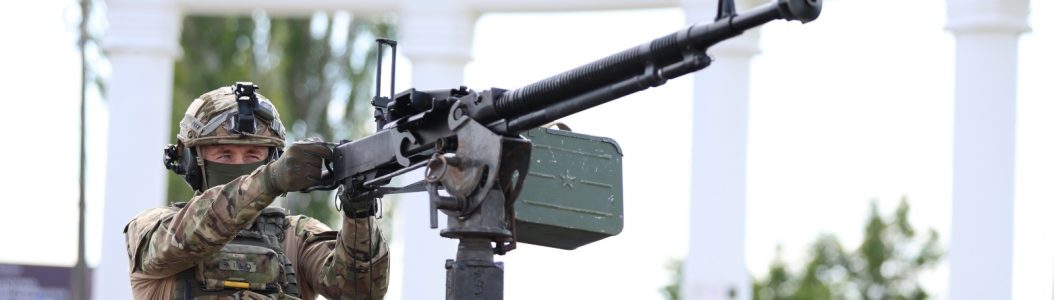
- CC BY 4.0/ © Photo by National Police of Ukraine (Mobile fire team of Rapid Operational Response Unit of Ukrainian police, which shoots Russian drones in Kherson region, 26 June 2024.)
What Kherson Is Teaching Europe
- Tizian Stocker
Kherson lies only a few kilometres from Russian positions on the other side of the Dnipro River. That proximity has turned the southern Ukrainian city into one of the clearest examples of how cheap, precise drones are changing both warfare and civilian life.
When Le Monde visited the city in June, explosions could be heard as often as every five minutes. Streets were being covered with anti-drone nets, while soldiers armed with shotguns provided a last line of defence. Around 60,000 of Kherson’s roughly 300,000 pre-war residents were estimated to remain in the city or travel regularly between Kherson and safer areas.
The threat has continued to grow. In July, the UN Human Rights Monitoring Mission in Ukraine recorded 34 civilians killed and 424 injured in Kherson. Across Ukraine, short-range drones killed 111 civilians and injured 710 that month, the highest monthly toll from such weapons since Russia launched its full-scale invasion in February 2022.
Sources: Le Monde | UN Human Rights Monitoring Mission in Ukraine
When the Front Reaches Daily Life
Short-range drones differ from many traditional battlefield weapons because their operators can observe potential targets through onboard cameras. First-person-view (FPV) drones can carry explosives, travel at high speeds and operate kilometres away from their controllers. Their relatively low cost has contributed to their rapid proliferation on both sides of the frontline.
Info boxes provided by Laksmitha Anindyanari:
FPV (First-Person-View) drones are remotely operated drones equipped with cameras that transmit live video to the operator, allowing them to see and control the drone from its perspective. In warfare, FPV drones are often modified to carry explosives and can be used to precisely strike targets while being operated from a distance. Their relatively low cost and manoeuvrability have made them widely used in the Russia-Ukraine war.
For civilians, this has changed the nature of danger. UN investigators have documented drones striking people travelling by bus, walking, cycling, driving civilian vehicles and providing humanitarian or medical assistance. Between February 2022 and April 2025, short-range drone attacks killed at least 395 civilians and injured 2,635. The vast majority, 89 per cent, resulted from Russian attacks in Ukrainian-controlled territory; 11 per cent of the casualties were documented in Russian-occupied Ukrainian territory.
The consequences extend beyond casualties. Fear of drones restricts movement and access to food and healthcare, while humanitarian organisations, medical personnel and municipal workers have had to limit some activities. Older people and people with disabilities are particularly vulnerable because many remain in frontline communities and have fewer options to relocate. Kherson illustrates this transformation particularly starkly. Yaroslav Shanko, head of the city’s military administration, told Le Monde that around 2,000 Russian drones were being directed against the city each week.
Ukrainian officials and residents have used the expression “human safari” to describe alleged deliberate attacks on civilians.
The phrase represents a Ukrainian description rather than an independently established Russian military policy. However, UN findings independently document extensive civilian harm caused by short-range Russian drone attacks and incidents in which civilians appeared to have been deliberately targeted.
Sources: UN Human Rights Monitoring Mission in Ukraine | Le Monde
Cameras Change the Legal Question
The ability of drone operators to see potential targets also raises important questions under international humanitarian law. Parties to a conflict must distinguish between civilians and combatants regardless of the weapons they use.
Info boxes provided by Laksmitha Anindyanari:
The principle of distinction is a fundamental rule of international humanitarian law requiring parties to an armed conflict to distinguish between civilians and combatants, as well as civilian objects and military objectives. Attacks may only be directed against legitimate military targets, and deliberately targeting civilians or civilian objects is prohibited. The principle applies regardless of the weapons or technologies used in warfare, including drones.
The UN notes that onboard cameras should, in principle, give operators greater ability to distinguish civilians from military targets. Yet investigators documented incidents in which operators appeared to have intentionally attacked civilians or civilian objects. Deliberately targeting civilians, if established, constitutes a war crime.
“Each of these attacks must be investigated,” Danielle Bell, head of the UN Human Rights Monitoring Mission in Ukraine, said when presenting its findings.
The mission called for those responsible for intentionally targeting civilians and humanitarian personnel to be held accountable. UN monitors have also verified civilian casualties from short-range drones in occupied Ukrainian territory. Independent verification remains more difficult because publicly available information from occupied territory is increasingly limited.
Source: UN Human Rights Monitoring Mission in Ukraine
Europe Turns Experience Into Policy
What is happening in Kherson increasingly matters beyond Ukraine. European policymakers are treating the conflict’s rapid technological development as a lesson for the continent’s own defence. In June, the European Council called for faster work on drones and counter-drone systems, early warning and air defence. EU leaders also stressed the need to draw on Ukraine’s experience with emerging technologies and strengthen cooperation between European and Ukrainian defence industries.
Info boxes provided by Laksmitha Anindyanari:
Counter-drone systems are technologies and equipment designed to detect, track, identify, disrupt, or destroy hostile drones. They can include radar and other sensors for detecting drones, electronic systems that interfere with their communications or navigation, and physical interceptors that disable or destroy them. These systems are increasingly important as inexpensive drones become more common in modern warfare and pose growing threats to military forces and civilian infrastructure.
That cooperation is becoming institutionalised. On 17 July, the European Commission launched the EU-Ukraine Drone Alliance. The alliance brings together companies, start-ups, researchers, armed forces and other users, with 18 EU-based and Ukrainian companies selected as its founding members.
The alliance is therefore more than another channel of military support for Kyiv. The Commission explicitly presents cooperation with Ukraine as a way to provide battlefield capabilities while strengthening Europe’s own defence readiness and industrial capacity. Its founding members are expected to meet in Brussels in September.
Sources: European Commission | European Council
Why This Matters for Europe
Kherson demonstrates how rapidly relatively inexpensive technology can change the relationship between military operations and civilian protection. Drones that once supplemented other weapons can now influence whether people near the frontline can safely use roads, public transport, hospitals, or humanitarian services.
For Europe, the lesson is both humanitarian and strategic. International humanitarian law requires civilians to remain protected regardless of technological change. At the same time, European governments increasingly face the question of how to protect their own populations, infrastructure, and armed forces against large numbers of comparatively cheap drones.
Ukraine is consequently becoming both a defence partner and an important source of operational knowledge for Europe. The EU-Ukraine Drone Alliance illustrates how lessons developed under wartime pressure are already entering European defence and industrial policy. Kherson’s experience therefore reaches beyond the Dnipro. The city provides a glimpse of a form of warfare that Europe is now preparing to defend itself against.
What to Watch Next
The first meeting of the EU-Ukraine Drone Alliance’s 18 founding members is expected in Brussels in September. Its progress will provide an early indication of how quickly political commitments can translate into joint European-Ukrainian production and effective counter-drone capabilities.
Further UN monitoring will also show whether the sharp rise in civilian casualties from short-range drones continues, and whether investigations and accountability mechanisms can keep pace with a technology that is evolving rapidly.
Sources
- UN Human Rights Monitoring Mission in Ukraine — Protection of Civilians in Armed Conflict, July 2026. Published 12 August 2026. Original source. Accessed 24 August 2026.
- UN Human Rights Monitoring Mission in Ukraine — Short-range drone attacks killed 395 civilians, injured 2,635 between February 2022 and April 2025. Original source. Accessed 24 August 2026.
- European Commission — Commission launches EU-Ukraine Drone Alliance to boost drone and counter-drone technology. Published 17 July 2026. Original source. Accessed 24 August 2026.
- European Council — European Council conclusions on Ukraine and European defence and security. Published 18 June 2026. Original source. Accessed 24 August 2026.
- Le Monde — “It’s pure terror against civilians”: In Ukraine, Kherson’s residents live under the constant threat of Russian drones. Published 24 June 2026. Article. Accessed 24 August 2026.
AI Transparency Note: Artificial intelligence was used to support research, source comparison and the structuring of this briefing. Editorial decisions, source selection and the final assessment remain subject to human review.
Author: Tizian Stocker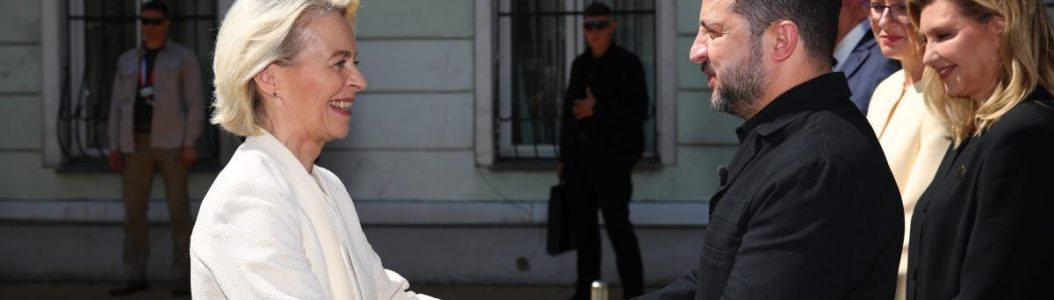
- © Photo by Christophe Licoppe European Commission (Visit of Ursula von der Leyen, President of the European Commission, to Ukraine, 15/07/2026.)
EU and Ukraine Join Forces to Build Europe’s Drone Defence Industry
- Sebastian Dodd
The EU-Ukraine Drone Alliance was officially launched on July 17 during the third EU-Ukraine Defence Industry Forum in Kyiv following the announcement of the Drone Deal on July 15. The goal of the alliance is to accelerate the development of a European ecosystem for drone and counter-drone technology. As the EU works to develop strategic autonomy, Ukraine is an ideal partner for strengthening its drone capabilities and defence industry. The alliance is part of broader EU efforts to enhance European defence capabilities in this area.
The initiative brings together drone manufacturers, technology companies, start-ups, research organisations, and military end users from the EU and Ukraine on a single industrial platform. Its objective is to establish joint ventures between Ukrainian and European companies, with a focus on accelerating the development and production of next-generation drones and counter-drone systems. In relation to the Drone Deal underpinning the Alliance, President Ursula von der Leyen stated, “Our defence industrial partnership integrates Ukraine’s defence economy the same way we integrate our markets: By removing barriers and aligning our standards as quickly as possible – from defence procurement to the protection of intellectual property. Allowing for a closer cooperation of our defence industries and joint ventures. Together, we are harnessing our shared industrial strength for our common security.”
The EU Drone Alliance was first announced by von der Leyen in her 2025 State of the European Union address and is a key deliverable of the Joint Communication Preserving Peace – Defence Readiness Roadmap 2030.
The new partnership creates a single EU-Ukraine framework for developing a strong drone industry that builds on the nine existing bilateral drone agreements between Ukraine and EU Member States, three of which were recently signed following the NATO Summit in Ankara. The framework includes plans to rapidly scale up the production and deployment of battle-proven capabilities to counter drones and missiles, while providing long-term predictability to secure investment and expand defence industrial capacity in both Ukraine and the EU.
One priority highlighted in the cooperation is protecting against low- to medium-range drones and missiles and deploying battle-proven drone systems at scale. Part of the plan is to build systems that can be stocked outside Ukraine while providing both industrial bases with the stability needed to secure investment and expand production. This focus is understandable given the effectiveness of drones in both the Russia-Ukraine war and the US war with Iran, which demonstrates the need for such systems. Iskander ballistic missiles in particular have been among the main weapon systems used by Russia to inflict significant damage on Ukrainian targets, particularly when fired in large numbers to overwhelm Ukrainian air defences. Finding ways to mitigate the effectiveness of such weapons will therefore be crucial to European and Ukrainian defence. This priority can also be seen in plans to expand EU-Ukraine defence industrial cooperation to facilitate the joint production of anti-ballistic missiles by 2028, addressing critical air and defence capability gaps.
On July 16, the European Commission selected Quantum Systems as a founding member of the EU-Ukraine Drone Alliance in support of the initiative. The appointment reinforces Quantum Systems’ position as a leading force in the European drone industry and a flagship of European-Ukrainian industrial cooperation. Since the company began operations in Ukraine in 2022, it has expanded its local footprint by increasing manufacturing capacity, integrating Ukrainian suppliers and software expertise, and deepening industrial collaboration.
Quantum Systems co-founded the first European-Ukrainian joint venture with Quantum Frontline Industries (QFI), under the defence industry cooperation framework “Build with Ukraine.” It has also established multiple new joint ventures with Ukrainian industry partners, showcasing its expertise in cooperative military development.
A total of 18 companies are involved in the drone initiative, nine from the EU and nine from Ukraine. The EU side includes ORQA, the Croatian FPV specialist, alongside Indra Group, Fincantieri, WB Group, Destinus, Delair, RSI Europe, TERMA, and the recently selected Quantum Systems. The Ukrainian side includes Skyfall Industries, Greentech Harvest, Tencore, Deviro, Vyriy Industry, Athlon Avia, TAF Industries, UFORCE, and F-Drones. F-Drones, in particular, highlights the adaptability of Ukrainian defence companies. The company transitioned from a fully Chinese supply chain in 2023 to manufacturing its own flight controllers, speed controllers, and video transmission systems by 2025.
The European Commission also disbursed a further €1 billion to support Ukraine’s drone capabilities under the €90 billion Ukraine Support Loan. This was the second drone related payment in three weeks, following the Commission’s initial €3.9 billion payout on June 30, the first payment of a roughly €6 billion tranche dedicated to drone procurement. This funding comes on top of Commission forward funding of up to €10 billion, which is expected to draw on the remaining funds of the EU’s SAFE (Security Action for Europe) programme, a €150 billion common borrowing facility adopted in May 2025.
All of this demonstrates the EU’s commitment to improving its drone capabilities and strengthening its drone industry. However, it is important to note that the drone deal is currently a memorandum rather than a binding treaty. The actual Defence Industrial Pact, which will cover intellectual property issues and joint venture rules, still needs to be negotiated.
Sources:
DroneXL, European Security & Defence, European Union, European Union.
Author: Sebastian Dodd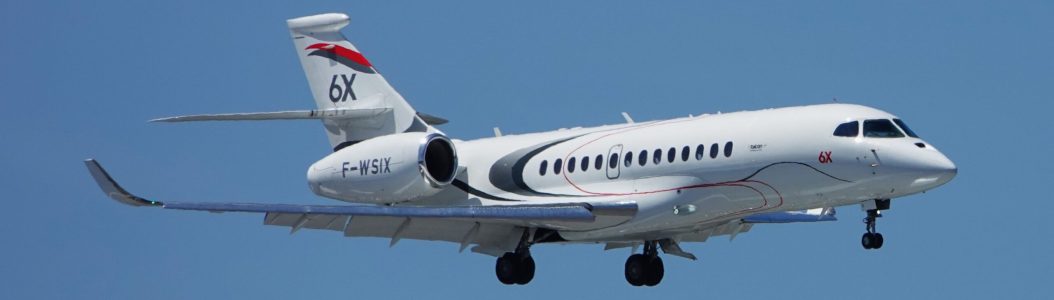
- CC BY 4.0 © Photo by Ibex73
Court Reopens Climate Fight Over Business Jets
- Maximilian Schlenker
On June 24th, the EU General Court reopened a politically sensitive question inside Europe’s sustainable-finance architecture: can business-jet manufacturing ever be treated as part of the climate transition? In Dassault Aviation v Commission, the Court annulled the Commission’s exclusion of aircraft intended for private or commercial business aviation from the EU taxonomy’s “transitional” activities. The taxonomy is not a tax measure; it is a classification system that tells investors and companies which economic activities can be reported as environmentally sustainable. That makes this a case on the credibility of Europe’s green label.
A regulation from the European Commission created technical screening criteria for aircraft manufacturing but excluded business aviation from activities considered to contribute to climate-change mitigation. Dassault, which manufactures business jets, argued that this exclusion was unlawful. The Court agreed, finding that the exclusion affected how Dassault had to present its activities in sustainability reporting and could influence its access to funding.
The climate problem
The judgment is not a finding that private jets are green. However, the Court held that Brussels had relied on CO₂ emissions per passenger-kilometre compared with other transport modes. The Court said this metric was not provided for in the Taxonomy Regulation and, crucially, concerned aircraft operation rather than aircraft manufacturing. It also faulted the Commission for assuming that other transport modes were necessarily low-carbon alternatives, without properly assessing business aviation’s claimed specificities (flexibility, speed and connectivity) or the ability of aircraft to use sustainable aviation fuels.
That legal distinction cuts directly into the climate debate. Private aviation remains a high-symbolism, high-emissions sector. A study on 2023 estimated at least 15.6 Mt of direct CO₂ emissions from private aviation, an average of 3.6 t per flight, with emissions rising 46% between 2019 and 2023 and nearly half of flights shorter than 500 km. More broadly, aviation decarbonisation is structurally difficult because liquid fuels are hard to replace and non-CO₂ climate effects matter, as net-zero pathways rely not only on aircraft efficiency but also on demand changes, large volumes of sustainable aviation fuels and, potentially, carbon removals.
Why it matters
The ruling changes the necessary argument for innovation in private aviation from moral intuition to administrative proof. The Commission can still draw strict boundaries around what counts as “transition”, it just has to show, activity by activity, why the boundary fits the Taxonomy Regulation. For climate policy, that is both a constraint and a warning. If the EU wants to keep carbon-intensive prestige sectors outside sustainable finance, it needs more than the political appeal of exclusion. It needs legally robust, lifecycle-aware and sector-specific evidence. Otherwise, the green taxonomy risks being attacked not because its climate judgments are too blunt.
Sources
- https://curia.europa.eu/site/upload/docs/application/pdf/2026-06/cp260091en.pdf
- https://eur-lex.europa.eu/legal-content/EN/TXT/PDF/?uri=CELEX:32020R0852
- https://eur-lex.europa.eu/legal-content/EN/TXT/PDF/?uri=OJ:L_202302485&qid=1782732475536
- https://www.nature.com/articles/s43247-024-01775-z
- https://www.nature.com/articles/s41893-022-01046-9
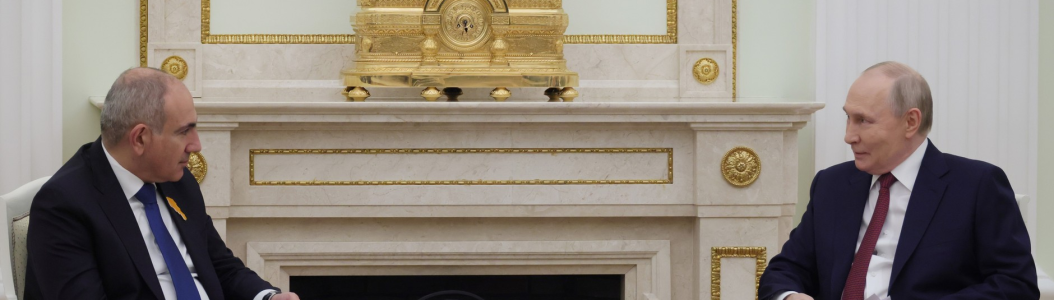
- CC BY 4.0 © Photo by kremlin.ru (Vladimir Putin and Nikol Pashinyan, April 2026.)
EU Welcomes Armenia’s Pro-Europe Election Results, but Can It Offer an Alternative to Russian Trade?
- Lena Sahakyan
Armenia’s most recent parliamentary elections reaffirmed the ruling party’s mandate and, with it, the country’s European course. Brussels, of course, welcomed the result, and the EU Commission President Ursula von der Leyen praised “a democratic Armenia that is drawing ever closer to Europe.” Yet, many Armenians find themselves anxious as to how Moscow will respond to the country’s growing distance from Russia.
“Armenia can count on us,” von der Leyen concluded in a statement on her X account. The country could indeed count on Europe, particularly in establishing new trade ties following Russia’s “strategic” ban on several Armenian products ahead of the key elections. In the past couple of weeks, Russia, Armenia’s largest export market, has banned several products from entering the local market. From alcoholic beverages that stopped “meeting mandatory requirements” to berries and vegetables flagged with an “increased number of violations,” this echoes Russia’s repeated warnings to Armenia regarding the consequences of its warmer ties with the EU.
Moscow Responds to Armenia’s European Aspirations
On June 10th, the Russian Foreign Minister Sergei Lavrov reminded Armenian authorities that the country cannot “sit on two chairs.” Accusing Western powers of interfering with Armenia’s elections, Lavrov highlighted that Armenia has to urgently decide whether it remains part of the post-Soviet military alliance, the Collective Security Treaty Organization (CSTO), and the Eurasian Economic Union (EEU) or moves ahead with the EU. He stressed that Russia respects the Armenian people’s right to decide through a referendum but wants clarity on Yerevan’s long-term direction, noting that such a choice would have major economic and regulatory consequences.
Tensions over Armenia’s European aspirations surfaced last year when the Armenian parliament approved a bill on European integration. Moscow responded by warning Yerevan that closer alignment with Europe could affect existing economic arrangements, including energy agreements. Armenian officials sought to reassure Russia, with the Foreign Ministry emphasizing that Moscow remains a reliable partner with which Armenia shares extensive ties.
Following the parliamentary elections, Prime Minister Nikol Pashinyan downplayed suggestions of a drift with Russia, stating that relations between the two countries are based on mutual respect and institutional cooperation. He told reporters that he did not see any real tension in ties between Yerevan and Moscow despite Armenia’s ongoing efforts to deepen relations with the European Union.
Does Europe Offer an Alternative?
European leaders welcomed the election results and reaffirmed their support for Armenia’s democratic strengthening. French President Emmanuel Macron expressed support for strengthening Armenia’s rapprochement with Europe. The EU Council shared a Statement by the High Representative reassuring the EU’s steadfast commitment to deepening the partnership with Armenia.
“We look forward to continuing our close cooperation with the future government and parliament of Armenia, to implement their comprehensive reform agenda, promote regional peace, economic growth and connectivity, with a view to strengthening Armenia’s sovereignty, resilience, democracy and prosperity.”
Labeling Russia’s sudden import barriers as “economic coercion,” Ursula von der Leyen announced the preparation of an EU support package for Armenia, including financial assistance worth over 50 million euro to ease trade for agricultural producers.
The EU Commission president also noted, that the EU has already organized practical support for affected sectors, such as flowers, including a shipment of 10,000 flowers to Latvia.
“We will also keep connecting our businesses, following up on the commitments taken at our recent Summit in Yerevan.” concluded von der Leyen.
While Armenian authorities face the challenge of finding alternative markets for local producers to mitigate the foreseeable impact of Russia’s export bans, European leaders welcome and praise the election results. This support will need to be reflected in sustainable trade alternatives, rather than primarily emergency responses such as the recent action plans.
Sources: European Council press release, European Commission press corner, OC Media, The Moscow Times, ArmenPress, Congratulatory Telegram,
Author: Lena Sahakyan
- © European Commission, 2026, photo by Iakovos Hatzistavrou (Panayiotou, Minister for Environment, Rural Development and Agriculture and Jessika Roswall in Larnaca district, Cyprus.)
The EU’s New Water Pollution Framework: Main Changes Under Directive 2026/805
- Ana Calatayud Márquez
The EU Directive 2026/805 entered into force on 11 May 2026, aiming to support pollution-free waters in the EU, as well as Europe’s water resilience. This new Directive, among many updates, revises the list of water pollutants and ensures better control over new substances. Moreover, it is expected to balance water-related economic activities with environmental and health concerns. As a result of EU Directive 2026/805, three key pieces of legislation will be modified: the Water Framework Directive, the Environmental Quality Standards Directive, and the Groundwater Directive.
Key Provisions
The changes made to the list of substances considered pollutants in the EU represent a landmark development, covering the so-called “forever chemicals” (PFAS), such as TFA, as well as other pesticides, microplastics, and pharmaceuticals that have recently been proven dangerous. Another fundamental aspect of the Directive is the introduction of “effect-based monitoring” as a requirement, providing a thorough water-quality risk assessment and potentially more efficient control.
Furthermore, this new legislation contributes to the European Commission’s “one substance, one assessment” approach by enabling the European Chemicals Agency to play a bigger role in future revisions of the pollutant substances list.
Jessika Roswall, Commissioner for Environment, Water Resilience, and a Competitive Circular Economy, explained: “The revised water law will help reduce pollution in our waters from PFAS, pesticides, and other harmful chemicals. This is exactly what we set out to do in the European Water Resilience Strategy — to make Europe more resilient in terms of water.”
Legislative Background
The first proposal for this law was adopted by the European Commission in October 2022 after a thorough technical process conducted with the support of the Joint Research Centre, Member States, stakeholder experts, and the Scientific Committee on Health, Environmental and Emerging Risks. It was not until February this year that the Council of the European Union formally adopted it.
As Minister of Agriculture, Rural Development and Environment of the Republic of Cyprus, Maria Panayiotou stated: “Water is an utmost priority of the Cyprus presidency, and protecting its quality is just as vital as securing its quantity.”
Sources:
European Commission, Council of the European Union, Directive 2026/805, Directive 2000/60, Directive 2008/105, Directive 2006/118, Chemicals Strategy for Sustainability, European Chemicals Agency
Author: Ana Calatayud Márquez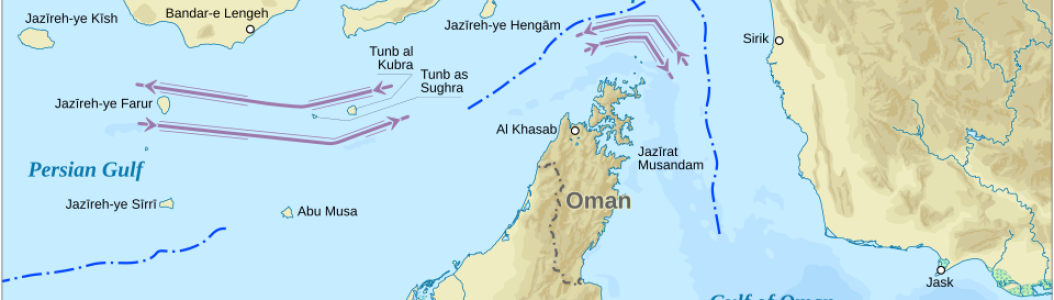
- CC BY-SA 4.0 © Photo by Goran_tek-en (Map of Strait of Hormuz.)
Strategic gap: Why the EU’s Hormuz response still falls short
- Alessandro Fanì
The European Commission’s assessment of oil and gas supply security, released on 30 April 2026 amid ten weeks of Middle East turmoil, delivers a composed statement: no immediate shortages, gas storage is filling, and emergency stocks are ready. Brussels presents this as validation of its post 2022 diversification strategy and the green transition. Yet a closer reading, supported by Eurostat data, suggests that the EU’s confidence rests on reactive measures that do little to address a fundamental dependency.
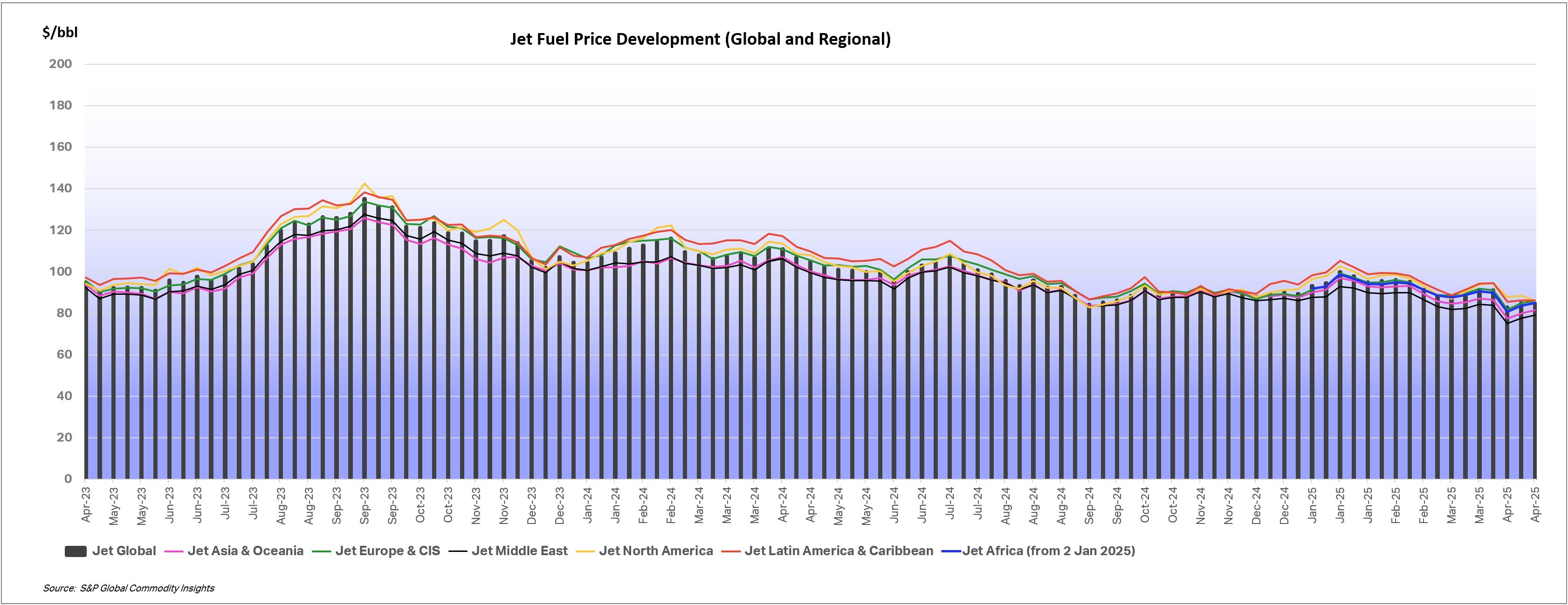
The numbers tell a sobering story. Crude oil and petroleum products still account for 38% of the EU’s energy mix, while overall import dependency remains at 57%. The post 2022 diversification effort has reshaped thegas supply picture significantly, Norway now covers 54% of pipeline gas imports, the US supplies 58% of LNG imports, and North Africa contributes a further 19% via pipeline. Russian gas imports have fallen from 45% in 2021 to around 6% via pipeline in 2025. Yet the structural shift has introduced new exposures. LNG’s share of total EU gas imports has risen from 20% in 2021 to 45% in 2025, meaning that nearly half of gas supply now depends on maritime routes and global spot markets. The most acute vulnerability, however, is aviation fuel. Europe consumes 1.6 million barrels of jet fuel per day, of which around 500,000 barrels are imported; historically, up to three quarters of that import volume has come from the Middle East, with the Strait of Hormuz accounting for approximately 40% of the region’s total jet fuel supply. This is not a latent risk, it is an active one. The vulnerability has changed in form, not in magnitude.
Faced with this reality, the EU’s emergency response relies heavily on existing instruments and incremental adjustments. According to POLITICO, the package encourages Member States to use existing legal frameworks, proposes covering up to 70% of wholesale power costs, and suggests measures such as targeted tax cuts or voluntary eco-driving campaigns. A significant portion remains either aspirational or incomplete, with key sections on jet fuel still to be developed.
There is also a dimension the Commission sidesteps entirely: price. Physical shortage and economic damage are not the same threshold, and the EU is already past the second one. Jet fuel costs have more than doubled relative to April 2024 levels, and the cascading costs across airlines, industries and consumers are accumulating regardless of whether storage levels hold. Adequacy of supply and affordability of energy are different problems. The current toolkit is better equipped to address the first than the second.
The Hormuz saga should prompt a more candid institutional assessment. That the EU is not at the forefront of geopolitical developments is hardly surprising; more concerning is its difficulty in acting, leaving it to absorb the consequences with a policy machinery calibrated for long-term reaction rather than anticipation.
Sources
- https://energy.ec.europa.eu/news/commission-assesses-eu-countries-security-oil-and-gas-supply-conflict-middle-east-continues-2026-04-30_en
- https://ec.europa.eu/commission/presscorner/detail/en/ip_26_629
- https://energy.ec.europa.eu/strategy/repowereu-phase-out-russian-energy-imports_en
- https://www.politico.eu/article/eu-bids-to-outmaneuver-iran-rollercoaster-with-emergency-energy-plan/
- https://www.consilium.europa.eu/en/infographics/where-does-the-eu-s-gas-come-from/
- https://www.reuters.com/business/energy/europes-jet-fuel-imports-middle-east-stop-raising-supply-crunch-fears-2026-04-28/
- https://ec.europa.eu/eurostat/statistics-explained/index.php?title=Final_energy_consumption_in_transport_-_detailed_statistics
- https://www.iata.org/en/publications/economics/fuel-monitor/
- https://www.argusmedia.com/en/commodities/jet-fuel
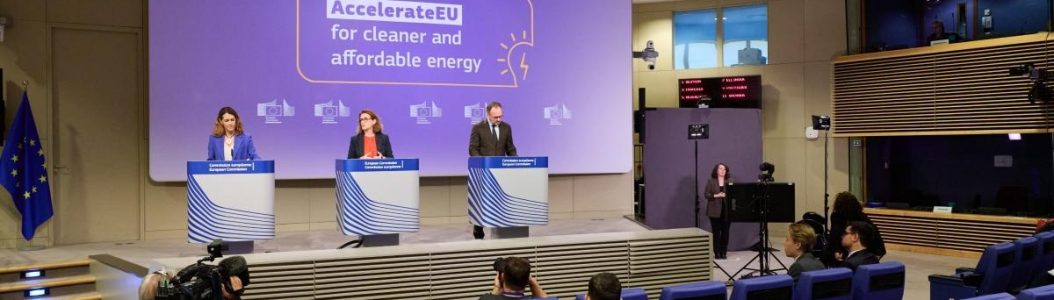
- © European Commission, 2026, photo by Dati Bendo (Weekly meeting on AccelerateEU by Teresa Ribera, Executive Vice-President of the European Commission, and Dan Jørgensen, European Commissioner.)
EU Unveils Plan to Counter Energy Shock from Iran War
- Ana Calatayud Márquez
The European Commission has proposed new measures to mitigate the energy impacts of Iran’s war, aiming to reduce electricity taxes and accelerate the transition to clean energy. Specifically, the proposal—called AccelerateEU—introduced this month, would ensure that electricity is taxed at a lower rate than fossil fuels to incentivize its use and ease the burden on energy-intensive industries.
In addition, the plan seeks to speed up the deployment of green technologies and improve coordination of gas storage measures. Despite the ambition of the 16-page proposal, the path to a more energy-resilient Europe still depends heavily on member states implementing the measures and supporting the proposed tax changes.
AccelerateEU is part of a broader set of initiatives put forward by the European Union in response to energy supply disruptions linked to tensions over the Strait of Hormuz. The situation has already cost the European Union an additional €24 billion in oil and gas imports, underscoring its significance in EU politics.
Looking ahead, the European Commission has expressed its willingness to collaborate with the International Energy Agency (IEA) on releasing oil stocks and monitoring energy markets to strengthen energy security.
Sources:
European Commission – Energy, World Economic Forum, Carbon Brief
Author: Ana Calatayud MárquezEuropean Parliament
© Laura Mazzei on Unsplash (European Parliament)

- CC BY-SA 3.0 © Photo by Ssolbergj (The emblem of the Court of Justice of the European Union.)
CJEU clarifies asylum detention in border procedures
- Maximilian Schlenker
What happened at the Court
Can a Member State run an asylum border procedure in a detention centre that is not physically located at the border, and can the applicant remain there after the border procedure has expired? On April 16th, 2026, the Court of Justice answered a practical question for EU asylum systems. In Danané and Others, the Court held that the first is possible, while the second requires a fresh legal basis and full detention safeguards.
The cases arose in Belgium, where several third-country nationals arrived by air at Brussels airport in September and October 2023 and applied for international protection shortly after arrival. Belgian authorities refused them entry and placed them in detention while their applications were examined under the border procedure. Some were held in centres such as Caricole or Sint-Gillis-Waas, which are not physically located at the border. When no final decision was taken within four weeks, the applicants were admitted to Belgian territory for the continuation of their asylum procedures, but they remained in detention under a new legal basis.
The legal difficulty lay in the relationship between geography and legal status. Article 43 of the Asylum Procedures Directive allows Member States to examine certain applications at the border or in transit zones. The Reception Conditions Directive then sets the conditions under which applicants may be detained, including the need for an individual assessment and the absence of less coercive alternatives. Advocate General Emiliou had already framed the issue as one concerning the legal fiction of non-entry, where a person is physically present on the territory but treated as not yet having entered for the purposes of the procedure.
Why it matters
The Court accepted a functional understanding of the border. It found that EU law does not prevent Belgium from treating an inland centre as a place used for border procedures, provided the designation is clear and does not weaken reception guarantees. This matters because it prevents the legality of border procedures from depending only on infrastructure at airports, ports or land crossings. At the same time, the Court drew a firm line at the expiry of the four-week period. After that point, the application may no longer be handled under the border procedure. Continued detention in the same facility is possible only if it rests on a separate ground under EU law and remains necessary, proportionate and subject to safeguards.
The judgment is therefore not simply a victory for administrative flexibility. It also shifts the main legal contest to the safeguards surrounding detention, especially in regard to the coming return hubs. Member States may be able to design border procedure systems in more flexible locations, but they must still justify each detention measure individually and inform applicants when their legal situation changes. Belgian coverage presented the ruling as backing Belgium’s approach, but the Court’s reasoning leaves room for future challenges where detention becomes automatic or poorly reasoned.
The wider relevance lies in the new Pact on Migration and Asylum. The Asylum Procedures Regulation makes border procedures a more central part of EU asylum governance and expressly contemplates designated locations within Member States. Academic commentary has warned that this development risks turning border procedures from an exceptional mechanism into a routine migration management tool. The Court here accepts that the border can operate as a legal function rather than only as a physical place, but it also makes clear that a functional border cannot become a legal blind spot.
References
- https://eur-lex.europa.eu/legal-content/EN/TXT/PDF/?uri=CELEX:32013L0032
- https://eur-lex.europa.eu/legal-content/EN/TXT/PDF/?uri=CELEX:32013L0033
- https://eur-lex.europa.eu/legal-content/EN/TXT/PDF/?uri=OJ:L_202401348
- https://academic.oup.com/ijrl/article/37/2/201/8166087
- https://www.belganewsagency.eu/eu-court-backs-belgium-on-detention-of-asylum-applicants
- https://curia.europa.eu/site/upload/docs/application/pdf/2026-04/cp260054en.pdf
- https://eur-lex.europa.eu/legal-content/EN/TXT/HTML/?uri=CELEX:62024CC0050
- https://eur-lex.europa.eu/legal-content/EN/TXT/?uri=CELEX:62024CJ0050

- © European Union, 2024 / EC - Audiovisual Service, Photo by Jennifer Jacquemart (20 February 2024, Janez Lenarčič, European Commissioner for Crisis Management, received Irakli Kobakhidze, Georgian Prime Minister.)
EU lists Georgia as “Safe Country of Origin” Despite Democratic Backsliding
- Lena Sahakyan
On February 10, the EU Parliament adopted changes to the EU Asylum Procedure Regulations. Most notably, a majority of Members of the European Parliament (408 votes in favor) endorsed the creation of a new EU-wide list of “safe countries of origin.” Lawmakers also approved changes related to the “third country concept” within the asylum framework.
What is a “safe country of origin” and what does it mean for asylum seekers?
A “safe country of origin” is a legal term in migration law referring to a country where, on the basis of the legal situation, political persecution is deemed absent, human rights are considered to be respected, and people are not seen as facing a real risk.
The newly approved EU list is intended to fast-track asylum procedures for nationals of designated countries. The list includes Egypt, India, Bangladesh, Colombia, Kosovo, Morocco and Tunisia, as well as EU candidate states such as Georgia.
In practical terms, inclusion on the list significantly complicates asylum prospects for citizens of these countries. Applications are fast-tracked and more likely to be rejected unless the applicant can demonstrate that their individual circumstances warrant protection. Under the new framework, the burden shifts more heavily onto applicants to prove a well-founded fear of persecution or a real risk of serious harm in their country of origin.
Under the agreement, the European Commission will oversee the monitoring of countries designated as safe, including EU candidate countries. If conditions in any of these states worsen, the Commission may temporarily remove it from the list, informing the European Parliament of the decision.
Georgia’s EU candidate status “in name only” amid democratic decline
After a long-sought EU membership journey, Georgia was granted EU candidate status on December 14, 2023, following the recognition of a “European perspective” in June 2022. However, candidate status was made conditional on the implementation of specific reforms aimed at strengthening democratic institutions and the rule of law. In contrast to this, critics argue that Georgia’s ruling party has accelerated democratic backsliding.
Following its victory in the disputed 2024 parliamentary elections, Prime Minister Irakli Kobakhidze announced the suspension of Georgia’s EU accession efforts until 2028. The Georgian Parliament also adopted a controversial “foreign agent” law requiring NGOs and individuals receiving foreign funding to register. The legislation was widely compared to similar laws in Russia and raised concerns over restrictions on civil society. The decisions triggered ongoing demonstrations and political unrest.
In addition, Opposition parties have accused the government of suppressing dissent and undermining media freedom. At the end of 2024, Transparency International Georgia, a non-governmental organization, released a report highlighting nearly 200 cases of violence against media representatives, almost five times more than the year before. Around 80% of the recorded cases took place during anti-government protests. This and many other alarming reports by civil society show that journalists and activists increasingly face intimidation, obstruction, and violence while carrying out their work under the ruling Georgian Dream party.
In 2025, the European Commission’s enlargement report on Georgia described “serious democratic backsliding marked by a rapid erosion of rule of law” in the country.
“The Georgian authorities have imposed repressive measures against civil society, media representatives and opposition leaders that severely undermine democratic processes and effectively abolished civic participation and the system of checks and balances,” the Commission wrote.
Even though Georgia’s long-sought aspirations to join the EU came to materialize to an extent, the following years have pushed some EU observers to describe Georgia as “a candidate country in name only.” Georgia expert Wojciech Wojtasiewicz has described the country on a “fast track to authoritarianism,” comparing its current political situation to the processes that took place in Belarus and even Russia, 25 years ago.
“The systemic repressive actions of the authorities, including legislation curtailing civic space and fundamental rights, the functioning of independent media and targeting LGBTIQ persons, excessive use of force in full impunity by the law enforcement authorities and hostile rhetoric against the EU, are in stark contrast with EU values and the actions expected from an EU candidate country,” the Commission wrote in their EU enlargement report.
Debating Georgia’s inclusion in the “safe country of origin” list
According to official statistics, in 2024, the overall asylum recognition rate for Georgians stood at 4%, providing a basis to be included in the “Safe Country of Origin” list. However, the decision has been debated among several members of the European Parliament.
“We are debating Georgia’s anti-democratic turn, while the EU at the same time declares Georgia a safe country of origin,” said Social Democrat MEP Cecilia Strada during a European Parliament debate in December.
She stressed that in 2025 Georgia experienced widespread repression of dissent, marked by violence against peaceful demonstrators and pressure on media freedom. According to her, these developments call into question whether the country can be considered safe for opposition members and independent journalists.
Growing Contradiction
While Georgia’s title as a “safe country of origin” reflects statistical asylum trends, it sits uneasily alongside the EU’s own assessment of democratic regression in the country. As Brussels seeks to balance migration management with its enlargement policy and commitment to democratic values, Georgia’s case stands out as an increasingly visible example of the gap between political realities on the ground and the legal assumptions embedded in EU asylum policy.
Sources: EUR Lex – Access to the European Union Law, European Parliament News, Georgia Enlargement Report, Transparency International Georgia, European Parliament, Civil Georgia, European Union Agency for Asylum, European Council, EPDE Georgia Election, EPDE Foreign Agent Law.
Author: Lena Sahakyan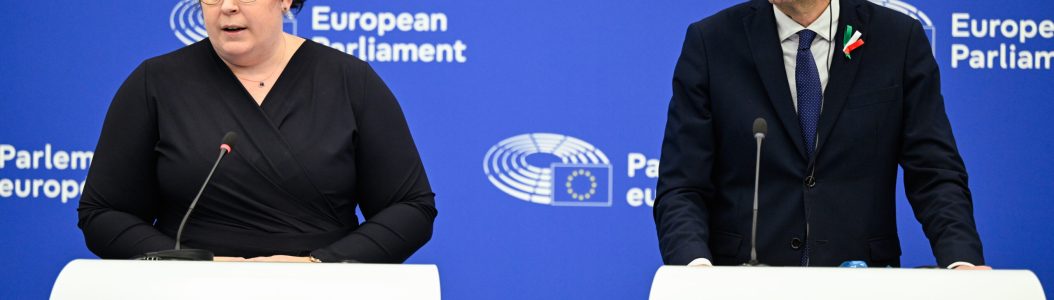
- © European Union 2026 - Source: EP, photo by Laurie DIEFFEMBACQ (10/02/2026. Press conference on safe third country concept.)
EU safe countries list tightens asylum rules: a “win” for Italy, but Albanian protocol remains on shaky ground
- Alessandro Fanì
On 10 February 2026, the European Parliament approved new EU rules on the safe third country concept and the EU-wide list of safe countries of origin. While the Parliament’s vote marks an important step (408 in favour, 184 against and 60 abstentions), the text still requires formal adoption by the Council before it becomes law.
The reforms introduce a common list of safe countries — Bangladesh, Colombia, Egypt, India, Kosovo, Morocco and Tunisia — and presume EU candidate countries are safe for their own nationals. Member States can now apply accelerated procedures for asylum applications from these groups. The rules also introduce new criteria for Member States to determine whether a country can be considered safe for applicants who are not nationals, expanding flexibility in assessing asylum requests. These changes aim to standardise procedures across the EU, reduce disparities between national approaches, and provide a clearer legal framework for deciding (in)admissibility.
However, the most substantial innovation is that EU countries will be able to conclude agreements with third countries to examine requests for protection. Beyond this, Member States may declare an asylum application inadmissible under the safe third-country concept in three scenarios: if the applicant has a connection to the third country—such as family members, prior residence, or linguistic, cultural, or similar ties; if the applicant transited through the third country on the way to the EU and could have requested effective protection there; or if a bilateral, multilateral, or EU-level agreement exists with the third country for admitting asylum seekers, except in the case of unaccompanied minors. Implementing them will require partner countries to have sufficient institutional capacity, legal safeguards, and human rights protections, including access to judicial review and compliance with non-refoulement obligations.
However, the new EU framework does not automatically regularise existing bilateral schemes such as Italy’s protocol with Albania. Under the EU rules, the third country designated as safe is expected to assume responsibility for examining asylum claims on its own territory and under its own legal system. This differs from the Italian arrangement, in which procedures are conducted under Italian jurisdiction inside facilities located in Albania. As a result, the European legislation does not directly validate or legalise the bilateral model, which remains subject to judicial scrutiny under both EU and national law.
Italy has nonetheless been one of the most vocal supporters of the reform. Interior Minister Matteo Piantedosi described the Parliament’s vote as a great success for Rome, arguing that the EU framework reflects strategies already promoted by the Italian government. Also Italian MEP Nicola Procaccini likewise framed the EU developments as evidence of Italy’s influence on European migration policy.
If the Council formally adopts the text and Member States succeed in negotiating workable third-country agreements, the reform could mark a new phase in European migration governance—while leaving unresolved legal questions around existing bilateral models.
Sources:
- https://www.ansa.it/english/news/politics/2026/02/10/eu-has-adopted-italy-migrant-strategy-says-procaccini_7aeb27ff-fead-4054-8233-15e791a047b4.html
- https://www.europarl.europa.eu/news/en/press-room/20260205IPR33617/asylum-new-rules-for-safe-third-countries-and-eu-safe-countries-of-origin-list
- https://www.ansa.it/english/news/2026/02/10/ep-ok-for-list-of-safe-countries-great-success-for-italy-says-piantedosi_a080b981-e59f-4dcd-aacd-b277ddd35dee.html
- https://www.consilium.europa.eu/en/press/press-releases/2025/12/18/safe-third-country-council-and-european-parliament-agree-on-new-eu-law-restricting-admissibility-of-asylum-claims/
- https://ec.europa.eu/assets/home/emn-glossary/glossary.html?letters=e&classification=6.2&detail=safe+third+country
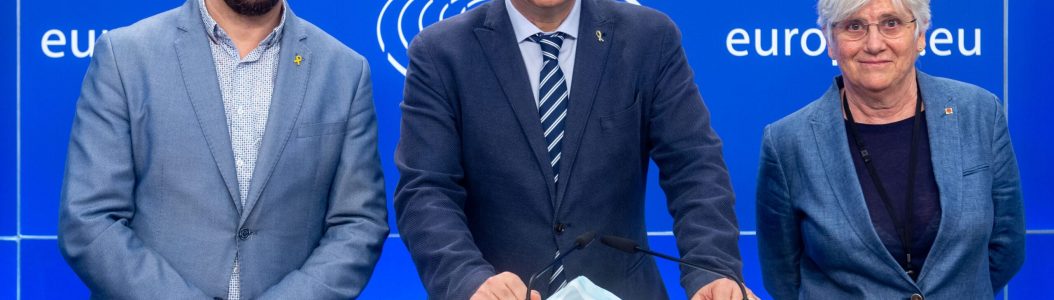
- © European Union 2021 - Source: EP, Photo by Jan VAN DE VEL, 03/06/2021 (EGCJ provisional ruling on the immunity of Carles PUIGDEMONT, Toni COMIN and Clara PONSATI.)
Process defects can sink a waiver – CJEU clips Parliament on immunity
- Maximilian Schlenker
On 5 February 2026, the Court of Justice annulled the European Parliament’s 9 March 2021 decisions waiving the parliamentary immunity of Carles Puigdemont, Antoni Comín and Clara Ponsatí in C-572/23 P. The Court did not rule on the merits of Spain’s underlying criminal case. Instead, it treated the waiver as an individual administrative decision that must meet minimum standards of impartiality under the right to good administration.
The trigger is Parliament’s own guardrail for immunity files. To avoid “club politics”, the rapporteur handling a waiver request should not sit in the same political group as the MEP concerned. The Court says the logic runs wider. Where a political party is directly involved in initiating the national proceedings that generated the waiver request, appointing a rapporteur from a group that includes that party can create objective doubts about neutrality. If the rapporteur is tainted, the reports underpinning the waiver are treated as invalid, and the waiver falls with them.
The result is a reminder that Parliament’s discretion in handling immunities is not unlimited. Even in a deeply political file, the Court is policing whether the institutional machinery is designed and seen to be even-handed.
What this means
For current affairs, this is a governance judgment with two clean implications. First, it raises the procedural bar for future immunity waivers. Parliament will likely need tighter conflict-of-interest screening for rapporteurs and clearer internal records showing why a given appointment does not compromise impartiality. The “rotation” logic in Parliament’s immunity practice remains, but it now carries more litigation risk if the political ecosystem behind a national case is too closely mirrored in the Parliament process.
Second, it offers a litigation playbook for high-salience waiver targets. Instead of arguing only about political motivation or the national file, applicants can attack the procedural architecture using Article 41 of the Charter as a lever, affecting the rapporteur selection, committee handling and the appearance of bias.
The broader EU point is institutional credibility. In a Union that relies on mutual trust—between courts, capitals, and Brussels bodies—process failures become a strategic weakness: they turn politically charged cases into procedural own goals.
Sources
- https://curia.europa.eu/site/upload/docs/application/pdf/2026-02/cp260010en.pdf
- https://eur-lex.europa.eu/legal-content/EN/TXT/PDF/?uri=CELEX:62021TA0272
- https://www.europarl.europa.eu/cmsdata/288291/Principles%20for%20immunity%20cases_EN.pdf
- https://www.europarl.europa.eu/doceo/document/TA-9-2021-03-09-TOC_EN.html
- https://eur-lex.europa.eu/LexUriServ/LexUriServ.do?uri=OJ:C:2004:310:0261:0266:en:PDF
- https://www.europarl.europa.eu/charter/pdf/text_en.pdf
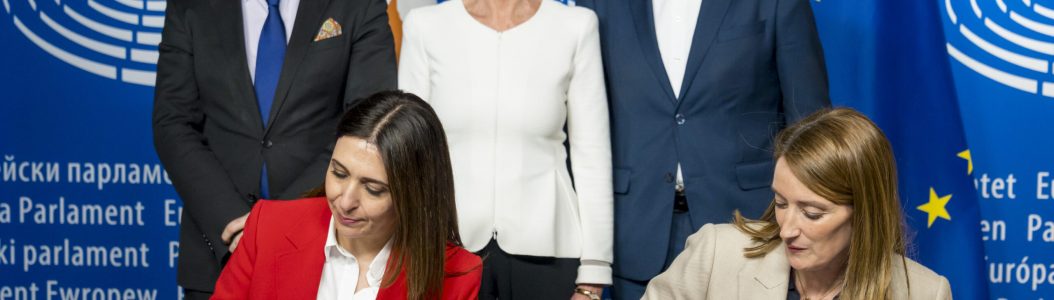
- © European Union 2026 - Source: EP, Photo by Daina LE LARDIC (LEX signing on phase out of Russian gas imports, Lex signing ceremony in presence of Roberta METSOLA, EP President and Marilena RAOUNA, Cypriot Deputy Minister for European Affairs, on behalf of the Cypriot Presidency, 26/01/2026)
The End of Russian Natural Gas Dependence
- Sebastian Dodd
On Monday, the European Parliament and the Council published the REPowerEU Gas Regulation, which sets out the legal framework to phase out Russian natural gas imports and end the EU’s dependence on them by 2027. The regulation includes several deadlines for existing contracts concluded before 17 June 2025 with transition periods: from April 2026, short-term liquefied natural gas (LNG) contracts will be banned; from June 2026, short-term pipeline gas contracts will be prohibited; from January 2027, all long-term LNG contracts will be banned; and from September 2027, pipeline gas imports under long-term contracts will also be prohibited.
This represents a major step forward for European strategic autonomy. The EU’s dependence on Russian natural gas has been weaponized repeatedly over the past decades, as Russia has sought to influence European political decision-making. This concern was explicitly highlighted in a European Commission statement following the publication of the regulation, in which the Commission noted that: “In order to avoid essential security risks and energy dependencies resulting from continued energy trade with the Russian Federation, the European Commission remains committed to ensuring the phase-out of all remaining oil imports from the Russian Federation by the end of 2027, in line with the Versailles Declaration.”
Russia’s invasion of Ukraine brought Europe’s reliance on Russian natural gas into sharp focus, as many EU Member States were forced to balance the imposition of economic sanctions on Russia with the energy needs of economies heavily reliant on Russian imports. Recognizing the urgency of reducing this dependency, EU Heads of State agreed in the March 2022 Versailles Declaration to gradually decrease, and ultimately eliminate, dependence on Russian energy. In May 2022, the Commission followed up with proposals to diversify energy supplies in a safe, affordable, and sustainable manner. Significant progress since then has laid the groundwork for the current regulation, which aims to fully phase out Russian natural gas imports by 2027.
In the regulation’s text, the European Parliament and Council explicitly cited Russia’s abuse of Europe’s energy dependence as justification for this move, including incidents predating the war in Ukraine. These include Russia’s suspension of gas supplies to several Southeast and Central European countries during a cold spell in 2006 and the complete cutoff of gas transiting through Ukraine in January 2009. The latter affected 18 Member States, some of which experienced zero gas flows for nearly two weeks. The regulation also highlights the role of the Russian state-controlled monopoly exporter Gazprom, which has been the subject of multiple Commission investigations for potential breaches of EU competition rules, including evidence of unfair pricing practices and the conditioning of energy supplies on political concessions, such as participation in Russian pipeline projects or the acquisition of control over EU energy assets.
Overall, the regulation marks a significant advance in European strategic autonomy, particularly in the context of ongoing Russian aggression. Greater energy diversification will allow the EU to make critical geopolitical decisions without the risk of sudden supply disruptions. This, in turn, will enable a faster and more coherent response to future crises, an issue underscored during the early stages of the war in Ukraine, when several Member States, including Germany, were forced to scramble to compensate for the abrupt loss of Russian natural gas supplies.
Sources
BBC, EUR-Lex, EUR-Lex, EU Energy,
Author: Sebastian Dodd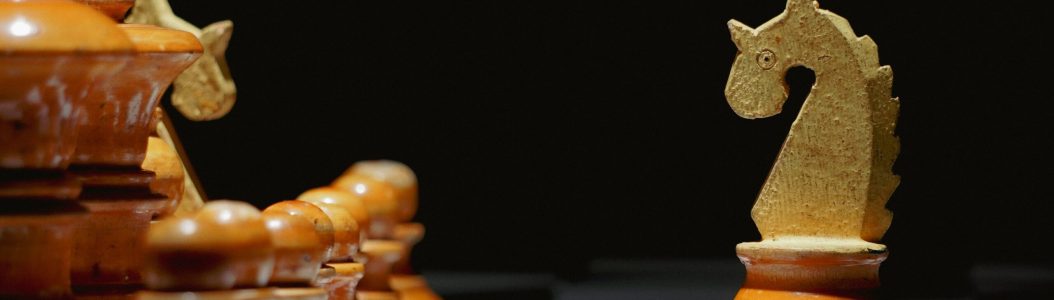
- © Abhishek Tewari /Unsplash(Chess pieces arranged on a board. A vintage wooden chess figure, illustrating the CJEU, being used by the EP to delay the Mercosur Agreement, even to avoid it against political competitors.)
CJEU review puts EU–Mercosur deal on constitutional hold
- Maximilian Schlenker
The Court of Justice of the European Union (CJEU) is set to weigh in on the EU–Mercosur Agreement after the European Parliament requested an advisory opinion under Article 218(11) TFEU on the agreement’s compatibility with EU primary law. The move shifts the center of gravity of the ratification debate from political bargaining to constitutional adjudication, with direct consequences for the agreement’s legal trajectory.
Under Article 218(11) TFEU, EU institutions may seek an ex ante ruling on whether an international agreement complies with the Treaties. If the Court were to find incompatibility, the agreement could not enter into force in its current form. Even in the absence of such a finding, the procedure introduces a significant temporal delay, as the Court’s opinion is not expected before late 2026 at the earliest.
Crucially, however, a pending CJEU opinion does not automatically preclude provisional application of the agreement’s trade components. Provisional application, decided by the Council and not subject to parliamentary consent, has long been used to bridge extended ratification periods. The EU–Canada CETA provides a relevant precedent: it has been provisionally applied since 2017, despite still not having formally entered into force.
From a legal perspective, existing CJEU case law offers mixed but not unfavorable signals. In Opinion 1/17, the Court upheld CETA’s compatibility with EU law, including its controversial investment court system, an element absent from the EU–Mercosur Agreement. Earlier, in Opinion 2/15 on the EU–Singapore agreement, the Court broadly confirmed the scope of the EU’s exclusive competence in trade policy, reinforcing institutional discretion in external economic relations.
Beyond the substance of the Mercosur deal, the referral underscores a broader pattern. The CJEU is increasingly acting as an arbiter not only of legal boundaries, but of political timing. In EU trade policy, judicial review is no longer merely a safeguard of constitutionality, it has become a strategic variable in managing contested external commitments.
Sources
- https://www.europarl.europa.eu/news/en/press-room/20260116IPR32450/eu-mercosur-meps-demand-a-legal-opinion-on-its-conformity-with-the-eu-treaties
- https://eur-lex.europa.eu/LexUriServ/LexUriServ.do?uri=CELEX:12008E218:en:HTML
- https://infocuria.curia.europa.eu/tabs/document?source=document&docid=213502&doclang=EN
- https://infocuria.curia.europa.eu/tabs/document?source=document&docid=190727&doclang=en
- https://eur-lex.europa.eu/legal-content/EN/TXT/PDF/?uri=CELEX:32017D0038

- © André Ravazzi/Unsplash(Rectangular brown wooden table with chairs. Symbolising a potential European Security Council meeting.)
Is it time for a European Security Council?
- Sebastian Dodd
Following Russia’s invasion of Ukraine and the United States’ increasing strategic uncertainty toward Europe, the EU has made significant strides in strengthening its defence posture over the past year. Through the White Paper and the Readiness Roadmap 2030, Member States have mobilised up to €800 billion for defence, including €150 billion for joint procurement under the Security Action for Europe (SAFE) programme. This funding has supported a wide range of initiatives, from expanding the European defence industrial base to targeted investments in drone and space capabilities, all of which help reduce Europe’s dependence on the United States for conventional defence.
Most recently, €38 billion in low-interest, long-term loans was released through SAFE to eight countries (Belgium, Bulgaria, Croatia, Cyprus, Denmark, Portugal, Spain, and Romania). These efforts have been complemented by the introduction of new policies under the European Defence Industry Programme (EDIP), the Communication on Defence Industry Transformation, and the Military Mobility Package.
However, despite these advances in funding and capacity-building, Europe still lacks a clear mechanism for coordinating forces and enabling rapid crisis response. The EU’s current defence decision-making structure requires unanimous approval from all 27 Member States, a process that is inherently slow and unwieldy. As EU Defence Commissioner Andrius Kubilius noted in his speech at the Folk och Försvar National Conference 2026, injecting funds into an old defence architecture is insufficient to deliver the qualitative transformation Europe requires. What is needed, he argued, is a structure that enables Europe to fight as a unified force rather than as a collection of national armies.
Kubilius identified the lack of political and operational unity as a central weakness in Europe’s defence posture, one not addressed by current reform efforts. Because the EU CSDP relies on unanimity in military decision-making, and because the United States retains significant influence within NATO, Europe remains slow to respond to emerging crises, including recent U.S. threats concerning Greenland. In response, Kubilius called for the informal E5 format to be formalised and upgraded into a European Security Council (ESC), consisting of several permanent members supplemented by rotating seats, to enable faster and more decisive action on European security.
He is not alone in advocating this approach. Sergey Lagodinsky, a German Member of the European Parliament, has proposed an ESC composed of the leaders of Europe’s “big six” (Germany, France, Italy, Spain, Poland, and the UK), alongside two rotating seats for smaller states and the President of the European Parliament. Under this proposal, the ESC would be established through a new intergovernmental treaty compatible with EU law, while circumventing the unanimity requirement for defence decisions and allowing non-EU members such as the UK to participate. Public opinion appears receptive: a Politico poll conducted in Germany found that 69% of respondents would prefer their country to be defended by a European army, compared with 13% favouring national forces and 12% NATO forces. Even in Poland were citizens are more skeptical of European defense, repondents preferred a European solution (37%) over NATO (27%) or a national response (24%).
Despite this support, significant obstacles remain. The idea of a European Security Council is not new, it was first floated in the 1980s and has been rejected several times since, notably in 2003 following EU divisions over the Iraq War and again in 2017 after being proposed by then Commission President Jean-Claude Juncker and French President Emmanuel Macron. Critics argue that deep geographical and political differences among Member States could reduce the ESC to a mere “talking shop,” while mid-sized countries without permanent seats may see such a body as an unacceptable constraint on national sovereignty in defence matters.
Nevertheless, if Europe is serious about countering the Russian threat and developing an independent defence capability, the creation of an ESC, will be unavoidable. Europe must be able to respond quickly, coherently, and effectively to evolving security challenges.
Sources
European Commission, European Commission, Just Security, Politico, Politico,
Author: Sebastian Dodd
- © Fulvio Ciccolo/Unsplash (A person in a lab coat is holding a test tube with liquid in it.)
EU Unveils Landmark Framework to Harmonize Chemical Safety Assessments
- Ana Calatayud Márquez
Chemical assessments covering commonly used products, such as food or toys, will finally be coordinated under EU frameworks to improve consistency and efficiency. On 1 January 2026, a new set of legislation, known as the “One Substance, One Assessment” (OSOA) framework, entered into force, aiming to strengthen environmental and public health protection. Under this framework, the EU will promote the coherence of chemical safety assessments.
This new EU legislation introduces several innovative proposals on chemical data sharing and risk monitoring for public authorities, enabling more informed and timely decision-making. Specifically, the OSOA consists of three legislative acts:
- A Regulation establishing a shared EU data platform for chemical assessments.
- A Regulation redistributing technical responsibilities and strengthening cooperation among EU agencies.
- A Directive transferring specific technical tasks to the European Chemicals Agency (ECHA).
The Chemical Strategy for Sustainability (2020), a key initiative under the European Green Deal’s zero-pollution ambition, had already set the objective of improving the coherence and efficiency of chemical safety assessments across the EU. Building on this strategy, the OSOA legislative package was proposed in December 2023, approved by the European Parliament in April 2025, and formally adopted by the Council of the EU in November 2025, thereby concluding the legislative process.
Given the UN Environment Programme’s forecast of a doubling of global chemical production over the coming decades, the timely adoption of robust regulatory measures is a clear priority for the European Union. As Jessika Roswall, Commissioner for Environment, Water Resilience and a Competitive Economy, explains: “By streamlining the way chemicals are assessed, we can act earlier and more decisively to protect people’s health and the environment. This new framework will make it easier to access reliable data, strengthen our scientific cooperation, and improve the EU’s ability to anticipate and manage chemical risks.”
In addition to delivering significant benefits for environmental protection and public health through improved chemical data management and enhanced cooperation, the OSOA also reinforces the EU’s internal coherence, a vital pillar for coordinated policymaking that underpins the Union’s capacity to lead in environmental, health, and regulatory standards worldwide.
Sources:
DG-ENV, Regulation (EU) 2025/2455, Regulation (EU) 2025/2457, Directive (EU) 2025/2456, Chemicals Strategy for Sustainability Towards a Toxic-Free Environment, Food Packing Forum, Council of the EU, UN Environment Programme
Author: Ana Calatayud MárquezEuropean Council
CC BY-SA 4.0 © Samynandpartners (European Council/Europa building, Brussels)

- © European Council (Logo of the European Peace Facility - EPF -)
Hungary Loses Bid to Challenge EU-Ukraine Arms Funding
- Maximilian Schlenker
With the EU courts back from their summer recess, the General Court returned to a politically charged question: how far can judges scrutinise decisions taken under the EU’s foreign and security policy? On September 9th, it dismissed Hungary’s challenge to a decision allocating revenues generated by immobilised Russian assets to military support for Ukraine. The Court did not decide whether Hungary had been lawfully excluded from the vote. Instead, it held that the dispute fell outside the jurisdiction of the EU courts because the allocation concerned political or strategic choices under the Common Foreign and Security Policy (CFSP).
The dispute concerned the European Peace Facility (EPF), an off-budget instrument through which Member States finance EU military operations and assistance measures that cannot be charged to the regular EU budget. After Russia’s full-scale invasion, the EPF became one of the EU’s central channels for military support to Ukraine.
In 2024, the Council created a mechanism to use extraordinary profits generated by immobilised Russian Central Bank assets. These profits arise because restrictions on transactions with the Russian Central Bank created large cash balances at central securities depositories, which in turn generated unexpected revenues. The underlying Russian assets themselves remain immobilised; the mechanism concerns the resulting net profits rather than confiscation of the principal.
Under the original arrangement, 90% of the contribution was allocated to the EPF for military support to Ukraine. Hungary voted for the decision creating the revenue mechanism but constructively abstained from the subsequent decision governing allocation through the EPF. When the EPF Committee later decided how the first instalment would be spent, Hungary was consequently excluded from the vote.
Beyond the Court’s Reach
Hungary challenged that exclusion, arguing that the voting procedure violated Article 31(1) TEU, the EPF’s own rules and broader principles including the equality of Member States, democratic functioning and the rule of law.
The central issue, however, became jurisdiction. In its 2024 KS and KD judgment, the Court of Justice developed this distinction in a case concerning the EU’s rule-of-law mission in Kosovo (EULEX). Relatives of people who had disappeared or been killed during the Kosovo conflict sought damages over alleged failures by the mission to investigate their cases and provide effective remedies. The Court rejected the idea that everything done within a CFSP mission automatically falls outside judicial review. Decisions over the resources allocated to the mission or the scope of its executive mandate were political or strategic choices and therefore beyond the EU courts’ jurisdiction. By contrast, matters such as staffing, procedural rules and individual remedial measures were treated as administrative management that the courts could review. That distinction became the test the General Court applied to Hungary’s challenge.
The General Court determined how the first instalment would finance military equipment for Ukraine, including ammunition and artillery systems, air-defence systems and equipment procured from the Ukrainian defence industry. It also implemented strategic orientation provided by the Political and Security Committee.
Hungary attempted to separate the procedure from the substance of that foreign-policy decision. The Court rejected that argument too. Its lack of jurisdiction extends to the “external legality” of strategic CFSP measures, meaning that a challenge to how such a decision was adopted does not by itself bring the dispute within judicial review.
Why it matters
For policymakers, the ruling clarifies where legal accountability gives way to political discretion. Once a CFSP measure is classified as a political or strategic choice, Member States cannot assume that procedural objections will receive separate judicial review. In practice, disputes over voting rights, participation and implementation may have to be settled primarily inside the Council and CFSP machinery.
That makes the internal design of instruments such as the EPF more important. Constructive abstention has helped the EU move ahead when unanimity would otherwise block action, but the Hungary case shows that standing aside at one stage can also reduce a Member State’s influence over subsequent implementation. For governments, the choice between abstaining, blocking and participating therefore carries consequences beyond the initial vote.
The case also illustrates the trade-off created by the EU’s growing security role. The EPF’s financing of lethal assistance to Ukraine marked a major expansion of the EU as a security actor. As these instruments become more operational and politically consequential, the Treaty’s CFSP carve-out means that some of the decisions with the greatest strategic impact may receive comparatively limited judicial scrutiny. This places more weight on political safeguards, clear voting rules and transparent decision-making before measures are adopted.
The immediate funding mechanism has already moved on. Following repeated difficulties around the EPF, the EU redirected most future extraordinary revenues towards the Ukraine Loan Cooperation Mechanism, reducing the EPF share from 90% to 5%. But the institutional lesson remains. The more the EU relies on flexible foreign-policy instruments to act despite internal disagreement, the more important it becomes to resolve questions of participation and accountability at the political stage, because courts may not provide a second forum afterwards.
Sources
- https://eur-lex.europa.eu/legal-content/EN/TXT/?uri=CELEX%3A62024TJ0457
- https://eur-lex.europa.eu/legal-content/EN/TXT/?uri=CELEX%3A02021D0509-20241216
- https://www.europarl.europa.eu/RegData/etudes/BRIE/2025/772833/EPRS_BRI(2025)772833_EN.pdf
- https://eur-lex.europa.eu/legal-content/EN/TXT/PDF/?uri=OJ:L_202401471
- https://curia.europa.eu/site/upload/docs/application/pdf/2026-09/cp260123en.pdf
- https://eur-lex.europa.eu/legal-content/EN/TXT/PDF/?uri=CELEX:62022CJ0029
- https://www.eulex-kosovo.eu
- https://www.cambridge.org/core/journals/european-journal-of-international-security/article/european-strategic-cultures-in-flux-case-study-on-the-european-peace-facility/4CB9C2D784A9D38F2DD3D6A110976A34
- https://journals.sagepub.com/doi/epub/10.1177/1023263X251411828
- CC BY 4.0/ © Photo by National Police of Ukraine (Mobile fire team of Rapid Operational Response Unit of Ukrainian police, which shoots Russian drones in Kherson region, 26 June 2024.)
What Kherson Is Teaching Europe
- Tizian Stocker
- CC BY-SA 4.0/ © Photo by Юрий Д.К. (Moscow. The Kremlin in Spring, taken on 29 March 2026.)
EU Tightens Sanctions on Russia’s War Machine
- Sebastian Dodd
Executive Summary
After being approved on July 23, the EU’s 21st sanctions package against Russia for its war of aggression against Ukraine entered into force on July 24. The package includes 218 designations, 170 entities and 48 individuals, making it the largest sanctions round in four years and bringing the total number of designations to nearly 3,000. This new package adds to the existing sanctions regime against Russia with a focus on combatting Russia’s methods of circumventing sanctions.
In regards to the EUs latest sanction package, EU foreign policy chief Kaja Kallas stated, “More than 50 military-industrial entities are included, (as well as) key actors involved in the production of Russia’s long-range drones,” arguing that Russia will negotiate an end to its illegal war and stop killing civilians only if it is pressured to do so. The package targets 56 military-industrial entities and individuals, with a particular focus on those involved in the production of long-range drones and communications networks. Experts argue that these measures could improve Ukraine’s battlefield efforts while strengthening Europe’s future security. The latest sanctions also continue the EU’s efforts to target suppliers of dual-use goods and technologies in third countries, including China and India, as these technologies are frequently found in Russian weapons such as missiles, drones, and tanks.
Info box provided by Laksmitha Anindyanari:
Sanctions are utilized by the EU to increase the economic and military costs of Russia’s war against Ukraine and limit its ability to sustain the conflict. By restricting access to international finance, energy revenues, advanced technologies and military-related goods, while targeting actors that help Russia circumvent these restrictions, the EU aims to weaken Russia’s capacity to wage war. The ultimate goal is to create incentives for Russia to negotiate by making continued warfare increasingly costly and strengthening Ukraine’s position in negotiations for a ceasefire and lasting peace.
The attention of EU officials and experts has focused in particular on two relatively new measures targeting Russia’s military capabilities. The first is that more than 30 designations target the manufacturing and supply network of Russia’s long-range Garpiya drones. Ukrainian civilians and civilian infrastructure have suffered immensely from Russian bombardment, particularly long-range drone attacks. As a senior EU official explained, “What we’ve done is we’ve focused on one category of long-range drones, Garpiyas, and we’ve mapped out effectively the entire manufacturing and supply network … In a single blow, we are targeting it today with over 30 designations.”
The second is that the package also targets Rassvet, a low-Earth-orbit satellite system produced by the Russian aerospace company Bureau 1440 and hailed by Russian media as a potential future counterpart to Starlink. The company launched 16 satellites in March 2026 and aims to have 250 in orbit by 2027. When Russia previously lost access to Starlink in February of this year, it had “very significant implications on their battlefield performance,” according to Bruegel Senior Fellow Jacob Funk Kirkegaard, making the denial of Russia’s ability to develop its own comparable capability an important EU priority as it seeks to pressure Moscow toward negotiations. Denying such capabilities is also in the EU’s own interests. As Kirkegaard put it, “As the EU or Europe more broadly prepares for a world in which we have to deter Russia on our own for the long run, denying Russia their military capabilities in the next three, four, 10 years from now is very important for our own security.”
Since one of the EU’s stated aims of the sanctions is to pressure Russia into negotiating an end to the conflict, the EU must continue updating its sanctions regime to keep pace with Russian efforts to circumvent existing restrictions. As Kallas stated, “With each round of sanctions, we squeeze Russia’s economy and its capacity to prolong its illegal war. Our 21st package includes the highest number of listings in four years. We’re hitting over a hundred banks and crypto operators, 40+ vessels in Russia’s shadow fleet, and several oil refineries in Russia and Belarus. More than 50 military-industrial entities are included, key actors involved in the production of Russia’s long-range drones. Russia will only negotiate to end its illegal war and stop killing civilians if it is pressured to do so. Sanctions add to this pressure.”
Info box provided by Laksmitha Anindyanari:
The shadow fleet refers to a network of vessels and related companies used to help Russia transport and sell oil while evading international sanctions and the G7 oil price cap. These vessels often operate through opaque ownership structures, use alternative shipping routes or change their registration and flags to make their links to Russia less visible. The EU targets the shadow fleet because it allows Russia to continue generating energy revenues that can help finance its war against Ukraine.
For the first time, the EU is introducing the possibility of a full third-country ban on crypto-asset services as a deterrent to countries hosting platforms that assist Russia in evading sanctions. This new instrument allows the EU to prohibit transactions between EU operators and crypto-asset providers used by Russia.
Energy also remains a major focus of the package. The new sanctions pause the automatic adjustment of the oil price cap mechanism until July 15, 2027, helping ensure that Russian profits from oil sales remain constrained. The Russian shadow fleet was targeted again by extending existing rules to cover vessels supporting the fleet, including those providing bunkering and other services. Another 41 vessels were sanctioned, on top of the previously sanctioned 632 vessels. Non-EU tankers that form part of the shadow fleet and circumvent the oil price cap mechanism, support Russia’s energy sector in other ways, transport military equipment for Russia, or transport stolen Ukrainian grain have also been targeted. Among the eight entities designated in relation to the shadow fleet ecosystem, a crewing agency has been included for the first time.
Info box provided by Laksmitha Anindyanari:
The oil price cap mechanism is a policy designed as a sanction instrument to limit Russia’s earnings from oil exports without completely removing Russian oil from global markets. Under the mechanism, companies in participating countries can provide services such as shipping, insurance and financing for Russian seaborne oil only when it is sold at or below a set price. This allows Russian oil to continue reaching global buyers while reducing the revenue Russia can earn from its exports, limiting funds available to support its war against Ukraine.
Why this matters for Europe
Overall, through this package the Council is continuing to seek ways to strengthen the sanctions regime against Russia by targeting the various methods Moscow has developed to circumvent existing restrictions. This is important because a common criticism of sanctions as a tool for changing state behaviour is that targeted states can adapt to restrictions over time. Recent evidence suggests that the Russian economy is struggling under the combined strain of the war and sanctions, as casualties continue to mount and Ukraine has regained some initiative on the battlefield. Continuing to compound Russia’s economic difficulties could therefore contribute to creating greater incentives for Moscow to negotiate. At a minimum, constraining Russia’s ability to produce and acquire important military capabilities will benefit Ukraine on the battlefield while strengthening European security by limiting Russia’s future military capacity.
What to Watch Next
- The response of countries affected by the new sanctions targeting domestic companies helping Russia circumvent restrictions, particularly China.
- The impact on Russian supply chains important for the production of various military assets, particularly the Garpiya drones.
- Information on the economic situation of Russia going forward.
- Whether Russia is pressured to come to the negotiating table.
Disclaimer: AI-powered language models were used selectively as tools to structure the research and formulate the text. The Research, selection and evaluation of sources, as well as the content analysis, assessments and conclusions, were conducted independently.
Sources Euronews, European Council, Reuters
Author: Sebastian Dodd - CC BY-SA 3.0 © Photo by Ssolbergj (The emblem of the Court of Justice of the European Union.)
CJEU blocks Italy’s 10-year welfare gate for protected migrants
- Maximilian Schlenker
On May 7th 2026, the Court of Justice of the European Union (EU) ruled that Italy cannot require beneficiaries of international protection to have lived in the country for 10 years before accessing its former “citizens’ income” scheme. In Case C-747/22, the Court found that the rule amounted to indirect discrimination, because it formally applied to everyone but, in practice, mainly excluded non-Italian nationals.
The case concerned a third-country national with subsidiary protection in Italy. After an administrative check, the Italian social security authority stopped his benefit and demanded repayment because he had not met the 10-year residence condition. Italy’s “citizens’ income” is not just a welfare payment, being framed as both anti-poverty support and a labour-market inclusion measure.
The Court rejected Italy’s argument that a long residence period proved integration or helped control administrative and financial costs. Under the EU Qualification Directive, beneficiaries of international protection must receive equal treatment with nationals in access to employment measures and necessary social assistance. The Court therefore treated the 10-year rule as more than a domestic welfare condition, it became an EU equal-treatment problem.
Politically, the judgment cuts into a familiar ‘welfare for our own’ reflex. EU social policy already encourages minimum-income schemes with transparent, non-discriminatory criteria and proportionate residence requirements. The CJEU has now given that logic legal force in a sensitive migration context.
The ruling does not mean that Member States must open welfare systems to everyone. Its message is that once a person has recognised protection status within the EU, governments cannot keep them in a second-class welfare waiting room simply because they have not lived in the country long enough. It also fits a broader Italian pattern in which complex eligibility rules have restricted migrants’ access to social benefits.
Sources
- https://curia.europa.eu/site/upload/docs/application/pdf/2026-05/cp260068en.pdf
- https://infocuria.curia.europa.eu/tabs/affair?sort=AFF_NUM-DESC&searchTerm=%22C-747%2F22%22&publishedId=C-747%2F22
- https://www.gazzettaufficiale.it/atto/serie_generale/caricaArticolo?art.codiceRedazionale=19G00008&art.dataPubblicazioneGazzetta=2019-01-28&art.flagTipoArticolo=0&art.idArticolo=1&art.idGruppo=1&art.idSottoArticolo=1&art.idSottoArticolo1=10&art.progressivo=0&art.versione=1
- https://eur-lex.europa.eu/legal-content/EN/TXT/PDF/?uri=CELEX:32023H0203(01)
- https://eur-lex.europa.eu/legal-content/EN/TXT/PDF/?uri=CELEX:32011L0095
- https://utrechtlawreview.org/articles/10.36633/ulr.897
- © Marcin Jozwiak/Unsplash (White smoke coming out from building in Germany, published on February 22, 2020.)
Deregulation Dilemma: Can the EU Revive Industry Without Weakening Climate Targets?
- Ana Calatayud Márquez
The Climate Action Network (CAN), a global network of NGOs, has urged the European Union not to roll back Europe’s green agenda as a measure to rescue its shrinking economy. CAN published a letter on February 6th, acknowledging the pressures European industry faces and arguing that these challenges are not caused by environmental regulations, which should remain in place. As the letter states, “deregulation is not an industrial strategy.”
This statement comes after a year of proposals by the European Commission, including ten “omnibus” measures aimed at loosening environmental regulations across sectors such as farming and the automotive industry. A notable example occurred in December 2025, when European authorities moved to ease the ban on sales of cars with combustion engines by 2035, following pressure from industry.
Commission President Ursula von der Leyen had previously emphasized the EU’s focus on improving industrial competitiveness over the next five years. However, CAN campaigners warn that pursuing deregulation as a strategy will undermine the effectiveness of future industrial policy.
As EU leaders meet this week in Belgium at the invitation of European Council President António Costa to discuss strengthening the single market, the warnings of environmental organizations are crucial and could determine Europe’s long-term sustainability and economic resilience.
Sources:
The Guardian, CAN Europe, Corporate Europe Observatory, Business and Human Rights Centre, Euronews
Author: Ana Calatayud Márquez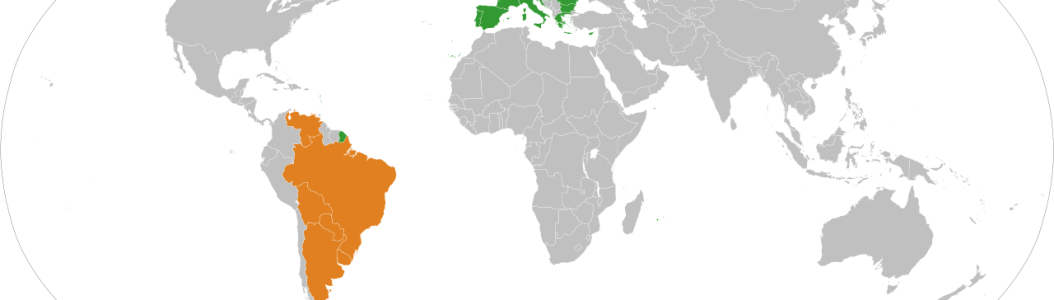
- CC BY-SA 3.0 © Photo by Treehill (Map showing the location of the European Union and Mercosur-states.)
Farmers Across Europe Protest Potential EU–Mercosur Deal Signature Next Week
- Ana Calatayud Márquez
Farmers across the EU are mobilising to protest the potential signing of the EU–Mercosur trade agreement. In several Member States, including Poland, Ireland, and France—where opposition to the deal is particularly strong—demonstrations have been widespread throughout the week. Even in countries more favourable to the EU–Mercosur initiative, discontent has emerged: Germany, despite supporting the agreement, experienced road blockades on Thursday.
The protests reflect concerns about unfair competition that could arise if the agreement comes into force. To address these concerns and secure the support of hesitant Member States, Commission President Ursula von der Leyen announced on Tuesday an additional €45 billion for the Common Agricultural Policy (CAP) to support farmers across Europe. Further proposals followed the next day, including lower tariffs on imported fertilisers and stricter limits on pesticide residues in imports.
The Road to Signing the EU–Mercosur Trade Deal
The EU–Mercosur free trade deal involves the 27 EU Member States and four Mercosur countries—Argentina, Brazil, Paraguay, and Uruguay. Negotiations have been ongoing for 25 years, with the text only finalised in December 2024; its signature is still pending. On Wednesday, EU agriculture ministers convened to discuss the agreement, during which the Commission presented the newly proposed measures to encourage Member States’ support.
The European Council voted on the agreement on Friday, authorising its signature after securing the backing of at least 15 Member States representing at least 65% of the EU population. Several countries, including Hungary, Ireland, Austria, and Poland, opposed the deal. France also withheld support, with President Emmanuel Macron describing it as “outdated.” Italy’s vote was decisive in reaching the required threshold, ultimately favouring approval.
President Ursula von der Leyen is expected to travel to Paraguay next week to sign the EU–Mercosur agreement. The deal still requires ratification by the European Parliament. According to EU trade negotiator Maroš Šefčovič, the agreement could boost EU agricultural exports by up to 50% and is expected to strengthen ties with key trading partners, reducing dependence on other markets such as the US and China.
Sources:
Euractiv, Euractiv, Le Monde, European Council, Deutsche Welle, The Associated Press,Reuters, The Guardian.
Author: Ana Calatayud Márquez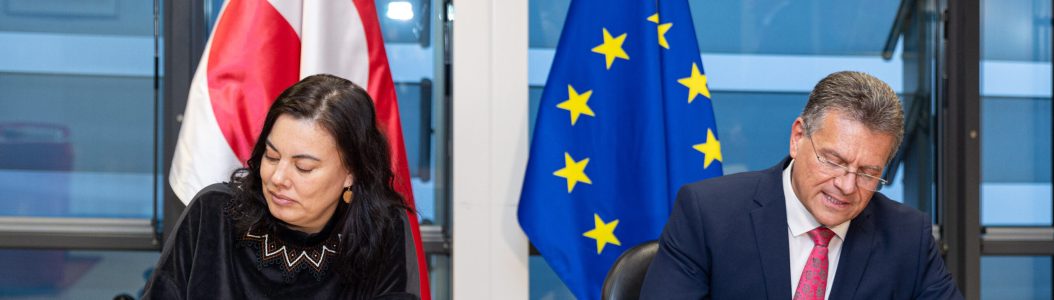
- © European Union, 2023 / EC, Photo: Xavier Lejeune (On 30 November 2023, Maroš Šefčovič, Executive Vice-President of the European Commission in charge of the European Green Deal, Interinstitutional Relations and Foresight, and Naaja H. Nathanielsen, Minister for Business, Trade, Mineral Resources, Justice and Gender Equality of Greenland, signed the Memorandum of Understanding on Critical Raw Materials betweeen the EC and the Greenland.)
The EU Council’s Stance on Greenland in an Evolving Arctic Context
- Lena Sahakyan
As an Arctic stakeholder, the EU pursues both long-term strategic objectives and day-to-day interests in the European Arctic and the broader Arctic region. Recent comments by EU leaders on the renewed US discourse about Greenland have drawn attention to the EU’s broader stance on the territory and how the EU Council balances Arctic geopolitics, sovereignty, and EU unity.
EU Council Reaffirms Support for Greenland
On January 7, the EU Council President António Costa made the organization’s stance clear at the opening ceremony of the Cyprus Presidency of the Council of the European Union:
“Greenland belongs to its people. Nothing can be decided about Denmark and about Greenland without Denmark, or without Greenland. They have the full solid support and solidarity of the European Union. Europe will remain a firm and unwavering champion of international law and multilateralism,” said Costa in Nicosia.
This statement follows intense discussions in the US concerning a potential purchase deal for Greenland, which is deemed necessary for “national security” issues, according to Donald Trump. While Trump has not ruled out using military force in the US’s ambitious plans, the suggested ploy has already been rejected by Greenland’s leaders as well as the Danish government, of which the island is a semi-autonomous territory.
Greenland’s Status and EU’s Strategic Interest
Although Greenland is not an EU Member State, it is an autonomous territory within Denmark, an EU Member State. Following a 1982 referendum, Greenland withdrew from the European Communities, primarily due to fisheries policies, and is today considered an Overseas Country and Territory (OCT). While this arrangement placed Greenland outside EU law, it has not prevented the structured partnership between the two, including financial assistance and sectoral cooperation. Therefore, the EU’s strategic interest in Greenland remains significant.
The EU’s commitment to a stable, sustainable, and peaceful Arctic is reflected not only in Leaders’ remarks but also in their Arctic policies. The EU’s updated Arctic policy, published on October 13, 2021, aims to preserve the Arctic as a region of peaceful cooperation alongside efforts to slow the effects of climate change. These priorities are regularly reaffirmed by the Council and the European Council, which provide political direction on Arctic engagement despite the EU’s limited formal competencies.
Under the Overseas Association Decision, Greenland has a wide-range of political and policy dialogue with the EU and is one of the largest recipients of EU support per capita in the Overseas Countries and Territories, foreseeing EUR 225 million between 2021 and 2027. The 2024 renewed protocol implementing the EU-Greenland Sustainable Fisheries Partnership Agreement (SPFA) covers the next few years through 2030. This agreement will permit EU vessels to fish key species in Greenland, aimed at a mutual commitment to sustainable fisheries and economic progress between the two sides. The EU’s permanent presence in Greenland promises enhanced partnership and visibility of EU actions on the ground, as stated by the European Commission. This can manifest itself through the establishment of a European Commission office on Greenlandic territory.
Greenland in a Changing Arctic
Climate change has increased Greenland’s strategic relevance, increasing accessibility to the Arctic and revealing potential reserves of critical raw materials essential for green and digital transitions. At the same time, the presence of the US Thule Air Base, which is part of NATO’s missile defense system, proves the territory’s long-standing security importance to the US.
Against this backdrop, the EU Council and the European Council have consistently emphasized respect for Greenland’s sovereignty, self-determination, and territorial integrity, aligning with the EU’s Arctic policy. Recent EU statements, therefore, reflect not only immediate diplomatic positioning but also its long-standing effort to assert political unity in Arctic affairs. By reaffirming the EU’s commitment to Greenland’s sovereignty and international law, the EU Council seeks to reinforce stability in the Arctic while signaling solidarity with Denmark and Greenland.
EU Council Council of the European Union EEAS Arctic Portal European Commission
Author: Lena Sahakyan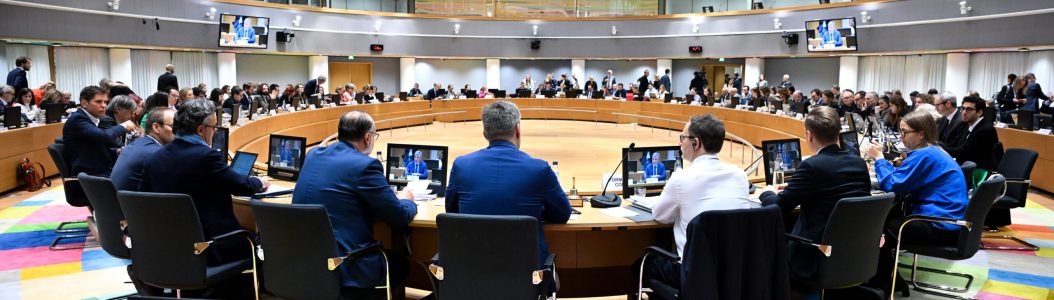
- © European Union 2025 - Source: European Council (Environment Council Roundtable (2nd day), 05/11/2025)
EU Council for Environment Approves Weakened Climate Targets Ahead of COP30
- Tizian Stocker
EU member states, meeting in the EU Council (Environment Council)1, reached an agreement on a binding goal to reduce net greenhouse gas emissions by 90% by 2040, marking a significant milestone toward achieving the EU’s climate neutrality objective by 2050. While maintaining the overall target, the Council introduced greater flexibility for member states, allowing for the limited use of international carbon credits, additional carbon removal options, and cross-sector flexibility to mitigate economic impacts. The environment ministers also reinforced the guiding principles for the post-2030 climate framework, highlighting the importance of competitiveness, a just transition, innovation, energy security, and realistic expectations for carbon removals. Additionally, a review mechanism was established to monitor progress, assess competitiveness effects, and evaluate the contribution of natural removals, with the possibility of adjusting the target if necessary.
Lars Aagaard, Denmark’s minister for climate, energy and utilities, said:
“This is important for the future of Europe – and it shows that even in challenging times, we can stand united. The target sets a clear direction years ahead for our policies, industries and investments.”
More precisely, the EU environment ministers agreed on a weakened climate package, setting a nonbinding 2035 emissions-cut target of 66.25–72.5 per cent below 1990 levels and adopting a legally binding goal to reduce emissions 85 per cent by 2040.
The deal allows an additional 5 per cent of cuts to be met through international carbon credits. It includes a review clause to adjust the 2040 target if climate policy proves detrimental to the economy.
The Council added a clause allowing the start of ETS2 to be delayed by one year, moving its launch from 2027 to 2028. The EU ETS 2 (Emissions Trading System 2) is a new carbon market that was initially scheduled to start in 2027. It extends the existing EU ETS, which covers power plants, industry, and aviation, to include road transport and heating fuels for buildings.
While most EU countries backed the plan, Hungary, Slovakia, the Czech Republic, and Poland opposed it, with Bulgaria and Belgium abstaining. The agreement ensures the EU has a position for the World Climate Conference (COP30) from November 10 to 21 in Belém, Brazil, 10 years after the signature of the Paris Agreement, which was intended to secure the 1.5 °C target of global warming. The European Parliament still needs to negotiate the final law.
What do the decisions of the EU Council mean for the EU/Europe and the world? A critical perspective:
- The plan by the EU Council reveals that not only did national EU ministers work through the night of 4 November until 5 November for a compromise, but also that the EU weakens its climate goals because it lacks a unified strategy to combat climate change and achieve its 2050 goal of a climate-neutral continent, as evidenced by the rejection of the Visegrad states. There are significant concerns in the affected states that they are unable to implement a social-ecological transformation for their citizens, who are under pressure from major global players, including China, the USA, and Russia, which utilise their resources to exert pressure on the EU in strategic and tactical ways.
- The 1.5 °C target of global warming loses meaning in the EU’s plan to combat climate change: a goal set 10 years ago, which is the central and common point of fighting against global warming.
- The UN warn that recent government climate pledges have done little to change the global warming trajectory. Despite recent promises, global temperature projections have improved by less than 0.2°C, indicating that the world remains on track for approximately 2.5°C of warming, well above the Paris Agreement’s target of 1.5°C. The report emphasises that only faster and more ambitious measures can avert escalating and potentially irreversible harm to people and ecosystems. The UN warns that governments must move from promises to tangible implementation, delivering deeper emission reductions, increased climate finance, and stronger policies without delay. If decisive action is not taken within this decade, the opportunity to limit warming and avoid catastrophic outcomes will continue to narrow, heightening the risk of crossing multiple tipping points.
- It is also doubtful if international carbon credits can be a factor in combating climate change. The Irish Times, for example, claims that carbon-credit systems are fundamentally failing as a climate solution. Instead of delivering real emission reductions, they have become a tool for widespread corporate greenwashing, enabling major polluters to claim environmental progress without making meaningful changes to their operations. Multiple investigations have revealed that most credits do not correspond to genuine climate benefits, with some studies finding that more than 90 per cent of rainforest offsets are effectively worthless “phantom credits.” Beyond their lack of climate integrity, many offset projects have caused serious harm in the Global South. Communities have reported land dispossession, inadequate consultation, and even cases of sexual harassment and abuse linked to project operations, particularly in Kenya. Such impacts reveal how carbon markets can perpetuate patterns of exploitation while allowing wealthy companies and countries to outsource their climate responsibilities. According to experts, offsetting responsibilities to other states does more damage than good: it delays the urgent cuts in emissions required, distracts political attention from real climate action, and entrenches power imbalances. Instead of carbon credits, there can be calls for direct emissions reductions, stronger public climate finance, effective regulation, and genuine support for communities and ecosystems on the frontline of climate change.
- Experts from the European Council on Foreign Relations warn from easing the climate ambitions for short-term profits. Europe’s troubled car industry, especially in once-dominant Germany, is struggling not because climate targets are unrealistic, but because Chinese electric vehicle makers are rapidly overtaking European brands at home and abroad. While EU manufacturers blame the 2035 phaseout of combustion engines and demand weaker climate rules, their real challenge comes from a wave of cheap, heavily subsidised Chinese EVs and intensifying competition in the Chinese market, where European sales are declining. Easing climate targets, experts warn, would only slow the arrival of affordable EVs, divert investment back into combustion engines, and leave Europe ill-prepared for a global shift already moving decisively toward battery-electric cars, without shielding it from Chinese rivals. China has treated the EV transition as a core industrial strategy for years, coupling subsidies with domestic-content requirements and aggressive technology development. Europe, by contrast, risks undermining its own competitiveness if it waters down regulation, instead of doubling down on the production of affordable, high-quality electric vehicles that can compete globally.
- EU member states have agreed to postpone the launch of the new ETS2 carbon market for transport and buildings from 2027 to 2028, a move that has sparked criticism from various industries in the EU. Business associations warn that the delay disadvantages smaller firms, which already pay a national carbon price. At the same time, competitors in other EU countries will benefit from an additional year without similar costs. They argue that the postponement weakens incentives for companies to switch to cleaner technologies and slows the broader transition effort.
- The EU cannot claim international credibility if it does not set ambitious climate targets for itself. This was once a strength for the progressive climate actor, accumulating soft power globally, and the idea of the EU as a normative power2 in the world. The Global South will view the EU critically at the climate conference in Belém, Brazil, especially given that Europe is historically among the main contributors to climate change. A lack of responsibility undermines trust and will directly affect economic and security cooperation, which is necessary considering that the world is changing for Europe, as it fights to avoid becoming unimportant in geopolitics alongside the USA, Russia, China, and India. If Europe fails to acknowledge its role in its own industrialisation over the past few decades, it risks long-term geopolitical and economic disadvantages, further damaging its soft power. The opportunity lies in forming new alliances with the Global South, combating climate change together through trust and cooperation, and establishing a rule-based order with like-minded partners. Political partners must be willing to reject the orders proclaimed by political theorists, such as Thomas Hobbes or Niccolò Machiavelli, that the winner takes it all and that the means to achieve a goal won’t be criticised. Trump, Putin, and Xi Jinping represent this perspective in the world currently. Therefore, increasing its independence from these current political powers is essential for the EU, meaning pushing for the green transition and securing partners in this ambition without raising a finger.
Read more on European Council, Politico EU, ECFR and UN.
- The European Council comprises all heads of state or government of the EU member countries. In contrast, the EU Council (also known as the Council of the European Union) consists of ministers responsible for specific policy areas structured in specific configurations. In this case, it was the environment ministers of the EU member states who conducted the negotiations within the Environment Council (ENV configuration). ↩︎
- The concept of the EU as a “Normative Power” comes from the work of Ian Manners, a British political scientist, who introduced the term in his influential 2002 article “Normative Power Europe: A Contradiction in Terms?” In his view, a normative power is an actor that influences global politics through the diffusion of norms embedded in its identity and legal-political order, rather than through military or economic coercion. His framework centres on a core set of constitutive norms (peace, liberty, democracy, the rule of law, and human rights) supplemented by additional norms such as social solidarity and sustainable development. ↩︎
European External Action Service
CC BY-SA 4.0 © FrDr (EEAS Brussels)

- © European Council, 2026, photo by FRANCOIS LENOIR (Kaja KALLAS, High Representative of the EU, at press conference, Foreign Affairs Council - 21/04/2026, Luxembourg.)
EU Foreign Affairs Council, 21 April 2026: Six Crises, Uneven Results
- Chloé BAMBERGER
Updated: 1 May 2026
Summary
The Foreign Affairs Council (FAC) of 21 April 2026 met in Luxembourg under HR/VP Kaja Kallas across six simultaneous crisis files:
- Ukraine
- Iran/Strait of Hormuz
- Gaza/West Bank
- the South Caucasus
- Sudan
- and Syria.
On Ukraine, Kallas announced an imminent €90 billion macro-financial loan and the prospective unblocking of the European Peace Facility (EPF) weapons fund — both enabled by Hungary’s post-election change of government. Ministers called for fast-tracking the 20th Russia sanctions package and unblocking Ukraine’s accession negotiation clusters.
On Iran, a political agreement was reached to extend EU sanctions to violations of freedom of navigation in the Strait of Hormuz, with formal adoption deferred to May.
On Gaza, proposals to suspend the EU-Israel Association Agreement and impose qualified-majority trade restrictions on settlements both failed.
The EU Partnership Mission in Armenia (EUPM Armenia) was formally adopted ahead of June legislative elections.
On Georgia, firm language was delivered without any sanctions instrument.
The meeting’s strategic yield is asymmetrical: genuine unblocking on Ukraine, a deferred coercive turn on Iran, institutional paralysis on Gaza, and measured signalling elsewhere.
Context
The FAC is the EU’s principal ministerial forum for foreign and security policy, chaired by HR/VP Kallas under the Lisbon Treaty’s double-hat arrangement — a Commission Vice-President and a Council chair — a structural tension that blurs executive and intergovernmental accountability.
Hungary’s blocking of the EPF since 2023 is the most documented dysfunction of unanimity-based EU foreign policy: weapons reimbursements to member states supplying Ukraine were frozen for three years until an external electoral event resolved what EU institutional rules had created but could not correct. The EU Military Assistance Mission Ukraine trained over 90,000 Ukrainian soldiers through bilateral channels, demonstrating EU support routed around Council gridlock at a cost to institutional coherence. Three days after the FAC, on 23–24 April 2026, the 20th Russia sanctions package was formally adopted and entered into force on 24 April; it includes 120 new individual designations — the largest round in two years — as well as the first use of the anti-circumvention instrument (targeting Kyrgyzstan), new restrictions on crypto-assets including the digital rouble, and a ban on maintenance services for Russian LNG tankers.
Analysis
Hungary unblock: structural relief, not systemic reform. The 20th package’s adoption within 72 hours of the FAC confirms the “new momentum” was real — but does not alter the structural argument: unanimity rules remain unchanged, and the next veto by any member state will reproduce the same vulnerability; no institutional reform was agreed.
Gaza: political fracture, not procedural constraint. Spain’s Foreign Minister stated publicly that EU credibility “is being compromised” by inaction on Israel’s violations of international humanitarian law. Both proposals failed for substantive political reasons — a durable north-east/south-west divide. The contrast with the speed of Russia sanctions since 2022, or the Iran agreement reached at this same meeting, is not explained by legal differences alone.
Iran: political agreement as a substitute for deterrence. Formal adoption of Hormuz sanctions is deferred to May — a recurring structural pattern that limits real-time deterrence and allows renegotiation before legal instruments take effect. The IRGC ship seizures of 22 April occurred while the legal instrument was still being drafted — a concrete illustration of the deterrence gap that political agreement alone cannot close.
Georgia: electoral-cycle immunity. Strong language without sanctions follows an established precedent in which the imminence of elections defers accountability measures — a logic that, applied consistently, offers any government an incentive to use the electoral calendar as a shield against EU pressure.
The FAC of 21 April confirms a familiar pattern: the EU moves fast when united, slowly when divided, and not at all when structurally blocked.
Sources
- Kaja Kallas press conference, FAC Luxembourg, 21 April 2026
- A-points list (non-legislative activities), Council of the EU, 21 April 2026
- EEAS announcement / FAC agenda 21 April 2026
- EU Agenda media advisory FAC 21 April 2026
- Crowell & Moring: EU Adopts 20th Russia Sanctions Package, 27 April 2026
- Skuld: Maritime Security Update — Gulf Region / Strait of Hormuz and Red Sea

- © Polish presidency of the Council of the EU (Brussels, 20 May 2025. Foreign Affairs Council (Defence) with Agnieszka Bartol and Kaja Kallas.)
Foreign Affairs Council, 16 March 2026: EU under crisis pressure
- Chloé BAMBERGER
EU foreign ministers met in Brussels on 16 March 2026 to address simultaneous crises affecting European security and prosperity. They focused on support to Ukraine, the escalation in the Middle East, and the protection of maritime routes crucial for energy and trade. Ministers sought to balance political signalling, operational commitments, and limited national capabilities, highlighting the “risk of a wider regional conflict”, including risks to regional stability, global trade routes, financial markets, and energy prices.
Strategic context
The Foreign Affairs Council (FAC) is the configuration of the Council bringing together EU foreign ministers under the chairmanship of the High Representative. It oversees the Common Foreign and Security Policy and the Common Security and Defence Policy, including sanctions, civilian and military missions, and partnerships with third countries. The 16 March 2026 session took place after months of sustained EU support to Ukraine and amid renewed tensions in the Middle East, affecting both energy flows and shipping lanes.
Key discussions
Member States entered the meeting with differing priorities, but Ukraine remained the central strategic priority. At the same time, instability in the EU’s southern neighbourhood and at sea is driving a broader assessment of risks, with particular concern over maritime security and freedom of navigation in the Red Sea and the Strait of Hormuz.
The protection of EU citizens in the region was highlighted as a key priority: “As this war expands, the EU’s priority remains the protection of our citizens” (Kaja Kallas). Restarting shipments of fertilisers, food, and energy through the Strait of Hormuz is also considered urgent, but “for the time being, there was no appetite to change the mandate of Operation ASPIDES – for now”. Ministers underlined the broader economic consequences: “20% of the world’s energy – oil and gas – goes through the Strait of Hormuz… Fertilisers are going through the Strait of Hormuz… If we do not have fertilisers now this year, we will have a famine next year”.
The meeting also stressed the importance of supporting Iranian civil society and continued engagement with regional partners, including Gulf countries, to support de-escalation efforts and regional security. The situation in Gaza and the West Bank was described as worsening rapidly, with both the humanitarian situation and the political horizon moving in the wrong direction; the EU will continue to press for improved humanitarian access, de-escalation**,** and support for Palestinian Authority reforms, while divisions persist on sanctions against violent settlers. The EU announced €100 million in humanitarian aid to Lebanon and reiterated support to the Lebanese Armed Forces “to disarm Hezbollah”.
Analysis
The FAC communication highlights strong, “steadfast” support for Ukraine and “comprehensive” engagement in the Middle East, signalling continuity rather than a change in policy. At the same time, the increasing focus on maritime security, freedom of navigation and energy‑related risks indicates a gradual shift in what the EU defines as core security interests. The cautious language on ASPIDES and other missions points to an incremental approach: rather than launching high‑profile new operations, the EU keeps options open to adjust existing mandates if conditions worsen. As Kaja Kallas noted, “the security environment is changing fast, and we cannot respond with emergency summits alone. We need a long‑term policy” – a statement that encapsulates the tension between short-term crisis management and the need for a more strategic, long-term approach.
Sources
EEAS, Foreign Affairs Council, 16 March 2026
EEAS, Press conference by HR/VP Kaja Kallas at the Foreign Affairs Council, 16 March 2026
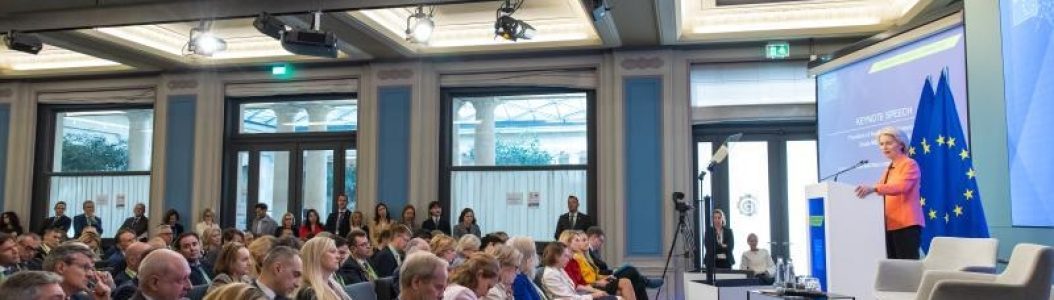
- © European Commission, 2026 (Speech by von der Leyen at the EU Ambassadors Conference, 09.03.2026.)
EU Ambassadors’ Conference 2026 – Team Europe in practice: what joint messaging by von der Leyen, Metsola and Costa reveals about intra‑EU alignment on foreign policy
- Chloé BAMBERGER
The 2026 EU Ambassadors’ Conference, held in Brussels from 9–13 March, brought together more than 145 EU ambassadors, Heads of Delegation and CSDP mission chiefs under the theme “Advancing EU Interests at a Turning Point.” This year’s edition showcased “Team Europe” in full force. Ursula von der Leyen, Roberta Metsola and António Costa jointly addressed the EU’s global diplomatic network, alongside keynote interventions by High Representative/Vice-President Kaja Kallas. Their coordinated messaging signalled a clear political intention to minimise institutional dissonance at a time of heightened geopolitical tension. In both tone and substance, the leaders converged on several priorities: sustained support for Ukraine, a more assertive security and economic agenda, and the need for faster, more unified European foreign-policy decision-making.
Hosted by Kallas, the conference sought to realign EU external action amid intensifying geopolitical rivalry, geoeconomic competition and global fragmentation. Strategically, it represents a key moment to recalibrate the EU’s diplomatic posture — reinforcing strategic autonomy while deepening partnerships with enlargement countries and actors across the Global South. The 2026 edition takes place against a backdrop of continued Russian aggression against Ukraine, instability across the Middle East and the Gulf, and growing pressure on the rules-based international order
Projecting unity at a geopolitical turning point
The conference illustrates a gradual discursive shift: from the traditional idea of “normative power Europe” toward a more interest-driven and security-oriented foreign policy, while still anchored in values. The presence of all three institutional presidents — alongside NATO Secretary-General Mark Rutte — underscores the consolidation of the “Team Europe” approach in external action, but also reflects a shared recognition that EU decision-making must accelerate to remain credible internationally. Strong emphasis on enlargement — described by Kallas and Costa as a “geopolitical choice” — as well as renewed engagement with the UK and Global South partners, suggests a reframing of neighbourhood and partnership policies through a geopolitical lens
Aligning the institutional triangle
This coordinated front matters because EU foreign policy emerges from a complex institutional triangle. The European Council sets the strategic direction, the European Commission operationalises it through policy instruments and budgets, and the European Parliament provides democratic scrutiny and political framing. When the three institutional leaders deliver aligned messages to EU delegations, they effectively define the parameters within which national capitals and EU services are expected to operate. For ambassadors, such alignment reduces ambiguity: how to balance values and interests, how to navigate the relationship between enlargement and neighbourhood stabilisation, and how far to advance economic security, de-risking and resilience in third countries.
The style of communication also reveals institutional roles. Von der Leyen frames external action around resilience, economic security and defence of the rules-based order. Metsola emphasises democracy, enlargement and support for partners aspiring to join the EU. Costa reflects the European Council’s role in forging unity among 27 sometimes diverging national positions. When their messages converge around ideas such as strategic autonomy, Ukraine’s European future or the need to counter foreign information manipulation, these notions move from contested concepts to shared orthodoxy. In this sense, “Team Europe” functions less as branding than as method: aligning institutional narratives early and projecting them consistently through EU delegations.
A common narrative, diverging national priorities
Yet this alignment has limits. A unified tone at the Ambassadors’ Conference does not erase persistent disagreements among Member States on defence spending, industrial policy, China or the pace of enlargement. Recent debates in the European Parliament on the Middle East, for instance, reveal fragmented voting patterns across political groups and national delegations, illustrating the difficulty of producing a truly unified position beyond compromise language. What the conference does establish, however, is a default script. EU ambassadors are expected to speak the language of a more geopolitical Union: one that treats enlargement and economic instruments as tools of influence and seeks to act less as a predominantly financial contributor and more as a strategic actor.
Sources
EU Ambassadors’ Conference 2026 | EEAS
Keynote speech by HR/VP Kaja Kallas at the 2026 EU Ambassadors Conference | EEAS
Speech by the President: EU Ambassadors Conference 2026 | European Commission
President Metsola addresses EU Ambassadors | European Parliament President
- CC BY-SA 4.0 © Photo by Goran_tek-en (Map of Strait of Hormuz.)
EU Turns to Hormuz as Gulf Escalation Hits Trade Routes
- Maximilian Schlenker
In the space of a few days, the Strait of Hormuz has moved from the background to an explicit EU concern. In a recent statement from March 1st on developments in Iran and the Middle East, the High Representative warned that disruption of critical waterways such as the Strait of Hormuz must be avoided.
The following day, the Commission’s Security College said it was reinforcing monitoring of transport disrupting risks around the Strait of Hormuz and the Red Sea.
On March 5th, after an extraordinary EU – Gulf Cooperation Council meeting, High Representative Kaja Kallas went further still, saying that European naval assets had been sent to the region because the security of the Strait and its trade routes was extremely important for both the EU and the Gulf states. She also noted that, while Operations ASPIDES and Atalanta are in the region, they are not currently operating in the Strait itself.
Before the most recent events in and around Iran, on February 23rd the Council already extended the mandate of EUNAVFOR ASPIDES until February 2027, an operation that monitors the maritime situation in the Strait of Hormuz amongst other things.
A ministerial joint statement then reinforced the point politically, stressing the importance of safeguarding freedom of navigation in the Strait of Hormuz and Bab-el-Mandeb, while linking maritime security directly to supply chains and the stability of global energy markets.
The significance of the Strait of Hormuz for the EU is already visible in markets. Benchmark European gas prices jumped by more than 50% after disruptions to energy shipments through the Strait, prompting the Commission to convene the EU’s gas and oil coordination groups. Only days later, Brent crude had briefly climbed to $119.50 per barrel, its highest level since 2022, as fears of prolonged disruption in Hormuz gripped traders. Shipping costs have also surged. Hull war–risk premiums for tankers transiting the area rose from around 0.25% of vessel value before the conflict to about 3%, implying roughly $7.5m in additional insurance costs for a typical tanker. Even without an immediate physical shortage inside the EU, these developments feed directly into higher import costs, freight rates, inflation expectations and broader market volatility.
That is why Hormuz matters. Europe is not the main direct destination for Gulf exports moving through the Strait, only a small part of crude oil and LNG flowing through Hormuz is routed into Europe. Yet this does not shield the EU from the consequences of disruption. Oil is priced globally, LNG disruptions push buyers onto tighter markets, and higher insurance and transport costs are passed along the supply chain. The Commission has therefore stressed that, while there are currently no immediate EU oil or gas supply concerns, a prolonged closure of Hormuz or further disruptions would require a reassessment of European energy security.
This also speaks to the broader argument developed in a forthcoming academic paper. My point there is that strategic autonomy is not only about decision-making or industrial strength, but also about access, about whether Europe can keep vital maritime routes and critical connections working when they come under pressure. From that perspective, the current Hormuz situation is a timely reminder of how closely Europe’s security and prosperity remain tied to the resilience of those routes.
Sources
- https://www.consilium.europa.eu/en/press/press-releases/2026/03/01/statement-by-the-high-representative-on-behalf-of-the-european-union-on-developments-in-the-middle-east/
- https://www.eeas.europa.eu/eeas/eu-gcc-extraordinary-meeting-press-remarks-high-representative-kaja-kallas_en
- https://ec.europa.eu/commission/presscorner/detail/da/read_26_513
- https://www.eeas.europa.eu/eeas/joint-statement-gcc-eu-ministers’-meeting-recent-developments-middle-east-iran’s-attacks-against-gcc_en
- https://www.consilium.europa.eu/en/press/press-releases/2026/02/23/red-sea-council-extends-the-mandate-of-operation-aspides-to-safeguard-freedom-of-navigation/
- https://www.reuters.com/business/energy/eu-policymakers-expect-no-immediate-oil-security-impact-iran-conflict-email-2026-03-02/
- https://www.abc.net.au/news/2026-03-09/us-israel-iran-war-oil-price-surge-share-markets/106432166
- https://energy.ec.europa.eu/news/commission-and-eu-countries-confirm-no-immediate-oil-or-gas-supply-concerns-following-disruptions-2026-03-04_en

- CC BY 4.0 © Photo by EUOPAS (Logo of EUNAVFOR OPERATION ASPIDES, 24 February 2024.)
EU Renews Red Sea Mission as Maritime Security Pressures Persist
- Sebastian Dodd
On Monday, 24 February, the Council of the European Union decided to extend the EU naval operation EUNAVFOR ASPIDES for an additional year following a strategic review. The Council also approved a financial reference amount of nearly €15 million to cover operational costs.
ASPIDES is an EU naval mission designed to safeguard freedom of navigation in the Red Sea and surrounding waters in response to threats against merchant and commercial vessels. European military assets provide defensive maritime security, protect vessels, and contribute to stability along key maritime routes in accordance with international law. The operation was originally established in February 2024 in response to the Red Sea crisis triggered by Houthi attacks on international shipping that began in October 2023.
The mission operates along critical sea lines of communication, including the Bab al-Mandeb Strait, the Strait of Hormuz, the Red Sea, the Gulf of Aden, the Arabian Sea, the Gulf of Oman, and the Gulf. Despite comprising only three naval units, Operation ASPIDES underscores the EU’s commitment to maritime security, regional stability, and the protection of global trade flows. The mission is aligned with United Nations Security Council Resolution 2722, which demands an end to Houthi attacks on merchant and commercial vessels.
Like many EU military operations, ASPIDES is conducted under the EU’s Common Security and Defence Policy (CSDP), the Union’s primary framework for defence cooperation and crisis management. Such operations require unanimous approval by the Council of the European Union and rely on capabilities contributed by EU Member States.
ASPIDES is one of eight ongoing military operations under the CSDP. Other missions are deployed in Mozambique (EUMAM Mozambique), Somalia (EUTM Somalia), the Central African Republic (EUTM RCA), Libya (EUNAVFOR MED IRINI), the Horn of Africa (Operation Atalanta), the Gulf of Guinea (EU SDI), Ukraine (EUMAM Ukraine), and Bosnia and Herzegovina (EUFOR Althea). These missions cover a broad spectrum of activities, including security sector reform, capacity building, maritime security, humanitarian support, conflict prevention and post conflict stabilization.
As Europe strengthens its security capabilities and advances its strategic autonomy, it remains to be seen whether additional CSDP missions will be launched or whether new mechanisms will emerge to coordinate joint European military operations abroad. Although the current missions are significant, they remain limited in scale compared to those of other major powers. If Europe intends to assume greater responsibility on the geopolitical stage, a corresponding increase in resources and political commitment will be required.
Sources:
European Comission, EEAS, EEAS, Council of the European Union
Author: Sebastian Dodd
India Emerges as a Key Partner in Europe’s Security Strategy
- Sebastian Dodd
As Europe seeks to gain greater strategic autonomy from the United States amid shifting geopolitical dynamics and a more bellicose U.S. administration, India has emerged as a key partner in advancing this objective. Earlier this year, India and the EU signed a free trade agreement that deepened economic ties between the bloc and the subcontinent. At the EU–India Summit, the two sides also signed a Security and Defence Partnership, endorsed by High Representative and Vice President Kaja Kallas and India’s External Affairs Minister, Dr. S. Jaishankar, further strengthening bilateral security cooperation.
According to the European External Action Service (EEAS), the “partnership establishes a comprehensive framework that will structure EU–India dialogue and cooperation on security and defence, and deliver concrete results in areas such as maritime security, cyber, and counterterrorism.” This builds on India’s recent participation in joint maritime activities with EU naval forces, such as its engagement with the EU’s ESIWA+ (Enhancing Security Cooperation in and with Asia and the Indo-Pacific) project. The agreement also expands upon the annual Security and Defence Consultations and the Strategic Dialogue on Foreign and Security Policy launched in June 2025.
At the bilateral level, France has also recently expanded security ties with India as part of efforts to diversify its defence industrial base. The sixth India–France Annual Defence Dialogue, held this week, focused on expanding industrial collaboration. The two countries renewed their existing defence cooperation agreement for a further ten years and concluded arrangements for the reciprocal deployment of officers. In addition, Bharat Electronics Limited (BEL) and Safran Electronics & Defence signed a Memorandum of Understanding to manufacture French HAMMER (Highly Agile Modular Munition Extended Range) missiles in India. These air-to-ground munitions enable long-range strikes against heavily defended targets while allowing aircraft to remain at a safer distance.
Indian Prime Minister Narendra Modi and French President Emmanuel Macron also virtually inaugurated the Airbus H125 production line in Vemagal, India, the country’s first private-sector helicopter assembly line. These developments align closely with the Defence Dialogue’s emphasis on co-development and co-production of military capabilities.
Overall, as Europe pursues greater strategic autonomy, India has emerged as a major economic and security partner. The agreements reached will advance both sides’ geopolitical interests, enabling India to gain increased access to advanced military technologies while allowing Europe to diversify defence production chains and reduce its reliance on the United States for key security and defence needs.
Sources
Airbus, DefenceIn, EEAS, European Commission, Safran, Times of India, Tribune India, Tribune India.
Author: Sebastian Dodd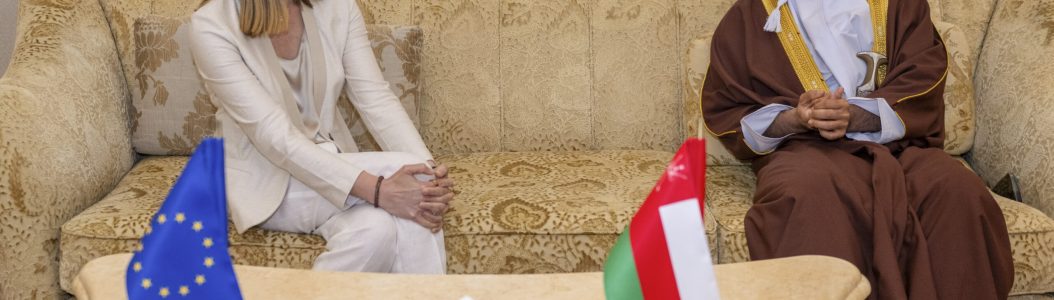
- © European Union, 2025 (Official visit by Roberta METSOLA, EP President to Abu Dhabi (UAE) - Meeting with Khalid AL MAWALI, Speaker of the Shura Council of Oman.)
EU–Oman: Translating UN Human Rights Commitments into Bilateral Practice
- Chloé BAMBERGER
Multilateral Context and EU Priorities
On 3 February 2026, the European Union (EU) and the Sultanate of Oman held their third bilateral human rights dialogue in Muscat. Officially presented as an “open and constructive” exchange centred on the sharing of good practices, the meeting – co‑chaired by Oman’s Ministry of Foreign Affairs and the European External Action Service – forms part of a process launched in 2022 and continued in Brussels in 2024. Discussions have focused on labour rights, gender equality, digital rights, civil society engagement, rule‑of‑law issues, and the death penalty, within a deliberately technical and non‑confrontational format.
This engagement unfolds within a broader multilateral framework. In January 2025, the EU Foreign Affairs Council adopted conclusions defining EU priorities in United Nations human rights fora for the year, guiding its action in Geneva and New York. These priorities include reaffirming the universality of human rights, ensuring accountability for serious violations, protecting human rights defenders, supporting the International Criminal Court, and addressing major crises such as Ukraine, the Middle East, and Myanmar. The key policy question is therefore one of coherence: how to reconcile an assertive normative agenda in multilateral settings with a pragmatic, low‑key approach in sensitive bilateral contexts.
Bilateral Dynamics and Structural Constraints
Within this framework, the EU seeks to develop a human rights diplomacy on the ground with key partners, including Oman, with the aim of gradually aligning bilateral agendas and multilateral action. Oman occupies a specific position in the Gulf political landscape. It is widely perceived as a relatively stable and diplomatically constructive actor, notably due to its mediation role and balanced regional posture. This perception shapes EU strategy: rather than prioritising pressure, the EU emphasises sustained engagement, continuity and trust‑building, viewing Oman as a potential interlocutor and regional relay.
Structural factors further encourage prudence. Unlike in enlargement or neighbourhood contexts, the EU lacks strong conditionality tools vis‑à‑vis Oman. Trade, aid and political cooperation do not provide sufficient leverage to sustain a coercive human rights strategy. A more confrontational posture could reduce diplomatic access without generating meaningful concessions, undermining the incremental channels through which limited progress might occur. Human rights are therefore compartmentalised within a broader partnership encompassing energy cooperation, maritime security, connectivity and regional stability – areas the EU is reluctant to jeopardise in a volatile regional environment.
At domestic level, civil and political rights in Oman remain constrained. The country is an absolute monarchy with significant restrictions on freedoms of expression, assembly and association, where criticism of state authorities can be criminalised and civil society organisations operate under strict legal and administrative controls. While Oman engages with international human rights mechanisms – including the Universal Periodic Review process and accession to the International Covenant on Civil and Political Rights in 2020 – implementation gaps persist, particularly regarding the situation of activists, journalists, migrant workers and women.
Policy Coherence and Implementation Prospects
The EU–Oman dialogue thus exemplifies a differentiated human rights diplomacy. In multilateral fora, the EU uses assertive language centred on accountability and universal standards; in bilateral formats with strategic partners such as Oman, it favours incrementalism and technical cooperation. The third EU–Oman dialogue appears as a test case for the EU’s ability to translate its UN priorities into concrete, monitorable commitments in a sensitive regional context.
The effectiveness of this approach will depend on follow‑up: integrating agreed themes – for example on labour standards, digital governance or anti‑trafficking measures – into measurable commitments and, where relevant, referencing them in future Human Rights Council or UN General Assembly debates would strengthen policy coherence and provide a clearer measure of the EU’s credibility as a global human rights actor.
Sources:
EEAS – Third EU‑Oman Human Rights Dialogue held in Muscat, 3 Feb 2026; EEAS – Second EU‑Oman Human Rights Dialogue held in Brussels, 19 Nov 2024; EEAS – EU Priorities for UN Human Rights Fora in 2025; Council of the EU – Council Conclusions on EU priorities in UN Human Rights Fora 2025 ; EP Fact Sheet – Human rights in EU external action; European Parliament; MENA Rights Group ; ECDHR ; Human Rights Watch
![CC0 1.0 Universal © Photo by Bruisefarshid (Graffiti "This year is the year of blood, Seyyed Ali [Ali Chamenei] will be overthrown", in Khorramabad during the 2025–2026 Iranian protests, January 2026.)](https://europeanrelations.com/wp-content/uploads/elementor/thumbs/Graffiti__This_year_is_the_year_of_blood_Seyyed_Ali_will_be_overthrown__in_Khorramabad_during_the_2025–2026_Iranian_protests-rhxd4xd1sql5xn93e6vc2vpk2rrlcaz6dgats5ogmw.jpg "Graffiti__This_year_is_the_year_of_blood,_Seyyed_Ali_will_be_overthrown__in_Khorramabad_during_the_2025–2026_Iranian_protests")
- CC0 1.0 Universal © Photo by Bruisefarshid (Graffiti "This year is the year of blood, Seyyed Ali [Ali Chamenei] will be overthrown", in Khorramabad during the 2025–2026 Iranian protests, January 2026.)
From reaction to strategy: how the EU balances sanctions, political signalling and internal dissent in response to the protests in Iran
- Chloé BAMBERGER
The renewed wave of nationwide protests in Iran since late December 2025, met with violent repression and extensive restrictions on communications, has triggered a rapid EU and G7 response. EU and partner reactions have focused on condemning what has been described as “brutal repression” and on readiness to adopt further targeted sanctions. In a statement on 3 January 2026, the EEAS spokesperson framed the demonstrations as reflecting “the demands of many Iranians” and called for restraint, respect for freedoms of expression, association and peaceful assembly, as well as the release of those detained for exercising their rights.
On 15 January, the G7 Foreign Ministers and the EU High Representative jointly condemned the deliberate use of violence and signalled that additional restrictive measures could follow if the crackdown continues. Commission President von der Leyen and HR/VP Kallas have both indicated that new EU sanctions could be proposed “swiftly”, building on an already extensive framework covering human rights, non-proliferation and regional security. Politically, the episode reinforces the EU’s profile as a normative actor, while also highlighting persistent differences among Member States over the appropriate level of escalation and the preservation of residual diplomatic channels on nuclear and regional issues.
Institutional and policy background
A long-standing EU concern
The current debate follows several years of sustained EU concern over Iran’s human rights record and nuclear activities, including the “Woman, Life, Freedom” protests and executions linked to dissent. Under the Common Foreign and Security Policy (CFSP), the HR/VP and the EEAS can react rapidly through political statements, while any new sanctions require unanimity in the Council.
An increasingly layered sanctions framework
Over time, the EU has progressively layered Iran-related restrictive measures, including human rights listings, non-proliferation sanctions, and measures linked to Iran’s support for Russia’s war against Ukraine and for regional armed groups.
Diverging institutional emphases
The European Parliament continues to take a particularly hard-line position. On 23 January 2026, MEPs will debate the “widespread demonstrations and harsh crackdown” and vote on a resolution calling for broader sanctions, while Parliament President Metsola has banned Iranian diplomatic staff from Parliament premises.
Within the Council, differences persist. While several Member States support renewed consideration of Islamic Revolutionary Guard Corps (IRGC) listing, others raise legal and political concerns and stress the need to preserve limited diplomatic channels.
Strategic signals
Recent EU and G7 statements illustrate a shift from largely exhortative language towards a more conditional approach that explicitly links continued repression to further restrictive measures. This strengthens the EU’s credibility on human rights, but also reduces diplomatic flexibility by narrowing the scope for engagement should de-escalation become a priority.
EU communication reflects a layered posture: strong unity on principles and public signalling, combined with an ongoing internal discussion on how to balance additional sanctions with the preservation of limited diplomatic leverage. This has resulted in a pragmatic model of conditional engagement, in which the scope of EU–Iran relations increasingly reflects developments on the ground, without a full suspension of dialogue at this stage.
Sources
EEAS – Statement of 3 January 2026; EEAS: G7 Foreign Ministers’ Statement on Iran, 14 January 2026.; European Parliament resolution of 23 January 2025 on the systematic repression of human rights in Iran; Euractive; Euronews
Author: Chloé BAMBERGERCourt of Justice of the European Union
G.Fessy © Court of Justice of the European Union (Petite Salle)
- © European Council (Logo of the European Peace Facility - EPF -)
Hungary Loses Bid to Challenge EU-Ukraine Arms Funding
- Maximilian Schlenker
- CC BY 4.0 © Photo by Albinfo (Shëngjin in Northern Albania: Italian migrants detention center, 26.05.2025.)
EU court adviser sets limits on Italian detention centers in Albania
- Maximilian Schlenker
On June 11th, Advocate General Laila Medina delivered her Opinion in Joined Cases C‑706/25 and C‑707/25, Comeri and Sidilli. Two third-country nationals subject to removal decisions had been transferred from detention in Italy to Gjadër in Albania. After they applied for international protection, the Rome Court of Appeal asked whether Italy could conclude the bilateral protocol and whether its detention regime preserves EU safeguards. Advocate General Medina’s answer is that location may remain a national choice, but harmonised EU asylum law follows Italian control.
She found the Albanian sites under the exclusive territorial control of Italian authorities, which exercise legislative, executive and judicial powers there. The relevant asylum directives therefore apply. EU law does not prescribe where detention facilities must be located, so Italy may operate them in Albania. However, the grounds for detaining asylum applicants are fully harmonised and minimum guarantees are binding, meaning that protection must be equivalent to that available on Italian territory.
Safeguards move to the centre
This is not a broad approval of asylum centres outside of the EU. Some possible deficiencies have been uncovered, concerning for example confidential communications between lawyer and client; lawyers’ physical access and reimbursement of travel costs; family visits and communications; and immediate release when the judicial-validation period expires. In this case, keeping someone confined while transport to Italy is arranged would amount to unlawful de facto detention. The national court must assess whether these safeguards work in practice. A degree from March 2025 enabled people already held in Italian return centres to be transferred to Albania, creating the route at issue here. In April 2026, Advocate General Emiliou had found the arrangement compatible with EU law in principle if individual rights were fully preserved. The Opinion by Medina now looks at the matter in more detail, clarifying which parts of asylum law leave no room for bilateral variation.
Why the timing matters
Academic analysis anticipated this framing. Arguments that Italy’s effective control creates a sufficient connection for EU law stand opposite of warnings that divergent offshore procedures could undermine the Common European Asylum System and that externalisation may repeatedly produce detention, remedy and implementation problems; and that regional legal orders could add constraints. These academic notions have been operationalised within this new Opinion, stating that administration may be relocated, but responsibility cannot.
The timing is no coincidence. The EU Migration and Asylum Pact entered into application on June 12th. On June 17th, the European Parliament approved a Return Regulation that would permit so-called return hubs in third countries, pending formal Council adoption. Comeri and Sidilli could therefore become a template for wider EU externalisation. If the Court follows Medina’s Opinion, the Albania model may survive, but only under the logic that jurisdiction follows control. Operational distance cannot justify lower protection. That may make offshore schemes more costly while preventing third-country facilities from becoming lower-standard zones.
Sources
- https://eur-lex.europa.eu/legal-content/EN/TXT/HTML/?uri=CELEX:62025CC0706
- https://eur-lex.europa.eu/legal-content/EN/TXT/PDF/?uri=CELEX:32013L0033
- https://www.gazzettaufficiale.it/eli/id/2025/05/23/25A03118/SG
- https://eur-lex.europa.eu/legal-content/EN/TXT/?uri=CELEX%3A62025CC0414
- https://academic.oup.com/rsq/article/44/3/345/8124016
- https://cris.maastrichtuniversity.nl/en/publications/the-italyalbania-protocol-a-new-model-of-border-shifting-within-t/
- https://home-affairs.ec.europa.eu/news/new-migration-and-asylum-rules-enter-application-what-changing-2026-06-12_en
- https://www.europarl.europa.eu/news/en/press-room/20260611IPR45214/new-eu-system-for-return-of-illegally-staying-third-country-nationals
- © EU Court of Justice, 2026 (CJEU Annual Press Conference 2026, 04.06.)
CJEU presents 2025 review as judicial reform takes hold
- Maximilian Schlenker
At its annual press conference in Luxembourg on June 4th, led by the Court’s President Koen Lenaerts and the General Court President Marc van der Woude, the Court of Justice of the European Union (CJEU) presented a year marked by institutional reform, high judicial activity and a push for greater public transparency. The CJEU’s Annual Report 2025 sets out key events, statistics and major case-law developments; it records 1,878 cases brought before the Court during the year, and 2,301 cases resolved by it.
The central development was the effects of the judicial reform introduced by Regulation 2024/2019. Since October 1st, 2024, preliminary references falling exclusively within six technical areas (VAT, excise duties, customs, tariff classification, passenger rights and emissions trading) may be transferred from the CJEU to the General Court through a ‘one-stop shop’ mechanism, meaning that national courts still submit all requests to the CJEU, which then screens them and decides whether to keep the case or send it to the General Court. In 2025, most such requests examined were transferred to the General Court, which is presented as evidence that the reform is already redistributing workload.
The year’s case law placed the CJEU at the centre of politically sensitive EU governance disputes. The Court held Malta’s investor-citizenship scheme contrary to EU law, stating that Union citizenship cannot result from a commercial transaction. The General Court annulled the Commission’s refusal to give access to text messages linked to the Pfizer COVID-19 vaccine negotiations; and early Digital Services Act litigation took place.
The institutional message from this is not only centred on efficiency. The Court is using the reform to reshape how EU justice is both delivered and explained. More technical, high-volume preliminary decisions are being channelled to the General Court, while the CJEU preserves greater capacity for cases with broader constitutional significance. At the same time, broadcast hearings, publication of written observations in preliminary ruling cases, audiovisual debriefings and the redesigned Curia communications ecosystem point to a more public-facing model of judicial authority. This is also the direction set for 2026, with the new Curia website, upgraded search tools and Curia Web TV intended to make case-law more accessible to citizens and legal professionals.
The report presents the CJEU as an institution in transition. Commentators have already framed the 2024 reform as a structural recalibration of EU judicial architecture; the Court’s own outlook suggests that the next test will be whether this redistribution of work can improve speed without weakening legal coherence or the authority of its (preliminary) rulings.
Sources
- https://curia.europa.eu/site/jcms/p1_1000084259/en/cjeu-annual-press-conference-2026
- https://curia.europa.eu/site/jcms/p1_1000081821/
- https://eur-lex.europa.eu/eli/reg/2024/2019/oj
- https://www.europeanpapers.eu/e-journal/2024-reform-eu-judicial-system-transformation-court-justice-constitutional-court
- https://curia.europa.eu/site/upload/docs/application/pdf/2025-04/cp250052en.pdf
- https://curia.europa.eu/site/upload/docs/application/pdf/2025-05/cp250060en.pdf
- https://curia.europa.eu/site/upload/docs/application/pdf/2025-09/cp250105en.pdf
- CC BY 4.0 © Photo by Albinfo (Shëngjin in Northern Albania: Italian migrants detention center, 26.05.2025.)
CJEU ruling tests EU transfer logic before return hubs
- Maximilian Schlenker
On June 4th, the Court of Justice of the European Union ruled in Joined Cases C-722/23 and C-91/24, Rugu and Aucroix, concerning two European Arrest Warrants issued by Romania and Greece for the enforcement of custodial sentences. Belgian appeal courts had refused surrender of the suspects, because detention conditions in those Member States could expose the requested persons to inhuman or degrading treatment. The Belgian Court of Cassation asked whether Belgium could, or had to, enforce the sentences itself. The CJEU held that the executing Member State must take all possible steps to ensure enforcement on its own territory, including by using the EU instrument on mutual recognition of custodial sentences, so that a rights-based refusal does not create impunity.
The ruling does not directly concern asylum, migration or returns. Its relevance lies in the transfer logic running through EU justice and migration policy. Member States may rely on mutual recognition and cross-border transfers, but not where fundamental-rights risks remain unresolved. The Court’s approach is corrective, it does not end cooperation but turns refusal into an obligation to find a lawful substitute.
That logic is relevant to the EU’s new return hubs in third countries and safe third-country arrangements. The Return Regulation deal of June 1st would allow Member States to establish return hubs for persons with no right to stay, provided agreements respect international human-rights standards and non-refoulement. Safe third-country reforms similarly expand the possibility of treating asylum claims as inadmissible where protection can be examined in a non-EU country under an agreement or arrangement.
The lesson from Rugu and Aucroix is that the CJEU may tolerate transfer-based governance, but not accountability gaps. For external hubs, the legal pressure point will be not only whether a third country is formally labelled safe, but who must act when detention, onward removal or reception conditions become unsafe. Academic analysis already stress valid individual decisions, judicial review, Charter compliance and independent monitoring. Concludingly, externalisation may move people outside EU territory; it is less likely to move responsibility outside EU judicial scrutiny.
Sources
- https://curia.europa.eu/site/upload/docs/application/pdf/2026-06/cp260078en.pdf
- https://eur-lex.europa.eu/eli/dec_framw/2002/584/oj/eng
- https://eur-lex.europa.eu/eli/dec_framw/2008/909/oj/eng
- https://www.consilium.europa.eu/en/press/press-releases/2026/06/01/council-and-parliament-reach-deal-on-returns-of-illegally-staying-third-country-nationals/
- https://www.consilium.europa.eu/en/press/press-releases/2025/12/18/safe-third-country-council-and-european-parliament-agree-on-new-eu-law-restricting-admissibility-of-asylum-claims/
- https://link.springer.com/article/10.1007/s12027-025-00854-8

CJEU lets Russia sanctions pierce trust structures
- Maximilian Schlenker
A trust can move ownership out of sight. It cannot, the CJEU has now made clear, move it beyond the reach of EU sanctions. On May 21st, the Court ruled in T Trust and a joint set of cases that assets placed in trusts may still be frozen where a sanctioned settlor or beneficiary retains real influence over them. The disputes came from Italy and concerned companies held through Bermuda trust structures, one involving a Swiss trustee, as well as the yacht “Sailing”. The claimants argued, in effect, that the legal form of the trusts meant the sanctioned persons could no longer dispose of or manage the assets. The Court was not persuaded.
The ruling matters because EU sanctions law is built to stop listed persons from using, controlling or benefiting from their wealth. Under Regulation 269/2014, funds and economic resources must be frozen when they belong to, are owned, held or controlled by sanctioned persons. The Court interpreted those terms practically. Control does not require a legal title. It may also exist where a sanctioned person has de facto power or influence over the assets. National authorities may therefore examine who benefits from the structure, how the trustee and beneficiary are connected and whether the arrangement looks unnecessarily complex or conveniently timed.
This is not an attack on trusts as such. Trusts are lawful instruments, and academic writers have warned that sanctions enforcement can sit awkwardly with traditional trust-law concepts. But the judgment tells trustees, banks and enforcement authorities to treat form as the beginning of the inquiry, not the end. It also fits a wider EU pattern as sanctions are moving from simple asset-freezing towards harder questions of ownership, control and circumvention. The message behind it is important. A trust may hide the paperwork. It will not necessarily hide the person still pulling the strings.
Sources
- https://curia.europa.eu/site/upload/docs/application/pdf/2026-05/cp260073en.pdf
- https://eur-lex.europa.eu/legal-content/EN/TXT/PDF/?uri=CELEX:02014R0269-20260423
- https://academic.oup.com/tandt/article-abstract/31/7/350/8129810
- https://finance.ec.europa.eu/system/files/2023-07/faqs-sanctions-russia-assets-freezes_en.pdf
- https://data.consilium.europa.eu/doc/document/ST-11623-2024-INIT/en/pdf
- CC BY-SA 3.0 © Photo by Ssolbergj (The emblem of the Court of Justice of the European Union.)
CJEU blocks Italy’s 10-year welfare gate for protected migrants
- Maximilian Schlenker
- CC BY-SA 3.0 © Photo by Ssolbergj (The emblem of the Court of Justice of the European Union.)
CJEU clarifies asylum detention in border procedures
- Maximilian Schlenker
Europol
CC BY-SA 3.0 © OSeveno (Europol building, The Hague)
Frontex
CC BY-SA 4.0 © Francesco Placco (Frontex flag on coast guard ship)
- CC BY-SA 4.0/ © Photo by Xemenendura (People protesting against migrants in Ceuta who arrived at the end of July 2026. September 2, 2026.)
Ceuta One Month Later – What the Aftermath Reveals About EU Migration Policy
- Clara Laurentia Hanitzsch
About a month after tens of thousands of migrants arrived in the Spanish exclave of Ceuta, the immediate border crisis has largely subsided. 90% of those who arrived returned to Morocco within a short period. While the initial wave of excitement around Ceuta has subsided, the situation on the ground remains unclear, meaning many seeking refuge face precarious living conditions. At the same time, analysts describe Ceuta as the first major stress test for the reformed Common European Asylum System (CEAS).
Sources: The Guardian, The Loop, Human Rights Watch
Info box:
The Common European Asylum System (CEAS) is the European Union’s framework for managing asylum and international protection across its member states. It sets common rules for how people seeking protection are registered, screened, assessed and accommodated, as well as how asylum applications and returns are handled. The system is intended to ensure that asylum seekers receive consistent standards of protection across the EU while helping member states manage migration at the EU’s external borders.
1. Current Situation on the Ground
At the end of July, tens of thousands of people, predominantly from Morocco, entered Ceuta in a very short period. Many crossed by swimming or entering through coastal sections of the border. Several dozen people seeking refuge died along the way. Ceuta has a population of only around 85.000; at times, the scale of the initial influx was therefore almost comparable to the city’s population. According to the Spanish government, the vast majority returned to Morocco within the first few days. By late August/early September, however, official estimates suggested that around 5.000 people remained in the exclave, while local aid organisations even reported figures of about 10.000 people. Those remaining include Moroccan nationals as well as people from countries such as Sudan, Somalia, Syria, Chad and Yemen, alongside numerous unaccompanied minors, many of whom expressed their wish to apply for asylum. This fact is particularly relevant because it means that there is no legally homogeneous group in Ceuta. Potential asylum seekers, minors and people not entitled to protection must be subject to different procedures.
The causes of the exceptional influx remain politically contested. Explanations include smuggling networks, misinformation about Spain’s migration policies (like the large-scale regularisation program), and the possible temporary inaction of Moroccan security forces to put pressure on Spain and the EU. So far, however, no conclusive evidence shows that the Moroccan government deliberately orchestrated the border crossings.
Sources: Euronews, Human Rights Watch, Verfassungsblog, The Guardian
2. Humanitarian Situation
The exodus of 10,000 migrants and the unpredictability of the situation meant that many people lost their lives whilst attempting to reach the mainland. Whilst some drowned on the way, others were crushed whilst trying to climb a border barrier. At the same time, there are also reports of Spanish security forces and residents of Ceuta using violence against arriving asylum-seekers.
Whilst the Spanish government speaks of the voluntary return of many people, the Moroccan Association for Human Rights (AMDH) has reported violent ‘mass pushbacks’ by the Spanish security forces, without assessing the individual protection needs of those arriving.
Sources: Human Rights Watch, The Loop
While the immediate pressure at the border has eased, the humanitarian situation in Ceuta remains critical. Reception facilities struggle to accommodate the thousands of people who remain in the exclave. In mid-August, Human Rights Watch reported that more than 1,000 men and boys were living in makeshift shelters at Trampolín beach, while thousands more were sleeping on streets, in industrial areas or in the hills surrounding the city. Hundreds of women and girls were housed in improvised outdoor facilities or on the streets. Access to sanitation and other basic services has remained inadequate, forcing people to use parks, remote areas, and the sea. Despite the expansion of emergency accommodation and the distribution of thousands of meals by authorities and local organisations, people tell journalists that they returned empty-handed from food distributions for several days in a row.
Sources: Human Rights Watch, Le Monde
Thousands of people have been in the streets in a legal vacuum, exposed to sexual violence and without adequate shelter, food, or sanitation for almost three weeks.
Human Rights Watch
Women, children and unaccompanied minors face particular risks. Two improvised shelters were set up for women and young girls who had been raped and sexually abused in their home countries or recently on the streets of Ceuta, since the number of sexual violations has risen sharply in the 4 weeks since the mass crossing. Especially unaccompanied minors (2,168, according to figures from the Spanish Ministry of the Interior) are struggling to find shelters, food and support. Temporary facilities in schools and other public buildings have further demonstrated the strain on the exclave’s limited infrastructure. As a small exclave, Ceuta has only limited ‘surge capacity’ in structural terms; an exceptional influx of people can therefore trigger a long-term humanitarian crisis, even if most leave again quickly.
Sources: Deutsche Welle, La Vanguardia, Human Rights Watch
Non-governmental organisations have expressed great outrage at the situation in Ceuta and are calling for the rights of migrants not to be overlooked amidst this challenging situation. While Spain further tries to accelerate the returns to Morocco, Human Rights Watch and Amnesty International demand that Spanish authorities should provide access to the asylum system since many of the migrants would like to apply for it. Furthermore, they reported no evidence that all adults had undergone systematic individual assessments. This is particularly relevant for people from countries such as Sudan, Somalia or Syria, as well as individuals with specific protection needs. Some Moroccan women told HRW that they had fled domestic violence (in some cases with their children). This is particularly relevant because Morocco’s general classification as a ‘safe country of origin’ does not automatically rule out individual grounds for protection.
Sources: Amnesty International, Human Rights Watch
As things stand, Madrid appears to be aiming to create additional capacity in Ceuta rather than transferring larger numbers to the Spanish mainland – “The Guardian” interprets this as an attempt to avoid backlash in domestic and European politics.
The large number of people arriving in Ceuta and the circumstances of crossings must not distract from the fact that under international law, the principle of non-refoulement is absolute and collective expulsions are prohibited in all cases.
Amnesty International
Under the new EU rules, screening, health and safety checks and a preliminary vulnerability assessment should already have been carried out. Many residents and local organisations assisted; but at the same time, HRW has documented growing insecurity, increasing social strain and fears of xenophobia and violence.
Sources: Amnesty International, The Guardian, Le Monde, Human Rights Watch
3. Political Situation in the EU
The Ceuta crisis quickly developed into a broader political dispute within the EU. While Spain called for European solidarity in managing pressure at an EU external border, several member states focused instead on preventing secondary movements from Spain. Italy, Germany, Greece and other countries pushed for tougher measures, while Spain’s migration and regularisation policies came under criticism for allegedly creating a “pull factor”. However, the causal link between Spain’s regularisation policy and the arrivals in Ceuta remains contested, not least because newly arrived migrants are not eligible for the scheme.
Within Spain, Sánchez faced fierce attacks from the conservative and right-wing populist opposition over his handling of the situation with Morocco and Ceuta. Relations remain strained, however: on 21 August, Spain summoned the Moroccan ambassador after Moroccan ministers had once again asserted claims to sovereignty over Ceuta and Melilla.
Sources: Euronews, The Italian Government, Verfassungsblog, The Guardian
Info box:
Secondary movement refers to asylum seekers or migrants moving from one EU member state to another after initially arriving in or being registered in the EU. In EU migration policy, the term often describes people moving onward to seek protection or settle in another member state rather than remaining in the country responsible for their asylum procedure.
The most immediate consequence has been renewed pressure on the Schengen system. Italy introduced temporary controls on air and sea connections from Spain, prompting Spain to impose reciprocal controls. Both countries subsequently extended these measures. Denmark and Finland went further by calling for Spain’s temporary suspension from Schengen, while a broader group of member states advocated stronger measures to prevent secondary movements. The crisis at the EU’s external border has therefore translated into restrictions at internal European borders.
Rather than demonstrating confidence in the resilience of the EU’s migration and asylum framework in the face of migratory challenges, Ceuta is being used to push for emergency measures in response to migration being used to exert political pressure.
Helena Hahn
Sources: Euronews, European Policy Centre
At the same time, Ceuta has strengthened calls for a more restrictive EU migration policy. Member states have found greater common ground on accelerating returns, strengthening cooperation with third countries and combating smuggling networks than on relocating migrants within the EU. Several governments, including Germany, Austria, Denmark, Greece and the Netherlands, are also exploring establishing “return hubs” outside the EU. However, significant legal questions regarding responsibility, detention and access to legal remedies remain unresolved.
Sources: Euronews
Info box:
Return hubs are proposed facilities, potentially located outside the EU, where people who are required to leave the EU could be transferred and held. At the same time, arrangements are made for their return to their country of origin or another destination. The concept is intended to make deportation procedures more efficient, but has raised concerns about detention conditions, legal safeguards and access to remedies.
The political response therefore reveals a continuing divide over responsibility and solidarity. Whereas Spain frames Ceuta as a common European challenge requiring support for a member state at the external border, other governments have primarily emphasised Spain’s responsibility to control onward movement. Euronews therefore describes migration as one of the key issues likely to cause conflict this autumn; a wider debate is scheduled for the European Council in October.
Rather than generating a new moment of European solidarity, the crisis has led to weakened solidarity between member states, hasty deportations and the disregard for human rights.
Sources: Euronews, European Policy Centre, The Loop
The question remains: if, immediately after a system of compulsory solidarity comes into force, Member States are the first to close their national borders, what does that mean for the reform?
4. Ceuta and CEAS
In recent weeks, many analysts have described the Ceuta crisis as the first major stress test for the reformed Common European Asylum System (CEAS) since the Pact on Migration and Asylum became fully applicable in June 2026. The new framework was designed to improve the EU’s capacity to handle sudden pressure at its external borders through faster screening and border procedures, more efficient returns, and a permanent solidarity mechanism between member states. Ceuta therefore provides an early indication of how these mechanisms function when confronted with an exceptionally large number of arrivals within a very short period.
Sources: European Policy Centre, The Loop
A first challenge concerns screening and border procedures. Under the reformed CEAS, people arriving irregularly at the EU’s external border should undergo registration, identity, security, and health checks, as well as a preliminary assessment of vulnerabilities, before being directed to the appropriate asylum or return procedure. Yet Human Rights Watch reported in August that many people in Ceuta still lacked clear information about how to apply for asylum and that systematic individual procedures were not evident for all adults. According to the Verfassungsblog, the reform introduces more tools. However, it still accepts a system in which large numbers of people can, in effect, be detained at the external border without any realistic prospect of continuing their journey.
Sources: Human Rights Watch, Verfassungsblog, The Loop
Ceuta also illustrates the tension between faster border procedures and fundamental-rights safeguards. One objective of the reform is to process asylum claims and returns more rapidly at the external border. However, rapid returns to Morocco after initial crossings raised concerns about whether authorities sufficiently assessed individual protection needs. This is particularly relevant for third-country nationals and vulnerable individuals who may have grounds for international protection.
Sources: Human Rights Watch, Amnesty International
Migrants are not passive instruments of state strategy, but people who move for reasons that a focus on border control alone can never address
ECPR
A second major test concerns European solidarity. The Pact introduced a permanent solidarity mechanism under which member states can contribute through relocation, financial assistance or operational support to countries facing migratory pressure. However, the political response to Ceuta has demonstrated the limits of this principle in practice. Rather than focusing primarily on relocation, several member states responded by tightening internal border controls and demanding stronger measures against secondary movements. Moreover, relocation mechanisms apply primarily to people within the asylum system, limiting their relevance for many Moroccan nationals expected to be returned.
Sources: European Policy Centre, Euronews, Verfassungsblog, the Italian Government
Ultimately, the GEAS reform was introduced primarily to make frontline states such as Spain more resilient in the face of exceptional migratory pressure.
However, what the Ceuta case has fundamentally demonstrated about the CEAS is:
- That it ultimately still depends on resources, capacity and staffing whether unexpected waves of migrant women can be managed without risking legal breaches, human rights violations or placing an excessive burden on the local population.
- The Pact can organise solidarity in legal terms; however, it has not resolved the political conflict over who should actually take in migrants. And as soon as concrete responsibilities are at stake, many Member States once again retreat into national isolation. And as long as intra-European solidarity remains politically difficult, the incentive to shift migration management to third countries or ‘return hubs’ increases, although the legal framework for this is highly controversial.
- External border crises can directly jeopardise internal freedom of movement as soon as states fear secondary migration. Ceuta thus illustrates the close link between external border management and Schengen
- Human rights: The operational logic of the new system – rapid screening, border procedures, swift return – comes into conflict, particularly during an exceptional influx, with individual assessment, special protection for vulnerable persons and humane reception conditions. Several local and international organisations have documented this conflict in Ceuta precisely.
Sources: European Policy Centre, Human Rights Watch, Euronews, Verfassungsblog, The Loop
Info boxes provided by Laksmitha Anindyanari.
For further updates on the topic, check the quick brief by ERA here
Author: Clara Laurentia Hanitzsch
- CC BY-SA 4.0 © Photo by Francesco Placco (Frontex logo displayed on a Romanian-flagged vessel moored for refuelling at the South Pier in Crotone, Italy. 7 November 2024.)
Recent developments and news concerning Frontex
- Clara Laurentia Hanitzsch
Plans for a Rapid-Response Structure
This week the EU border agency Frontex is reportedly in discussions with several Member States – including Poland, Germany, and Estonia – regarding the potential location of a headquarters for a new rapid-response force. The initiative aims to enable the swift deployment of personnel and technical assets to external EU borders during sudden migration pressures.
European Commission President Ursula von der Leyen indicated, according to Dziennik Gazeta Prawna, that the agency’s personnel strength could ultimately rise to around 30,000 staff.
2025 Annual Overview and Declining Irregular Crossings
The working paper also provides a broad overview of the activities of Frontex in 2025, highlighting a notable expansion of return operations and new technical initiatives. In total, the agency supported 63,493 returns during the year, of which approximately 23,000 were categorised as forced removals, representing an overall increase of about 50 per cent compared with 2023, when 39,231 returns were recorded. The resumption of operations involving Syrian nationals on 17 March contributed to 5,911 individuals being described as having ‘voluntarily’ returned with Frontex assistance, with more than three quarters of these cases carried out by Cyprus and Germany alone. By 24 November 2025, a further ten individuals had been returned ‘voluntarily’ to Afghanistan. Alongside these operational developments, the agency also launched two new projects – the ‘Vulnerability Check Application’ and ‘RECAPP’ – aimed at strengthening procedural and technical capacities within its activities.
Parallel analyses by Statewatch suggest that return and deportation activities linked to the agency are also expanding, intensifying debates around externalisation, readmission agreements, and human rights safeguards. Frontex is systematically expanding its deportation activities. A distinction is made between voluntary and involuntary deportations. The spokesperson for refugee policy for Germany’s Left Party told the German newspaper “nd” that she considers the distinction between voluntary and involuntary to be purely statistical: “Many are under enormous pressure even without handcuffs: loss of residence rights, work bans, reduced benefits, constant fear of arrest.”
Sources: Portal Polskiego Radia SA, Council of the European Union, Statewatch, nd
Author: Clara Laurentia Hanitzsch - CC BY-SA 4.0 © Photo by Francesco Placco (Frontex logo displayed on a Romanian-flagged vessel moored for refuelling at the South Pier in Crotone, Italy. 7 November 2024.)
CJEU decision on Frontex accountability in pushback cases
- Clara Laurentia Hanitzsch
The Court of Justice of the European Union (CJEU) on December 18, 2025 issued a landmark ruling in Hamoudi v. Frontex that substantially lowers procedural barriers for migrants seeking legal redress for alleged pushbacks involving the EU’s border agency Frontex.
The case stems from an April 2020 incident in which asylum seekers who had reached Greek territory were allegedly pushed back to Turkey without access to asylum procedures. A Syrian national sought damages from Frontex, arguing that the agency was present during the operation and failed to uphold its obligation to ensure respect for fundamental rights, including the principle of non-refoulement. The EU General Court initially dismissed the claim, holding that the applicant had not sufficiently proven his presence and the harm suffered.
The CJEU overturned key elements of that judgment, finding that the General Court had imposed an unrealistically high burden of proof on the claimant. The Court emphasised that alleged pushback victims are typically in situations of extreme vulnerability and cannot reasonably be expected to secure detailed evidence. Where applicants present plausible, initial indications (prima facie evidence), EU courts must actively seek relevant information from the agency concerned rather than dismissing claims outright. The case was referred back to the General Court for reassessment under these standards.
The decision is significant because it clarifies that Frontex is not shielded from judicial scrutiny and can be held accountable under EU law for fundamental-rights violations linked to its operations. By recalibrating evidentiary standards, the CJEU effectively opens a viable path to justice for victims of alleged pushbacks and strengthens the enforceability of human-rights obligations at the EU’s external borders.
Sources:
Technologisation of Border Surveillance
- Clara Laurentia Hanitzsch
Frontex continues to accelerate the technological upgrading of EU border management, exemplified by its recent competition on countering the criminal use of drones. In cooperation with the Portuguese Air Force, the agency tested systems capable of detecting, tracking, and neutralising drones used for smuggling or illicit surveillance, with companies from several member states demonstrating their solutions. As the second competition of its kind since 2023, the initiative forms part of a broader shift towards “smart” border technologies in which Frontex acts as an innovation broker. This trend positions the EU’s external borders as a testing ground for advanced security tools, while raising persistent questions about transparency, oversight, and fundamental rights.
Source: Frontex
Author: Clara Laurentia HanitzschLampedusa as testing ground for border-screening
- Clara Laurentia Hanitzsch
At the same time, Lampedusa is being used as a testing ground for the new screening model. In cooperation with the EUAA, Europol, and Italian authorities, Frontex is trialling procedures for registration, identity checks, security vetting, and vulnerability assessments under real-world high-pressure conditions. This pilot illustrates a shift from traditional border control towards highly standardised pre-procedures in which asylum, law-enforcement, and security functions increasingly converge, with Frontex acting as coordinator and operational enabler. The learnings from the pilot will be shared with all EU-Member-States.
Sources: Frontex
Author: Clara Laurentia HanitzschScreening on European Borders
- Clara Laurentia Hanitzsch
The new screening regime at the EU’s external borders in the context of the implementation of the EU Migration and Asylum Pact, creates a pivotal interface between border management, asylum procedures, and fundamental rights protection. Recent discussions within the Frontex Consultative Forum on a seminar on rights based border-screening emphasise that the screening regulation, due to be fully applied from June 2026, must be operationalised in a manner that embeds effective safeguards, particularly vulnerability assessments, robust monitoring, and the translation of legal standards into concrete border procedures. Frontex positions itself as a key facilitator by developing guidance, tools, and training to support member states in implementing rights-compliant screening.
Sources: European Commission, Frontex
Author: Clara Laurentia HanitzschEuropean Central Bank
CC BY 2.0</a> © Guilhem Vellut (Euro statue, European Central Bank in Frankfurt)