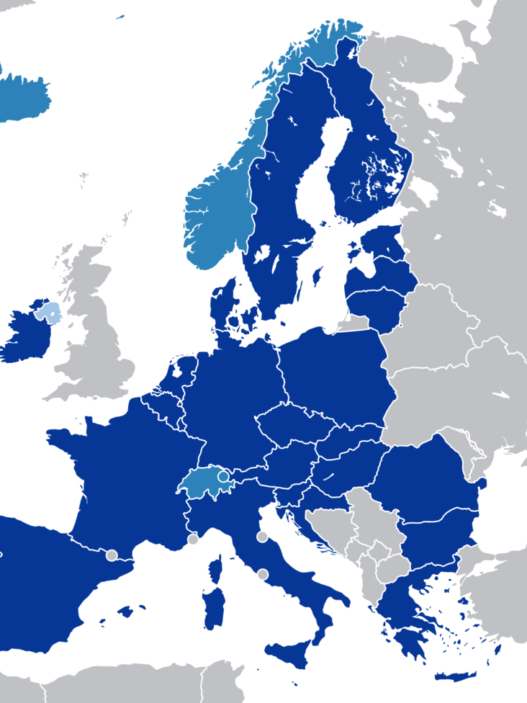














Context of the CEAS Reform
The Pact on Migration and Asylum was conceived as a comprehensive package of EU legislative measures aimed at fundamentally reforming the Common European Asylum System (CEAS).
On 10 April 2024, the European Parliament approved the legislative package, followed by the Council’s endorsement on 14 May 2024.
The legal instruments formally entered into force in June 2024, with a two-year transitional period foreseen before full application of the new framework, expected around summer 2026.
The European Commission has presented a Common Implementation Plan, outlining the practical steps through which the Member States are expected to carry out the implementation of the reform.
Sources:
European Commission – Directorate-General for Migration and Home Affairs (2024) Pact on Migration and Asylum: A common EU system to manage migration.
Further reading:
European Union Agency for Asylum (2024) Asylum Report 2024.
Why was a reform necessary?
- Despite common EU directives and regulations, significant disparities persist among national asylum systems.
- The Dublin system has failed to ensure a fair distribution of responsibility, placing a disproportionate burden on border states and creating legal uncertainty for asylum seekers.
- Recognition rates for applicants from the same countries of origin vary widely across Member States, and minimum standards of living are not consistently upheld in accordance with the EU Charter of Fundamental Rights and the European Convention on Human Rights.
- Many protection seekers feel compelled to move onwards to other Member States, particularly to those offering more favourable reception conditions and procedures, resulting in so-called secondary migration.
Sources:
Asylum Information Database (2025) Comparative reports. European Council on Refugees and Exiles.
Keller, Fabienne (2020) Report on the implementation of the Dublin III Regulation [A9-0245/2020]. European Parliament.
The reform consists of ten new legal instruments:
- Directive (EU) 2024/1346 (Reception Conditions): regulates the standards of reception for asylum seekers in Member States.
- Regulation (EU) 2024/1347 (Qualification): establishes uniform criteria for granting international protection, determining when refugee status or subsidiary protection should be conferred.
- Regulation (EU) 2024/1348 (Asylum Procedures): aims to establish a common asylum procedure across the EU.
- Regulation (EU) 2024/1349 (Border Return Procedures): governs procedures at the external borders following the rejection of an asylum application.
- Regulation (EU) 2024/1351 (Asylum and Migration Management): replaces the Dublin III Regulation and establishes new rules for responsibility-sharing among Member States.
- Regulation (EU) 2024/1356 (Screening) and Regulation (EU) 2024/1352 (Screening Consistency): introduce mandatory screening for all individuals who do not meet the entry requirements upon arrival at the EU’s external borders.
- Regulation (EU) 2024/1358 (EURODAC): sets out rules for the collection and storage of personal data, such as fingerprints, in the EURODAC database.
- Regulation (EU) 2024/1359 (Crisis and force majeure): provides a framework for responding to “crisis situations” and “situations of force majeure.”
- Regulation (EU) 2024/1350 (Resettlement): provides common rules for the safe and legal admission of third-country nationals and stateless persons to the EU.
Further reading:
European Parliament (2017) Reforming the Common European Asylum System. Institution of the European Parliament.
Criticism by Human Rights Organisations
- Erosion of core refugee protection norms: The reform increasingly disregards established protection standards and the fundamental rights enshrined in EU law.
- Quasi-detention facilities at external borders: The planned establishment of large-scale border centers (with a capacity of approximately 30,000 people) raises serious concerns about deprivation of liberty, arbitrary detention, and erroneous asylum decisions.
- Accelerated border procedures with restricted rights of appeal following the rejection of asylum claims.
- Application of such procedures to families with children, with exemptions foreseen only for unaccompanied minors.
- Insufficient procedural safeguards in border procedures, including lack of guaranteed access to legal counsel, fair hearings, and effective remedies.
- Externalization of asylum processing to third countries deemed “safe,” creating risks of chain refoulement and grave human rights violations.
- Undermining of the non-refoulement principle, leading to potential returns to countries where serious violations may occur (e.g., Tunisia).
- Threats to the best interests of the child, particularly through detention or restrictive measures that contravene obligations under the UN Convention on the Rights of the Child and the Convention on the Rights of Persons with Disabilities.
- Overemphasis on deterrence and enforcement rather than protection and fair responsibility-sharing.
- Expansion of exclusionary practices: The reform risks entrenching displacement and containment of asylum seekers outside Europe.
- Lack of solidarity: The system provides little relief for border states; relocation remains voluntary, perpetuating structural inequalities among Member States.
- Humanitarian consequences: Increased detention, overcrowding, violence, and inadequate access to healthcare at EU external borders.
Sources:
Human Rights Watch (2024) NGOs Joint Statement : The future EU must uphold the right to asylum in Europe.
Rescue, International (2025) More than 50 NGOs warn that the EU’s ‘safe country’ proposals risk weakening protection for asylum seekers. International Rescue Committee.
Amnesty International (2024) EU: ‘Reject plans to offshore asylum and safeguard refugee protection,’ say over 90 NGOs.
HIAS (2025) Joint statement: EU ‘safe country’ and return proposals would seriously undermine protection and human dignity.
Adoption in Germany
German Parliament agrees to implement the controversial CEAS adaptation law (February 2026)
On 27 February the German Bundestag adopted thighter asylum rules, including faster procedures, stricter controls, and new labour regulations. In doing so the parliament implemented an EU Reform into German law.
With the support of the CDU/CSU and the SPD parliamentary groups, parliament passed both the so-called GEAS Amendment Act (21/1848) and the “GEAS Anpassungsfolgegesetz” (21/1850) on Wednesday, 27 February (see the post from October 2025 for further information on the main changes and legal instruments).
Criticism from within the parliament came from the parties of Die Linke and Bündnis 90/ Die Grünen. They described the law as a very drastic tightening of asylum laws, at the expense of those seeking protection. Meanwhile, the AfD condemned the reform as insufficient.
Several German and international human rights organisations expressed serious concerns about the consequences this legal adaption might have and warned of serious human rights violations. The main point of criticism is the drastic tightening of asylum law in Germany. In some cases, the implementation even goes beyond European standards and, overall, represents a step backwards for refugee protection. In addition, the plans call for the construction of more closed detention centres and the expansion of detention, including for children, meaning isolation, exclusion, and stigmatisation of refugee children.
Many organisations, such as PRO ASYL, also criticise increased benefit cuts and deteriorating living conditions. Measures such as benefit cuts and more restrictive accommodation rules would significantly worsen the situation of those seeking protection.
Another point of criticism concerns asylum screenings procedures at the EU’s external border, which are also intended to make it possible to deport those seeking protection as soon as they arrive. According to NGOs such as Amnesty International, this could significantly impair access to fair proceedings and protection rights.
Human rights experts are criticizing the new facilities for “secondary migration.” The plan calls for special reception centres for individuals who are actually supposed to be in another EU member state – a structure not provided for under EU law itself.
Sources:
Deutscher Bundestag (2026) Ausschuss gibt grünes Licht für GEAS-Anpassungsgesetze
Amnesty International (2026) Deutschland: Amnesty und PRO ASYL fordern Abgeordnete zur Ablehnung des GEAS-Umsetzungsgesetzes auf
Terre des Hommes (2026) Terre des Hommes warns of child rights violations
PRO ASYL (2025) GEAS-Umsetzung in Deutschland: Mit voller Härte
European Commission (2024) Pact on Migration and Asylum
Verfassungsblog (2026) Schlechte Aussichten für Geflüchtete
Tagesschau (2026) Bundestag beschließt verschärfte Asylregeln
Draft law on CEAS adaptation is debated in German parliament (October 2025)
The German Parliament adopted an adaptation draft law in September 2025 to implement the principles of the Common European Asylum System (GEAS) reform into German national law.
On 9 October 2025, the Bundestag (German Parliament) held the first reading of the Federal Government’s draft law on the Adaptation of National Legislation to the Reform of the Common European Asylum System (GEAS Adaptation Act).
Subsequently, the draft was referred to the Committee on Internal Affairs for detailed deliberation.
Criticism of the draft law was voiced by various civil society organisations as well as by the party Bündnis 90/Die Grünen and Die LINKE. They warned against a significant tightening of asylum law and a restriction of protection for refugees. The planned centres for secondary migration were criticised for potentially resulting in conditions amounting to detention de facto. The far-right party AfD considered the draft ineffective and merely “symbolic legislation.”
Main legal instruments
Introduction of “secondary migration facilities” (§§ 44, 46, 47a AsylG-E)
- Mandatory residence for persons subject to the Dublin procedure for up to 24 months.
- Possibility to restrict their stay to the premises of the facility.
- Objective: reduction of “irregular onward migration.”
Border asylum procedures (§ 18a AsylG-E):
- Introduction of border procedures – also in cases not mandatory under EU law.
- Accelerated processing and potentially detention-like accommodation conditions.
Expansion of detention and restrictions on liberty (§§ 68 ff. AsylG-E)
- New provisions on detention, movement restrictions, and residence obligations.
- For example, in cases of presumed “risk of absconding,” authorities may detain residents on grounds of “public order.”
Extension of the “safe country of origin” concept (§ 29b AsylG-E)
- The federal government may designate new safe countries of origin by regulation.
- Facilitates outsourcing of border procedures and deportations.
Introduction of “safe third countries” (§ 29 Nos. 3–4 AsylG-E)
- Enables rejection of asylum applications as inadmissible if a third country is deemed safe.
- Reflects the EU’s “externalisation approach” at the national level.
New provision on Eurodac (§ 91k AufenthG-E)
- Restriction of the right of access to information for persons classified as security risks.
Monitoring mechanism
- Establishment of an independent mechanism to monitor compliance with fundamental and human rights in screening and border asylum procedures (details yet to be specified
Sources:
Deutscher Bundestag (2025) Kontroverse um Umsetzung des Gemeinsamen Europäischen Asylsystems.
Deutscher Bundestag (2025) Entwurf eines Gesetzes zur Anpassung des nationalen Rechts an die Reform des Gemeinsamen Europäischen Asylsystems (GEAS-Anpassungsgesetz). Drucksache 21/1848.
Critics from the german institute of human rights
1. Expansion of deprivation of liberty and detention
- Severe restrictions on the freedom of movement of asylum seekers (Art. 2(2) and Art. 104 of the Basic Law).
- Mandatory residence in secondary migration facilities constitutes a de facto deprivation of liberty.
- Lack of protective safeguards for particularly vulnerable persons (children, survivors of violence, persons with disabilities).
- Blanket presumption of risk of absconding and resulting detention are legally disproportionate.
- No ex officio judicial review of detention provided, contrary to EU requirements.
2. Pilot implementation of border asylum procedures
- Border procedures before 2026 are not legally required and not comparable to future EU procedures, making German rules more restrictive than the reform itself.
- Missing protection mechanisms (exemptions for minors, monitoring, vulnerability assessment).
- Shortened deadlines and limited legal remedies undermine access to fair procedures.
3. Safe countries of origin and safe third countries
- Unconstitutional shift of competences: the federal government may designate safe countries without Bundestag or Bundesrat approval.
- Circumvention of Art. 16a of the Basic Law (right to asylum) → violation of the principles of democracy and the rule of law.
- “Anticipated evaluation of evidence”: weakens the individual assessment of protection needs.
- The safe third country clause facilitates chain deportations and undermines the non-refoulement principle (Art. 33 Refugee Convention, Art. 3 ECHR).
- Recognition of states such as Tunisia as “safe” would legalise and simplify deportations there and cooperation with the Tunisian coast guard.
4. Neglect of special protection needs
- Provisions for women, children, and persons with disabilities formulated only as non-binding “should” clauses → no legal obligation for Länder authorities.
- Narrow residence requirements restrict access to shelters and protection facilities (e.g. women’s shelters).
5. Detention of minors and vulnerable persons
- § 70a AsylG-E allows the detention of minors – despite no EU obligation.
- Again, Germany’s adaptation law is more restrictive than necessary.
- Violates Art. 3 UN CRC (best interests of the child) and Art. 37 UN CRC (detention only as a last resort).
6. Restrictions on legal assistance and transparency
- § 12c AsylG-E allows authorities to limit NGO and counselling centre access to detention facilities.
- Undermines the right to effective legal remedy (Art. 47 EU Charter of Fundamental Rights).
7. Data protection concerns (Eurodac)
- Blanket denial of access rights to individuals flagged as security risks in the Eurodac database.
- Contradicts Art. 23 GDPR; no compensatory safeguards provided.
Source:
Deutsches Institut für Menschenrechte (2025) Stellungnahme zum Entwurf eines Gesetzes zur Anpassung des nationalen Rechts an die Reform des Gemeinsamen Europäischen Asylsystems (GEAS-Anpassungsgesetz).
Adoption in France
France has already adopted a national reform law in the context of the GEAS reform debated in the European Parliament in December 2023, which in a sense anticipates the GEAS reform but already transposes several of its provisions into national law.
1. Pôles France Asile:
- The existing Guichet unique pour demandeur d’asile (GUDA) is being replaced by new structures called Pôles France Asile. These are intended to centralize information provision, the collection of application documents, and the initial stages of the asylum procedure.
2. Link between accommodation and procedure:
- If an asylum seeker leaves their reception facility without a justified reason, their asylum application may be closed.
3. Access, registration & residence permits:
- Access to the asylum procedure takes place through centralized reception platforms (SPADA) and single entry points (GUDA / in the future Pôles).
- Asylum seekers first receive an asylum claim certificate, which serves as a temporary residence permit, and must then submit their complete asylum application within 21 days.
- The reform introduces the possibility of placing individuals under house arrest or in detention if they fail to submit an application and are considered at risk of absconding.
4. Border controls & entry refusal:
- Stricter provisions regarding refusal of entry at external borders. However, in 2024 a legal article that had permitted general refusal of entry under all circumstances was annulled by the Conseil d’État, following a judgment of the Court of Justice of the European Union.
- Internal border controls have been maintained, particularly at airports, seaports, and land borders.
Source:
Forum Réfugiés (2025) Short overview of the asylum procedure. European Council on Refugees and Exiles.
Criticism by the International Refugee Assistance Project (IRAP) Europe regarding the French reforms
1. General critique
- The law (“Darmanin Law”, loi pour contrôler l’immigration et améliorer l’intégration) represents the thirtieth reform of France’s asylum and immigration legislation in forty years – a sign, according to IRAP Europe, of political activism rather than legal clarity.
- It was adopted under an accelerated procedure and without a comprehensive impact assessment.
- The political negotiation process circumvented institutional procedures and allowed for last-minute, unrelated and restrictive provisions to be inserted into the law.
- It contributes to the stigmatization of foreigners as potential criminals and further exacerbates the public discourse on migration.
- Despite the partial annulment of several provisions by the Conseil constitutionnel, the law still contains numerous measures that weaken the rights of asylum seekers and migrants.
2. Restrictions on Family Reunification
- Introduction of quotas for the annual number of persons permitted to settle permanently in France, including through family reunification.
- Lowering of the age limit for dependent children joining a parent from 19 to 18 years – a change that disproportionately disadvantages young adults.
- Exclusion of:
- Children whose family relationship with the parent was established after the parent’s asylum application was submitted;
- Siblings of unaccompanied minor refugees residing in France;
- Minor children who have “formed their own family unit” – a category that frequently includes victims of forced marriage.
- According to IRAP Europe, these restrictions violate:
- Article 8 of the European Convention on Human Rights (right to respect for family life),
- Directive 2003/86/EC on the right to family reunification, and
- The principle of the best interests of the child (UN Convention on the Rights of the Child).
- Consequences: Family separations, significant protection gaps for girls and young women, and an increased risk of irregular migration, as lawful pathways for family reunification are effectively closed off.
3. Procedural Barriers to Family Reunification
- The 18-month deadline for submitting applications following the granting of protection status is unrealistic given the protracted processing times in practice.
- The requirement to legalize all foreign civil status documents introduces unnecessary bureaucratic burdens, particularly for applicants from countries without functioning administrative systems.
- The ground for refusal based on “insufficiently stable and continuous relationships” contradicts the very purpose of family reunification.
- These provisions create virtually insurmountable obstacles, especially for refugees from countries lacking French diplomatic representation (e.g., Afghanistan).
- The NGO refers to the jurisprudence of the Court of Justice of the European Union (CJEU, Afrin, 2023) and the European Court of Human Rights (ECtHR, Tanda-Muzinga v. France), both of which call for more flexible and humane procedures to ensure effective access to family reunification
4. Fundamental Human Rights Assessment
- The law would have lowered existing protection standards below the European minimum threshold.
- It constitutes a serious and disproportionate interference with the right to family life.
- It poses specific risks to vulnerable groups, including children, women, LGBTQI persons, and persons with disabilities.
- The reform is counterproductive to integration, as family life represents a key prerequisite for successful social inclusion—yet the law undermines precisely this foundation
Source:
International Refugee Assistance Project Europe (2024) On the Reform of France’s Asylum and Immigration Law: Position Note.