








Summary
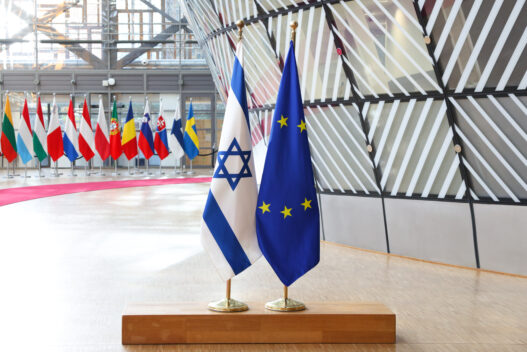
By spring 2026, the European Union had not suspended the EU–Israel Association Agreement, despite an official review concluding that there were “indications” Israel had breached Article 2, which makes respect for human rights and democratic principles an essential element of the agreement. The core reason is not the absence of legal or political grounds, but the lack of a sufficient majority in the Council for the most far‑reaching options, and in particular the absence of unanimity required for full suspension.
Since May 2025, institutional dynamics have significantly intensified. On 20 May 2025, High Representative Kaja Kallas announced the launch of an Article 2 review; the findings, presented to the Foreign Affairs Council on 23 June 2025, concluded there were indications that Israel was in breach of its human‑rights obligations. In September 2025, following her State of the Union address, Commission President Ursula von der Leyen proposed a package including partial suspension of trade concessions under the agreement, sanctions on Hamas, and targeted measures against extremist ministers and violent settlers. The European Parliament, in its 11 September 2025 resolution on “Gaza at breaking point”, called for the immediate suspension of the agreement and, as a first step, of preferential trade access.
Institutional context and key actors
The Association Agreement is the legal backbone of EU–Israel relations, with Article 2 enshrining human rights and democracy as “essential elements”. A serious violation can justify proportionate measures, but full suspension requires a unanimous Council decision, a high political threshold in a deeply divisive file.
Kaja Kallas, as High Representative/Vice‑President, was the procedural catalyst, securing a “strong majority” for launching the Article 2 review and presenting its conclusions to ministers. The von der Leyen Commission then moved from monitoring to proposing a graduated response: first a partial suspension of Israel’s participation in Horizon Europe, then suspension of trade‑related provisions and targeted sanctions. The European Parliament consistently pushed for immediate suspension or at least suspension of the trade pillar, stressing that the Commission’s own review had confirmed indications of breach.
Most Member States supported opening the review, but the Council never converged on full suspension. Politically, several governments considered the agreement a key legal basis for engagement and humanitarian leverage, and thus favoured incremental, reversible measures.
Why the Council blocked – and what this reveals
Three factors explain the Council’s inaction.
- First, unanimity: full suspension “can only be decided by the Council acting unanimously”, and this condition has not been met.
- Second, strategy: the agreement is seen as a necessary framework for “frank and principled dialogue” and for securing humanitarian steps on the ground.
- Third, design: by advancing partial measures (Horizon Europe, trade concessions, targeted sanctions), the Commission implicitly acknowledged that support for a total suspension was lacking, and opted for a modular response more likely to pass in the Council.
This has triggered three main lines of criticism:
- inconsistency between legal findings and political follow‑through;
- institutional fragmentation between Parliament, Commission and Council;
- and a slow, incremental pace that risks eroding the credibility of Article 2 conditionality.
For future action, the case points to the need for a clearer, more transparent mechanism for activating human‑rights clauses, better use of partial measures under non‑unanimity decision rules, and stronger upstream involvement of the European Parliament in monitoring “essential elements” clauses.
Sources
Amnesty International
Euractiv
European Commission – Press release (trade concessions / sanctions)
European Parliament – Motion for a resolution (9 September 2025)