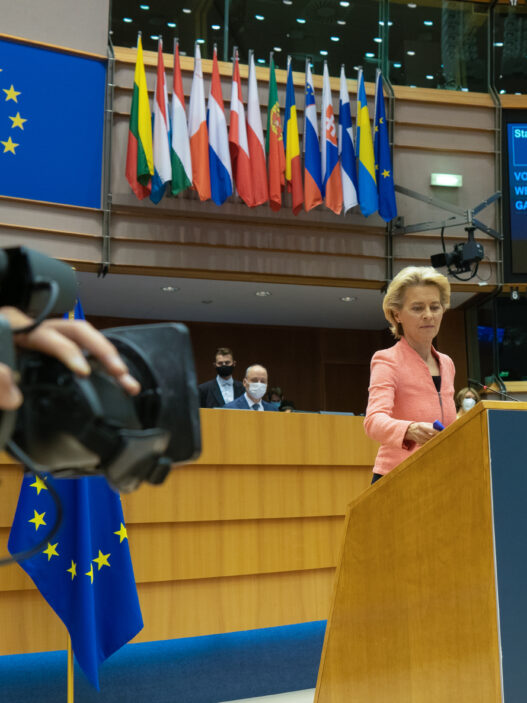









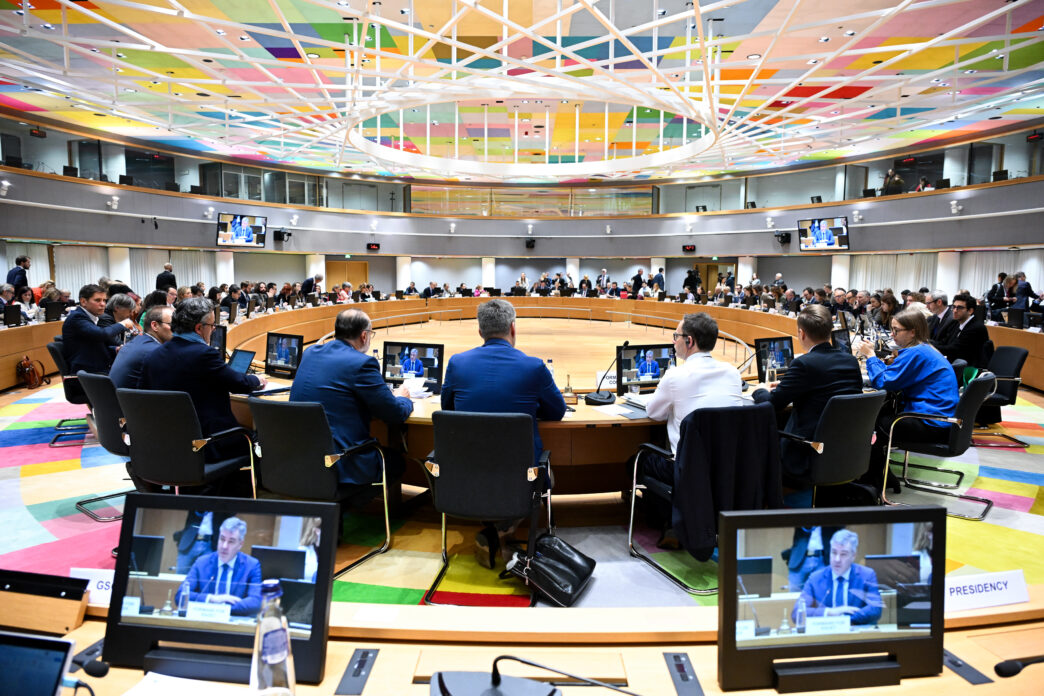
EU member states, meeting in the EU Council (Environment Council)1, reached an agreement on a binding goal to reduce net greenhouse gas emissions by 90% by 2040, marking a significant milestone toward achieving the EU’s climate neutrality objective by 2050. While maintaining the overall target, the Council introduced greater flexibility for member states, allowing for the limited use of international carbon credits, additional carbon removal options, and cross-sector flexibility to mitigate economic impacts. The environment ministers also reinforced the guiding principles for the post-2030 climate framework, highlighting the importance of competitiveness, a just transition, innovation, energy security, and realistic expectations for carbon removals. Additionally, a review mechanism was established to monitor progress, assess competitiveness effects, and evaluate the contribution of natural removals, with the possibility of adjusting the target if necessary.
Lars Aagaard, Denmark’s minister for climate, energy and utilities, said:
“This is important for the future of Europe – and it shows that even in challenging times, we can stand united. The target sets a clear direction years ahead for our policies, industries and investments.”
More precisely, the EU environment ministers agreed on a weakened climate package, setting a nonbinding 2035 emissions-cut target of 66.25–72.5 per cent below 1990 levels and adopting a legally binding goal to reduce emissions 85 per cent by 2040.
The deal allows an additional 5 per cent of cuts to be met through international carbon credits. It includes a review clause to adjust the 2040 target if climate policy proves detrimental to the economy.
The Council added a clause allowing the start of ETS2 to be delayed by one year, moving its launch from 2027 to 2028. The EU ETS 2 (Emissions Trading System 2) is a new carbon market that was initially scheduled to start in 2027. It extends the existing EU ETS, which covers power plants, industry, and aviation, to include road transport and heating fuels for buildings.
While most EU countries backed the plan, Hungary, Slovakia, the Czech Republic, and Poland opposed it, with Bulgaria and Belgium abstaining. The agreement ensures the EU has a position for the World Climate Conference (COP30) from November 10 to 21 in Belém, Brazil, 10 years after the signature of the Paris Agreement, which was intended to secure the 1.5 °C target of global warming. The European Parliament still needs to negotiate the final law.
What do the decisions of the EU Council mean for the EU/Europe and the world? A critical perspective:
- The plan by the EU Council reveals that not only did national EU ministers work through the night of 4 November until 5 November for a compromise, but also that the EU weakens its climate goals because it lacks a unified strategy to combat climate change and achieve its 2050 goal of a climate-neutral continent, as evidenced by the rejection of the Visegrad states. There are significant concerns in the affected states that they are unable to implement a social-ecological transformation for their citizens, who are under pressure from major global players, including China, the USA, and Russia, which utilise their resources to exert pressure on the EU in strategic and tactical ways.
- The 1.5 °C target of global warming loses meaning in the EU’s plan to combat climate change: a goal set 10 years ago, which is the central and common point of fighting against global warming.
- The UN warn that recent government climate pledges have done little to change the global warming trajectory. Despite recent promises, global temperature projections have improved by less than 0.2°C, indicating that the world remains on track for approximately 2.5°C of warming, well above the Paris Agreement’s target of 1.5°C. The report emphasises that only faster and more ambitious measures can avert escalating and potentially irreversible harm to people and ecosystems. The UN warns that governments must move from promises to tangible implementation, delivering deeper emission reductions, increased climate finance, and stronger policies without delay. If decisive action is not taken within this decade, the opportunity to limit warming and avoid catastrophic outcomes will continue to narrow, heightening the risk of crossing multiple tipping points.
- It is also doubtful if international carbon credits can be a factor in combating climate change. The Irish Times, for example, claims that carbon-credit systems are fundamentally failing as a climate solution. Instead of delivering real emission reductions, they have become a tool for widespread corporate greenwashing, enabling major polluters to claim environmental progress without making meaningful changes to their operations. Multiple investigations have revealed that most credits do not correspond to genuine climate benefits, with some studies finding that more than 90 per cent of rainforest offsets are effectively worthless “phantom credits.” Beyond their lack of climate integrity, many offset projects have caused serious harm in the Global South. Communities have reported land dispossession, inadequate consultation, and even cases of sexual harassment and abuse linked to project operations, particularly in Kenya. Such impacts reveal how carbon markets can perpetuate patterns of exploitation while allowing wealthy companies and countries to outsource their climate responsibilities. According to experts, offsetting responsibilities to other states does more damage than good: it delays the urgent cuts in emissions required, distracts political attention from real climate action, and entrenches power imbalances. Instead of carbon credits, there can be calls for direct emissions reductions, stronger public climate finance, effective regulation, and genuine support for communities and ecosystems on the frontline of climate change.
- Experts from the European Council on Foreign Relations warn from easing the climate ambitions for short-term profits. Europe’s troubled car industry, especially in once-dominant Germany, is struggling not because climate targets are unrealistic, but because Chinese electric vehicle makers are rapidly overtaking European brands at home and abroad. While EU manufacturers blame the 2035 phaseout of combustion engines and demand weaker climate rules, their real challenge comes from a wave of cheap, heavily subsidised Chinese EVs and intensifying competition in the Chinese market, where European sales are declining. Easing climate targets, experts warn, would only slow the arrival of affordable EVs, divert investment back into combustion engines, and leave Europe ill-prepared for a global shift already moving decisively toward battery-electric cars, without shielding it from Chinese rivals. China has treated the EV transition as a core industrial strategy for years, coupling subsidies with domestic-content requirements and aggressive technology development. Europe, by contrast, risks undermining its own competitiveness if it waters down regulation, instead of doubling down on the production of affordable, high-quality electric vehicles that can compete globally.
- EU member states have agreed to postpone the launch of the new ETS2 carbon market for transport and buildings from 2027 to 2028, a move that has sparked criticism from various industries in the EU. Business associations warn that the delay disadvantages smaller firms, which already pay a national carbon price. At the same time, competitors in other EU countries will benefit from an additional year without similar costs. They argue that the postponement weakens incentives for companies to switch to cleaner technologies and slows the broader transition effort.
- The EU cannot claim international credibility if it does not set ambitious climate targets for itself. This was once a strength for the progressive climate actor, accumulating soft power globally, and the idea of the EU as a normative power2 in the world. The Global South will view the EU critically at the climate conference in Belém, Brazil, especially given that Europe is historically among the main contributors to climate change. A lack of responsibility undermines trust and will directly affect economic and security cooperation, which is necessary considering that the world is changing for Europe, as it fights to avoid becoming unimportant in geopolitics alongside the USA, Russia, China, and India. If Europe fails to acknowledge its role in its own industrialisation over the past few decades, it risks long-term geopolitical and economic disadvantages, further damaging its soft power. The opportunity lies in forming new alliances with the Global South, combating climate change together through trust and cooperation, and establishing a rule-based order with like-minded partners. Political partners must be willing to reject the orders proclaimed by political theorists, such as Thomas Hobbes or Niccolò Machiavelli, that the winner takes it all and that the means to achieve a goal won’t be criticised. Trump, Putin, and Xi Jinping represent this perspective in the world currently. Therefore, increasing its independence from these current political powers is essential for the EU, meaning pushing for the green transition and securing partners in this ambition without raising a finger.
Read more on European Council, Politico EU, ECFR and UN.
- The European Council comprises all heads of state or government of the EU member countries. In contrast, the EU Council (also known as the Council of the European Union) consists of ministers responsible for specific policy areas structured in specific configurations. In this case, it was the environment ministers of the EU member states who conducted the negotiations within the Environment Council (ENV configuration). ↩︎
- The concept of the EU as a “Normative Power” comes from the work of Ian Manners, a British political scientist, who introduced the term in his influential 2002 article “Normative Power Europe: A Contradiction in Terms?” In his view, a normative power is an actor that influences global politics through the diffusion of norms embedded in its identity and legal-political order, rather than through military or economic coercion. His framework centres on a core set of constitutive norms (peace, liberty, democracy, the rule of law, and human rights) supplemented by additional norms such as social solidarity and sustainable development. ↩︎