







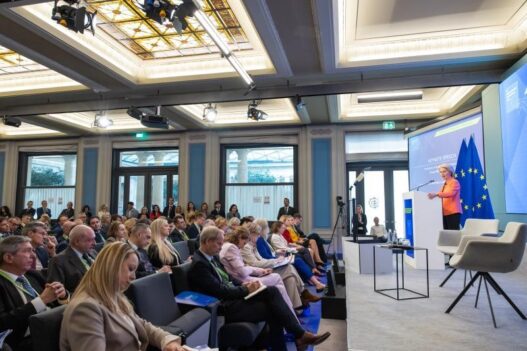
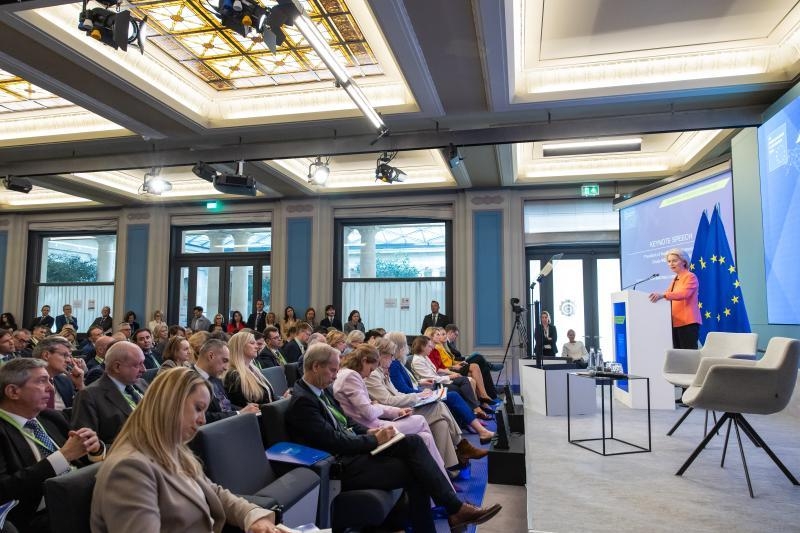
The 2026 EU Ambassadors’ Conference, held in Brussels from 9–13 March, brought together more than 145 EU ambassadors, Heads of Delegation and CSDP mission chiefs under the theme “Advancing EU Interests at a Turning Point.” This year’s edition showcased “Team Europe” in full force. Ursula von der Leyen, Roberta Metsola and António Costa jointly addressed the EU’s global diplomatic network, alongside keynote interventions by High Representative/Vice-President Kaja Kallas. Their coordinated messaging signalled a clear political intention to minimise institutional dissonance at a time of heightened geopolitical tension. In both tone and substance, the leaders converged on several priorities: sustained support for Ukraine, a more assertive security and economic agenda, and the need for faster, more unified European foreign-policy decision-making.
Hosted by Kallas, the conference sought to realign EU external action amid intensifying geopolitical rivalry, geoeconomic competition and global fragmentation. Strategically, it represents a key moment to recalibrate the EU’s diplomatic posture — reinforcing strategic autonomy while deepening partnerships with enlargement countries and actors across the Global South. The 2026 edition takes place against a backdrop of continued Russian aggression against Ukraine, instability across the Middle East and the Gulf, and growing pressure on the rules-based international order
Projecting unity at a geopolitical turning point
The conference illustrates a gradual discursive shift: from the traditional idea of “normative power Europe” toward a more interest-driven and security-oriented foreign policy, while still anchored in values. The presence of all three institutional presidents — alongside NATO Secretary-General Mark Rutte — underscores the consolidation of the “Team Europe” approach in external action, but also reflects a shared recognition that EU decision-making must accelerate to remain credible internationally. Strong emphasis on enlargement — described by Kallas and Costa as a “geopolitical choice” — as well as renewed engagement with the UK and Global South partners, suggests a reframing of neighbourhood and partnership policies through a geopolitical lens
Aligning the institutional triangle
This coordinated front matters because EU foreign policy emerges from a complex institutional triangle. The European Council sets the strategic direction, the European Commission operationalises it through policy instruments and budgets, and the European Parliament provides democratic scrutiny and political framing. When the three institutional leaders deliver aligned messages to EU delegations, they effectively define the parameters within which national capitals and EU services are expected to operate. For ambassadors, such alignment reduces ambiguity: how to balance values and interests, how to navigate the relationship between enlargement and neighbourhood stabilisation, and how far to advance economic security, de-risking and resilience in third countries.
The style of communication also reveals institutional roles. Von der Leyen frames external action around resilience, economic security and defence of the rules-based order. Metsola emphasises democracy, enlargement and support for partners aspiring to join the EU. Costa reflects the European Council’s role in forging unity among 27 sometimes diverging national positions. When their messages converge around ideas such as strategic autonomy, Ukraine’s European future or the need to counter foreign information manipulation, these notions move from contested concepts to shared orthodoxy. In this sense, “Team Europe” functions less as branding than as method: aligning institutional narratives early and projecting them consistently through EU delegations.
A common narrative, diverging national priorities
Yet this alignment has limits. A unified tone at the Ambassadors’ Conference does not erase persistent disagreements among Member States on defence spending, industrial policy, China or the pace of enlargement. Recent debates in the European Parliament on the Middle East, for instance, reveal fragmented voting patterns across political groups and national delegations, illustrating the difficulty of producing a truly unified position beyond compromise language. What the conference does establish, however, is a default script. EU ambassadors are expected to speak the language of a more geopolitical Union: one that treats enlargement and economic instruments as tools of influence and seeks to act less as a predominantly financial contributor and more as a strategic actor.
Sources
EU Ambassadors’ Conference 2026 | EEAS
Keynote speech by HR/VP Kaja Kallas at the 2026 EU Ambassadors Conference | EEAS
Speech by the President: EU Ambassadors Conference 2026 | European Commission
President Metsola addresses EU Ambassadors | European Parliament President