










On 19 March 2025, the European Commission published the White Paper on European Defense Readiness 2030, which outlines valuable plans for the EU’s pursuit of strategic autonomy in defense.
Europe, which is barely considered in U.S. President Donald Trump’s security and geopolitical agenda, is being affected by several violations of the liberal international order. For decades, Europe has enjoyed its benefits and multilateral institutions. However, they are no longer sufficient to prevent wars or simply deter aggressive countries and individuals.
The international order has been changing, with Europe being a recipient of its outcomes. Unless it decides its future and adapts to the negative changes that are imposed by external powerful actors such as the U.S., Russia, and China, it will not be able to maintain a strong voice in international affairs. Some of these actors mobilize efforts and resources while also utilizing technology more effectively to achieve national objectives and disseminate political ideologies. They are a real threat to the Western rules-based system and democratic way of life, which may be regarded as one of the latest significant models of a peaceful, stable, and coexistent international order. 
Additionally, Donald Trump’s attempts to make U.S.-Russia relations functional again through his diplomatic talks with Russia in Saudi Arabia, irrespective of European interests, and along with his criticism of Ukraine’s President Zelensky for not being ready for peace, are deeply concerning for the EU. In response, Europe is taking these geopolitical issues very seriously by developing an independent strategy for defense, security, political stability, and democratic norms, which may be outside or even against the influence of the United States.
The shifting power dynamics are also prompting the European Union to rethink its reliance on traditional alliances, particularly with the United States. The recent meetings held on March 11, 2025, in Saudi Arabia between U.S and Ukrainian representatives excluded the European representation, and the separate talks between Trump and Putin, as well as Trump and Volodymyr Zelensky, also left Europe out. These geopolitical events are directly connected to Europe, yet it was excluded from them. Therefore, the only option for Europe to maintain international influence and safeguard its values and interests in a multipolar world is to strengthen joint defense capabilities and secure critical technologies.
The European Commission has developed the White Paper on European Defense Readiness 2030, which provides valuable insights for the EU’s pursuit of strategic autonomy in defense. The analysis highlights the White Paper’s objectives concerning the current geopolitical events, emphasizes the financial initiatives, and addresses EU’s aim of creating a more secure and integrated Europe in the face of the U.S. unpredictability, the Russo-Ukrainian war, and the violation of international law and international humanitarian law in the Israeli war in Gaza.
Deteriorating Strategic Context for Europe
The EU’s defense is fundamental to the democratic, economic, and social life of Europe. However, it has been weakened by decades of underinvestment. Additionally, Europe faces multiple security and transnational challenges, such as the rapid technological change in which it does not play a significant role, and the increasing strategic and economic competition from states like China and the U.S. The continuous Russian aggression against Ukraine and Trump’s controversial approach to international relations and conflict resolution have also demonstrated the fragility of European security.
Geographical vulnerability is another challenge to Europe. Its proximity to the unstable political regimes in North Africa, including the rivalry between Morocco and Algeria, the ongoing civil wars in Libya and Sudan, and the growing violent extremism in the Sahel, poses a direct security and economic threat to Europe.
In the Middle East, the war in Gaza, involving Israel, supported by Trump’s administration, against Hamas, supported by Iran, fuels regional and international tensions as well. Some commentators have argued that Europe should take greater responsibility for addressing human suffering and reducing the economic insecurity around the Red Sea. In addition, Russia’s military alliance with Iran is seen as a critical concern for Western security in general.
Geopolitical rivalries have also led to a global technology race. Technology is an essential feature of competition in the new geopolitical environment. AI, quantum, biotech, and robotics demonstrate an area in which Europe is not a leading competitor. Therefore, technology remains one of the key areas in which the European Union must invest heavily to meet a rigid technology ecosystem and advance its members’ national security objectives.
Besides the new technology race, hybrid threats such as cyber-attacks, sabotage, electronic interference in global navigation and satellite systems, disinformation campaigns, political and industrial espionage, as well as weaponization of migration, further contribute to global instability and Europe’s insecurity.
That is why, on 19 March 2025, the European Commission published a White Paper proposing that Europe must strengthen its defense readiness and suggesting that Europe take greater responsibility for its defense, as well as its technological and industrial bases.
European Defense Readiness 2030
The White Paper has demonstrated that there is much the EU can do to strengthen its defense. The primary value that the EU will add to European defense readiness 2030 is facilitating collaboration and efficient scale for the European defense industry in developing, producing, and marketing weapons systems. Second, the EU will help interchange and lower weapon costs and avoid their competitive purchasing while helping to generate stability and predictability with multi-year industrial demand. Finally, the EU will support dual-use infrastructure for mobility and space-based communications and navigation. Simply put, the EU will enable partnerships and provide the base for European countries to build their defense to prevent and respond effectively to security threats and geopolitical changes.
The Gaps in European Defense
For Europe to deter security threats, stand for international norms, and address instability and conflicts, the EU needs to close critical capability gaps. The EU must prioritize investment capability, make member states commit to it, and establish a practical governance framework for investment.
In the defense capability domain, the White Paper has identified seven crucial areas for rebuilding European defense. The most important among them are air and missile defense, artillery systems, drone and counter-drone systems, and military mobility. There is a compelling case for closing these capability gaps collaboratively. The EU, NATO, the European Defense Agency, and the Organization for Joint Armaments Cooperation (OCCAR) will join efforts to deliver reasonable equipment procurement. In this context, the EU directives are to establish and speed up the rules and procedures of the European Defense Fund. For the EU, funding is the priority for addressing all the existing and upcoming gaps.
Also, adopting a joint commission on military mobility and strengthening land, air, and maritime borders is necessary to confront the growing challenges at the EU’s Eastern borders. The White Paper has demonstrated the capability gaps and critical areas to address them and build a robust European defense.
Most of the gaps mentioned in the White Paper are related to building a strong and autonomous defense, remaining competitive in the global tech race, and joining forces in close coordination with NATO. With that being said, tackling the current gaps needs a high level of understanding and long-term commitment among member states, with EU funding and incentives. The EU is already helping member states initiate technologically advanced capability projects, demanding collaborative military and industrial actions.
More Support for Ukraine
The White Paper lays out a clear pathway for EU member states to continue their rational and strategic support for Ukraine, demonstrating that it is the frontline state for European defense. In fact, Europe intends to make Ukraine a heavily defended, deterrent state. Framed under the “Porcupine Strategy,” the EU highlights several key military measures for this purpose. First, the provision of 2 million rounds of large-caliber ammunition per year to Ukraine. Second, the supply of air defense systems, including missiles and drones. Third, the launch of a new air defense initiative to address Ukraine’s air defense capability gaps.
Since Ukraine is already effectively using drones, electronic warfare, cyber defense, along with scaling up the production of weapons and defense systems, this initiative aims to further support Ukraine’s defense sector through the Ukraine Support Instrument (USI) and expand its participation in EU programs such as the Permanent Structured Cooperation (PESCO) and the Coordinated Annual Review on Defense (CARD).
Finally, the EU attempts to reinforce European security by providing military and structural aid, helping Ukraine build a sustainable defense capacity beyond the needs of the ongoing war. In short, the EU views the Russian-Ukrainian war as an opportunity to reinforce Ukrainian resilience against Moscow and shape European autonomy and defense.
European Defense Industry
The White Paper views the EU defense industry as fragmented, under-invested, and too slow to meet the challenges caused by the U.S. distancing itself from its traditional Western European allies. Hence, the Paper presents some strategic goals for the European defense industry. The most prominent among them are reducing dependency on external suppliers of important materials and technologies, increasing defense investment, and supporting SMEs and startups as key players in defense innovation. Additionally, focusing on disruptive technologies like AI and robotics and developing expertise in the European defense sector will further contribute to the resilience of European defense.
Partnerships Enhance Security
The EU considers international cooperation a key solution to addressing the current security challenges. The war in Ukraine shows that today’s conflict can have a cross-border impact, requiring joint international responses. Therefore, the EU advocates partnerships with global organizations and other countries to manage such challenges.
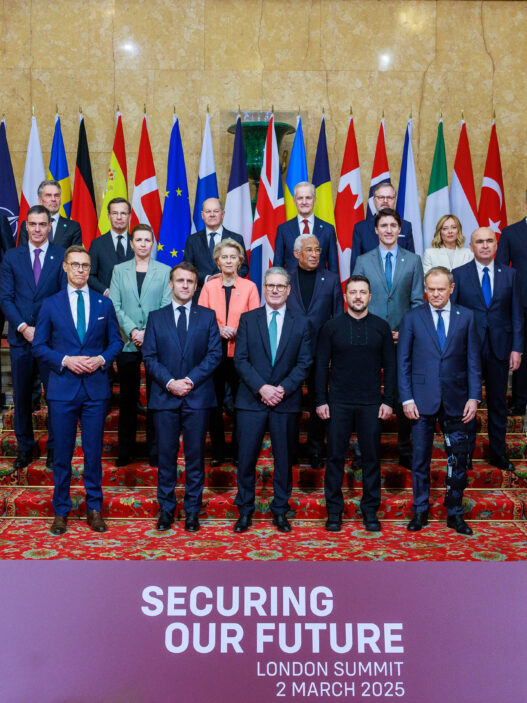
NATO, as the foundation of collective defense in Europe, is essential for EU security, and cooperation with the U.S. remains vital for developing cyber, space, and maritime security and defense procurement. Bilateral cooperation with the UK, Norway, and Canada, as well as having a constructive relationship with Türkiye, based on reciprocity and mutual interest, is essential for EU security. Partnerships with Japan, South Korea, Australia, and India in the Indo-Pacific must also be expanded to reinforce the EU’s security presence in the region.
Overall, diversifying and developing relations with countries that can contribute to the enhancement of the defense industry of Europe is highly desirable to reduce dependencies and boost European resilience.
Conclusion
Europe’s security threats proliferate amid dramatic shifts in U.S. international interests, deteriorating rules-based global order, conflicts and instability at the European borders, and rapid technological change. The Russian war on Ukraine poses a threat to European states and makes them vulnerable to any outcomes that might benefit Russia. The fact that the EU has almost no say and is not involved in the negotiations on a ceasefire and a lasting peace deal in Ukraine proves the urgency of the need for decisive actions within European defense. The EU should strengthen its defense autonomy, invest in its technological and military sectors, continue to actively support Ukraine, and diversify its partnerships and cooperation around the globe to have a strong voice in global affairs.