









The Democratic Dilemma in the EU
Democracy entails inclusion, fairness, and collective decision-making. Yet, it faces internal contradictions when alleged democratic measures are used to undermine its principles. This is exemplified by Hungarian Prime Minister Viktor Orbán, who since 2010 has systematically consolidated executive power in his own country, weakened judicial independence and eroded democratic norms—actions often justified under democratic pretexts. Despite being an EU member, Hungary has regressed in its democratic values, posing a risk to the Union’s core principles. In September 2018, the European Parliament initiated Article 7 of the Treaty on European Union. The procedure is still ongoing, but the situation in Hungary and Orbán’s role in EU decision-making have become more critical. The EU struggles to act against Hungary using strong legal measures while maintaining unity and upholding democratic principles.
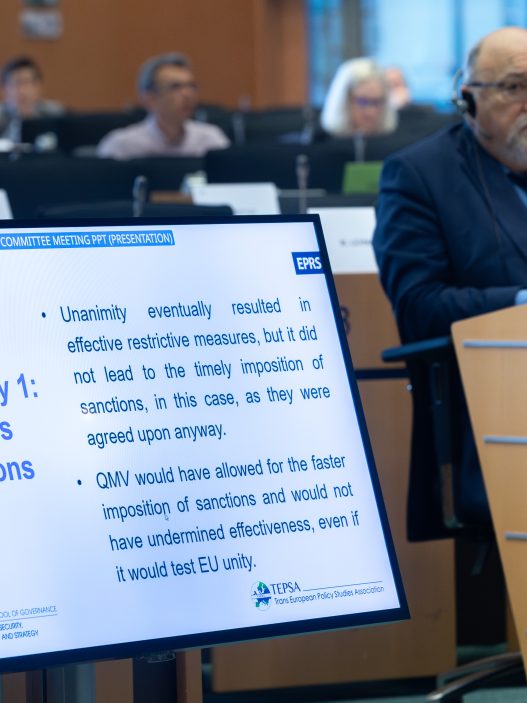
Orbán’s autocratic actions extend to a supranational level, where his obstructionism, particularly regarding sanctions against Russia, reflects a prioritization of national self-interest over collective EU action. While he frames his stance as a pursuit of peace and diplomacy, his actions undermine the collective voice of the EU. With EU law showing insufficient legal measures to bypass Orbán’s veto power, EU members are discussing measures based on national decisions. The case of Orbán illustrates a dilemma of European democracy at a time when a united front is needed the most and democratic values are questioned.
Orbán’s Rhetoric and Hungary’s Illiberal Development 
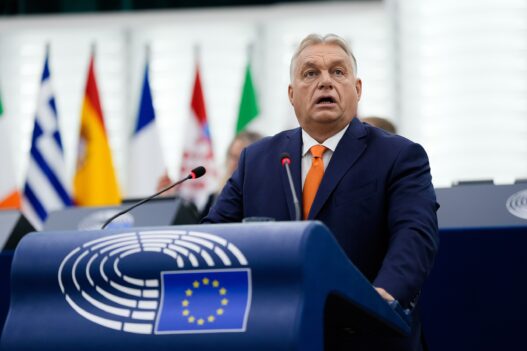
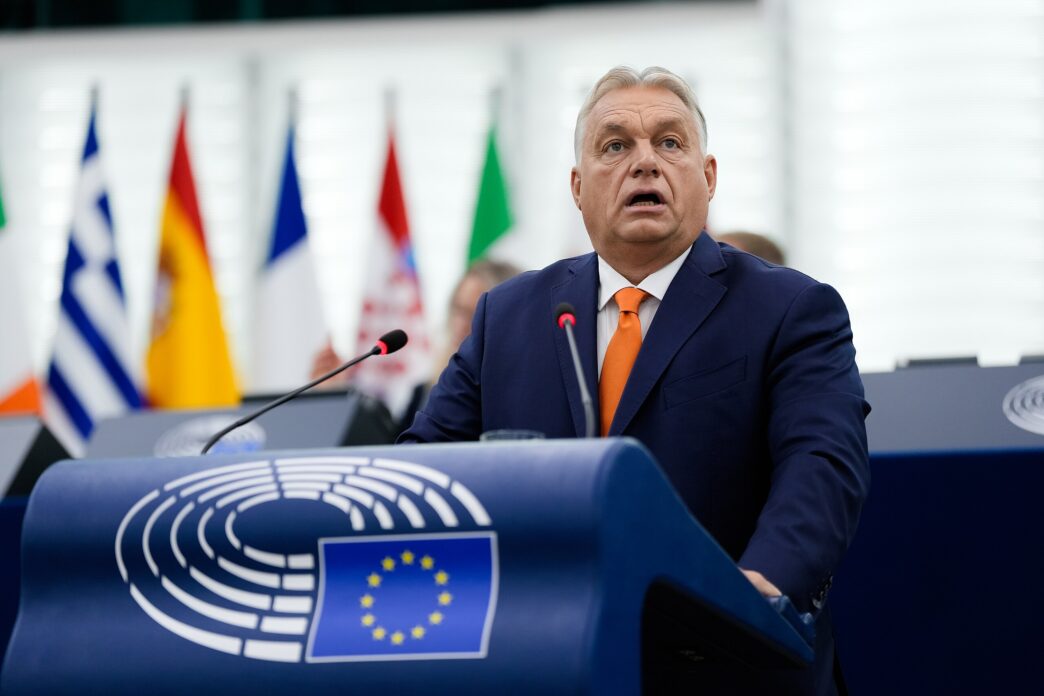
In the 2024 interview on the BILD Talk podcast, following his visits to Kyiv and Moscow, Orbán presented himself as a peace-seeking statesman and diplomat. He criticised EU alignment with US-based “war policy” and the lack of EU interest in the Russian-Ukrainian conflict. His rhetoric emphasized realism over moral idealism, positioning Hungary as a pragmatic yet constrained actor. The Hungarian prime minister focused on sovereignty, stressing its importance in a peace mission, hence justifying why he kept his visits secret. Furthermore, in the overall situation of the conflict, he pointed out that “we” speak much about strategic autonomy but do less in favour of it. Strategic sovereignty means nothing without “interest based on sovereign foreign policy”, he states. His statements reflect his overall standpoint on European and national matters.
This narrative obscures Hungary’s own regression and positioning. Under Orbán and his Fidesz party, Hungary has deviated from liberal democracy, as recognized by the European Parliament in 2018. Media freedom has declined, judicial independence has eroded, and electoral integrity is compromised by exploitative welfare reforms and vote manipulation. Orbán’s fourth election in 2022, along with the continued erosion of EU values, prompted the European Parliament to label Hungary an ‘electoral autocracy’.
Since its independence from Soviet communist rule in 1989, Hungary has established democratic alliances and undergone reforms to become a liberal democracy. Viktor Orbán’s rule has done much to reverse these achievements. His nationalist and populist stance has boosted his popularity, especially during EU migration debates. Calling migrants “Muslim invaders” and migration “poison”, the Hungarian Prime Minister used strong rhetoric during the migration debates, showing his uncompromising character. His many actions and statements present a double standard. Orbán advocates for a European community, but one that respects national state sovereignty and populist stances prevail. His rhetoric and political actions reflect a different conceptual understanding of the European Union. In 2021, the Hungarian Prime Minister signed a resolution that supported the primacy of the Polish constitution over EU law and its stance on incompatibility with the EU treaties. In defence of this perspective, the Hungarian resolution defended Poland and argued that the EU was not respecting the powers of the member states. Hungary has been challenging the EU on numerous occasions and has proven to be a difficult partner in policymaking, particularly with its further erosion of democratic values.
EU Actions and Sovereignty Tensions
The European Union has been paying attention to Hungarian development and despite multiple legal measures in action, Orbán’s autocratic stance remains unshaken, it appears. Despite the European Parliament initiating measures under Article 7, which enables sanctions against a member state violating EU values, the European Council has, to date, failed to determine Hungary’s “risk of serious breach” of the European Union’s values. In 2022, under the rule of law conditionality regulation, the European Commission proposed “budget protection measures” against Hungary. In its February 2025 analysis, Zselyke Csaky from the Centre for European Reform summarizes that in total, the Commission suspended the designation of €32 billion of EU funds to Hungary. Although €10.2 billion were released after Hungary complied with some judicial reforms in 2023 and €0.9 billion in pre-financing under REPowerEU, the financial sanctions against Hungary remain considerable. Many European voices are pressing for further sanctions in this regard. The pressure on Orbán is growing, and some member states are even looking for “Orbán-proof” solutions to bypass his influence and obstructionism. As a council member, Hungary’s Viktor Orbán and like-minded Slovakian Prime Minister Robert Fico can obstruct any further action of Article 7, such as suspension of voting rights. As EU law reaches its limits, this situation is increasingly straining the European rule of law crisis.
Another looming crisis in European discourse is the issue of sovereignty and national agendas. Examining Orbán’s rhetoric since 2010 reveals that much of it centers on sovereignty and national interest. The EU’s foundational challenge lies in reconciling supranational governance with national sovereignty. The rise of right-wing parties and illiberal actors on the European continent and beyond is driving the discourse of sovereignty, as evidenced by the former Polish government’s push for constitutional primacy and the 2016 Brexit referendum. In this discourse, Orbán is one of the many advocates of national sovereignty. From an EU perspective, there is no reason for member states to propagate the importance of sovereignty and confront EU integration. In a 2022 study by the European Parliament’s Policy Department for Citizens’ Rights and Constitutional Affairs, the authors analyze that, despite the European Court of Justice stating that EU law has absolute primacy and extends to the constitutions of member states, the court has been quite flexible in its implementation.
Furthermore, many member states have embedded exceptions to EU law primacy, especially considering “constitutional identity”. Since 2010, Hungary has challenged the idea of European integration. Orbán’s domestic policies are strengthening a nationalist agenda, excluding itself from the European Union, while seeking the benefits of EU funds. Orbán’s rhetoric confronts EU involvement in national policies but also argues in favour of a stronger and interest-driven EU.
Post-World War II integration efforts were driven by a desire to transcend conflict through cooperation. However, the expectation that member states would accept limitations on national sovereignty has proven contentious. As Orbán’s Hungary illustrates, the EU’s mechanisms for enforcing democratic norms and measures are both procedurally cumbersome, politically sensitive and lengthy.
Erosion of Democratic Values Across the EU
The Hungarian trajectory is not isolated and is strongly connected to a much bigger picture of “backsliding” across the EU and is similarly visible on an international scale. The 2025 Liberties Rule of Law Report, published by the Civil Liberties Union for Europe (Liberties), highlights democratic backsliding across multiple EU states. In summary, the report concludes:
“[…], EU enforcement mechanisms remain weak, allowing illiberal trends to fester and rather than sending a clear message of the centrality of the rule of law and fundamental rights there are alarming signs of the EU degrading the rule of law from within. Without decisive action, the EU risks further democratic erosion, internal fragmentation, and weakened global standing.”
In their reports, Liberties analyses the horizontal dimensions of justice, anti-corruption, media freedom, civic space, and human rights. Furthermore, it includes member states from both established Western democracies and newer Eastern democracies. To exemplify, Hungary faced criticism for its law on foreign-funded NGOs. Since the law’s passing in 2017, the EU Commission has initiated an infringement procedure stating that the “law does not comply with EU law”. The law aimed to increase the transparency of NGOs’ funding by obliging them to label any foreign funding in their publications and public presence, in cases where their foreign funding exceeded HUF7.2 million. Viktor Orbán’s declarations portrayed NGOs as “foreign agents” attempting to influence the Hungarian opposition and undermine national sovereignty. Similarly, laws aimed at restricting “foreign agents” have been introduced in other member states as well, according to the Liberties reports. France introduced its “Law to Prevent Foreign Interference” in 2024, and the Netherlands has been discussing a draft Transparency Act since 2018, the latter similar to the Hungarian version, focusing on Civil Society Organizations (CSOs). Despite their differences and intentions, other member states have created multiple instances of challenging the EU’s rule of law and democratic values.
This complicates efforts to hold Hungary accountable, in addition to legal barriers, as deficiencies in the rule of law exist elsewhere. Moreover, Hungary’s departure from the International Criminal Court (ICC) in the face of Israel’s Prime Minister Netanyahu’s visit and other controversial diplomatic actions mirrors those of other member states, weakening the EU’s normative authority.
Conclusion
Calls to suspend Hungary’s voting rights or withhold funds have gained traction, yet the political cost remains high. A closer perspective shows that EU measures against challengers of European values are quite limited. In fact, it can be labelled as self-restriction as the democratic principles of veto power or Hungary’s membership in the Council limit further measures. At this point, it remains unrealistic for Hungary, as a member of the European Council, to consider itself a risk to the EU. Viktor Orbán’s statements and actions have made it clear that he has a different understanding of Europe and its union values. While the EU has strengthened the rule of law in recent years, the Hungarian example shows that further revisions may be necessary. When confronted with the choice of supporting Ukraine or Russia by halting further sanctions, member states may need to consider legal measures beyond the current treaty toolbox. With the Russian invasion of Ukraine having severe consequences on European security, markets and interests, the severity of the Hungarian situation with Viktor Orbán has to be considered differently.
The case of Viktor Orbán illustrates the fragility of European democracy when foundational values are undermined from within. In his BILD Talk interview, Orbán promotes an interest-driven version of the EU while simultaneously obstructing its normative power — the Union’s foundational source of integrity. The EU must reassess its enforcement capabilities and demonstrate institutional resolve. Upholding democratic standards across all member states is essential for the Union’s credibility, coherence, and future.