








Far from Europe’s main political and economic centres, the small republic of Moldova is navigating a turning point in its recent history, with its future increasingly shaped by the geopolitical shifts unfolding across the continent.
A former Soviet republic, but culturally very close to its neighbour Romania, this country of just 2.9 million inhabitants is seeking to join the European Union under the shadow of Russia, with the frozen conflict in Transnistria to the east and the war in Ukraine providing the backdrop.
A history shaped by empires
Moldova’s history itself was forged between empires. The Principality of Moldavia emerged in the 14th century under the protection of the Kingdom of Hungary. It was later transferred to the Russian Empire under the name of Bessarabia. Following the October Revolution, when it became a republic, it joined Romania through a popular vote, as the majority of its population was ethnically Romanian.
However, following the Ribbentrop-Molotov Pact, Romania handed the territory over to the Soviet Union after receiving an ultimatum, and the Moldavian Soviet Socialist Republic was established as part of the USSR. During the Soviet period, the USSR organised the immigration of Russian speakers to compensate for the demographic losses caused by the Second World War. 
Following the collapse of the Soviet Union, Moldova became an independent republic in 1991, a status subsequently reaffirmed in the 1994 referendum, while the possibility of unification with Romania was a discussed issue. Thus, the state we know today as Moldova emerged. However, it was far from a homogeneous country, and tensions soon began to surface.
The ethnic and identity question
Although around 78% of the population is Moldovan/Romanian, the country is also home to Russian, Ukrainian and Gagauz minorities, the last one having Constitutional recognition to the right to establish its own territorial entities. The preferences of these minorities frequently clash with the popular will of the Romanian-majority population.
During the Soviet period, efforts were made to emphasise the differences between Moldovans and Romanians, with the two languages officially treated as separate. The truth is that there is still a debate on whether Moldovans constitute a distinct ethnic group in their own right or are part of the Romanian ethnic group. Nevertheless, numerous politicians and public figures in the country have advocated unification with Romania. The Romanian flag and national anthem were adopted, and popular support for reunification appears to be gradually increasing, particularly among younger generations.
As a result, there are several examples of ethnic tensions between the Moldovan/Romanian majority and the minorities living in the country. One case is the southern autonomous region of Gagauzia, inhabited by the Turkic Gagauz people. Although the conflict was settled through the granting of regional autonomy in 1994, its inhabitants continue to make demands for independence and have repeatedly expressed their closeness to Russia and opposition to the European Union.
Transnistria: the frozen conflict
Transnistria is the eastern region of Moldova. It is de facto independent but internationally recognised as part of the country, as it has not received recognition from any state. Its demographic particularity lies in the fact that it is mainly populated by Slavs of Russian and Ukrainian origin, a consequence of Soviet internal migration and its proximity to Ukraine.
In 1990, multi-ethnic Slavic and local populations organized politically and declared self-governing independence, amidst growing alarm over rising Moldovan nationalism and a “Romanianization” process, fearing political and linguistic marginalization. These ideological and territorial tensions ultimately erupted into the 1992 Transnistrian War, pitting Moldovan government forces against separatists backed by Russia’s 14th Army.
The war ended with the ceasefire agreement of 21 July 1992, which established a security zone and a Joint Control Commission with a tripartite peacekeeping force composed of Russian, Moldovan and Transnistrian battalions. However, the agreement did not resolve the issue of Russian military presence. Although Moldova and Russia signed a withdrawal agreement in 1994, it never entered into force due to the lack of Russian ratification. Moscow also committed to remain neutral and withdraw its troops by 2002, a pledge that remains unfulfilled.
Transnistria has thus become one of the frozen conflicts of the post-Soviet space. The Council of Europe considers it Moldovan territory occupied by Russia. From Moscow’s perspective, there is an evident interest in maintaining this situation, as it allows Russia to preserve its influence in the region.
Nevertheless, Moscow has opted for an ambiguous policy: it implicitly supports Transnistria through economic aid and the granting of citizenship, without officially recognising it, while maintaining relations with the Moldovan government and pro-Russian sectors. Europe, for its part, has chosen to avoid confrontation and instead seeks to exert influence by strengthening Moldovan institutions and trade.
Russia’s annexation of Crimea in 2014 raised concerns about the possibility of the Russian Federation absorbing Transnistrian territory. The military operation in Ukraine also prompted discussions about whether Russia might use the separatist region to open another front in the war.
The Russian Federation thus takes profit of the clientelist relationship established with Transnistria, gaining a strategic advantage in the dispute for influence in the post-Soviet space and favouring the maintenance of the status quo. However, the Kremlin favors integration of the separatist region into a Moldovan state, but under Russian conditions and influence.
For its part, the EU has adopted an indirect approach to the conflict, avoiding negotiations with Russia, which has nevertheless failed to prevent the consolidation of a de facto state. However, the Moldovan population, increasingly favourable to European integration, would be more willing to accept a fragmented state within the EU than to risk seeing its political orientation fall under Moscow’s influence. Although this trend has accelerated in the wake of Russia’s invasion of Ukraine, economic and industrial factors make an escalation in Transnistria an unlikely scenario.
Maia Sandu and the pro-European project
Since gaining independence in the 1990s, the Republic of Moldova has gradually moved closer to the West, particularly to the European Union. This process experienced two turning points in 2004: the EU’s eastward enlargement and the Orange Revolution in Ukraine. These developments led the ostensibly pro-Russian president Vladimir Voronin to sign the EU–Moldova Action Plan.
In 2009, the Alliance for European Integration came to power, making EU integration its central objective. In 2014, the Association Agreement with the EU was signed, facilitating trade and visa arrangements, to which Russia responded with economic pressure. The process continued even during the presidency of pro-Russian Igor Dodon, between 2014 and 2020.
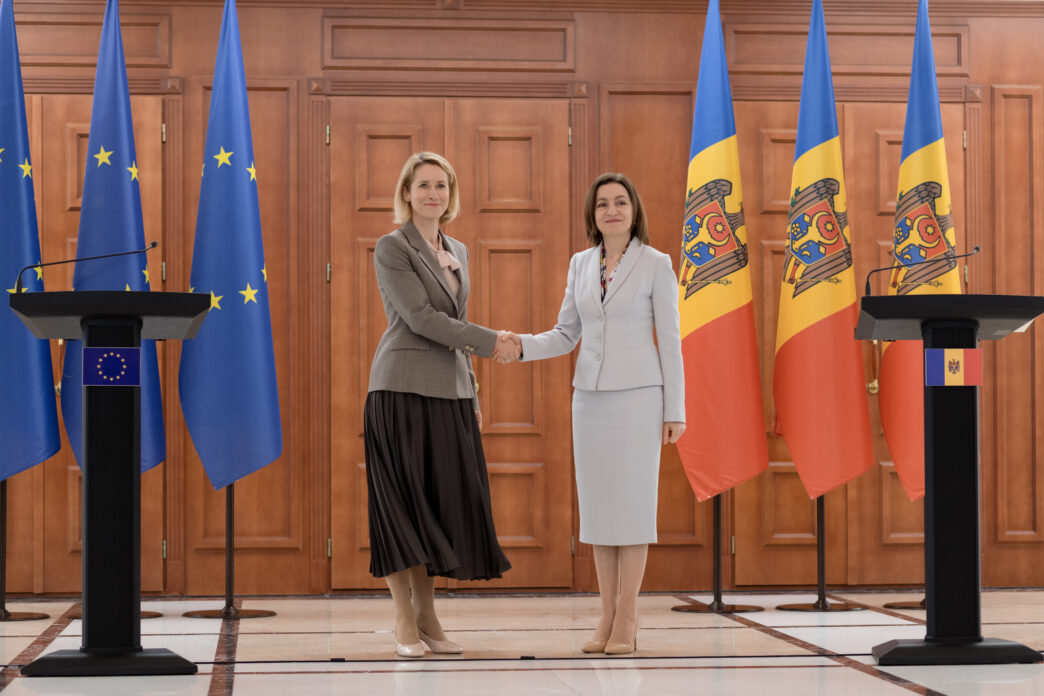
The year 2020 marked a turning point with the election of pro-European President Maia Sandu, who was re-elected in 2024. On both occasions, she won by a narrow margin against candidates supported by the Kremlin. In 2023, her government declared Romanian, rather than Moldovan, to be the country’s official language, marking a clear step towards the West.
Nevertheless, the event that accelerated Moldova’s European integration was the war in Ukraine. Fearing a possible Russian intervention similar to the one in Ukraine, Moldova applied for EU membership in March 2022 and was granted candidate status in June of that year.
Negotiations formally began in June 2024, the same year in which the membership referendum was held. The ‘Yes’ vote prevailed by an extremely narrow margin, securing 50.38% of the votes, amid accusations of Russian interference.
The EU is currently Moldova’s largest trading partner, accounting for 55.9% of the country’s total trade in goods in 2025, thanks to trade liberalisation. It is also the country’s largest provider of financial assistance.
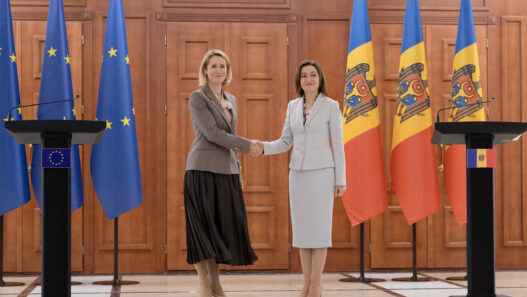
Last December, the EU praised Moldova for its progress in the democratic reforms required for accession. In June of this year, the second EU–Republic of Moldova summit was held, and last July a new cluster of accession chapters was opened for Ukraine and Moldova. This thematic cluster covers trade and international policies, as well as foreign and security policy.
Despite this accelerated pace of integration, and the Foreign Minister’s assertion that European accession and a solution to the Transnistrian issue were parallel processes, the reality is that both have followed separate paths. This raises the question of how the EU will integrate countries with territories beyond their government’s control.
In an attempt to shed light on this situation, Europe has sought to attract Transnistria through a soft power strategy, offering economic benefits and promoting democratic reforms. The aim is to make the advantages of belonging to the European bloc tangible to the region’s inhabitants.
Russia’s role
Moldova’s gradual rapprochement with the Western bloc follows the trend among former communist countries, most of which have progressively joined the EU and NATO. Russia views this development with suspicion, considering Western expansion into what the Kremlin regards as its traditional sphere of influence a threat to its security and territorial integrity.
Russia therefore uses the Transnistrian conflict to exert influence over Moldova and prevent its rapprochement with the West, employing natural gas and Moldova’s dependence on Russian supplies as instruments of control and pressure.
Furthermore, the presence of Russian troops in the region allows the Eurasian power to project its influence in this strategic area. In contrast to the EU, which has chosen not to become actively involved in resolving territorial conflicts in the post-Soviet space, Russia has monopolised peacekeeping missions.
Moscow also employs strategies associated with hybrid warfare, including disinformation campaigns, provocations and institutional sabotage, as well as interference in electoral processes and support for pro-Russian candidates.
In this way, it seeks to undermine democratic institutions and advance its interests in the region, although these strategies do not appear to have been particularly effective in areas such as communications.
Russia therefore considers the post-Soviet space to be the central sphere of its strategic interests, using the defence of the rights of Russian minorities in these states as a pretext to justify interference in their internal affairs.
The Kremlin is thus attempting to prevent countries within its traditional sphere of influence from moving closer to the West, pursuing a form of hybrid geopolitics with the EU characterised by conflict but also by the need for cooperation.
Is there light at the end of the tunnel?
Moldova’s European integration process is at a considerably advanced stage, and public support for European integration has remained significant, with 63% of Moldovans backing EU membership based on an IRI survey in 2022. However, the country’s pro-European government has faced considerable challenges from pro-Russian political forces.
In June 2023, Moldova’s Constitutional Court declared the Șor Party unconstitutional, following allegations of illegal political financing and a threat to constitutional values.. Its leader, Ilan Șor, a Moldovan-Israeli oligarch with links to Moscow, had been sentenced two months earlier to 15 years in prison for fraud and money laundering in connection with the country’s major banking scandal.
Despite popular support for the European project, this support is not replicated when it comes to NATO, with more than 50% of the population opposed to membership, according to the same survey. For Moscow, the enlargement of the North Atlantic Treaty Organization represents a clear threat to its sovereignty, and perhaps this is where the key to the situation lies.
Moldova’s EU accession process is conditional upon fulfilling the requirements set by the European Commission, rather than resolving the territorial dispute over Transnistria, with the case of Cyprus serving as a precedent.
Moreover, Moldova’s accession to the Union could encourage the secessionist enclave to move closer to Chisinau through economic benefits. However, this could also indefinitely postpone a resolution to the conflict, as Transnistria adopts a multi-vector foreign policy that allows it to benefit from both Europe and Russia. A negotiated settlement would most likely entail a commitment to Moldova’s neutrality, with the country not joining NATO nor CSTO.
Therefore, the country is making steady progress towards EU membership in areas such as economic modernisation and the fight against corruption, although shortcomings remain in the implementation of reforms, alongside significant political polarisation. While this process is moving forward without a resolution to the Transnistrian conflict, it could play a key role in resolving it, as territorial integrity remains an objective shared by Sandu’s government and Brussels.
Nevertheless, the most likely scenario is that the situation will remain frozen, given the interests of both Moscow and Tiraspol, and a less stable state like Moldova could even become a Trojan horse within the EU. Therefore, as it pursues its European path, Chișinău must seek to strengthen its democratic institutions, reduce its energy dependence on Russia, and deepen its economic integration in order to counter the Kremlin’s influence in the region. The extent of this influence will be strongly shaped by the outcome of the war in Ukraine. As for the EU, it will need to develop more innovative and effective strategies for engaging with de facto states.