






Donald J. Trump assumed power on January 20, 2025, and became the 47th President of the United States of America. Trump’s nationalist “America First” policy, centered around aggressive trade protectionism, pushed US foreign policy towards unilateralism and transactional diplomacy, severing ties with many of its European allies and undermining free trade; the backbone of liberal internationalism. The “Turnberry agreement,” with its high tariffs and the push to increase defense spending to 5% of its GDP, in exchange for US security guarantees, is fading the Transatlantic security and economic alliance. This is materialized in the unilateral actions of the United States against Iran and NATO’s refusal to join the war, exposing strategic divergence between Washington and European Capitals. Trump’s policies toward Europe, his protectionism, push to acquire Greenland, and disengagement from the Ukraine war are driven by the goal of “making America great again,” which European leaders see as yet another thorn in their side. This is a gradual shift towards realism and hierarchical alliance politics, where security is no longer a democratic norm but a commodity to be chased. In response, European leaders are moving towards strategic autonomy and soft-balancing, reducing their dependence on Washington for security.
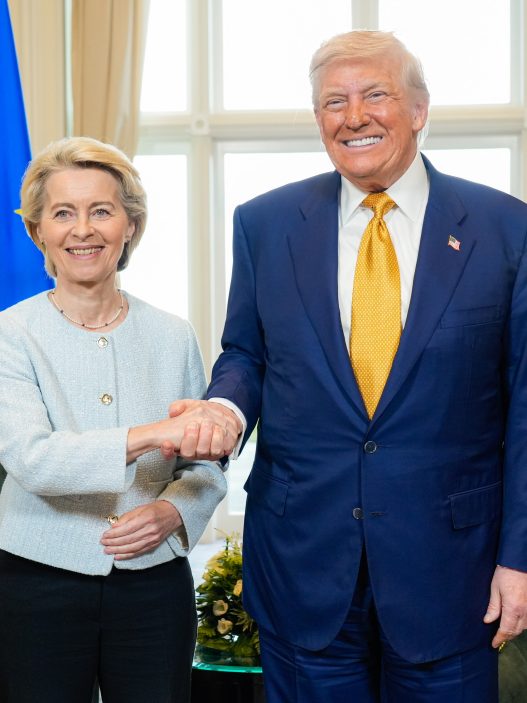
The European Union is perceived as a protectionist bloc benefiting from US security, trade rules, and subsidies while ‘ripping off’ US industries. The relationship with the EU is seen purely in realist cost-benefit terms and as a transactional bargaining partner rather than a partnership built on liberal values and rules. Trump has repeatedly called the EU a ‘foe’ worse than China and accused their leaders of ‘Free riding’ on US security and threatened to withdraw its security guarantees. He ridicules Europe for adopting multiculturalism and civilizational decline due to declining fertility and loose immigration policies. The US imposed a 10% tariff on all goods from Denmark, Norway, Sweden, France, Germany, the United Kingdom, the Netherlands, and Finland to advance its protectionist policies and exercise influence to change their stance on the Greenland issue. The EU and individual leaders have responded by underscoring the risks of bilateral economic upheavals that could result from the rising tariffs. The European Commission President, Ursula von der Leyen, denounced Trump’s tariffs as a “major blow” to the global economy and warned of an “uncertainty spiral” for trade. Germany’s Chancellor Merz warned that ongoing tariff uncertainty is harmful for both European and US economies, arguing that such threats undermine long‑term investment and trade. This was the beginning of the fraying of the transatlantic alliance that was further severed by subsequent policies.
Trump cited Greenland as a strategic asset for Arctic security, publicly calling for the United States to “secure Greenland one way or another” in his first speech to Congress on 5th March, 2025. He framed it as a global security issue, and the preeminence of the US will prevent China and Russia from gaining influence over key resources and strategic reserves of Greenland, attributing to Denmark as an ineffective security provider. The White House threatened to raise tariffs from 10-25% on key NATO allies if they oppose Trump’s plan to annex Greenland, highlighting his transactional strategy towards Europe. Greenland provides a strategic edge to Washington through sea routes, early warning and surveillance systems, and key mineral reserves, providing leverage in the trade war with China, which processes 90% of the world’s rare earth minerals. These moves triggered a coordinated response from seven European allies (Germany, France, the UK, the Netherlands, Sweden, Norway, and Finland) that “Greenland belongs to its people” and that any change in its status is a matter for Denmark and Greenland alone. Denmark’s Prime Minister emphasized that Greenland’s security is not for sale and the future of its people must be decided by its people. The French President Emmanuel Macron and Merz also warned against using tariffs and trade deals as a hard bargaining chip to manufacture consent on Greenland. The UK and Nordic States also showed discontent with Trump’s transactional approach to Europe. Economic blackmail for broader geopolitical interests is a move towards a realist political system, undermining the rule-based liberal internationalism.
In late 2025, Trump’s team unveiled a 28‑point peace plan that European and Ukrainian officials see as a “Kremlin‑style wish list”, including demands that Ukraine cede Crimea, Donetsk, and Luhansk to Russia, limit the size of its military, and effectively abandon hopes of NATO membership. Although a revised 20‑point draft softened some language, it still asked Ukraine to accept significant territorial losses and security guarantees rather than full reparation and full integration into NATO. Since the assumption of Trump’s presidency, the military and economic aid to Ukraine has been cut largely by 99% in comparison to the Biden presidency under the claimed need to “re‑evaluate” assistance in light of his “America First” priorities. The United States is “pushing for peace at any price” at the expense of Ukrainian territorial integrity and long‑term European security, while calling Trump’s Peace Plan a unilateral proposal lacking any European counseling and participation. The US has largely shifted the burden of Ukraine’s war to Europe. In 2025, EU‑provided military aid increased by about 67%, and European leaders approved a €90 billion loan package to cover both military and budgetary support through 2026–2027. Trump’s gradual disengagement under the guise of Protectionism, America First, and Realpolitik is straining the long-held transatlantic partnership and fading reliance on international cooperation, diplomacy, and a culture of military restraint. 
Trump unilaterally launched operation ‘Epic Fury’ against Iran on 28th February, 2026, in the guise of removing the preeminent threat to the US through their nuclear program. In response, Iran blocked the Strait of Hormuz, and Trump demanded that NATO members join his efforts against Iran. European leaders politically outright refused to join the Iran War, citing that it’s a ‘war of choice’ not covered by NATO’s collective defensive obligations, and met with Trump’s threat that refusal ‘will be very bad for the future of NATO.’ Trump has been publicly ridiculing Italian Prime Minister Georgia Meloni, the UK Prime Minister Keir Starmer, and Macron for their refusal to join a naval blockade and aggressive war against Iran. Spanish Prime Minister Pedro Sanchez has described the Iran War as “unjustifiable” and “dangerous” and closed airspace for Washington. The Iran war pushed Trump to relax sanctions on Russian oil, which was seen critically by European states and strengthened the Russian War Machine. These unilateral and hierarchical alliance politics further contributed to moving Europe away from its long-held security guarantor and accelerated the drive toward strategic autonomy. There has been a strategic shift from Europe’s democratic, cooperative, and militarily restrained region to a more assertive geopolitically‑oriented actor that actively invests in defense, technology, and energy to reduce dependence on unreliable external powers. In 2024, the EU increased its combined spending to €343 billion, equivalent to about 1.9% of the EU’s GDP. EU‑level planning under the ReArm Europe/Readiness 2030 framework aims to mobilize around €800 billion in cumulative defense‑related investments over the coming decade. The Iran War exposed transatlantic mistrust, revealing that security dependence doesn’t guarantee policy convergence as governments consider strategic and domestic risks. Although the EU is increasing its defense spending, but they lack a unified military decision-making framework. A European independent security future depends on a structurally unified decision-making framework, increased investments in long-range strike systems and air-defense, and expanded production capacity. This will therefore hedge European security reliance on external powers and provide bargaining leverage and strategic independence.