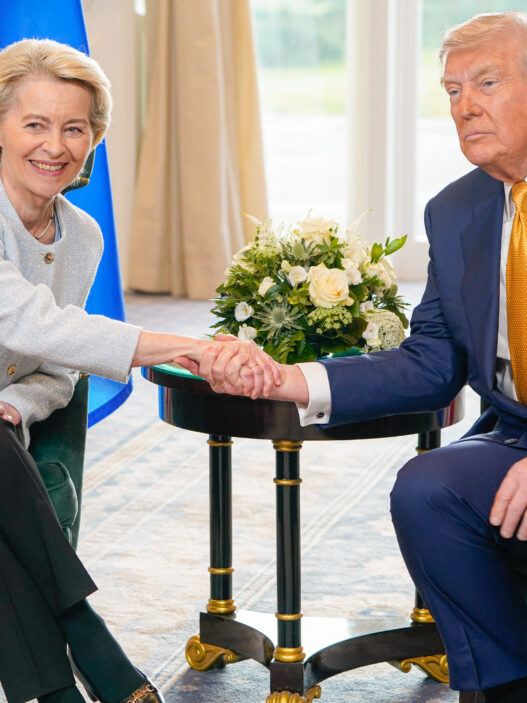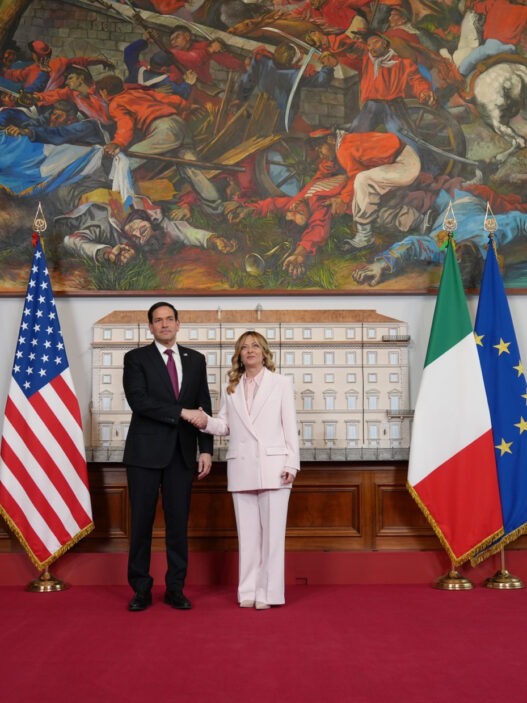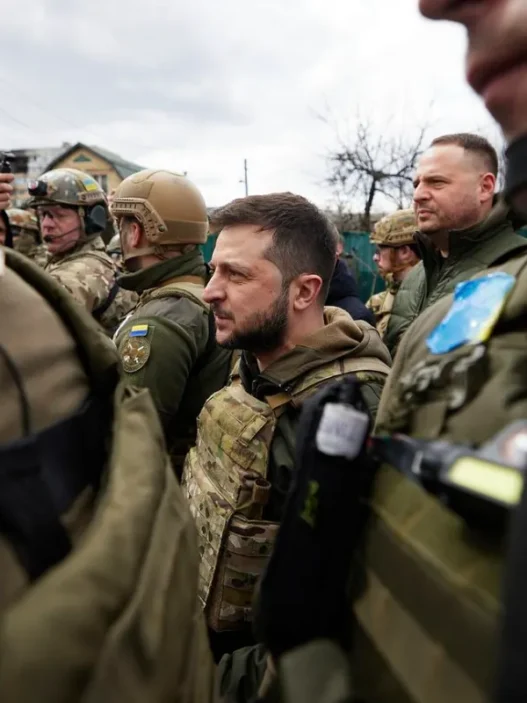









On January 3rd 2026, the United States officially captured Venezuelan President Nicolas Maduro and brought him back to American soil to face drug charges in New York. The Trump administration justified it because, under Maduro, Venezuela was the hub for drug trafficking and “narco-terrorism” that led to the deaths of many Americans. In response to this action, many European officials were relatively weak in their criticism of the United States’ violation of international law. When examining the weak European reactions to the American action in Venezuela, it becomes clear that the Europeans have lost the moral high ground in their criticism of other countries’ refusal to take a clear stand in Ukraine.
Europe’s Rhetoric on International Law in Ukraine
Ever since Russia invaded Ukraine in February 2022, the Europeans have claimed extensively that it is a clear violation of international law. In February 2022, French President Emmanuel Macron stated that Russia’s invasion of Ukraine violated the United Nations charter on territorial sovereignty. In March 2022, the European External Action Service (EEAS) statement said, “The EU condemns in the strongest possible terms Russia’s unprovoked and unjustified military aggression against Ukraine.”
In addition, many Europeans vehemently criticized other countries’ neutral response to the Russia-Ukraine War, especially those countries in the Global South. For example, in September 2022, Macron stated that those who voted neutral were “complicit” in Russia’s war. For nearly 3 years, Europe vehemently criticized India’s neutral position in the war, and especially its purchase of Russian oil. Similarly, many in Europe have been dissatisfied with not only Brazil’s position, but also with “South Africa’s neutral stance on the Ukraine war, a position that puts the country on the “wrong side of history”, as stated by the Irish Times.
By criticizing countries that took a neutral stance on Ukraine, Europe sought to position itself as the moral arbiter of international law and sovereignty. However, Europe’s weak reaction to America’s action in Venezuela calls into question that very notion. 
Europe’s Failure to Condemn the US
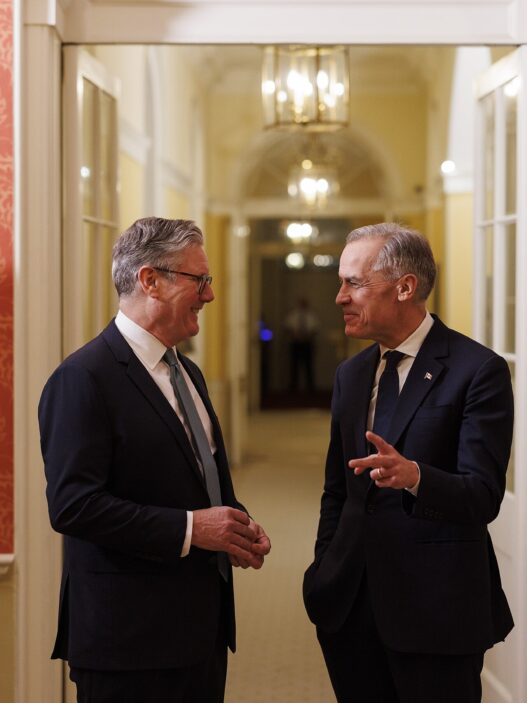
In the aftermath of the operation, the Europeans’ reaction was relatively mild, as the official statement of the EEAS made no direct mention of the United States violating international law. The British Prime Minister, Keir Starmer, insisted that it was up to the United States to justify its decision to remove Maduro. Others, such as Italian Prime Minister Giorgia Meloni and Hungarian Prime Minister Viktor Orban, echoed the Trump administration’s claims that it was a necessary move to counter drug-trafficking.
While some officials – such as Macron (who clarified that his tweet on Venezuelans rejoicing at Maduro’s fall did not constitute an endorsement of American actions) and Spanish Prime Minister Pedro Sanchez– were more vocal in their criticism of the US, by and large, Europe’s reaction was weak. In fact, the reaction by French far-right politician Marine Le Pen was arguably stronger than that of many incumbent European politicians.
This isn’t the first time that Europe refrained from rebuking America’s violations of international law. For example, in June 2025, when the United States (and Israel) launched a pre-emptive strike on Iran, much of Europe echoed Washington’s line that Tehran must not be allowed to have a nuclear weapon.
The reasons for Europe’s unwillingness to condemn the United States are apparent. Many European countries still rely on the American security umbrella, and the continent is highly dependent on the American economy. Importantly, with the ongoing War in Ukraine, the Europeans need to be on good terms with the Trump administration.
However, by refusing to condemn the United States outright, Europe’s irrelevance in global affairs only increases, such as by inviting more American aggression over Greenland, bearing the geoeconomic consequences from Washington’s war of choice against Iran, and reinforcing the Global South’s perception of Europe as a hypocritical actor when it comes to international law.