







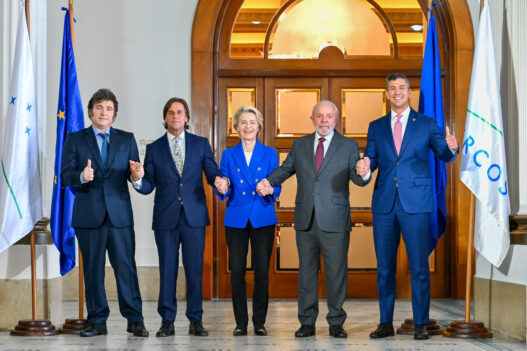
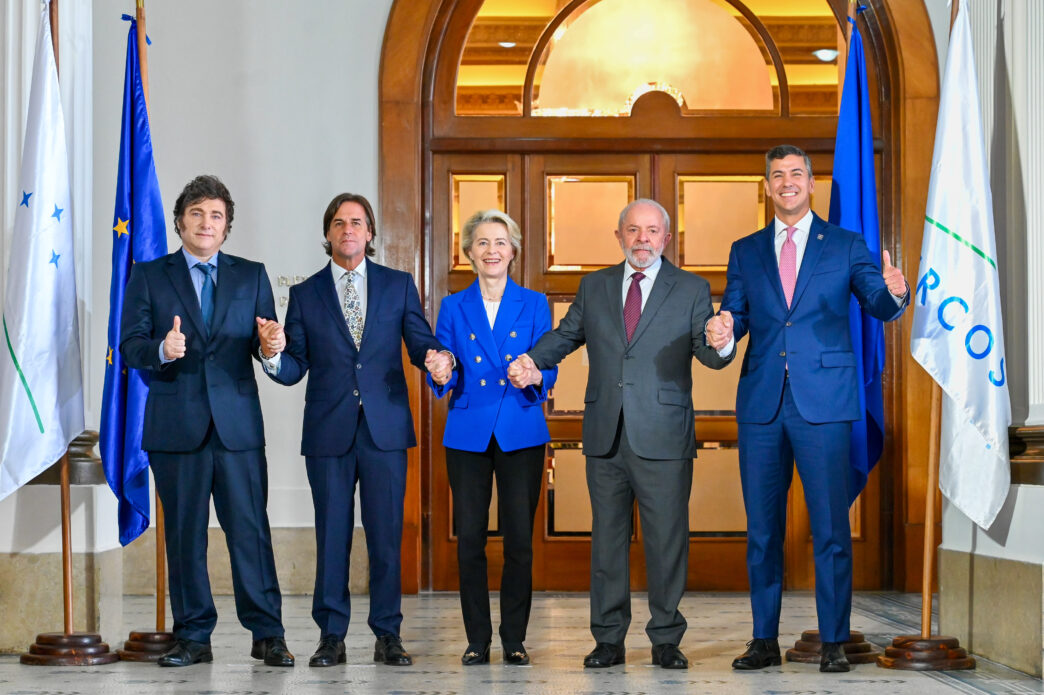
After nearly 25 years of negotiation and a year since its finalization, the EU-Mercosur Trade Agreement was approved by the European Council on January 9, 2026. The highly politicized agreement provides Europe with the opportunity to reinvigorate its global economic presence, reduce its economic reliance on China and the United States, and forge a new multilateralism with Latin American partners based on sustainable development and global trade. It is also a much-needed political victory following the reputational damage taken following the renegotiated US-EU trade agreement.
EU-Mercosur proves the EU can effectively and autonomously pursue geopolitical agreements while promoting its own sustainable agenda. Governments in the region (especially Brazil) have been receptive, committing themselves to improving human rights and sustainable resources extraction in line with the EU’s agenda. This mutually beneficial partnership would establish the EU as a reliable trade partner and champion sustainable mining and environmental protection practices. EU-Mercosur would also allow Europe to refrain from the type of “pick-a-side” diplomacy, in which partners are pressured to align with either Washington or Beijing. Focusing on cooperation in the shift to renewable energy would make the EU stand out as a non-transactional power, enhancing its international trade credibility.
The EU-Mercosur Agreement: A Breakdown
The agreement combines the markets of Mercosur countries Brazil, Uruguay, Bolivia, Paraguay, and Argentina, creating one of the largest free trade zones in history with a total consumer base of over 770 million people. Perhaps the biggest benefit for EU businesses is the removal of Mercosur tariffs on industries like car parts (currently at 35%), machinery (20%), chemicals (18%), and pharmaceuticals (14%). Additionally, the agreement removes high agricultural tariffs on main exports, including dairy products (28%), chocolate and confectionery (20%), spirits (35%), and wines (27%). The agricultural sector was particularly contentious, as European farmers consistently expressed concern about unfair competition resulting from exposure to cheaper agricultural products produced within the Mercosur market. Addressing these concerns was central to securing the final agreement, which includes negotiated safeguards to limit EU agricultural producers’ exposure to external shocks.
Challenges to Ratification
Despite the numerous difficulties it faced due to the EU’s insistence on compliance with climate regulations and internal opposition from European farmers, negotiations concluded in December 2024, and the agreement was signed in January 2026. The agreement now depends on ratification, the process of which is lengthy and complicated. In short, once the Commission negotiates a trade agreement, it must get permission for a negotiating mandate from the Council of the European Union. Once the agreement is concluded, it must be approved both by the Council and the European Parliament by qualified majority vote (requiring 55% of Member states and 65% of the EU population). Should the agreement affect issues dictated by a member state’s national sovereignty, each member state’s legislature must ratify it. Only after each state has approved ratification will it come into effect. 
Opposition to the EU-Mercosur agreement in its current form has mainly come from France (which voted against the agreement on January 9), Austria, Ireland, and Poland. Farmers from these countries have expressed concern over increased competition from Latin American agricultural producers. Supporters include Spain, Portugal, Germany, Sweden, and Finland, as these countries aim to benefit from the increased export access and raw material procurement provisions. To address the concerns of European farmers, the agreement provides limited access to EU agricultural products like beef, poultry, and sugar, and imposes restrictions on the imitation of over 300 traditional EU food products, thereby shielding EU farmers from excessive competitive pressure.
Geopolitical Significance
The significance of the EU-Mercosur Agreement is heightened in the wake of US economic nationalism and increased Chinese economic influence. Latin America and its emerging markets are strategically valuable due to their abundance of critical resources like lithium and copper. These components are crucial to supporting European energy initiatives based on the transition to renewable energy, international cooperation, and resource diversification. Europe gets 98 percent of its rare earths and 66 percent of critical raw materials from China, whereas 34 percent of Latin American exports to China were critical raw materials. Some projections even expect China to surpass the United States as Latin America’s most important trading partner by 2035. EU economic presence would serve as a counterbalance to China in the region and reduce its dependence on Chinese rare earth minerals.
The July 2025 EU-China Summit saw EU Commission President von der Leyen acknowledge the existence of an “inflection point” in trade relations, confirming the EU’s ambition to counterbalance Chinese economic influence. The EU’s trade deficit with China has nearly doubled since 2017, and protectionist measures employed by both sides have continued the economic back-and-forth. The EU-Mercosur trade agreement serves as a centerpiece to EU geoeconomic influence, allowing the EU transition away from Chinese rare earth minerals while deepening its connection with the emerging Latin American economy.
In the same vein, the agreement enables the EU to reduce its economic reliance on the United States. While the EU currently runs a €50 billion trade surplus with the US, it relies heavily on the US as an export partner. In 2024, 20 percent of EU exports went to the United States, but the recent addition of tariffs imposed by President Donald Trump in early 2025 has seen exports decline sharply, a trend expected to continue into the next year. This illustrates the risks of a potential overreliance on the United States and the importance of diversifying the EU’s trade partnerships as outlined by the EU Commission.
Turning Trade Into Influence
The EU’s power lies in its ability to condition access to its markets on its institutional values, turning trade into a lever of geopolitical influence. The EU-Mercosur Agreement represents this perfectly, mandating institutional conditions in exchange for market access. Adherence to the Paris Climate Agreement is an essential element of the deal, as well as commitments to preserve the ecosystems and combat deforestation. It also includes compliance with European labour standards, ensuring that civil society organisations are directly involved with the implementation of sustainability commitments. This type of structural influence embeds the Mercosur countries that are party to the trade deal into EU regulatory structures, giving the EU long-term economic and diplomatic influence.
However, the question of whether the EU can actually translate this influence into tangible results remains to be answered. While the EU-Mercosur Agreement is symbolically a sign of the EU’s ability to independently expand its geoeconomic influence on the world stage, internal fragmentation still undermines its credibility as a global geopolitical actor. EU-Mercosur took nearly 25 years of negotiations to finally advance to the ratification process, and even now, its future is not yet guaranteed.
To successfully leverage the agreement into real influence, the EU must take steps to act more coherently and ensure that EU-Mercosur is more than a political victory. Backing up its trade rhetoric with investment is a must, as is implementing joint sustainability mechanisms to ensure the deal’s environmental and labour standards are being met. The Mercosur deal ultimately represents the potential Europe holds to provide a sustainable, rules-based alternative to China’s Belt & Road Initiative, Beijing’s global infrastructure initiative aimed at increasing China’s global influence. How Europe follows through is crucial; should ratification stall again, the perception of the EU being inefficient and slow-acting will be reinforced and further damage its geopolitical standing.
Looking Forward
The EU-Mercosur Trade Agreement has been a long time coming. It would bolster the EU’s economic power by creating one of the world’s largest free trade zones. But it also serves as a chance for the EU to more effectively exert its geoeconomic influence within an increasingly polarized world. The EU’s identity as a champion of green energy and human rights offers Latin America a compelling partner in building a new multilateralism, one that isn’t built on transactionality but on a cooperative partnership. If ratified, the EU-Mercosur Agreement would do much more than liberalize trade: it would signify Europe’s re-entry into the global fold as a standalone economic power in a region dominated by Beijing and Washington.