









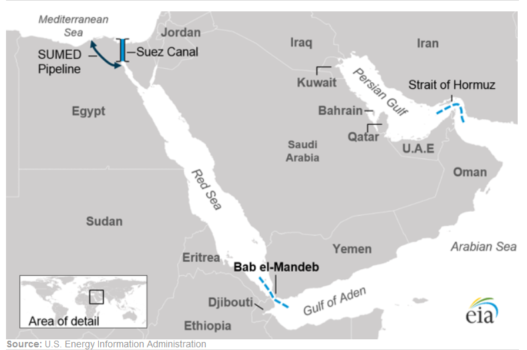
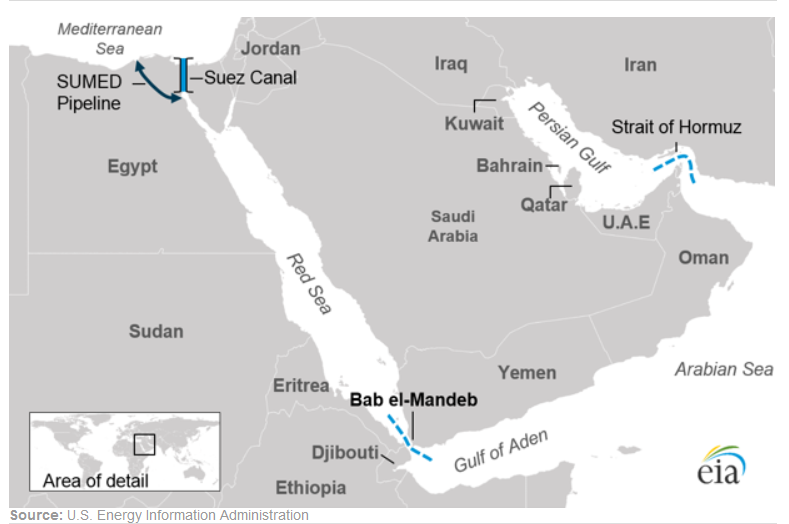
On September 17, Italian Defence Minister Guido Crosetto announced that Italy would deploy warships to protect commercial shipping in the Bab el-Mandeb Strait. Tajani stressed that Italy “was not at war” but urged the EU to strengthen its existing Red Sea mission, ASPIDES, in response to the renewed Houthi threat in the strait. Houthi forces recently captured the strategic Hanish archipelago as part of a broader offensive along Yemen’s Red Sea coast, strengthening their ability to control access to and threaten shipping through the Bab el-Mandeb Strait. This development has raised international concern given the group’s history of attacking vessels it considers linked to the US or its regional allies.
Both the US and EU have previously conducted military operations to protect merchant shipping from Houthi attacks. Still, these efforts have struggled to fully secure the route as fighting in Yemen has escalated. Thus far, the Houthis have claimed that their blockade targets Saudi Arabia and Saudi-linked shipping rather than other commercial vessels. However, tensions could escalate given Saudi Arabia’s status as a key US ally in the Middle East and its place within the broader network of US partnerships that includes European states.
Tajani’s assertion that Italy was not at war came in response to a question about Rome’s reaction to an Italian F-2000 (Eurofighter) aircraft sustaining damage during a Houthi strike on Taif Air Base in Saudi Arabia. Defence Minister Guido Crosetto added that Rome would not wait for a joint EU decision to act, arguing that states must not allow bureaucratic delays in decision-making to exacerbate an already complex situation.
Italy has good reason to fear a closure of the Bab el-Mandeb Strait. As Tajani stated, “We have a strong strategic interest: 40% of Italy’s entire commercial maritime traffic and 60% of the goods we export to Asia pass through the Red Sea.” Months before the recent Houthi advances, Italy was already urging other countries to contribute additional resources to EUNAVFOR ASPIDES.
ASPIDES is an EU naval mission designed to protect freedom of navigation in the Red Sea and surrounding waters in response to threats against merchant and commercial vessels. European military assets provide maritime security, protect vessels, and contribute to stability along key maritime routes in accordance with international law. The operation was established in February 2024 in response to the Red Sea crisis triggered by Houthi attacks on international shipping that began in October 2023.
As part of his efforts to bolster ASPIDES, Tajani said, “I will do so again next week in New York, on the sidelines of the UN General Assembly,” underscoring the importance the Italian government places on the issue. Tajani is also set to discuss the mission at an EU Foreign Affairs Council meeting, a G7 foreign ministers’ meeting, and a meeting of the Rome Coalition for food security during the UN General Assembly.
Why This Matters for Europe
Saudi Arabia has already cancelled crude supplies to European customers for the coming month as attacks on its export infrastructure and disruption around the Bab el-Mandeb constrain its Red Sea export route. This exacerbates existing energy shortages, higher prices, and cost-of-living pressures already intensified by the US-Iran war and the Russia-Ukraine war. Consequently, even if the conflict does not escalate and the Houthis adhere to their stated position that non-Saudi vessels may pass through the strait, Europe could still face significant economic consequences.
The conflict also has the significant potential to worsen, as the recent Houthi attacks have led Saudi Arabia to launch strikes inside Yemen and seek allies for a broader campaign. The Houthis could also perceive the deployment of Italian warships as an escalation. While Tajani has stressed that Italy is not going to war, the presence of Italian naval assets in the strait nevertheless creates additional opportunities for incidents that could broaden the conflict.
Other conflicts in the region have demonstrated the potential for unintended escalation through friendly fire, collateral damage, or munitions striking unintended targets. The recent damage to an Italian fighter at a Saudi airbase during a Houthi strike illustrates this risk. Italy is also not the only European country with significant trade passing through the Bab el-Mandeb Strait. Any escalation that further disrupts or closes the strait would therefore have significant economic implications for the continent.
Europe has largely avoided direct involvement in the US-Iran war so far. However, given the Houthis’ relationship with Iran, a confrontation between European forces and the group could increase the risk of European states becoming more directly involved in the wider regional conflict.
What to Look for Next
As Italian warships carry out their defensive maritime mission in the Red Sea, a key question will be how the Houthis respond. Will they view the deployment as an escalation or as a limited defensive measure? Even if the Houthis do not respond directly to the presence of Italian warships, another question is whether they can reliably distinguish between Saudi vessels and other commercial shipping, or whether misidentification could result in attacks on unintended targets.
Another important development to monitor will be the diplomatic meetings taking place around the UN General Assembly in New York. These discussions could provide greater insight into whether other EU member states are prepared to commit additional resources to ASPIDES in response to Italy’s calls to strengthen the mission.
AI Transparency: This brief was edited and fact-checked with AI assistance.
Sources: Anadolu Agency, Al Jazeera, ECFR, ERA, Quick Brief ERA