










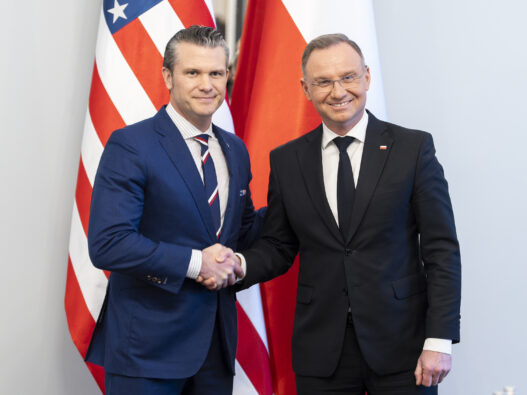
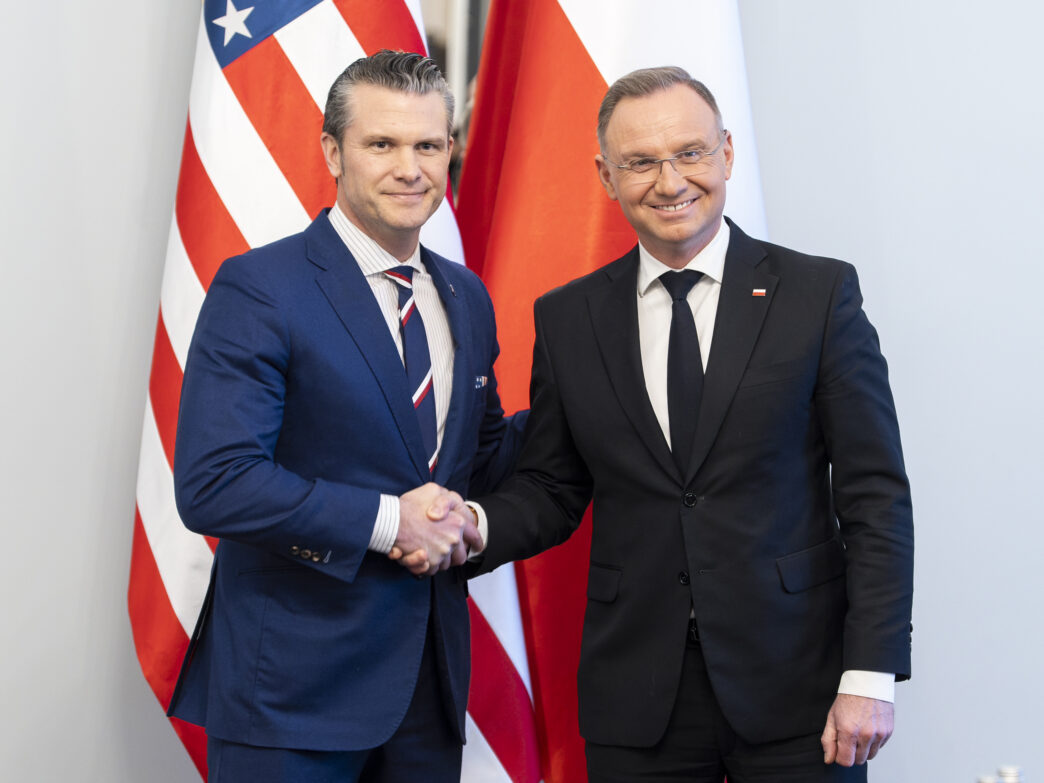
The United States abruptly canceled the planned rotational deployment of 4,000 troops to Poland this past week, a move that reportedly came as a shock to Polish officials. “No one in Poland knew that the rotation of the American brigade would be suspended,” said Polish Deputy Defense Minister Paweł Zalewski. The decision, approved by Defense Secretary Pete Hegseth, suspended the long-planned deployment of soldiers from the 2nd Armored Brigade Combat Team,1st Cavalry Division.
Despite the apparent surprise in Warsaw, acting Pentagon Press Secretary Joel Valdez stated that the cancellation was “not an unexpected last-minute decision,” but rather part of the Trump administration’s broader effort to reassess the U.S. defense posture in Europe. However, Polish Defense Minister Władysław Kosiniak-Kamysz responded that “At no point have we been informed that the presence of U.S. armed forces in Poland would be reduced,” adding that “I understand that the reorganization process is underway, but it cannot come at the expense of such a staunch ally as Poland.” Kosiniak-Kamysz also emphasized that President Donald Trump had previously pledged that U.S. forces would not be withdrawn from Poland.
The Polish government has sought to frame the suspension of the troop rotation as only one component of a broader restructuring of U.S. forces in Europe, suggesting that Poland’s overall U.S. troop presence may ultimately remain stable once the process is complete. The move comes amid broader discussions over the future U.S. military posture in Europe, including the recent withdrawal of 5,000 U.S. troops from Germany. Poland currently hosts approximately 10,000 U.S. troops, most of whom rotate through the country on temporary deployments. Warsaw views the American military presence as a critical deterrent against potential Russian aggression.
Hegseth’s decision has drawn criticism in Washington from both political parties and has left Polish officials uncertain about the future direction of U.S. policy in Europe. Unlike Germany, Poland has not criticized the U.S. war in Iran and remains NATO’s highest defense spender as a percentage of GDP. During a ceremony marking the opening of a Polish repair center for U.S.-made M1 Abrams tanks, Polish Prime Minister Donald Tusk stated, “You have the most loyal ally. It is worth remembering that, because America will not find a better ally anywhere.” In addition to its high defense spending, Poland is also among the largest European purchasers of American weapons systems, with Trump previously describing the country as a “model ally.”
The move comes amid growing tensions within NATO, as Trump has repeatedly expressed frustration with European allies over what he views as insufficient support for the war in Iran. While the withdrawal of troops from Germany could be interpreted as a response to comments made by German Chancellor Friedrich Merz regarding the Iran conflict, the decision to suspend deployments to Poland, despite its status as a close U.S. partner, may indicate that the Trump administration is serious about reducing the American military footprint in Europe more broadly.
The Pentagon recently conducted a global force posture review, with officials indicating that the study did not recommend a major withdrawal from Europe. However, the National Defense Strategy released earlier this year emphasized reallocating military assets to other regions and shifting greater responsibility for European security onto European states themselves. U.S. defense officials also stated last October that they would not replace an Army brigade scheduled to leave Romania, a decision consistent with this broader strategic direction.
According to former Finnish official Joel Linnainmäki, such moves represent “a major challenge to Europe’s security and a severely disruptive way of shifting responsibility to Europeans,” adding that “for allies next to Russia, it will have to change their calculus.” While encouraging European allies to assume a greater share of the security burden has been a longstanding U.S. objective since the end of the Cold War, implementing such changes rapidly and unilaterally has strained relations between Washington and its European allies, many of whom increasingly question the reliability of the United States as a long-term security partner.
Despite substantial increases in European defense spending in recent years, Europe remains unable to replace many key U.S. military capabilities quickly. As a result, sudden reductions in troop levels, particularly when perceived as occurring without sufficient coordination or communication, have generated serious concern among America’s European allies.
Sources: European Relations, Politico, Politico, Reuters, The Guardian, US Department of Defense