









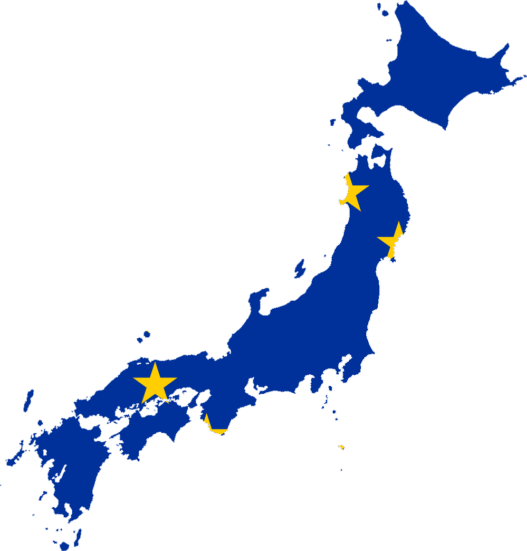

Europe Turns to Japan to Cut China Dependence
The European Union is deepening its economic and strategic partnership with Japan, driven by China’s tightening grip on rare-earth exports and the growing geopolitical rivalry in the Indo-Pacific. In 2025 alone, 11 European Commissioners have visited Japan, one of Asia’s largest economies next to China and India, as Brussels looks to secure new supply chains for critical materials and reduce its dependence on Beijing, a strategy known as “de-risking.”
On 4 April 2025, China introduced export restrictions on seven rare earth elements and related magnets, amid escalating U.S.–China trade tensions, when Beijing began using its economic power to limit access to rare earths. Japan has long experience navigating such challenges: following a 2010 maritime incident with China near the Senkaku Islands, rare earth shipments to Japan were reportedly disrupted or curtailed, forcing Tokyo to diversify supply lines through partners such as Australia and Vietnam. Now, the EU is turning to Japan as a trusted ally to strengthen its own economic resilience and safeguard access to vital resources.
“EU–Japan cooperation takes place within a rapidly evolving geopolitical and economic context,” a European Commission spokesperson said. “The EU aims to diversify trade relationships, strengthen supply chains, and reduce dependencies.”
Unlike the United States, which under the Trump administration has pursued a hard decoupling from China, the EU and Japan advocate de-risking rather than disengagement. Both share a commitment to a rules-based trade system, multilateral cooperation, and climate action — principles that have weakened in an increasingly competitive global order under the Trump administration.
Analysts say that with the U.S. becoming a less predictable and less equal partner, Brussels and Tokyo are poised to deepen ties even further in the coming years. Their cooperation spans trade, technology, and security, including the EU–Japan Digital Partnership, semiconductor cooperation, and a Green Alliance focused on clean energy and sustainable innovation.
This evolving alliance marks one of the most significant shifts in EU foreign and economic policy, positioning Japan as the bloc’s key democratic partner in Asia and a cornerstone of its strategy to ensure strategic autonomy in a world increasingly defined by great-power rivalry.
Further details on the EU’s Tokyo drift on EEAS, European Parliament, CEPR, and Euractiv.